IVF in Guangzhou: Fertility Companion Service Costs & How It Works
IVF Guangzhou Cost with Companion Service: A Practical Guide for International Patients
In vitro fertilization (IVF) means fertilizing eggs with sperm in a laboratory, then transferring the resulting embryo into the uterus. For international patients, doing this in an unfamiliar Chinese city adds a layer of logistical complexity. That’s where a fertility companion service comes in — a bilingual coordinator who handles registration, translation, and navigation while you focus on the medical process. The IVF Guangzhou cost with companion service typically ranges from $8,000 to $18,000 for a full cycle, depending on the clinic tier and whether you need add-ons like genetic testing. Companion fees are separate and generally start from $300 per day.
Guangzhou hosts 10 of China’s Fudan-ranked Top 100 hospitals, the third-highest concentration after Beijing and Shanghai. Several have dedicated reproductive medicine departments that treat international patients through their VIP or international divisions. But the system works differently from what you might expect in Europe or North America. Understanding the real sequence — from first contact to embryo transfer — matters more than memorizing price lists.
How This Actually Works, Step by Step
The process starts remotely. You send your existing fertility records — hormone panels, ultrasound reports, semen analysis results, any prior IVF cycle summaries from your home country. Our team translates these into Chinese and submits them to the reproductive medicine department of a hospital you’ve selected from our top-ranked hospital database. A specialist reviews the materials and gives a written preliminary assessment: whether IVF is appropriate, what protocol they’d recommend, and what additional testing you’d need on arrival.
If the assessment looks favorable, you schedule a video consultation with the treating physician. This costs between $100 and $300 for a standard international-department consultation, or $500 to $800 for a top-specialist video session. During this call, the doctor explains the proposed stimulation protocol, expected timeline, and realistic success probabilities based on your age and ovarian reserve markers. You’re not committing to anything yet — this is the information-gathering phase.
Once you decide to proceed, the companion service takes over the logistics. We coordinate your initial in-person appointments, arrange for a bilingual escort to accompany you through registration and testing, and help you understand each medication and procedure as it’s prescribed. You’ll need roughly 14 to 21 days in Guangzhou for a fresh cycle, though some patients split it into two shorter trips.
What the Companion Service Actually Does — and What It Doesn’t
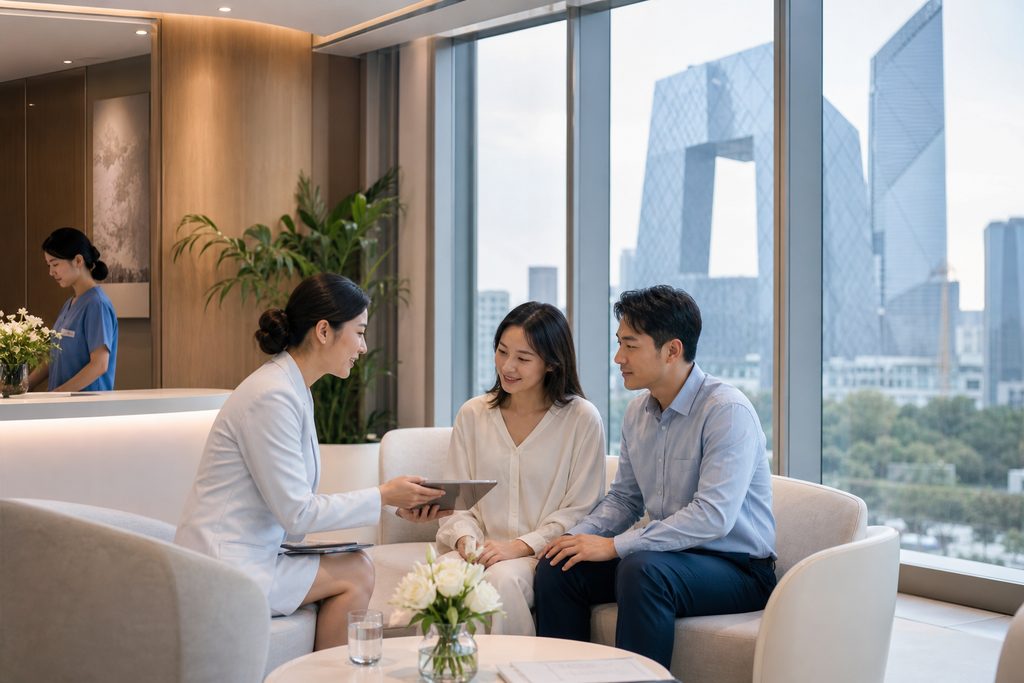
A fertility companion in Guangzhou is not a medical professional. Think of us as a highly specialized logistics and translation layer. On a typical morning, your companion meets you at the hospital entrance, handles the registration kiosk, collects your queue number, and walks you to the correct department. When the doctor speaks, the companion translates both directions — your questions, the doctor’s answers, the nurse’s instructions. When you need to pay for a blood draw or an ultrasound, the companion processes the payment and keeps your receipts organized for insurance claims.
What the companion does not do: interpret your lab results, recommend medication changes, or speak to the doctor on your behalf without you present. Those boundaries protect you. You remain the decision-maker at every step.
For international patients specifically, the companion also bridges cultural gaps. Chinese doctors tend to be direct and brief. Appointments are shorter than Western patients often expect. A companion prepares you for that rhythm, helps you ask the right questions in the limited time, and follows up on anything unclear after the consultation ends.
Best Fertility Clinics Guangzhou for Foreigners: What to Look For
No, but you need someone who does. Hospital international departments have some English-speaking staff, but the broader system — registration, pharmacy, laboratory, nursing — operates in Chinese. A bilingual companion service covers these gaps and ensures you understand every instruction and result.
Canceled cycles typically incur 30 to 50 percent of the full cycle fee. Failed cycles — where transfer occurs but pregnancy does not — incur the full fee. Most clinics offer a reduced rate for subsequent cycles. Discuss cancellation and refund policies before you start, and get them in writing.
Yes. Preimplantation genetic testing (PGT) is available at major Guangzhou IVF centers. It adds $3,000 to $6,000 to the cycle cost and extends the timeline by 4 to 6 weeks, since transfer usually happens in a subsequent cycle. PGT is not permitted for sex selection.
Is it legal for foreigners to do IVF in China?
Yes. China permits IVF for married heterosexual couples using their own gametes
Frequently Asked Questions
Yes. The hospitals used for international patients are JCI-accredited and follow the same international safety standards as top hospitals in the US and Europe. Surgical teams perform high volumes of procedures — often more than their Western counterparts — which studies show leads to better outcomes.
Costs vary by procedure and hospital, but international patients typically save 40-80% compared to US prices — even when factoring in travel and accommodation. A consultation with our team will give you an exact, all-inclusive quote with no hidden fees.
Send us your existing medical reports to get started. We handle everything from hospital selection and appointment scheduling to visa assistance and post-operative recovery planning. Your medical records are reviewed by the specialist before you even book a flight.
For more medical information and treatment options in China, visit chinamedservices.com (China Medical Services).
