Jugular Tumor in China: Eye and ENT Team Care Explained
Jugular Tumor in China: Eye and ENT Team Care Explained
You have probably been told that a jugular tumor is a rare, awkward diagnosis that only a handful of surgeons worldwide know how to handle. That is partly true. What gets left out is that a jugular tumor in China is treated at a small number of high-volume centers where ENT and eye teams work the same operating room, and where the cost of that combined care runs a fraction of what a Western hospital bills. The catch is not quality. It is navigation.
Here is the short answer. China’s top-tier hospitals do treat glomus jugulare and related skull-base tumors, and they do it through a joint ENT, neurosurgery, and ophthalmology pathway. What most foreign patients cannot do is walk in and book that pathway from overseas. Public hospital registration does not work that way. Understanding how the pieces fit together — and where the eye team enters — is the whole point of this article.
Jugular Tumor Care in China: The Short Answer
A jugular tumor — most often a paraganglioma such as a glomus jugulare tumor — sits at the base of the skull, near the jugular foramen. It grows slowly. It can press on cranial nerves that control hearing, swallowing, voice, and, in some cases, eye movement and vision. Because of that location, no single specialty owns it. ENT surgeons, neurosurgeons, interventional radiologists, and ophthalmologists usually share the case.
In China, that shared model exists at a limited set of tertiary hospitals, mainly in Beijing, Shanghai, and Guangzhou. These are the institutions that appear on the Fudan Hospital Rankings, the closest thing China has to a national quality benchmark. The ranking is tiered rather than numbered at the top — A++++ down to A — so you will not see “the number one hospital in China” on any official list. You will see tiers, and specialty reputation rankings for 45 departments.
Key point: The eye and ENT teams are not competitors for your case. They are two halves of the same surgical plan. The question is whether the hospital you choose actually runs them together.
Who This Is Right For — and Who It Isn’t
Not every jugular tumor patient should fly to China. Some should stay exactly where they are. Being honest about that distinction matters more than any sales pitch.
Usually a reasonable fit:
- Adults with a confirmed or suspected paraganglioma who have been told the tumor is surgically complex or “borderline resectable”
- Patients facing a quoted price at home that exceeds what their insurance will cover
- People on a long public waitlist in a system where the wait is measured in months, not weeks
- Patients whose local team has limited experience with skull-base paragangliomas — a genuinely rare tumor
- Families who want a second surgical opinion before committing to a major operation
Probably not the right move:
- Anyone with an acute, unstable presentation — airway compromise, rapid neurological decline, or active bleeding — needs the nearest emergency department, not a flight
- Patients with significant cardiovascular or pulmonary disease that makes long-haul travel itself risky
- Those who need a highly specific surgeon by name; we coordinate, we do not guarantee a particular physician or date
- People expecting a Western-style private hospital experience at a public hospital price. Those are two different products
If you are unsure which list you fall into, that is exactly the kind of question a written second opinion is built to answer.
The Options, Compared
Below is a plain comparison of the realistic paths for a jugular tumor patient. Figures are indicative and vary by hospital and case complexity.
| Path | Typical Wait | Indicative Cost (USD) | Language Support | Best For |
|---|---|---|---|---|
| Home country, public system | 2–9 months | $0–$40,000+ (insurance dependent) | Native | Stable tumors, full insurance coverage |
| Home country, private | 2–5 weeks | $60,000–$180,000 | Native | Speed and familiarity, if budget allows |
| China, public tertiary (standard channel) | Requires in-person registration first | $15,000–$45,000 | Limited English | Cost-sensitive patients with a companion |
| China, international / VIP channel | Coordinated in advance | Roughly 1.5–2× standard channel | English-speaking staff | Patients who need predictability |
| China, private international hospital | Days to weeks | $40,000–$90,000 | Full English, direct insurance billing | Insurance that settles directly |
Which column fits you depends on three things: how urgent the tumor is, how much English support you need, and whether your insurer will pay a Chinese hospital directly or reimburse you afterward. Public hospitals generally require prepayment; many private international hospitals bill insurers directly.
How the Eye and ENT Teams Actually Split the Work
This is the part most general articles skip, and it is the part that matters for a jugular foramen tumor.
The ENT or skull-base team typically leads. They approach the tumor through the temporal bone and neck, and they are the ones managing hearing preservation, facial nerve function, and lower cranial nerves. A neurosurgeon joins when the tumor extends intracranially. An interventional radiologist may embolize the tumor before surgery to reduce bleeding — a step that is standard at high-volume centers and can meaningfully change the operative risk profile.
Where does ophthalmology come in? More often than you would expect. Jugular and skull-base tumors can affect eye movement, cause diplopia, produce papilledema from raised intracranial pressure, or involve the cavernous sinus. Some patients present to an eye clinic first, with double vision or a drooping eyelid, before anyone suspects a neck or skull-base mass. In those cases the ophthalmologist is the one who orders the imaging that finds the tumor.
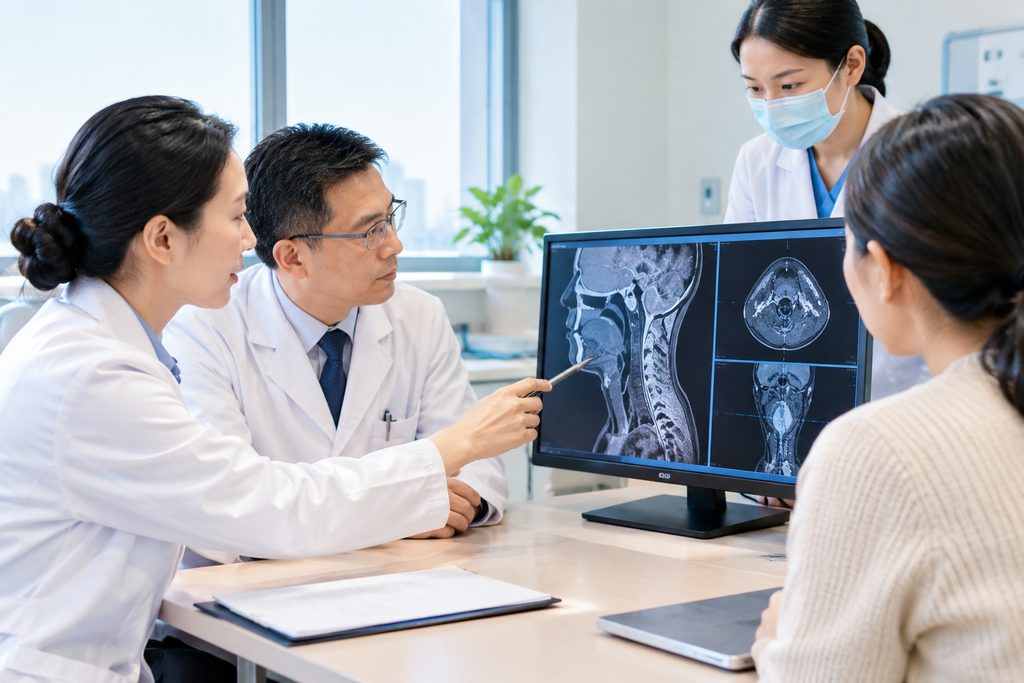
At a hospital that runs a genuine multidisciplinary team, the eye and ENT specialists sit in the same case conference. They look at the same MRI and CT angiography. They agree on the approach before anyone scrubs in. At a hospital that does not, you may end up shuttling between departments that never speak to each other.
Practical tip: When evaluating a hospital, ask one question — does this center hold a joint skull-base or multidisciplinary tumor board, and how often? A vague answer is itself an answer.
China’s larger tertiary centers see high surgical volumes, which matters for rare tumors. Volume is not the same as outcome, and no honest coordinator will claim otherwise. But surgeons who operate on skull-base paragangliomas regularly tend to have more refined judgment about when to operate and when to watch.
What It Costs and How Long It Takes
For a complex skull-base resection in China, the total treatment cost typically lands between $15,000 and $45,000 at a public tertiary hospital, and higher at a private international facility. That range covers imaging, embolization where needed, surgery, ICU time, and a hospital stay. It does not cover flights, lodging, or a companion’s expenses.
Compare that with the same operation in the United States, where skull-base surgery commonly runs $60,000 to well over $150,000 before complications. The gap is real, but it is not the whole story. Complications extend stays. Revision surgery adds cost. Budget for the realistic case, not the best case.
Timeline, roughly:
- Week 1–2: Records translated and submitted; written second opinion returned
- Week 2–4: Video consultation with the specialty team; surgical plan discussed
- Week 4–8: Visa (S2 for short-stay medical treatment), travel, and appointment coordination
- On arrival: In-person consultation, imaging review, pre-operative workup
- Surgery and recovery: Varies widely — a straightforward resection may need 10–14 days in hospital; complex cases run longer
Note the sequencing. In most Chinese public hospitals, surgery cannot be scheduled until the patient has been seen in person. That is why remote evaluation first, travel second, is the sensible order.
Practical Considerations for International Patients
Records. Bring your MRI and CT on disc, plus the radiology reports, pathology if a biopsy was done, and a medication list. Chinese specialists read English imaging reports without trouble, but a translated summary speeds things up.
Visa. Medical travel to China uses the S2 visa, applied for with supporting documents from the treating hospital. Family accompanying you applies for S2 as well. Do not confuse this with the M visa, which is for commercial and trade activity and has nothing to do with treatment. Requirements shift, so confirm current rules with the nearest Chinese embassy or consulate before you apply. Approval is never guaranteed.
Payment. Public hospitals want prepayment; you then seek reimbursement from your insurer. Private international hospitals frequently bill insurers directly. Check which model your policy supports before you commit.
Language. China’s flagship hospitals can see more than 10,000 outpatient visits in a single day. Signage, registration systems, and most staff operate in Chinese. This is not a small inconvenience — it is the single biggest practical barrier, and the reason bilingual medical companions exist.
Follow-up. Plan your post-operative imaging and review before you fly home. Ask the surgical team what surveillance schedule they recommend and whether your local physicians can execute it.
For a broader look at how hospital selection works, our guide to China’s top-ranked hospitals by city breaks the Fudan tiers down geographically. If you want to understand the specialty-level picture, the department rankings for ENT and related specialties are a useful starting point.
Frequently Asked Questions
Generally no. Standard outpatient registration happens on the day, in person, and surgery follows an in-person consultation. The realistic route for a foreign patient is a remote evaluation first, then travel, then an in-person visit that leads to scheduling. International or VIP departments can sometimes coordinate further ahead, at roughly 1.5 to 2 times the standard cost.
It depends on the hospital. At centers with a genuine multidisciplinary skull-base program, ophthalmology participates when the tumor affects vision, eye movement, or the cavernous sinus. At other hospitals, you may be referred to a separate eye clinic with no shared discussion. Ask specifically about the tumor board before you choose.
This is a fair worry, and it deserves a straight answer. Complex skull-base surgery carries real risks — cranial nerve deficits, bleeding, infection, and the possibility of incomplete resection. Your Chinese surgical team should provide discharge documentation and imaging in a form your home physicians can act on. But follow-up care happens where you live, and continuity is not automatic. Discuss this openly with both teams before surgery.
Your Next Step
A jugular tumor is rare enough that the quality of the team around it matters more than the country it sits in. China’s leading tertiary hospitals run combined ENT, neurosurgery, and eye pathways at a cost that is often a fifth to a tenth of Western pricing — but the system is genuinely hard to enter without help.
We are China Medical Services, a coordination service, not a hospital. We do not diagnose, and we do not promise outcomes. What we do is translate your records, route them to the right specialty team, arrange written second opinions and video consultations, and — if you decide to travel — handle hospital registration, appointment coordination, and bilingual accompaniment on the ground. You can start with a free consultation and decide from there. No pressure, and no obligation to travel.
This article is for general information only and is not medical advice. Treatment decisions for any skull-base or jugular tumor should be made with qualified physicians who have reviewed your individual imaging and history.
For more medical information and treatment options in China, visit chinamedservices.com (China Medical Services).
