Liver Cancer Check in China: What to Book and What It Costs
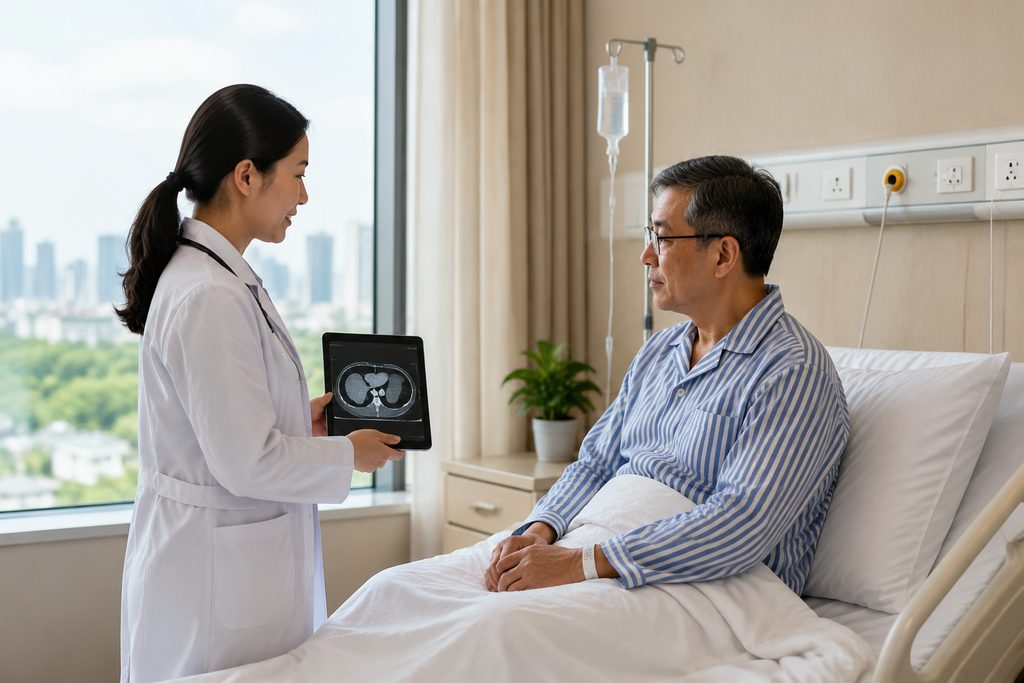
What if the scan you need could happen in three weeks instead of three months? For many international patients facing a liver cancer diagnosis, that single question reshapes everything.
The short answer: liver cancer treatment cost China typically runs $8,000 to $45,000 depending on the procedure, compared with $100,000 or more in the United States. Booking requires a written second opinion first, then a hospital appointment through an international department, and an S2 visa for medical travel.
Liver Cancer Check in China: The Short Answer
You cannot simply book a liver cancer consultation in China the way you book a hotel room. Public hospital outpatient slots are not reservable from overseas. What you can book, before you ever board a plane, is a written second opinion or a video consultation with a Chinese specialist who reviews your existing imaging and pathology reports.
That distinction matters more than it sounds. A remote review tells you whether the trip is worth making at all — and roughly one in five cases we see ends with the honest answer that the patient’s local plan is already sound. That is a good outcome, not a wasted inquiry.
China’s top-tier hospitals are genuinely strong in hepatobiliary oncology. Several rank among China’s top 10 for oncology on the Fudan specialist reputation rankings, and annual liver resection volumes at major centers run into the thousands. Volume builds surgical judgment. That is the real draw — not price alone.
Who This Is Right For — and Who It Isn’t
Medical travel is not a universal upgrade. It helps some patients enormously and wastes the time and money of others.
Usually a reasonable fit:
- You have a confirmed or strongly suspected hepatocellular carcinoma (HCC) or intrahepatic cholangiocarcinoma and want a second surgical opinion
- Your local wait for a hepatobiliary surgeon exceeds 6–8 weeks
- You have been told your tumor is unresectable and want to know whether resection, ablation, or transplant evaluation is possible elsewhere
- You are paying out of pocket or your insurer reimburses internationally
- You can travel for 2–4 weeks and have a companion
Usually not a fit:
- You are medically unstable for long-haul flight — decompensated cirrhosis with active encephalopathy, uncontrolled ascites, or active variceal bleeding
- Your case is straightforward and your local center performs high-volume liver surgery
- You expect a guaranteed surgery date before anyone has seen your scans. No reputable hospital works that way
- You are seeking a liver transplant as a foreign national. Organ allocation in China follows domestic waiting-list rules, and foreign-patient access is not something any service can promise or arrange. If transplant is your goal, discuss it with your home team first
The Options, Compared
Here is how the realistic paths stack up. Figures are typical ranges and vary by hospital and case complexity.
| Path | Typical Cost (USD) | Time to Start | Best For |
|---|---|---|---|
| Written second opinion (top hospital specialist) | $300–500 | 3–7 days | Testing whether travel makes sense |
| Video consultation, top specialist | $500–800 | 5–10 days | Discussing surgical feasibility face to face |
| Multidisciplinary team (MDT) review | $1,500–2,000 | 1–2 weeks | Complex or borderline-resectable cases |
| In-person top-specialist consultation in China | $800–1,200 coordination, plus hospital fees | 2–4 weeks | Patients ready to commit to travel |
| Liver resection, top public hospital | $12,000–25,000 | After in-person assessment | Resectable disease |
| Liver resection, US center | $100,000–200,000+ | Often 4–12 weeks | Comparison baseline |
| TACE or ablation, top public hospital | $8,000–18,000 | After in-person assessment | Intermediate-stage disease |
Which column fits you? If you are still deciding whether to travel, the top three rows are your entry point — low cost, fast, and reversible. If you have already decided and have a confirmed surgical plan from home, skip to the in-person rows. And if your tumor is unresectable at home but potentially convertible, the MDT row is where the real value sits.
How to Book Liver Cancer Treatment in Beijing or Shanghai
This is the part most guides gloss over, so let’s be specific about the two cities that matter most.
Beijing has 21 hospitals on the Fudan Top 100 — more than any other Chinese city. Shanghai has 18. Both have deep hepatobiliary benches, and both are well served by international departments with English-speaking staff.
To book liver cancer treatment in Beijing, the sequence is almost always the same:
- Send your imaging (CT, MRI, or PET-CT on disc or DICOM files), pathology reports, bloodwork including AFP and liver function, and a summary of treatments already received
- A hepatobiliary specialist reviews the file and issues a written opinion — typically 3–7 days
- If surgery looks feasible, you move to a video consultation to discuss approach and risks
- Only then does the hospital international department open a slot for an in-person visit
- You arrive, attend the appointment, and — if the surgeon agrees — get admitted. Admission is never guaranteed in advance
If you are searching for the best liver cancer hospitals in Shanghai, the same logic applies. Shanghai’s advantage is concentration: several top-ranked general hospitals sit within a few kilometers of each other, which makes multi-hospital second opinions logistically easy. Beijing’s advantage is sheer breadth of subspecialty expertise.
One practical note. Public hospital general outpatient queues in China are not something a foreign patient can navigate without language support. A single major hospital can see 10,000+ outpatient visits in a day. Signage, registration kiosks, and payment systems are overwhelmingly in Chinese.
What It Costs and How Long It Takes
Costs split into two buckets: what you pay us, and what you pay the hospital. Keeping them separate matters.
Service fees (ours):
- Written second opinion: $300–500
- Video consultation with a top specialist: $500–800
- MDT video consultation: $1,500–2,000
- In-person top-specialist consultation coordination: $800–1,200
- Bilingual medical companion: from $300 per day
- Airport transfer: $200 round trip
Any consultation fee is credited in full toward on-the-ground coordination if you travel within 90 days. It is a one-time credit applied to the coordination fee — never to hospital treatment charges.
Hospital fees (theirs): a liver resection at a top public hospital generally lands between $12,000 and $25,000 all-in, covering surgeon fees, anesthesia, ICU days, ward bed, medications, and follow-up imaging. TACE or radiofrequency ablation typically runs $8,000–$18,000. Private international hospitals cost more — often 1.5 to 2 times the public rate — but offer direct insurance billing and Western-style rooms.
Public hospitals require prepayment. Insurance reimbursement happens afterward, in your home country, and depends entirely on your policy.
On timing: expect 1–2 weeks from first contact to a written opinion, another 1–2 weeks to a video consultation, and 2–4 weeks to an in-person appointment. From first email to surgery, most patients are looking at 6–10 weeks. That is faster than many Western public systems, but it is not instant.
Practical Considerations: Visas, Records, and Follow-Up
Visa. Foreign nationals traveling to China for medical treatment apply for the S2 visa, which covers short-stay private affairs including medical treatment. Stays beyond 180 days fall under S1. Accompanying family members also apply for S2. The M visa is for commercial and trade activity and has nothing to do with medical care — if a service tells you otherwise, that is a red flag. Requirements change; always confirm current documentation with the nearest Chinese embassy or consulate, and expect to submit a hospital invitation letter.
Records. Get certified English translations of pathology reports. Chinese specialists read English fluently, but the hospital’s formal record needs a clean translation. Ask your home hospital for the full operative note if you have had prior surgery.
Payment. International credit cards work at private hospitals and increasingly at public hospital international departments. Large wire transfers may hit daily limits — arrange this before you fly.
Language. Assume you need support. This is the single most common source of stress we see, and it is entirely solvable with a bilingual companion who handles registration, queuing, payment, and interpretation.
Follow-up. Before discharge, ask for your imaging, pathology, and operative reports on disc, plus a written follow-up plan in English. Your home oncologist will need all of it. Post-operative surveillance for HCC typically means imaging every 3–6 months, and that can usually happen at home.
If you want to see how hospital tiers compare across the country, our Fudan-ranked hospital directory by city groups them clearly. Oncology subspecialty rankings live in the department-by-department guide.
Frequently Asked Questions
At top-tier public hospitals and JCI-accredited private hospitals, surgical safety standards are comparable to Western centers. China performs very high volumes of liver resection, and volume correlates with outcomes. That said, “China” is not one thing — a provincial hospital and a Fudan Top 100 center are not equivalent. Safety depends heavily on which hospital you choose, and on arriving with complete, translated records so nothing is missed.
For a liver resection, plan on 10–14 days in hospital including pre-operative workup and post-operative recovery, then 1–2 weeks nearby before you are cleared to fly. Total stay is usually 3–5 weeks. Ablation or TACE is shorter — often 5–8 days in hospital. Add 4–8 weeks beforehand for the remote review and visa process.
Packaged “all-in” deals exist, but we would urge caution. Liver cancer care is highly individualized — the right plan for a 3 cm solitary tumor is nothing like the plan for multifocal disease with portal vein involvement. Fixed packages tend to either exclude the expensive parts or push you toward whatever the partner hospital offers. Staged coordination, where you pay for evaluation first and treatment later, keeps the clinical decision separate from the commercial one.
No. Chinese public hospitals require an in-person consultation before scheduling surgery. You can secure the appointment, the specialist review, and the visa — but the operating room date comes after the surgeon examines you. Any provider promising a confirmed surgical date in advance is overpromising.
That happens, and it is valuable information. You may instead be offered TACE, ablation, systemic therapy, or enrollment in a clinical trial. You can decline any of it, take the written opinion home, and share it with your local team. A second opinion that says “no” is still a second opinion worth having.
Your Next Step
The core message is simple: start with a remote review, not a plane ticket. It costs a few hundred dollars, takes about a week, and tells you whether traveling to China is genuinely in your interest — before you spend thousands finding out.
We are not a hospital and we do not diagnose or treat anyone. We are a coordination team that translates your records, connects you with the right Chinese specialty through official hospital international departments, and supports you on the ground if you decide to come. If you would like an honest read on your options, start with a free consultation — no obligation, and no pressure to travel.
This article is for general information only and is not medical advice. Liver cancer treatment decisions should be made with a qualified physician who has reviewed your individual case. Costs, visa rules, and hospital policies change — confirm current details before making travel plans.
For more medical information and treatment options in China, visit chinamedservices.com (China Medical Services).
