Liver Cancer Screening in China: Ultrasound and AFP Explained
Liver Cancer Screening in China: Ultrasound and AFP Explained
Most people assume that a proper cancer screening requires a Western hospital, a long wait, and a five-figure bill. For liver cancer screening in China, that assumption collapses fast. The standard first-line protocol recommended by major liver societies worldwide — abdominal ultrasound plus a blood alpha-fetoprotein (AFP) test every six months — is available at top-ranked Chinese hospitals for a fraction of U.S. prices, often within days rather than months. Understanding the liver cancer screening cost China hospitals charge, and what that price actually buys, is the first step toward making a clear decision.
This guide walks through the protocol itself, the real numbers, the hospitals worth considering, and the practical mechanics of getting screened as an international patient.
How This Actually Works, Step by Step
The pathway looks different depending on whether you are already in China or planning from abroad. Here is the honest sequence for an overseas patient.
Step one — you send your existing records. That means prior imaging (CT, MRI, or earlier ultrasound reports), blood work including any previous AFP values, and a short summary of your history: hepatitis B or C status, cirrhosis diagnosis, fatty liver, family history, alcohol use. If you have none of this, say so. It changes the recommendation.
Step two — a Chinese hepatology or gastroenterology specialist reviews the file. Not a salesperson. A clinician at a hospital international department reads your materials and writes back with an opinion: whether a simple ultrasound-plus-AFP screen is appropriate, or whether your risk profile calls for contrast-enhanced ultrasound, CT, or MRI from the start.
Step three — you receive a written plan and a cost estimate. This is where the liver cancer screening cost China figure becomes concrete for your case rather than a generic range.
Step four — appointment coordination. If you decide to proceed, registration, hospital card creation, and scheduling are handled through the hospital’s official international or VIP channel. You are not buying a queue jump. You are using the hospital’s own published service for foreign patients.
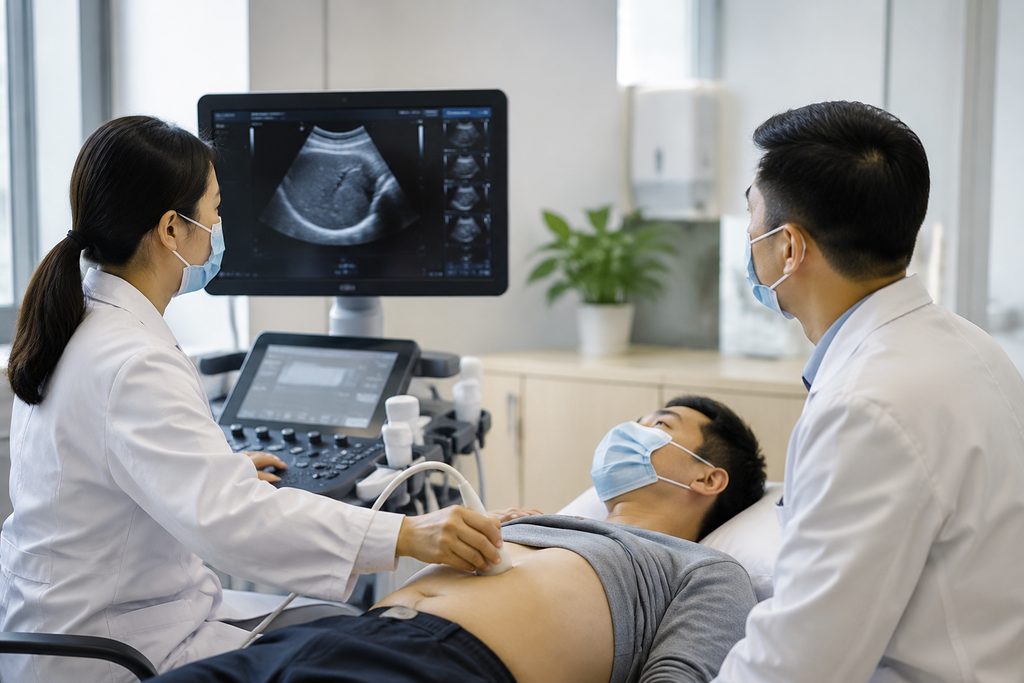
Step five — you arrive, get scanned, and receive results. Ultrasound takes roughly 15–30 minutes. AFP is a blood draw. Same-day or next-day reporting is common at large hospitals, though it is never guaranteed.
One rule that surprises people: at most Chinese public hospitals, you cannot pre-book an ordinary outpatient slot from overseas. You register on the day. The international department is the exception — and that is the channel we use.
What Ultrasound Plus AFP Actually Detects — and What It Misses
This is the part most articles skip, and it matters more than any price.
Ultrasound plus AFP is a surveillance test, not a diagnostic one. Its job is to catch hepatocellular carcinoma (HCC) early in people who already carry risk — chronic hepatitis B, hepatitis C, cirrhosis of any cause, or a strong family history. Used that way, in a six-month cycle, it has repeatedly been shown to shift diagnosis toward earlier stages when curative options still exist.
Its limits are real. Ultrasound is operator-dependent. Body habitus matters — in patients with significant obesity, image quality drops. Small nodules in a cirrhotic liver can be genuinely hard to distinguish from regenerating tissue. AFP is imperfect too: roughly a third of small HCCs do not produce elevated AFP, and AFP can rise for reasons unrelated to cancer.
So a normal result is reassuring but not a guarantee. And an abnormal AFP with a clean ultrasound is not automatically cancer. It is a prompt for the next test.
At Chinese tertiary hospitals, the natural escalation path is contrast-enhanced ultrasound (CEUS), multiphase CT, or gadoxetic acid-enhanced MRI — often within the same week if findings warrant it. That continuity is one practical advantage of doing the whole thing in one system.
Is Liver Cancer Screening in China Safe?
This question deserves a straight answer rather than reassurance.
The equipment at China’s top hospitals is current-generation. Siemens, GE, Philips, and Canon ultrasound platforms are standard at major centers. AFP testing runs on automated immunoassay analyzers with external quality-control programs. The physicians reading your scan at a Fudan-ranked hospital are typically reading several thousand liver studies a year — volume that builds pattern recognition in a way lower-volume settings cannot match.
Where safety genuinely varies is which hospital. China has more than 35,000 hospitals. Quality is not uniform across them. The roughly 340 hospitals in our database represent the top 5% by Fudan ranking and JCI accreditation, and the gap between that tier and an average provincial facility is substantial.
Practical safety points for foreign patients:
- Confirm the hospital has an international department with English-speaking staff, or arrange a bilingual companion.
- Ask whether the ultrasound report includes a structured liver description or a single-line impression. The former is far more useful.
- Request that images, not just reports, are given to you on disc or via a patient portal before you leave the country.
- If you have cirrhosis, ask specifically whether the radiologist performs dedicated HCC surveillance protocols.
Language is the single largest practical risk. A misheard instruction during a breath-hold can degrade image quality. This is not a reason to avoid Chinese hospitals. It is a reason to plan for interpretation. Our bilingual medical companion service exists precisely for this gap.
The Real Numbers: What Screening Costs
Prices vary by hospital tier, city, and whether you use the international channel. The figures below are typical ranges in U.S. dollars, and they are not quotes.
| Service | Typical Range (USD) | Notes |
|---|---|---|
| AFP blood test alone | $10–$40 | Higher end at private international hospitals |
| Abdominal ultrasound (liver focus) | $30–$120 | Public tertiary vs. private international |
| Combined ultrasound + AFP package | $50–$180 | Common bundled screening price |
| Contrast-enhanced ultrasound (CEUS) | $150–$400 | When a lesion needs characterization |
| Multiphase liver CT | $200–$600 | Includes contrast agent |
| Liver MRI with hepatobiliary contrast | $400–$1,000 | Highest-detail option |
| Comprehensive liver health checkup package | $300–$900 | Adds liver function, viral markers, FibroScan |
For comparison, an abdominal ultrasound in the United States commonly runs $300–$800 before insurance, and an AFP test $50–$150. The liver cancer screening cost China hospitals charge is frequently one-fifth to one-tenth of that. Even after adding flights and a hotel, a patient combining screening with a broader workup often comes out ahead.
A Realistic Timeline
Optimistic marketing says “a week.” Here is what actually happens, with the waiting steps included.
| Stage | Realistic Duration | What Causes Delay |
|---|---|---|
| Records collection and translation | 3–10 days | Obtaining prior imaging from your home hospital |
| Written specialist review | 2–5 business days | Queue at the international department |
| Decision and appointment coordination | 3–14 days | Hospital scheduling windows; peak periods are slower |
| Visa (S2, medical/private affairs) | 1–3 weeks | Consulate processing times vary by country |
| Travel and arrival | 1–3 days | Flight availability |
| Screening visit itself | Half a day to 2 days | Blood draw and scan are quick; reporting may take a day |
| Results discussion and next-step plan | 1–3 days | Whether follow-up imaging is needed |
Total, from first email to results in hand: roughly three to six weeks for a planned trip. If you are already in China, the same screening can be completed in two to four days.
Note the visa point carefully. Medical travel to China uses the S2 visa, annotated for medical treatment or private affairs, with S1 for stays beyond 180 days. Accompanying family members also apply under S2. The M visa is a commercial and trade category and has nothing to do with medical treatment — if a provider tells you otherwise, that is a red flag. Requirements change, so confirm current rules with your nearest Chinese embassy or consulate.
Choosing a Hospital: What Actually Differentiates Them
Search interest in the “best liver cancer screening hospital Shanghai” is high, and Shanghai genuinely has depth — Fudan University’s affiliated hospitals, Ruijin, and several others sit in the top tier for hepatology and digestive disease. Beijing is comparable, with 21 Fudan Top 100 hospitals to Shanghai’s 18.
But “best” is the wrong frame for screening. Here is what to weigh instead.
Volume in liver imaging specifically. A hospital that reads thousands of liver ultrasounds annually will catch subtle findings a general imaging department misses. Ask about it.
Whether hepatology and radiology talk to each other. At strong centers, an abnormal AFP triggers an automatic imaging review rather than a note to “follow up with your doctor.”
Access to the escalation path. If your ultrasound shows something, can you get CEUS or MRI within days at the same institution? At a top-tier hospital, usually yes. At a small facility, you may be sent elsewhere.
International department capability. English-language reports, insurance documentation, and staff who can explain findings clearly. Private international hospitals such as United Family and Jiahui offer this as standard; public hospitals offer it through their VIP/international channels at roughly 1.5–2x the ordinary price.
You can browse Fudan-ranked options by city on our top hospitals directory, or filter by specialty on the department rankings page.
Practical Considerations for International Patients
Records. Bring everything, translated. Prior imaging on disc is worth more than a typed report. If you have had a previous AFP value, that single number gives the specialist a trend line, which is far more informative than one isolated result.
Payment. Chinese public hospitals require prepayment; insurance reimbursement happens afterward, in your home country. Private international hospitals often bill insurers directly. Confirm which model applies before you commit.
Timing of the six-month cycle. If you are already under surveillance, do not stretch the interval to fit a trip. Screening works because it is regular. Missing a cycle by three months is a real, if modest, risk.
Follow-up at home. Get your images and reports before you fly. Your home physician will want them, and requesting them after you leave is far harder.
Fasting. Abdominal ultrasound typically requires 6–8 hours fasting. AFP does not, but blood is usually drawn at the same visit, so plan for fasting anyway.
Frequently Asked Questions
Typically $10–$40 as a standalone blood test. At a private international hospital you will pay toward the higher end; at a public tertiary hospital, the lower end. Bundled with an ultrasound, the combined screening price usually lands between $50 and $180.
Not through the ordinary outpatient system — public hospitals generally require same-day registration in person. The international or VIP department is the exception, and that is the channel used for foreign patients. Expect to send records first so the hospital can confirm the screening is appropriate.
No. Both tests have known sensitivity limits, particularly for small tumors in cirrhotic livers and in patients with elevated body mass index. A normal result means no abnormality was detected at this screening — which is why the six-month interval matters and why persistent symptoms should prompt imaging regardless of screening results.
Yes. The S2 visa covers short-stay medical treatment and private affairs, and accompanying family members apply under the same category. The M visa is for commercial and trade activity and is not a medical visa. Confirm current documentation requirements with your nearest Chinese consulate, as rules are updated periodically.
At a top-tier hospital, the usual next step is contrast-enhanced ultrasound, multiphase CT, or liver MRI, often scheduled within days. This is a diagnostic workup, not a treatment commitment. Any treatment decision would follow a full evaluation and discussion with a qualified physician.
Your Next Step
Screening works when it is regular, appropriate to your risk profile, and read by someone who does it often. China’s top-tier hospitals deliver all three at a cost that surprises most Western patients — and the ultrasound-plus-AFP protocol itself is the same one used worldwide.
We are China Medical Services. We connect international patients with more than 340 top-ranked hospitals across 37 cities, and we handle records translation, appointment coordination through official international departments, and bilingual accompaniment on the ground. We do not provide medical advice, and we cannot promise a specific doctor or date — only a genuine effort and a full refund if a confirmed booking cannot be arranged.
If you would like a specialist to review your records and tell you whether screening is warranted, start with a free consultation. No pressure, no obligation — just a clear answer about what makes sense for your situation.
This article is for general information only and does not constitute medical advice. Screening decisions should be made with a qualified physician who knows your history. Prices are indicative ranges and vary by hospital and case complexity.
For more medical information and treatment options in China, visit chinamedservices.com (China Medical Services).
