Lumbar Spinal Stenosis: Records a Chinese Specialist Needs
Key Takeaways
- For lumbar spinal stenosis, a Chinese specialist usually needs a recent MRI (or CT if MRI is not possible), standing X-rays where available, the radiologist’s written report, a symptom and walking-distance history, and a list of treatments already tried. Reports alone are often not enough; the images themselves matter.
- Chinese spine centers see very high volumes of degenerative lumbar disease, and the records you send determine whether a remote review can give useful direction before you consider travel.
- The hard part is not collecting files — it is organizing them into a package a hospital department can read quickly, in Chinese, with the imaging in a format their system accepts.
- No review, remote or in person, can promise a diagnosis, a surgical plan, or an outcome. What a well-prepared record set can do is make the first real conversation more productive.
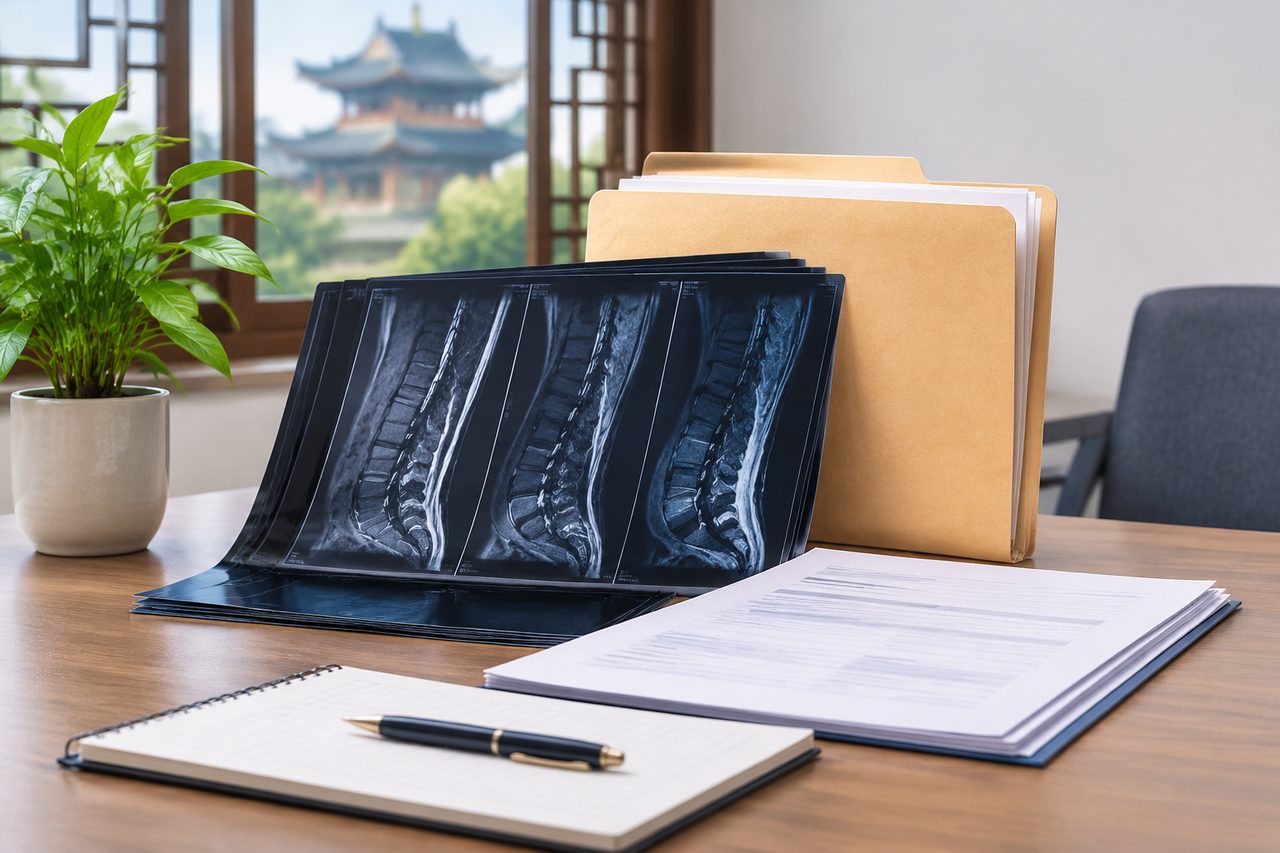
If you are asking what lumbar spinal stenosis records a Chinese specialist needs, the short answer is this: the actual MRI images, not only the report; any standing X-rays; the radiologist’s written interpretation; a clear description of your symptoms and how far you can walk; and a record of what has already been tried, from physical therapy to injections to surgery. Chinese spine specialists work from the same diagnostic logic as specialists anywhere — the difference is in how records must be prepared and transmitted so a hospital department can review them efficiently.
Our team at China Medical Services coordinates record preparation and hospital communication for international patients, and the questions below reflect what we see repeatedly: patients arrive with a folder of PDFs that turns out to be missing the one thing the surgeon actually needs. This guide explains what to gather, why each item matters, and where the process commonly breaks down.
The Problem: A Report Is Not an Image, and a Folder Is Not a Record Set
A high-volume spine service reads a large number of lumbar MRI studies every week. That familiarity helps with the nuanced calls — for example, distinguishing symptomatic central stenosis from incidental narrowing, or judging whether a degenerative spondylolisthesis needs stabilization. It does not replace your own specialist’s judgment, but it makes a remote second review more substantive than a generic written opinion.
The most useful first step is often not a flight but a written review. A Chinese specialty team can examine your submitted records and provide written analysis and treatment direction — what the imaging shows, what options are reasonable, and what further information would be needed. This is a review for reference, not a prescription, and it is not a substitute for an in-person examination. But it can clarify whether traveling to China for treatment is even the right question to be asking.
Cost is a legitimate factor. Treatment prices in China’s top public hospitals are generally lower than in the United States for comparable procedures, though figures vary widely by hospital, city, implant choice, and case complexity, and no responsible provider quotes a fixed all-in price before evaluation. What can be stated plainly is that the record-preparation stage costs far less than travel, and it is where most of the useful information is gained.
The Records Checklist: What to Send for Lumbar Spinal Stenosis
This is the core of the article. The list below reflects what a spine department typically needs to conduct a meaningful review. Not every item will apply to every patient, but omitting the imaging or the symptom history is the most common reason a review stalls.
| Record | Why the specialist needs it | Practical notes |
|---|---|---|
| Lumbar MRI — the image files (DICOM), not only the report | Shows the level, severity, and cause of stenosis; assesses discs, facet joints, and ligamentum flavum | Request the DICOM files on a disc or secure download from the imaging center. Phone photos of a screen are usually unreadable. |
| Radiologist’s written MRI report | Provides the formal interpretation and measurements; useful cross-check | Send the full report, including any comparison with prior studies. |
| Standing or dynamic X-rays, if taken | Assesses alignment, degenerative slippage (spondylolisthesis), and instability | Flexion-extension views are relevant if instability is suspected. Include them if you have them. |
| CT or CT myelogram, if MRI is contraindicated | Alternative view of bony anatomy and canal caliber | Relevant for patients with pacemakers or other MRI exclusions. |
| Symptom history: pain, numbness, weakness, walking distance | Correlates imaging with function; distinguishes neurogenic claudication from vascular causes | Describe how far you can walk before symptoms force you to stop, and whether leaning forward or sitting relieves them. |
| Treatments already tried | Shows what has and has not worked; informs the next step | Physical therapy, medications, epidural injections, nerve blocks — with dates and responses. |
| Relevant medical history and medications | Surgical risk assessment and anesthesia planning | Include diabetes, cardiac disease, anticoagulants, and allergies. |
| Prior spine surgery records, if any | Prior instrumentation or decompression changes the surgical picture | Operative notes and postoperative imaging are valuable. |
How to Prepare and Transmit the File Set Correctly
Collecting records is one task; making them usable is another. Three practical points matter most.
Get the original imaging, not a summary. Contact the imaging center that performed your MRI and ask for the DICOM files. Many centers provide a disc or a secure portal download. If you only have a printed report, ask whether the images can still be retrieved — they are usually archived for years.
Write the symptom history in plain, specific language. Rather than “back pain and leg pain,” describe the pattern: does the pain worsen with standing and walking and ease with sitting or leaning forward? How many blocks or minutes before you must stop? Is there numbness, and in which toes or parts of the leg? These details are what let a specialist distinguish stenosis from other causes of leg symptoms.
Expect translation and formatting. A Chinese hospital department will review your file in Chinese. Reports and history need accurate translation, and the imaging needs to be in a format the hospital system accepts. This is administrative work, and it is where a coordination service earns its place — not by securing access to a particular surgeon, but by making sure the file arrives complete and readable.
Practical Considerations: Visa, Payment, and What Happens After the Review
If a remote review suggests that in-person evaluation in China is worth pursuing, several practical matters follow. For medical travel, the applicable short-stay visa category is S2, used for medical treatment and private affairs and subject to the latest embassy or consulate requirements and supporting hospital documents; stays expected to exceed 180 days fall under S1. Accompanying family members apply under the same category. The M visa is for commercial and trade activities and is not a medical visa — be wary of any source that says otherwise. Visa issuance is never guaranteed, and requirements change, so confirm current rules with the relevant embassy or consulate.
On payment, Chinese public hospitals generally require prepayment, with insurance reimbursement handled afterward; private international hospitals more often bill insurers directly. Bring a clear picture of what your insurance will and will not cover before you commit to any treatment plan. For follow-up after you return home, ask in advance how imaging and reports will be shared with your local physician — this is a reasonable question and one worth settling before treatment, not after.
Frequently Asked Questions
Can a Chinese specialist review my records without me traveling there?
Yes. A written second opinion based on your submitted imaging and reports is a standard first step, and a video consultation can follow so you can discuss symptoms and goals directly with the specialty team. Neither replaces an in-person examination, and neither can promise a diagnosis or a treatment plan.
What if I only have the MRI report and not the images?
Send the report, but understand its limits: a radiologist’s summary cannot substitute for the images when a surgeon is assessing stenosis severity and surgical options. Try to obtain the DICOM files from the imaging center first. If they are genuinely unavailable, say so clearly so the reviewing team knows what it is working with.
What happens if the review finds that surgery is not appropriate?
That is a useful outcome, not a failure. A review may conclude that conservative care, further imaging, or a different specialist evaluation is the better path. The purpose of preparing records carefully is to reach that kind of clarity before anyone books a flight.
Your Next Step
The most valuable thing you can do now is assemble the imaging files and a specific symptom history — those two items carry most of the diagnostic weight. Our team is not a hospital and does not provide diagnoses; we help international patients organize records, arrange written reviews and video consultations with Chinese specialty teams, and coordinate hospital communication when a plan takes shape. If you would like help assessing whether your current records are complete, you can start with a free consultation and we will tell you honestly what is missing.
Preparing the right records turns a vague hope of “getting an opinion in China” into a concrete, reviewable question — and that is the position from which good decisions are made.
For more medical information and treatment options in China, visit chinamedservices.com (China Medical Services).
