Medical Companion in China: Who Stays With You During Treatment?
Medical Companion in China: The Short Answer
Nobody should fly 7,000 miles for surgery and wake up alone. The honest answer to “who will be with you” is this: a professional bilingual medical companion—not a hospital nurse, not a translator borrowed from the front desk. Hospital nurses in Chinese public hospitals handle clinical tasks: medications, vitals, wound care. They do not sit with you, translate for you, or help you order food. A dedicated companion does. The medical companion service China cost typically starts around $300 per day, and that number buys a lot more than translation.
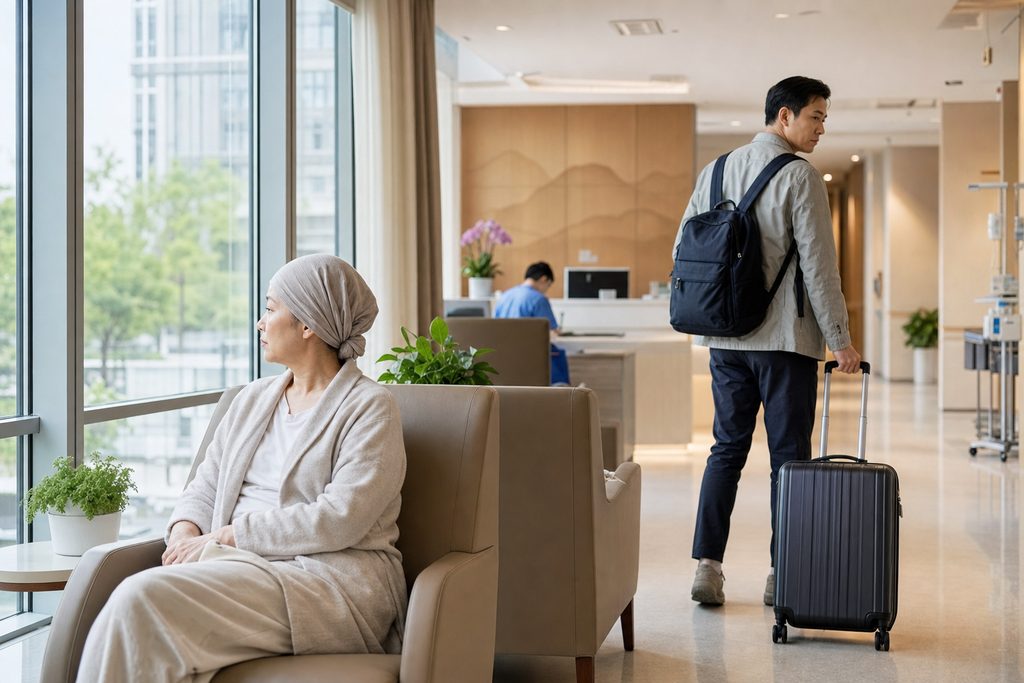
But here is what makes this complicated. Chinese hospitals have their own rhythms. Family members often camp in wards. Nurses expect someone at the bedside. The system quietly assumes you brought a person with you. If you arrive alone, you are not just lonely—you are logistically exposed.
Who This Is Right For — and Who It Isn’t
Traveling for medical care in China works well for many people. It does not work for everyone. Knowing which group you fall into saves time, money, and risk.
Good candidates for a companion-supported trip:
- Patients traveling alone who need surgery or a multi-day hospital stay
- Older adults who need help with mobility, paperwork, or medication schedules
- Anyone with limited Mandarin who will be admitted to a public hospital rather than a private international facility
- Patients whose family members cannot take extended leave from work
- People undergoing procedures where post-operative instructions are detailed and time-sensitive
Who should reconsider:
- Patients with unstable medical conditions that make long-haul travel dangerous—your home doctor should clear you first
- Anyone expecting a companion to make medical decisions for them. Companions are not clinicians.
- People who want a family member present but cannot accept that family may need a visa and time off work
- Patients whose treatment plan is still unclear. Do not book flights before a remote consultation confirms feasibility.
Be honest about your needs. A companion solves coordination problems. It does not solve medical uncertainty.
The Options, Compared
You have several ways to ensure someone is physically present with you in a Chinese hospital. They differ in cost, scope, and clinical authority.
| Option | Typical Cost | What You Get | Limitations |
|---|---|---|---|
| Family member travels with you | $1,500–4,000 (flights, hotel, meals, visa) | Emotional support, trusted advocate, help with basic tasks | No medical training, usually no Mandarin, may need their own S2 visa |
| Bilingual medical companion | from $300/day | Translation, hospital navigation, queuing, payment coordination, liaison with nurses and doctors | Not a nurse, cannot provide clinical care |
| Private nurse companion for medical trip Shanghai | $120–250/day | Clinical monitoring, wound checks, medication reminders, some personal care | May not speak fluent English; cost varies widely by hospital and agency |
| Hospital-provided international ward nursing | Included in VIP/international ward fees (often 1.5–2× standard rates) | English-speaking nurses, better nurse-to-patient ratios | Not one-on-one; nurses rotate shifts; no help with non-clinical errands |
| Medical tourism companion packages China | $1,800–5,000+ per week | End-to-end coordination: airport pickup, hotel, hospital liaison, companion, follow-up | Higher cost; quality varies by provider; verify what is actually included |
Most solo patients combine two columns: a bilingual companion for daily logistics, plus hospital nursing for clinical care. That is the realistic setup. A family member is wonderful if available, but many cannot take two weeks off work. If you are asking “can my partner stay with me during surgery in China” the answer is yes—public hospitals generally allow one family member in the ward during visiting hours, and some international wards permit overnight stays. But your partner will not be able to translate lab results or argue with the billing office.
What Actually Happens When You Arrive Alone
This is the section every article skips. Here is the real sequence for a solo patient at a top-tier Chinese public hospital. You land. You check into a hotel. The next morning, you arrive at a hospital with 10,000 other outpatients. The registration desk speaks Mandarin. The signs are bilingual in major hospitals, but the staff often are not. You need a hospital medical card. You need to pay a deposit. You need to find the right department on the right floor. Then you wait. Hours, sometimes.
If you have surgery scheduled, someone must sign consent forms. Someone must collect your discharge medications. Someone must understand whether the doctor said “take with food” or “take before food.” A bilingual companion handles all of this. Without one, you are relying on translation apps and the goodwill of strangers. Some patients manage. Many do not. The stress compounds when you are in pain or groggy from anesthesia.
And that raises the question many patients ask: is it safe to travel alone for surgery abroad? The honest answer is that it depends on the procedure. Minor outpatient procedures—mole removal, dental work, diagnostic endoscopy—are manageable alone with a companion for the procedure day. Major surgery requiring general anesthesia and an overnight stay is different. You need someone. Not optional.
What It Costs
Let’s be specific about money. The medical companion service China cost breaks down into layers.
- Bilingual medical companion: from $300/day for a full 8-hour day. Half-day (4 hours) is available in some cities. This covers hospital navigation, translation, queuing, payment assistance, and communication with medical staff.
- Private nurse companion: $120–250/day depending on the hospital tier and the nurse’s qualifications. Shanghai tends to run at the higher end.
- Airport transfer: around $200 round-trip.
- Hospital appointment coordination: from $300. If the appointment cannot be secured, reputable providers refund this fee.
- Remote video consultation before travel: $100–300 for a standard international department consult, $500–800 for a top specialist.
- VIP end-to-end coordination: $5,000–8,000 for high-touch, full-trip management. This is for patients who want everything handled without thinking about it.
What drives the variance? City, hospital tier, language requirements, and whether you need a companion for 4 hours or 12. A companion in Beijing at a Fudan-ranked hospital costs more than one in a smaller city. Private international hospitals like United Family or Jiahui often have English-speaking staff in-house, which reduces the need for a separate companion—but their treatment fees are significantly higher than public hospital international wards.
Also worth knowing: any remote consultation fee you pay can be credited in full toward on-the-ground coordination if you proceed with treatment in China within 90 days. That is a one-time credit applied to coordination fees only, never to hospital treatment charges.
Practical Considerations: Visas, Payments, and Recovery
Let’s talk logistics, because this is where trips fall apart.
Visas. You and any accompanying family member apply for an S2 visa, which covers short-term private affairs including medical treatment. Stays beyond 180 days require an S1 visa. Your hospital must provide supporting documents—an invitation letter or treatment confirmation—so coordinate this before applying. The M visa is for commercial and trade activities. It is not for medical travel. Do not apply for the wrong category.
Payments. Public Chinese hospitals require prepayment. You deposit money at admission, and the hospital draws down from it. International credit cards are not always accepted at public hospital cashiers. Bring a UnionPay card or arrange payment through your coordination service. Private international hospitals often accept major credit cards and may bill your insurer directly.
Insurance. Most international insurers require you to pay first and claim later at Chinese public hospitals. Private hospitals with direct billing agreements are the exception. Check your policy before booking anything.
Language. Even at top hospitals like Peking Union Medical College Hospital or Fuwai Hospital, the doctors may speak some English, but the nurses, pharmacists, and billing staff often do not. A companion fills this gap.
Recovery after discharge. This is the part people forget. Surgery is one day. Recovery is two weeks. If you are asking “how do I find a caregiver for recovery in Beijing,” the answer is through the same channels as a hospital companion—agencies and coordination services that provide bilingual support. You may need help with hotel arrangements, wound care reminders, meal ordering, and follow-up appointments. Plan for this before you arrive, not after discharge.
Frequently Asked Questions
Yes, in most public hospitals your partner can be in the ward during visiting hours. Some international and VIP wards allow overnight stays for one family member. But your partner cannot scrub in, cannot translate medical documents reliably, and cannot navigate the billing system unless they speak Mandarin. Many couples bring a partner for emotional support and hire a bilingual companion for logistics.
For minor procedures, yes. For surgery requiring general anesthesia or an overnight hospital stay, traveling completely alone is risky. You need someone to receive discharge instructions, fill prescriptions, and get you back to your hotel safely. A professional companion is the minimum for anything beyond a simple outpatient procedure.
Packages vary. Most include airport pickup, hotel coordination, hospital liaison, daily companion hours, and interpretation. Some include post-discharge care coordination. Read the fine print. Ask whether the package covers the companion’s meals and transport, whether hospital deposits are included, and what happens if your surgery date changes.
Through the same coordination service that arranges your hospital companion, or through local agencies that specialize in medical support for foreigners. Start your search before you travel. Good caregivers in major cities book out weeks in advance. Verify language ability, experience with post-surgical patients, and whether they can accompany you to follow-up appointments.
This is the question everyone should ask and few do. If complications arise, your companion can escalate to the medical team, contact your family, and coordinate with your insurer. But a companion is not a medical professional. For clinical emergencies, the hospital is your source of care. For logistical emergencies—missed appointments, billing disputes, language breakdowns—your companion is the first line of defense. Choose a provider with a clear escalation process and a local phone number that someone actually answers.
Your Next Step
Traveling to China for medical care is a serious decision. The people around you during that trip matter as much as the surgeon you choose. We are China Medical Services, a coordination team that helps international patients navigate Chinese hospitals—from selecting a top-ranked hospital to arranging bilingual companions, visa documentation, and recovery support. We are not a hospital, and we do not provide medical advice or diagnoses. What we do is make sure you are never alone in a system you do not understand.
If you are considering treatment in China and wondering who will be with you, start with a conversation. Tell us your situation. We will tell you honestly what support you need—and what you do not. No pressure, no obligation. Just a clear answer to the question you came here with.
For more medical information and treatment options in China, visit chinamedservices.com (China Medical Services).
