Medical Tourism Accommodation in China: A Complete Guide
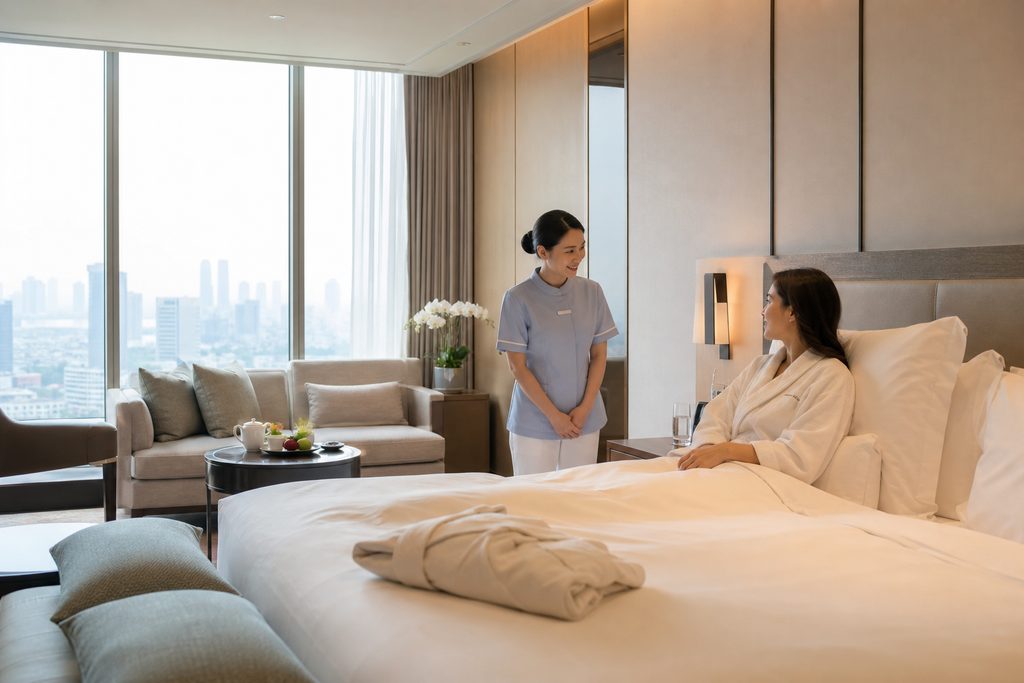
Where will you sleep the night before surgery in a country where you don’t speak the language? That single question stops more international patients than cost ever does. And it’s the one nobody answers clearly until you’re already booking flights.
Medical tourism accommodation in China isn’t a hotel-booking problem. It’s a logistics problem with a medical deadline attached. The right housing depends on which hospital accepts you, how long you’ll stay, whether a family member is coming, and how mobile you’ll be during recovery. Get it wrong and you’re paying for a two-hour commute to a 7 a.m. blood draw. Get it right and the whole trip gets calmer.
We coordinate hospital visits for international patients across 37 cities, working with 340+ top-ranked hospitals — the top 5% of China’s 35,000+ medical institutions, ranked by Fudan and JCI standards. Housing comes up in almost every first conversation. Here’s what we’ve learned about how it actually works.
How This Actually Works, Step by Step
Accommodation planning doesn’t start with apartments. It starts with a hospital decision, because everything else radiates outward from that address.
Step one: confirm the hospital and department. Until a Chinese specialty team has reviewed your records and confirmed they can take your case, no housing decision makes sense. A written second opinion or video consultation comes first. That tells you the city, the hospital, and roughly how long you’ll be in it.
Step two: map the treatment timeline. A diagnostic workup might mean five to seven days. A cardiac procedure plus recovery could mean three to four weeks. Outpatient visits are scattered; inpatient stays are fixed. Your housing needs to match the shape of the treatment, not a generic vacation length.
Step three: pick your radius. Most patients want to be within a 15-to-30-minute ride of the hospital gate. In Beijing and Shanghai, that radius is expensive. In Chengdu or Xi’an, it’s remarkably cheap. Knowing which city you’re in changes the math entirely.
Step four: match housing type to mobility. A patient who can walk to a noodle shop is fine in a serviced apartment. A post-operative patient who needs a lift, a kitchen, and a quiet floor is not. This is where most self-booked trips go sideways.
Step five: lock in the practical layer. Airport transfer, a bilingual companion for the first hospital visit, and a local phone number. These are small things that decide whether week one feels manageable or overwhelming.
Notice what’s missing from that list. Nobody books housing before the hospital says yes. That sequence is the whole game.
Where Do International Patients Stay During Treatment in China?
Four categories cover nearly every case we handle. Each has a different price band, a different level of support, and a different set of trade-offs.
| Housing Type | Typical Nightly Range (USD) | Best For | Trade-offs |
|---|---|---|---|
| Hospital international wing / VIP ward | $150–$500 (varies by hospital and room class) | Inpatient stays, post-surgical monitoring | Limited to admitted patients; family space is tight |
| Serviced apartment near hospital | $60–$180 | Stays of 2+ weeks, families, cooking needs | Quality varies wildly; verify the actual address |
| International-brand hotel | $90–$300 | Short diagnostic trips, first-time visitors | English service, but no kitchen and no medical support |
| Recovery apartment (assisted) | $100–$250 | Post-discharge recovery, reduced mobility | Fewer units; book early in peak seasons |
Those numbers are ranges, not quotes. A hospital-adjacent serviced apartment in central Shanghai can cost three times what an equivalent unit costs twenty minutes further out. And “near the hospital” is a phrase that gets abused in listings — we’ve seen apartments advertised as hospital-adjacent that were a 40-minute drive in morning traffic.
For patients working with a private international hospital, housing is often easier. These facilities — United Family, Jiahui, Parkway, Raffles among them — tend to have English-speaking staff and sometimes maintain preferred-housing lists. If you’re weighing public versus private, our breakdown of private international hospitals with direct insurance billing covers the differences in service model and cost.
A Realistic Timeline
Here’s how a typical international patient’s accommodation planning unfolds. Ranges assume no complications and a standard visa situation.
| Phase | What Happens | Typical Duration |
|---|---|---|
| Records review | You send existing reports; Chinese specialty reviews them | 3–10 days |
| Remote consultation | Video call or written opinion clarifies feasibility and plan | 1–2 weeks after records arrive |
| Document translation | Medical records translated and certified if required | 3–7 days |
| Visa application (S2) | Application submitted with hospital supporting documents | 1–3 weeks, varies by consulate |
| Hospital appointment coordination | Registration, medical card creation, slot confirmation | 1–3 weeks lead time |
| Housing booking | Apartment or hotel secured once dates are firm | Book 2–4 weeks ahead in peak season |
| Arrival and first visit | Airport pickup, hospital registration, initial consult | Days 1–3 on the ground |
| Treatment and recovery | Procedure, inpatient stay, discharge, follow-up | 1–6 weeks depending on case |
The step people forget is translation. If your records are in English, German, or Arabic, they usually need certified Chinese translation before a public hospital will formally accept them. That adds days. Budget for it.
Visa timing is the other one. Foreign patients coming for medical treatment typically use the S2 visa, with family members applying under the same category. Stays beyond 180 days fall under S1. Requirements shift, so always confirm current rules with the nearest Chinese embassy or consulate and bring the hospital’s supporting documents. Approval is never guaranteed, and no service can promise it.
What Can Go Wrong — and What Happens Then
Most accommodation problems fall into a handful of predictable patterns. Knowing them in advance is half the fix.
The hospital changes. A specialty team reviews your records and decides a different department — or a different city — is the better fit. If you booked housing first, you’re now paying for a place you won’t use. The fix: never book non-refundable housing before the hospital confirms. Use free-cancellation bookings until the appointment is locked.
The listing lied about distance. “Five minutes from the hospital” often means five minutes by car with no traffic. In Beijing, that’s a fantasy at 8 a.m. The fix: check the actual street address against the hospital’s official location, not the listing’s description.
The apartment has no lift. Fine for a tourist. Brutal for someone three days post-surgery on the fourth floor of a walk-up. The fix: confirm elevator access in writing, and confirm it reaches the floor you’re on.
The stay runs longer than planned. Recovery takes what it takes. A two-week booking becomes four. The fix: ask about extension terms before you sign, and prefer housing that allows week-by-week extension over fixed long-term leases.
Payment doesn’t work. Many Chinese apartments and smaller hotels don’t accept foreign credit cards or require a Chinese payment app. The fix: confirm payment method before arrival, and carry a backup. Public hospitals also typically require prepayment, with insurance reimbursement handled afterward — a separate cash-flow issue worth planning for.
None of these are disasters. All of them are annoying. And all of them are avoidable with a little sequencing discipline.
How Much Does Patient Housing Cost in Beijing?
Beijing deserves its own section because it’s the most common destination and the most expensive one. It hosts 21 of the Fudan Top 100 hospitals — more than any other city — which means demand near the major medical districts is high year-round.
Expect a serviced apartment within a 20-minute ride of a major hospital to run $80–$200 per night, depending on size, age, and how close you actually are. A one-bedroom unit suitable for a patient plus one caregiver sits in the middle of that band. Two-bedroom units for a family push toward the top. International-brand hotels near the same districts run $120–$300.
Go 30 to 40 minutes out and prices drop by roughly a third. Whether that trade is worth it depends entirely on how many hospital visits you’ll make. Five visits over two weeks? Take the cheaper place and use taxis. Daily radiation or dialysis? Pay for proximity.
Beijing also has the widest hospital choice, so housing decisions here tend to follow the hospital decision more tightly than elsewhere. Our Beijing hospital and city guide groups the major institutions by district, which makes the radius question much easier to answer.
Practical Considerations: Visas, Payment, and the Details That Bite
Visa category and timing. The S2 visa is the standard short-stay category for medical treatment and private affairs, subject to current embassy requirements and hospital supporting documents. Accompanying family members apply under S2 as well. The M visa is for commercial and trade activity — it is not a medical visa, and using it for treatment creates problems at entry. Plan one to three weeks for processing and confirm specifics with your nearest consulate.
Payment. Public hospitals require prepayment; insurance reimbursement happens afterward, often after you’ve returned home. Private international hospitals more often bill insurers directly. For housing, assume you’ll need a working international card plus a backup, and ask about deposit terms upfront.
Language. This is the single biggest practical gap. China’s top hospitals can see tens of thousands of outpatient visits a day. Signage, registration systems, and queueing are built for Chinese speakers. A bilingual medical companion handles registration, queueing, payment, wayfinding, and translation — it’s not a luxury, it’s the difference between a manageable day and a lost one. Our patient consultation and support services page explains how that works in practice.
Follow-up at home. Before you leave China, ask for your discharge summary, imaging, and operative notes in a form your home physician can read. Getting these translated and transferred later is far harder than collecting them in person.
Insurance. Check whether your policy covers treatment abroad, what documentation it requires, and whether it reimburses or pays directly. Most Western policies reimburse after the fact, which means you’ll front the cost.
Frequently Asked Questions
You can hold a free-cancellation reservation, but don’t commit to anything non-refundable. Hospital acceptance drives city, district, and duration. Until a specialty team has reviewed your records and confirmed a plan, your housing requirements are guesses. Book flexible, then firm up once the appointment is confirmed.
For stays under a week, hotels usually win — no deposit, no minimum term, daily cleaning. For two weeks or more, serviced apartments are typically 30–50% cheaper per night and give you a kitchen, which matters for dietary needs during recovery. The break-even point sits around the ten-day mark.
Some international wings and VIP wards offer inpatient rooms with varying levels of comfort, and a few maintain relationships with nearby housing. But this is not universal, and it rarely covers family members or the pre-admission period. Treat hospital housing as one option among several, not the default.
It happens regularly. Ask about extension terms before booking — weekly extension rights, notice periods, and whether the rate changes. Serviced apartments are usually more flexible than long-term leases, and hotels are the most flexible of all. Build a contingency buffer into your budget of roughly 20–30% above your planned stay.
Two to four weeks ahead is comfortable in most cities. Peak seasons — around major Chinese holidays and graduation periods — tighten availability near hospital districts, so add a week. If your treatment dates are still uncertain, book flexible and rebook once they’re firm.
Your Next Step
Accommodation is the part of medical travel that feels trivial until it isn’t. The patients who have the smoothest trips are the ones who sequenced it correctly: hospital first, timeline second, housing third. Everything else follows from that order.
We’re China Medical Services — a coordination team, not a hospital and not a doctor. We help international patients get written second opinions, arrange video consultations, coordinate hospital appointments through official international departments, and provide bilingual companions on the ground. We don’t promise admission, specific specialists, or clinical outcomes. We do promise to tell you honestly what’s realistic.
If you’re early in the process and just want to understand your options, start with a conversation. No pressure, no obligation — just a clearer picture of what your trip would actually look like.
This article is for general information only and is not medical advice. Treatment decisions should always be made with a qualified physician who has reviewed your individual case. Costs, timelines, and visa requirements vary and should be confirmed directly with the relevant hospital and consulate.
For more medical information and treatment options in China, visit chinamedservices.com (China Medical Services).
