Meniscus Tear: Records a Chinese Specialist Needs
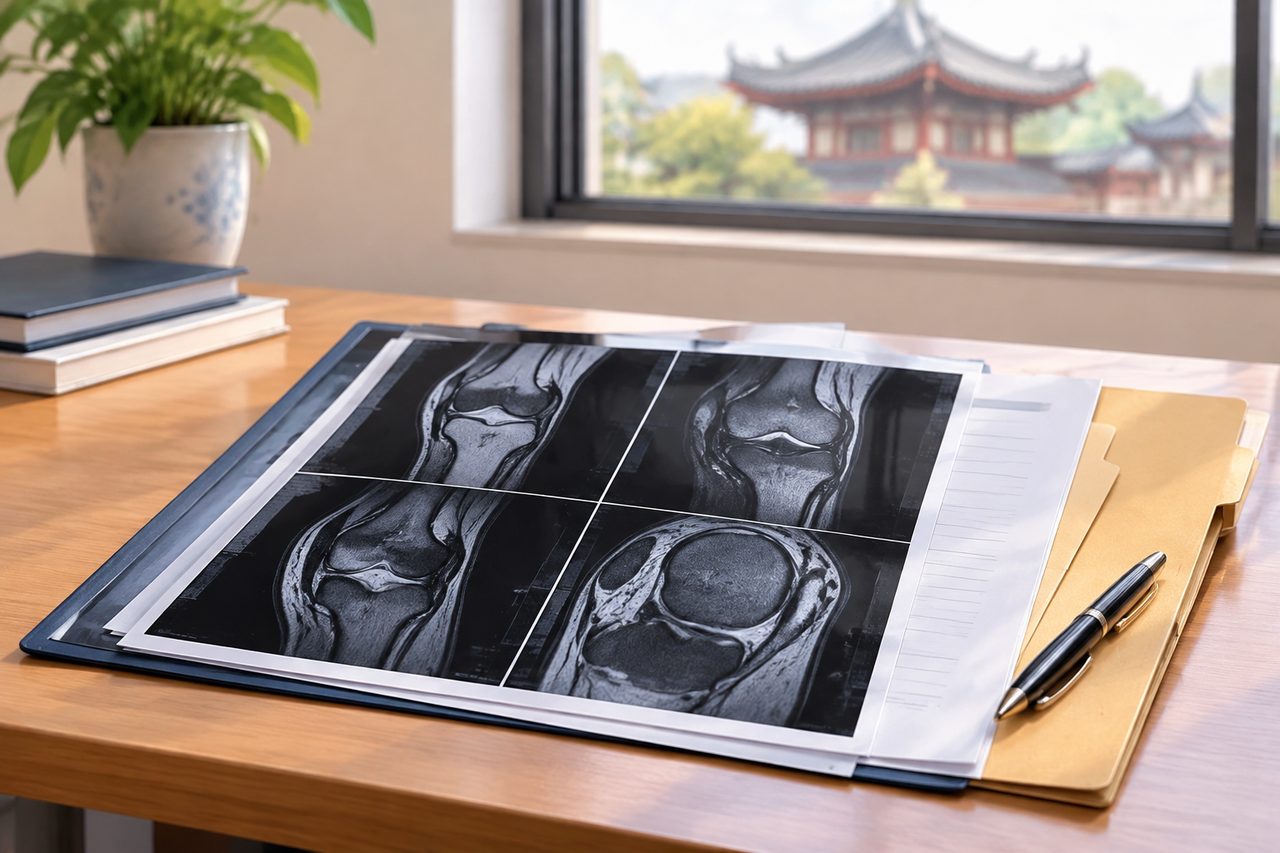
Meniscus Tear: Records a Chinese Specialist Needs
If you are preparing to consult a Chinese orthopedic specialist about a meniscus tear, the records a Chinese specialist needs are, at minimum, your most recent MRI of the affected knee (ideally with the original DICOM images, not just the written report), any earlier MRI or X-ray for comparison, your operative report if you have had prior knee surgery, and a clear clinical summary of your symptoms and how the injury happened. Chinese sports-medicine and joint specialists work from imaging and history together; a written MRI report alone is usually not enough to plan anything.
That short list is the honest core of it. The complication is that “records” means different things to a radiologist, a triage coordinator and a surgeon, and Chinese public hospitals have their own expectations about format, language and recency. The rest of this guide explains what each document does, why the original images matter more than the report, and how to assemble a package that a specialist can actually use — without over-collecting or paying for scans you do not need.
Meniscus Tear Records a Chinese Specialist Needs: The Short Answer
For a first remote or in-person orthopedic review of a meniscus tear, a Chinese specialist typically wants four things: current knee MRI images in DICOM format, the accompanying radiology report, a short clinical history (mechanism of injury, symptoms, mechanical signs such as locking or giving way, and treatments tried so far), and any prior imaging or surgical records. Age, general health and your functional goal — returning to sport, resolving pain, or simply walking without discomfort — round out the picture.
Why the emphasis on original images? A meniscus tear is graded and characterized by what the surgeon sees on the slices: tear type (horizontal, vertical, radial, flap, bucket-handle), location relative to the blood supply at the meniscal rim, size, and stability. A one-line radiology report saying “medial meniscal tear” does not tell a surgeon whether repair is plausible or whether debridement is more realistic. Chinese specialists are no different from specialists anywhere in this respect; they need the source images to form an opinion.
Key takeaway: The single most useful thing you can send is the original MRI image set on a disc or secure download link, together with the radiology report. Everything else supports that.
Who This Is Right For — and Who It Isn’t
Seeking a Chinese specialist opinion on a meniscus tear makes practical sense for some patients and little sense for others. Being explicit about the difference keeps expectations honest.
Typically a reasonable fit:
- You have a confirmed or suspected meniscus tear on MRI and want a second read on whether repair, partial meniscectomy or non-operative management is appropriate.
- You are considering surgery in China and want a remote evaluation before committing to travel.
- You have a complex or degenerative tear and want a specialist view on preserving meniscal tissue.
- You are already in China, or travel there regularly, and want continuity of orthopedic care.
Probably not the right path:
- You have an acute locked knee with inability to straighten the leg, or a suspected concurrent fracture or infection — this needs urgent local assessment, not international planning.
- You have significant instability suggesting a ligament injury that has not been evaluated; that changes the whole treatment plan.
- You are seeking a guaranteed surgical date or a specific surgeon before any imaging review. No responsible coordinator can promise that.
- Your main goal is a lower price with no interest in the clinical process. Cost matters, but it is a poor primary reason to choose where to have knee surgery.
The Options, Compared
Patients weighing a Chinese specialist opinion usually compare a few realistic routes. The table below sets out what each involves in terms of records, timing and commitment. Figures are general and vary by hospital and case.
| Route | Records typically required | Typical first step | Commitment |
|---|---|---|---|
| Local orthopedic review (home country) | MRI images + report, clinical exam | In-person appointment | Low; depends on local wait times |
| Written second opinion from a Chinese specialist | MRI DICOM + report, history, prior records | Send records for written analysis | Low; no travel |
| Video consultation with a Chinese specialty team | Same records, plus a conversation about goals | Online discussion after records review | Moderate; planning stage |
| In-person consultation and possible surgery in China | Full package, plus passport and visa documents | Coordinated appointment at a hospital international department | High; travel and treatment |
Most international patients start with the second or third row. A written or video opinion costs far less than travel and often clarifies whether surgery is even indicated — which is the question that matters most before booking flights.
What Each Document Actually Does
Not every record carries equal weight. Understanding the role of each file helps you decide what to gather and what to skip.
The MRI image set (DICOM). This is the primary document. It should include all sequences — sagittal, coronal and axial — not a handful of selected screenshots. Ask your imaging center for the full study on a disc or a secure download. If you only have printed films, a high-quality digital copy is worth requesting.
The radiology report. Useful context, but secondary. It tells the specialist what the reporting radiologist concluded; the surgeon will form an independent view from the images. Send it, but do not treat it as a substitute.
Prior imaging. If you had an MRI or X-ray months or years earlier, include it. Comparison helps distinguish an acute tear from degenerative change, which influences treatment choice.
Operative records. If you have had knee surgery before — meniscal repair, ACL reconstruction, arthroscopy — the operative report and any postoperative notes are important. They tell the specialist what has already been done and what tissue remains.
A clinical summary. A short, plain-language account of when the injury happened, what you felt, whether the knee locks, catches or gives way, what conservative treatment you have tried (physiotherapy, bracing, injections), and what you want to get back to. One page is plenty. This is often the document patients under-prepare, and it shapes the recommendation as much as the imaging.
Practical tip: Label every file clearly — patient name, date of scan, body part and type (for example, “Knee MRI, right, March 2026, DICOM”). Unlabeled files slow down review and increase the chance of an error.
How Long It Takes and What It Costs
Timing depends on how complete your records are. If you send a full DICOM set with a clear history, a written specialist opinion can typically be arranged within a short window; if files are missing or unreadable, review stalls. Video consultations add scheduling time for the specialty team.
On cost, the service fees for record-based review are separate from any hospital medical charges, and they are not credited toward later treatment. Written second opinions from top-hospital specialists generally fall in the range of a few hundred dollars, video consultations vary by hospital tier, and in-person coordination carries its own fee. Exact figures depend on the hospital and the complexity of your case, and a written quote is the only reliable basis. Hospital treatment costs — imaging, arthroscopy, rehabilitation — are billed by the hospital separately and vary widely by city, hospital tier and whether you use the international department.
Practical Considerations: Language, Format and Follow-Up
Records from your home country will usually be in English or another language. Chinese specialists at top hospitals increasingly read English imaging reports, but clinical summaries and operative notes may need translation for accuracy. A translated summary reduces the risk of misunderstanding and speeds review.
For payment, Chinese public hospitals generally require prepayment, with insurance reimbursement handled afterward in your home country; private international hospitals more often bill insurers directly. Confirm the mechanism before you commit. If you travel, the applicable visa category for medical treatment is S2, subject to the latest embassy requirements and supporting hospital documents — not the M visa, which is for commercial activities.
Follow-up after returning home matters too. Ask, before treatment, who will manage rehabilitation and imaging review once you are back, and request copies of all operative and imaging records before you leave China. For a broader view of how orthopedic services are organized across Chinese hospitals, the specialty department directory lists leading centers by field, and the ranked hospital guide groups top institutions by city.
Frequently Asked Questions
It is possible to receive a general comment, but it will be limited. A meniscus tear’s suitability for repair versus removal depends on the images themselves — tear pattern, location and stability. Without the DICOM set, a specialist can only offer broad guidance, not a treatment recommendation.
Usually not, if you have a recent MRI of adequate quality. Chinese specialists can review imaging done abroad. A new scan may be requested if the existing images are outdated, incomplete, or if the clinical picture has changed — but that decision belongs to the treating clinician, not to a coordinator.
No. A written or video opinion is advisory. You can use it to inform a decision at home, to compare approaches, or to plan treatment in China later. Nothing obliges you to travel, and no responsible service should present a remote opinion as a binding treatment plan.
Your Next Step
The core message is simple: gather the original MRI images, the report, a short clinical history and any prior surgical records, and you have what a Chinese specialist needs to give you a meaningful opinion. Everything else is detail. China Medical Services is a coordination service, not a hospital — we do not diagnose or treat, but we help international patients assemble records, connect with appropriate specialists through hospital international departments, and navigate language and logistics. If you would like an informal conversation about your situation, you can request a free consultation and we will tell you honestly what is and is not possible.
This article is for general information only and does not constitute medical advice. Meniscus tears should be evaluated by a qualified clinician; treatment decisions depend on individual examination and imaging.
For more medical information and treatment options in China, visit chinamedservices.com (China Medical Services).
