Men’s Tests in a Full Body Checkup in China: What You Get and What It Costs
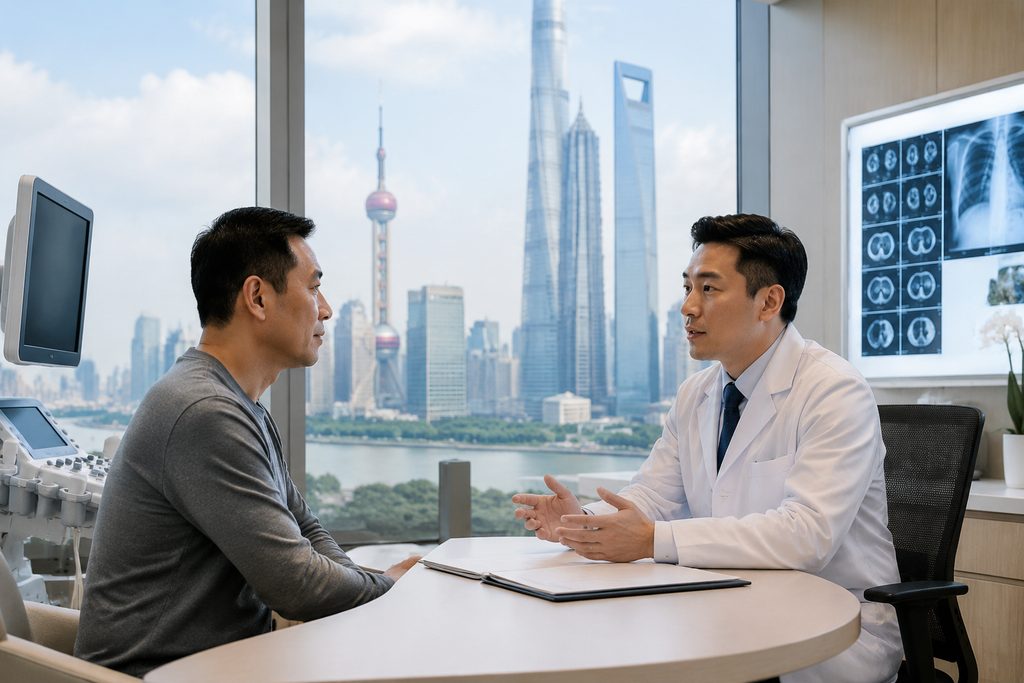
While a routine physical in the United States often ends at blood pressure and a basic lipid panel, a men’s full body checkup at a top-tier Chinese hospital can involve 40 to 60 individual measurements in a single morning — for a fraction of what the same panel would bill through a U.S. insurance network. That gap is not a marketing claim. It reflects a different health system, one built around volume, speed, and early detection rather than episodic sick care.
If you have ever priced a comprehensive executive physical in the West and quietly closed the browser tab, you already understand the problem this article addresses.
Key Takeaways
- A comprehensive men’s screening at a major Chinese hospital typically runs $300 to $1,200 out of pocket, depending on tier and city — often 70–90% below comparable U.S. executive physicals.
- Top facilities process hundreds of examinees daily, so results for standard panels often return within 24–72 hours, with English-language reports available at international departments.
- The real friction is navigation, not medicine: public hospital registration, payment systems, and queue logic are built for Chinese-speaking patients, and most public clinics cannot be pre-booked from overseas.
- Not every test in a “full body” package is worth doing. Knowing which add-ons matter for men — and which are upsells — is the difference between a smart checkup and an expensive one.
The Problem: Screening Gets Skipped Because It Costs Too Much
In the United States, a comprehensive executive physical — the kind with cardiac imaging, full bloodwork, and specialist review — routinely bills between $2,500 and $5,000, and insurance frequently classifies it as elective, leaving the patient to pay. A 2023 survey by the Kaiser Family Foundation found that roughly 1 in 4 adults with employer coverage reported skipping recommended care because of cost. For men specifically, the pattern is worse: CDC data consistently show that men are less likely than women to visit a doctor for preventive care at all.
The result is predictable. Conditions that announce themselves quietly — elevated PSA, fatty liver, early-stage hypertension, prediabetes, sleep apnea — go undetected for years. By the time symptoms force a visit, the cheap, early intervention window has often closed.
So the question many internationally minded patients now ask is not whether to get screened, but where to get the most complete picture for the least financial pain.
Why China Delivers Real Value on Men’s Health Screening
China’s top hospitals are not smaller versions of Western clinics. They operate at a scale that changes the economics of diagnostics entirely.
Volume that drives down per-test cost
Fuwai Hospital in Beijing performs more than 14,000 cardiac surgeries annually — the highest volume of any heart center in the world. That kind of throughput exists across specialties. When a hospital runs thousands of imaging studies and lab panels per day, the marginal cost of each additional test collapses. A CT scan that bills at $1,500 in the U.S. may cost $150–$300 in a Chinese tertiary hospital. An MRI of the prostate can land under $250.
Technology access without the queue
Top Chinese hospitals operate the same imaging platforms as major U.S. academic centers — 3-Tesla MRI, 256-slice CT, digital mammography, and advanced endoscopy suites. The difference is scheduling. Where a Canadian patient might wait weeks for a non-urgent MRI, a self-paying patient at a Chinese international health screening center can often be scanned the same week.
Cost structure, not cost-cutting
Lower prices do not mean older machines or less qualified readers. The structural reasons are straightforward: physician salaries are lower relative to U.S. levels, hospital administration is leaner, and the absence of an insurance middle layer removes a significant markup. The clinical standards at Fudan-ranked hospitals follow international guidelines, and many departments publish in the same journals their Western peers read.
What Tests Are Included in a Men’s Full Body Checkup in China
Packages vary by hospital and tier, but most comprehensive men’s screenings cluster into recognizable groups. Here is what a mid-to-upper tier package typically contains.
| Category | Typical Tests | Why It Matters for Men |
|---|---|---|
| Blood panel | CBC, liver and kidney function, fasting glucose, HbA1c, lipid profile | Baseline metabolic and organ health; catches prediabetes early |
| Cardiac | ECG, echocardiogram, carotid ultrasound, cardiac risk markers | Heart disease remains the leading cause of death in men worldwide |
| Prostate | PSA, digital exam, optional prostate MRI | Prostate cancer is the most common male cancer in many Western countries |
| Imaging | Chest CT (low-dose), abdominal ultrasound, thyroid ultrasound | Lung and liver findings often silent until advanced |
| Digestive | Stool occult blood, optional gastroscopy and colonoscopy | Colorectal and gastric cancer screening; China has strong endoscopy capacity |
| Other | Urinalysis, body composition, vision, hearing, bone density (age-dependent) | Completes the systemic picture |
Endoscopy deserves special mention. In China, both gastroscopy and colonoscopy are frequently performed under light sedation as part of a single-day package — a combination that in the U.S. often requires two separate appointments, two anesthesia events, and two facility fees.
Men’s Full Body Checkup Cost China: Real Numbers by City and Tier
Pricing depends on hospital tier, city, and how many advanced imaging studies are included. The ranges below reflect typical self-pay rates at public tertiary hospitals and private international clinics.
| Package Tier | Representative City | Typical Cost (USD) | Includes |
|---|---|---|---|
| Basic | Beijing, Chengdu | $300–$500 | Blood, urine, ECG, ultrasound, chest X-ray |
| Comprehensive | Shanghai, Guangzhou | $600–$900 | Adds low-dose chest CT, cardiac echo, PSA, thyroid ultrasound |
| Premium / executive | Shanghai, Beijing | $900–$1,200 | Adds endoscopy, prostate MRI, specialist consultation, English report |
| Private international clinic | Shanghai, Beijing | $1,500–$3,000 | English-speaking staff, concierge scheduling, direct insurance billing |
For comparison, an equivalent executive physical in the U.S. runs $2,500–$5,000; in the UK private sector, £1,500–£3,500; in Singapore, SGD 1,800–4,000. The Chinese public-hospital tier sits well below all three. Prices vary by hospital and case complexity, and any quote you receive should be treated as an estimate until the final package is confirmed.
Best Hospitals for Men’s Health Screening in Shanghai and Beijing
Two cities dominate the landscape for international patients, and each has a distinct character.
Shanghai combines top-ranked public hospitals with a mature private international sector. The Shanghai hospital directory lists facilities ranging from Fudan-affiliated tertiary centers to JCI-accredited private clinics with English-speaking staff and direct insurance billing. For men who want a Western-style experience with Chinese pricing on the diagnostic side, Shanghai is often the easiest entry point.
Beijing offers the deepest concentration of top-ranked public hospitals — 21 of the Fudan Top 100 sit in the capital, more than any other city. To book men’s full body checkup in Beijing at a major tertiary hospital, expect to work through the international department or a VIP channel, since standard outpatient registration is walk-in only.
If you are weighing specific specialties — cardiology, urology, gastroenterology — the department rankings by specialty show which hospitals lead in each field. For a broader view of private options with English service and insurance integration, the private international hospital guide covers the main operators.
Is a Full Body Checkup in China Worth It for Men?
For most internationally mobile patients, the answer is yes — with caveats.
It is worth it if you are paying out of pocket in a system where comprehensive screening is expensive or slow, if you want imaging that would otherwise require a long wait, or if you are combining the checkup with travel or a specialist consultation. The cost-to-completeness ratio is genuinely difficult to beat.
It is less compelling if you have generous insurance that already covers annual executive physicals at home, if you require continuity with a physician who knows your history, or if you cannot arrange interpretation and follow-up. A screening without a clear plan for acting on abnormal findings is just data collection.
Practical Considerations: Booking, Payment, and Follow-Up
Public tertiary hospitals in China generally do not accept advance overseas bookings for standard outpatient slots. You register on the day, in person, in Chinese. International departments and VIP channels are the exception — they can often be scheduled in advance, provide English support, and cost roughly 1.5 to 2 times the standard rate.
Payment at public hospitals is typically upfront and self-pay, with insurance reimbursement handled afterward in your home country. Private international clinics frequently bill insurers directly. Bring your passport, any prior medical records with translations, and a list of current medications.
For visa purposes, medical travel to China falls under the S2 category (short-stay, private affairs, annotated for medical treatment), with S1 for stays exceeding 180 days. Accompanying family members apply under the same category. Requirements are set by the latest embassy and consulate guidance, and approval is never guaranteed. Note that the M visa is for commercial and trade activities and is not the correct category for medical treatment.
After you return home, share the English report with your primary care physician. Chinese hospital reports are structured and legible, but your local doctor will want to interpret them in the context of your history.
Frequently Asked Questions
At private international clinics and hospital international departments, yes — advance scheduling is usually possible. At standard public hospital outpatient desks, no. Those operate on same-day, in-person registration, which is why most international patients route through the international or VIP channel.
Standard blood and urine panels typically return within 24 hours. Imaging results usually follow within 24–72 hours. Full compiled reports with English translation generally take 3–7 business days, depending on the hospital and whether pathology is involved.
At Fudan-ranked tertiary hospitals and JCI-accredited private facilities, equipment and clinical protocols meet international standards, and many departments publish in peer-reviewed international journals. The larger risk is not quality — it is miscommunication. Without fluent interpretation, you may not fully understand your results or the recommended next steps.
This is exactly why planning matters. Abnormal findings should be reviewed by the appropriate specialist, and you should have a clear pathway — whether that means a follow-up consultation in China or transferring records to a physician at home. Screening is the beginning of a conversation, not the end of one.
Your Next Step
A men’s full body checkup in China can deliver a genuinely comprehensive picture of your health at a cost that makes annual screening realistic rather than a once-a-decade splurge. The medicine is strong; the logistics are the hard part.
Our team at China Medical Services helps international patients navigate that logistics layer — hospital matching, appointment coordination, bilingual accompaniment, and visa guidance. We are not a hospital and we do not provide diagnoses or treatment. If you would like help understanding your options, you can start with a free consultation and we will walk you through what is realistic for your situation.
This article is for informational purposes only and does not constitute medical advice. Always consult a qualified physician regarding your individual health needs.
For more medical information and treatment options in China, visit chinamedservices.com (China Medical Services).
