Microbiome Testing in China: What It Shows and What It Costs
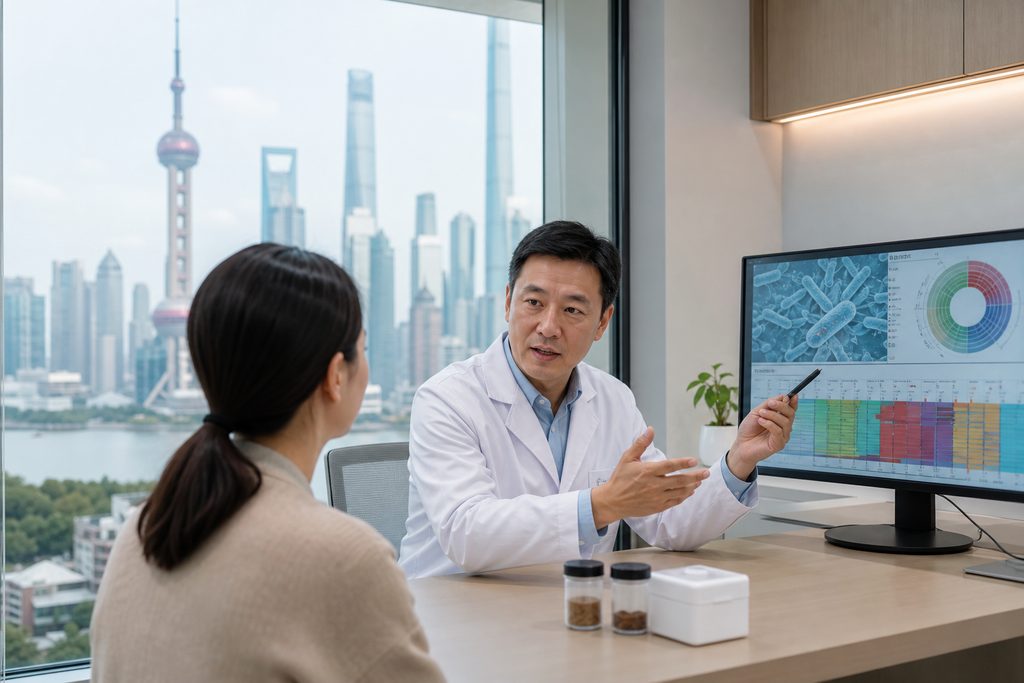
Microbiome Testing in China: What It Shows
What if the answer to your bloating, fatigue, or stubborn skin problem was sitting in a stool sample you could mail to a lab — but the lab is 7,000 miles away? That is the question more and more international patients are asking us, usually right after they get a quote for microbiome testing cost China labs charge versus what they were quoted at home.
Here is the short version. A gut microbiome test sequences the bacterial DNA in your stool and reports which organisms are present, in what relative amounts, and sometimes what metabolic functions they appear capable of. That is genuinely useful information. It is not a diagnosis, and no test sold anywhere in the world will tell you “this bacterium caused your IBS.”
China has become a real option for this kind of testing, largely because several large hospitals and research-affiliated labs run sequencing at a scale that keeps prices down. But the landscape is uneven. Some of it is excellent. Some of it is a wellness product with a lab coat on. This guide walks through what the tests actually measure, what they cost, how to judge quality, and how to arrange one without flying blind.
How This Actually Works, Step by Step
The sequence matters, because microbiome testing is not a walk-in service in most Chinese hospitals. It usually runs through a gastroenterology, internal medicine, or digestive disease department, and increasingly through hospital-affiliated precision medicine centers.
Step one: you send records. Existing bloodwork, stool studies, endoscopy or colonoscopy reports, medication lists, and a short description of your symptoms and goals. If you have already done a microbiome test abroad, send that report too — a Chinese lab may be able to compare or re-analyze it.
Step two: a specialty team reviews the file. Not a salesperson. A clinician decides whether microbiome sequencing is even the right test for your situation, or whether you need something more basic first — a calprotectin, a stool culture, a breath test for SIBO, a thyroid panel. This step saves people money more often than you would expect.
Step three: you get a written opinion. What the team thinks is going on, what testing they recommend, what it costs, and what the results could and could not change about your treatment. Written second opinions from top-tier hospital specialists typically run $300–500.
Step four: sample collection. Some labs accept a home collection kit shipped internationally. Others require the sample to be collected and processed locally, because fresh samples give better sequencing quality than samples that have spent five days in transit. If you are already in China, this is straightforward. If you are not, a video consultation first ($100–300 with a standard hospital international department) will clarify which route applies to you.
Step five: results and interpretation. Turnaround is commonly two to four weeks for full 16S or metagenomic sequencing. The report comes back with a taxonomic breakdown, diversity indices, and often a functional prediction. Interpretation is where the real value sits — and where cheap direct-to-consumer kits usually fall down.
What a Gut Microbiome Test Actually Shows — and What It Cannot
This is the section most people skip, and it is the one that determines whether you get your money’s worth.
A standard 16S rRNA sequencing test identifies bacteria by genus, sometimes by species. A deeper metagenomic (shotgun) test identifies species and strains, and can flag genes associated with antibiotic resistance or specific metabolic pathways. Some Chinese labs also run short-chain fatty acid panels and calprotectin alongside the sequencing, which adds inflammatory context the sequencing alone cannot provide.
What you get in the report:
- Relative abundance of major phyla — Firmicutes, Bacteroidetes, Actinobacteria, Proteobacteria, and others
- Diversity scores, usually Shannon or Chao1 indices, compared against a reference cohort
- Presence or absence of specific genera that researchers have associated with conditions like inflammatory bowel disease, metabolic syndrome, or Clostridioides difficile colonization
- Sometimes a functional profile predicting which metabolic pathways the community is enriched for
What you do not get: a diagnosis. A microbiome profile is a snapshot of one sample at one moment. Diet, sleep, antibiotics, travel, and even the time of day you collected the sample shift the result. Two samples from the same person a month apart can look meaningfully different. Anyone who tells you a single test confirms a specific disease is overselling.
Is Microbiome Testing in China Reliable?
Fair question, and the honest answer is: it depends entirely on the lab. China has world-class sequencing infrastructure. It also has a large gray market of wellness clinics selling “gut health panels” with no accreditation and no clinician oversight.
Signals that a lab is serious:
- It sits inside or is formally affiliated with a tertiary (Grade 3A) hospital or a university research institute
- It publishes methodology — which sequencing platform, which reference database, which bioinformatics pipeline
- A clinician, not a salesperson, signs the interpretation
- It runs negative and positive controls, and can tell you its contamination thresholds
- It will discuss limitations without prompting
Signals to walk away from: guaranteed cures, proprietary “proprietary strains” with no published data, a report generated in 48 hours with no quality metrics, and anyone who promises a specific outcome from a probiotic protocol before seeing your results.
For patients searching for the best microbiome testing clinic Beijing or Shanghai has to offer, the practical answer is to start with the gastroenterology or digestive disease department of a major tertiary hospital rather than a standalone commercial lab. Those departments have research-grade sequencing access plus the clinical context to interpret it. Our department directory lists top-ranked hospitals by specialty, which is a reasonable place to begin narrowing down.
A Realistic Timeline
Timelines below assume you are arranging this from abroad. If you are already in China, cut the logistics rows substantially.
| Stage | Typical Duration | Notes |
|---|---|---|
| Record collection and translation | 3–10 days | Longer if records are in a non-English, non-Chinese language |
| Specialist file review | 2–7 days | Depends on department workload |
| Video consultation (if needed) | Scheduled 3–14 days out | Time zone coordination adds friction |
| Kit shipment or local collection | 5–14 days | International shipping of collection kits is not offered by every lab |
| Sample processing and sequencing | 10–21 days | Rush options exist at some labs, at extra cost |
| Report issuance and interpretation | 3–7 days | Interpretation is the bottleneck, not the sequencing |
| Follow-up consultation | 1–3 weeks after report | Where the actual plan gets built |
Total from first contact to interpreted result: roughly four to eight weeks. Anyone promising a full result in a week is either skipping quality control or skipping the interpretation.
What Can Go Wrong — and What Happens Then
Sample degradation in transit is the most common failure. Stool samples are sensitive to temperature and time. If a kit spends a week in a customs warehouse in July, the sequencing quality drops and the diversity metrics become unreliable. The fix is a re-collection, which means another kit, another shipment, and another two weeks. Some labs will replace the kit at no charge; some will not. Ask before you pay.
Ambiguous results are the second issue. A report showing “reduced diversity” and “elevated Proteobacteria” sounds alarming and often is not, on its own. Without a clinician who knows your history, that finding can trigger unnecessary anxiety and unnecessary spending on supplements.
The third failure mode is the one nobody warns you about: a test that answers a question you did not need answered. Plenty of people arrive wanting microbiome sequencing when what they actually need is a straightforward workup for celiac disease, bile acid malabsorption, or a parasitic infection. A good review process catches this. A commercial lab selling kits will not.
Payment and refunds are worth clarifying upfront. Chinese public hospitals generally require prepayment, with insurance reimbursement handled afterward by you. Private international hospitals more often bill insurance directly. If a test cannot be performed for a technical reason, ask in writing what portion is refundable.
Microbiome Testing Cost in China vs. Elsewhere
Now the number everyone wants. Microbiome testing cost China providers charge varies widely by test depth and whether clinical interpretation is included.
| Service | Typical Range (USD) | What’s Included |
|---|---|---|
| Basic 16S sequencing, direct-to-consumer style | $80–200 | Taxonomic report, minimal interpretation |
| Hospital-based 16S with clinical interpretation | $200–450 | Sequencing plus clinician-signed report |
| Shotgun metagenomics with functional analysis | $400–900 | Species-level data, pathway prediction |
| Panel including calprotectin and SCFA analysis | $300–700 | Adds inflammatory and metabolic markers |
| Written second opinion on existing results | $300–500 | Specialist review, no new sample |
| Video consultation with hospital specialty team | $100–300 | Standard international department |
For comparison, comparable clinical-grade sequencing in the United States frequently runs $500–1,500 before interpretation, and interpretation is often billed separately. That gap is the main reason patients look at China for this specific test. Prices vary by hospital and case complexity, so treat the ranges above as orientation rather than a quote.
One note on the gut microbiome test price Shanghai labs advertise: the cheapest listings are usually research-use-only kits with no clinical sign-off. They are not fraudulent, but they are not what most patients actually want. Paying $250 for a properly interpreted hospital test beats paying $99 for a spreadsheet of bacteria names.
Practical Considerations: Records, Language, and Follow-Up
Records first. A microbiome result is only interpretable alongside your history. Bring prior stool studies, any endoscopy reports, a current medication list including antibiotics from the past year, and a food diary if you have one. Chinese specialists read English records comfortably at top-tier hospitals, but translated summaries speed things up considerably.
Language is the practical hurdle. Large Chinese public hospitals see tens of thousands of outpatients daily, and signage, registration systems, and lab instructions are predominantly in Chinese. This is not a criticism — it is simply the reality of a system built for volume. A bilingual medical companion (from $300/day) handles registration, queueing, payment, sample drop-off, and on-site translation so that the clinical conversation is the only thing you have to focus on.
Visa category matters if you plan to travel. Medical treatment in China falls under the S2 short-stay category for stays under 180 days, with S1 for longer stays, and accompanying family members apply under the same category. Requirements shift, so confirm current rules with the nearest Chinese embassy or consulate and bring supporting hospital documentation. The M visa is for commercial and trade activity and is not the right category for medical travel.
Follow-up after you go home is the piece people forget to plan. Ask, before you leave, how the lab handles re-testing, whether they will release raw sequencing data, and whether a follow-up video consultation is available. Getting a second sample processed six months later is far easier if you set it up while you are still in the country.
Frequently Asked Questions
Not always. Some hospital-affiliated labs accept internationally shipped collection kits, though sample quality degrades with transit time. For the most reliable results, local collection and processing is preferred. A video consultation first will tell you which route fits your situation.
It can show which bacterial groups are under- or over-represented, which some clinicians use to guide recommendations. But the evidence linking specific probiotic strains to specific microbiome profiles is still developing. Treat any protocol built on a single test as a hypothesis, not a certainty.
Top hospital-affiliated labs in China use the same sequencing platforms and reference databases as leading Western labs, and several publish in international journals. Quality varies far more between individual labs than between countries. Ask about accreditation, methodology, and who signs the report.
This is common. Request a follow-up consultation with the interpreting clinician and ask specifically what the findings change about your management. If the answer is “nothing yet,” that is a legitimate and useful answer.
It is a stool sample. Kits are designed for home collection and are less awkward than most people expect. The bigger practical issue is timing — some protocols require the sample to reach the lab within 24 to 72 hours, which affects how you plan collection around travel.
Your Next Step
A microbiome test is a measurement, not a treatment. It is worth doing when a clinician has a specific question it can answer — and worth skipping when the question is vague. The value in China is access to research-grade sequencing at a fraction of Western pricing, paired with specialists who can actually read the output.
China Medical Services connects international patients with 340+ top-ranked hospitals across 37 cities, and we handle the logistics that make a Chinese hospital visit workable for someone who does not speak Mandarin. We are not a lab and we do not interpret results — that stays with the clinical team. If you want to know whether microbiome testing is the right next step for you, start with a free consultation and we will help you find out.
This article is for general information only and does not constitute medical advice. Testing and treatment decisions should be made with a qualified clinician who has reviewed your full medical history.
For more medical information and treatment options in China, visit chinamedservices.com (China Medical Services).
