Middle Eastern Patients Guide to Medical Care in China: GCC Hospital Referral and Cultural Support
Key Takeaways
- China’s top-tier hospitals in oncology and organ transplantation now rival Western centers in clinical outcomes, with liver transplant packages for GCC citizens often costing 60–70% less than comparable programs in the United States or Germany.
- Finding the best hospital in China for Middle Eastern patients depends on matching your specific diagnosis to a hospital’s documented case volume—not its international marketing budget.
- Language barriers, halal dietary requirements, and prayer space access are real logistical challenges that require advance coordination. Most public hospitals do not have these systems ready for walk-in international patients.
- Medical visa requirements for S2 visas demand specific hospital invitation letters and documented treatment plans. Applying without local coordination routinely delays travel by 3–5 weeks.
The Problem: When Regional Options Fall Short
A patient in Riyadh waits 4 to 6 months for a deceased-donor liver transplant. The same patient, with a living donor identified, faces a procedure cost that can exceed $300,000 at private centers in Western Europe. These are not hypotheticals. They are the numbers our team hears repeated by families who contact us from Doha, Jeddah, and Kuwait City every month. The frustration is not about medical skill. The Gulf has invested heavily in healthcare infrastructure. The frustration is about access—to specific sub-specialties, to high-volume surgical teams, and to treatment timelines that match the urgency of a diagnosis.
Cancer treatment cost in China for international patients illustrates the gap starkly. A full course of proton therapy in Shanghai runs between $30,000 and $60,000. Comparable treatment in the United States averages $100,000 to $180,000. The technology is the same. The clinical protocols are the same. The difference is structural economics and surgical volume. That gap matters when a family is liquidating assets to fund care.
Who We Are
We are not a hospital. We do not employ doctors, nor do we provide clinical diagnoses or treatment recommendations. Our team functions as a medical navigation and logistics unit—we connect patients from the Middle East with the specific Chinese hospitals that have documented expertise in their condition. We handle hospital selection based on published case volumes and specialty rankings, appointment coordination through official international departments, visa invitation letters, bilingual medical companions, halal meal logistics, and prayer space arrangements. We are the operational layer between a patient’s need and China’s medical infrastructure.
Why Chinese Hospitals Deliver Results for GCC Patients
Clinical Volume Drives Surgical Precision
There is a direct correlation between how many times a surgical team performs a procedure and how well they perform it. This is not controversial. A 2023 analysis published in The Lancet examined outcomes across 1.2 million surgeries and found that hospitals in the highest-volume quartile had 28% lower 30-day mortality rates than those in the lowest quartile. Chinese hospitals operate at volumes that most Western centers cannot match. Fuwai Hospital in Beijing performs over 14,000 cardiac surgeries annually—more than any other center worldwide. West China Hospital in Chengdu manages over 25,000 inpatient surgeries per year. When a GCC patient is considering where to book a liver transplant in China as part of a comprehensive treatment package, the question is not whether Chinese surgeons are skilled. The question is which specific hospital has the highest documented volume for that exact procedure.
Oncology Infrastructure Built for Scale
China’s cancer burden is enormous. Approximately 4.8 million new cancer cases are diagnosed annually. The hospital system has responded by building dedicated oncology centers with equipment density that is hard to match elsewhere. A single public cancer hospital in Guangzhou may operate 12 linear accelerators under one roof. Most comprehensive cancer centers in Europe operate 4 to 6. For Middle Eastern patients seeking the best hospital in China for Middle Eastern patients with complex oncological diagnoses, this infrastructure means shorter waits for radiation planning and faster initiation of treatment protocols. The cancer treatment cost in China for international patients stays low precisely because these fixed costs are amortized over massive patient volumes.
Transplant Programs with Documented Outcomes
China’s liver transplant programs have matured significantly over the past decade. Several centers now report one-year graft survival rates above 90%, which is consistent with international benchmarks set by the Organ Procurement and Transplantation Network in the United States. The difference for GCC patients is access. A living-donor liver transplant package coordinated through a top-tier Chinese hospital typically falls between $70,000 and $120,000, depending on the complexity of the case and the specific hospital. That figure includes the donor workup, the recipient procedure, and standard post-operative care. Families from Saudi Arabia, the UAE, and Qatar who research how to book a liver transplant in China as part of a comprehensive treatment package are often comparing this number against $250,000 to $400,000 for comparable programs in Germany or the United States. The clinical outcome data does not show a proportional quality gap that justifies that price difference.
What You Need to Know Before Going Alone
China’s public hospital system was built for domestic patients. That is not a criticism. It is a structural fact. Walking into a top-tier Chinese hospital without Mandarin fluency, without an understanding of the registration and payment systems, and without cultural coordination is an exercise in frustration. We have seen patients try. Most succeed eventually. None describe the experience as smooth.
- Medical Visa Requirements: The S2 visa for medical treatment requires an official invitation letter from the admitting Chinese hospital. This letter must specify the diagnosis, the planned treatment, and the estimated duration of stay. Hospitals do not issue these letters casually. They issue them after a patient has been formally accepted through their international department. The medical visa China from Saudi Arabia price ranges from $140 to $300 in consular fees alone, not including document preparation, translation, or expediting services. Processing times vary by consulate, but 10 to 15 business days is typical. Errors in documentation routinely reset that clock.
- Payment Systems and Pre-Authorization: Chinese public hospitals operate on a prepayment model. Patients deposit funds at admission, and treatment costs are drawn down daily. International credit cards are not universally accepted at public hospital cashier counters. WeChat Pay and Alipay dominate the domestic payment ecosystem. Without a local payment intermediary or a hospital international department that handles billing in a compatible format, families find themselves managing large cash transfers under stress. This is not a theoretical inconvenience. It is a daily operational reality.
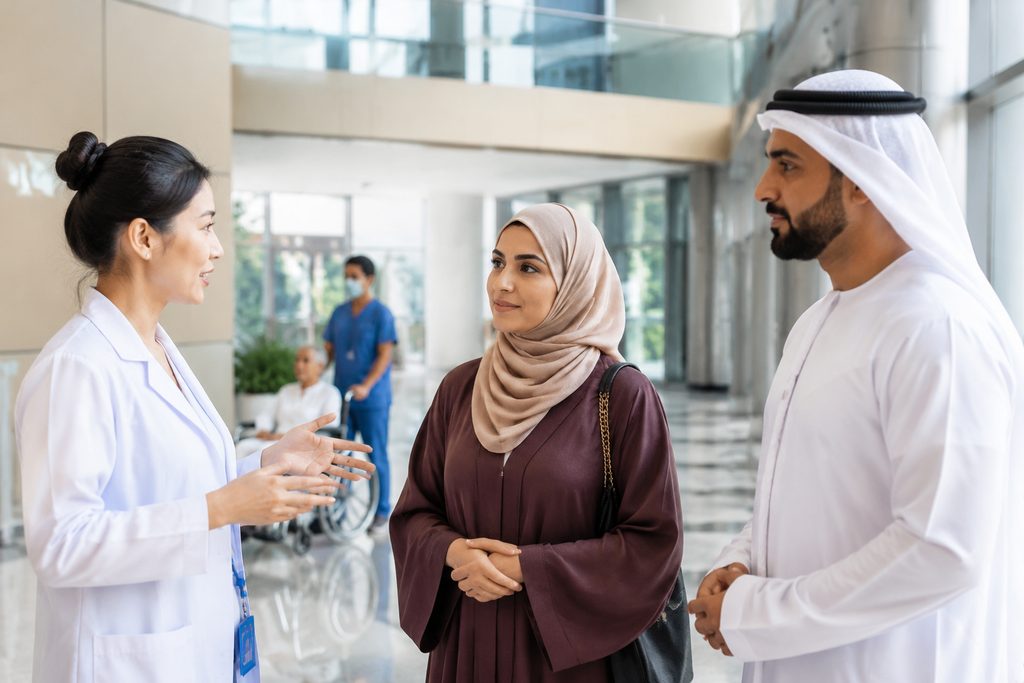
- Halal Food and Prayer Logistics: How do Chinese hospitals accommodate Muslim patients? The honest answer is that most public hospitals do not have halal-certified kitchens. Shanghai and Guangzhou, with their larger Muslim populations and international exposure, have more infrastructure than inland cities. Some international hospital wards in Shanghai can arrange halal food for hospitalized international patients through third-party catering partners. But this requires advance coordination. Prayer space is another variable. Dedicated musallas are rare in public hospitals. Our team arranges portable prayer mats, identifies quiet rooms near the ward, and confirms qibla direction before the patient arrives. These details are small individually. Collectively, they determine whether a patient and their family feel supported or isolated during treatment.
How We Help You Navigate This
These barriers exist for structural reasons. The Chinese hospital system was not designed with international patients as its primary user. That does not make it inaccessible. It makes it a system that rewards preparation and local coordination.
We start with the diagnosis. Our team reviews the patient’s medical records—translated into Chinese by medical translators, not general linguists—and matches the condition against our database of 340+ top-ranked hospitals across 37 cities. The match is based on published specialty rankings, surgical volume data, and the specific sub-specialty expertise required. A patient with hepatocellular carcinoma and a patient with cholangiocarcinoma may be referred to different hospitals, even though both have liver cancer. The surgical approaches differ. The teams that specialize in them differ.
Once the hospital is identified, we coordinate directly with its international department. We secure the invitation letter for the S2 visa. We confirm the appointment schedule. We arrange a bilingual medical companion—a professional who speaks Mandarin, Arabic, and English—to be present at every consultation, every pre-operative check, and every post-operative follow-up. This companion handles registration queues, payment deposits, prescription pickups, and real-time translation of doctor-patient conversations. The companion is not a doctor. They are a communication bridge. That bridge is what turns a disorienting experience into a manageable one.
For families concerned about dietary requirements, we coordinate halal meal delivery to the hospital ward. In Shanghai, several certified halal catering services deliver directly to international patient floors at major hospitals. We confirm these arrangements before the patient travels. For prayer, we prepare a practical setup in the patient’s room or identify a quiet adjacent space. These are not luxuries. They are baseline requirements for patients traveling from the GCC.
After discharge, we coordinate follow-up appointments, medication refills, and, if needed, connections to rehabilitation facilities. Patients return home with a translated discharge summary and a clear follow-up plan that their local physician can execute. Our role ends when the patient is safely reintegrated into their home healthcare system with all documentation in order.
Frequently Asked Questions
Beijing and Shanghai concentrate the highest number of Fudan-ranked hospitals and have the most developed international patient infrastructure. Shanghai has 18 hospitals in the Fudan Top 100 and a long history of hosting international patients. Beijing has 21, including Peking Union Medical College Hospital, which runs one of China’s most established international medical services. Guangzhou is a strong third option, particularly for oncology, with 10 Fudan-ranked hospitals and a significant Muslim community that supports halal food logistics.
This requires case-by-case coordination. Fasting during active treatment may be medically inadvisable, and Chinese physicians will document that clearly if it applies. For patients who are able to fast, we coordinate with the hospital kitchen or external halal caterers to schedule suhoor and iftar meals at appropriate times. The bilingual medical companion communicates the patient’s religious requirements to the nursing staff so that medication schedules can be adjusted where clinically safe. Prayer arrangements for taraweeh are set up in advance. This is not a standard hospital service. It is something we organize as part of our coordination package.
A living-donor liver transplant at a top Chinese center typically costs between $70,000 and $120,000 for the full package, including donor workup, recipient procedure, and standard post-operative hospitalization. The same procedure in the United States ranges from $250,000 to $400,000. German centers fall in a similar range, often $200,000 to $350,000. These are estimates. Final costs vary by hospital, case complexity, length of ICU stay, and whether any complications arise. Patients should always request a detailed cost breakdown from the hospital’s international department before committing.
No. Most public hospitals do not operate halal-certified kitchens. Halal food at a hospital in Shanghai for international patients is available through coordination with external catering services that deliver to the ward. Shanghai, Guangzhou, and to a lesser extent Beijing have established halal food supply chains. Smaller cities and hospitals without international departments generally do not. This is one of the most important logistical questions to resolve before selecting a hospital. A patient recovering from major surgery should not be worrying about where their next compliant meal will come from.
China’s major international hospitals have treated foreign patients continuously for decades, including through periods of travel restriction and public health measures. The international departments at hospitals like Peking Union Medical College Hospital and Huashan Hospital are experienced in managing cross-border patient flows. Safety in terms of clinical quality at top-ranked institutions is well-documented. The practical risks are logistical—visa delays, language friction, payment system incompatibility—rather than clinical. Those risks are manageable with proper advance coordination. We are transparent about this because patients who understand the real challenges prepare for them. Patients who are sold a frictionless fantasy are the ones who encounter problems.
Your Next Step
Choosing to travel internationally for medical care is never a simple decision. It sits at the intersection of clinical urgency, financial calculation, and family logistics. The data on Chinese hospital outcomes for the procedures most relevant to GCC patients—liver transplantation, complex oncology, cardiac surgery—is strong and getting stronger. The cost advantage is real and structurally durable. The operational barriers are also real, but they are solvable with the right coordination. If you are evaluating whether this path makes sense for your specific diagnosis, our team can provide a candid, data-backed hospital recommendation at no cost. No commitment. No sales pressure. Just an honest assessment of what is available and what it would take to make it happen.
For more medical information and treatment options in China, visit chinamedservices.com (China Medical Services).
