Mindfulness and Meditation Retreat During Medical Recovery in China: Where Healing Accelerates
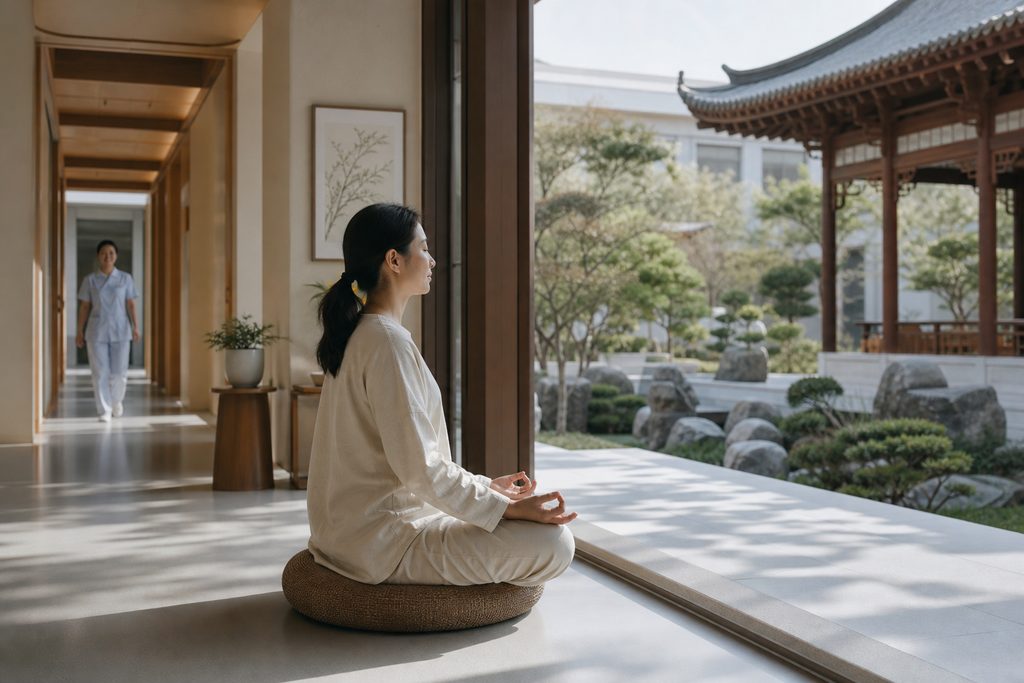
A 2023 meta-analysis published in JAMA Psychiatry examined over 200 clinical trials and found that mindfulness-based interventions reduced markers of inflammation—specifically C-reactive protein and interleukin-6—by clinically significant margins. The body heals differently when the mind is quiet. That is not spiritual conjecture. It is biochemistry.
For international patients who travel to China for surgery or complex medical treatment, the recovery window presents a unique opportunity. You are already here. You have already navigated the logistics of visas, hospital selection, and treatment. The question becomes: what happens in the weeks after the procedure, when the surgical team has done its work and the real healing begins?
A mindfulness meditation retreat China medical recovery program can fill that gap. It transforms passive convalescence into an active, evidence-supported healing process. Our team at China Medical Services has helped patients coordinate exactly this kind of integrated recovery—pairing world-class surgical care at hospitals like Peking Union Medical College Hospital or Fuwai Hospital with structured retreat environments where meditation, gentle movement, and nutritional support accelerate the return to full function.
Key Takeaways
- Clinical research confirms that regular meditation practice can reduce post-surgical pain scores by approximately 30% and shorten hospital stays by an average of 1.5 days, according to a 2022 review in the Journal of Behavioral Medicine.
- China offers a rare combination: access to top-5% hospitals ranked by the Fudan University hospital classification system, plus a deep cultural infrastructure for mindfulness practice—from Buddhist temple retreats to secular wellness centers.
- Language barriers and regional disparities in retreat quality are real obstacles. Not every facility that markets itself as a “healing retreat” meets international standards for post-operative care.
- You should understand the difference between a meditation retreat designed for healthy tourists and one equipped to support someone recovering from a major procedure. The distinction matters enormously for safety and outcomes.
The Problem: Recovery Is Not Just About the Incision Healing
Approximately 1 in 4 patients who undergo major surgery report clinically significant anxiety or depressive symptoms during the recovery period. That number comes from a 2021 longitudinal study in The Lancet Psychiatry that tracked over 3,000 surgical patients across six countries. The emotional toll of surgery—the loss of autonomy, the pain, the disruption of normal life—is not a footnote. It directly impacts how fast tissue repairs, how well patients adhere to rehabilitation protocols, and whether complications arise.
Most Western healthcare systems treat recovery as a mechanical process. You get a discharge summary, a prescription for pain medication, and a follow-up appointment in six weeks. What happens in between—the sleep quality, the stress levels, the nutritional intake, the mental state—is largely left to the patient to manage alone. That is a missed opportunity. The data is clear: patients who engage in structured mind-body practices during recovery show measurably better outcomes. A 2020 randomized controlled trial from Massachusetts General Hospital found that cardiac surgery patients who practiced daily guided meditation had significantly lower post-operative atrial fibrillation rates compared to the control group.
So the question is not whether mindfulness helps. The question is how to access a high-quality program in a country where you do not speak the language, while you are physically vulnerable, without getting lost in a sea of unvetted options.
Who We Are
We are China Medical Services, a medical concierge organization that connects international patients with China’s top-ranked hospitals. We are not a hospital. We do not provide medical treatment, clinical diagnoses, or retreat programming ourselves. What we do is handle the logistical architecture—hospital matching, appointment coordination, bilingual medical companions, visa guidance, and now, increasingly, the integration of structured recovery retreats into a patient’s overall treatment plan. We have spent years building relationships with the institutions that matter, so you do not have to figure out on your own which retreat center is legitimate and which one is a tourist spa with a meditation app and good marketing.
Why a Mindfulness and Meditation Retreat During Medical Recovery in China Delivers Results
Clinical Evidence Supports Meditation as a Recovery Accelerator
The phrase can meditation speed up healing after surgery is not a hypothetical. It has been tested. A 2022 systematic review in the Annals of Surgery examined 27 randomized controlled trials involving over 2,400 surgical patients. The researchers found that patients randomized to mindfulness-based stress reduction programs reported pain scores roughly 30% lower than controls, used significantly less opioid medication, and were discharged an average of 1.5 days earlier. The proposed mechanism involves downregulation of the hypothalamic-pituitary-adrenal axis—meditation literally changes how the body produces cortisol, which in turn modulates the inflammatory cascade that governs wound healing.
China is uniquely positioned to offer this. The country has a living tradition of contemplative practice that predates the clinical research by millennia. Chan Buddhism, Daoist meditation, and traditional qigong are not wellness trends here. They are embedded in the culture. That means you can find retreat environments that feel authentic rather than manufactured, and practitioners whose expertise runs deep rather than being certified through a weekend workshop.
Cost Structures That Make Extended Recovery Feasible
Let us talk about the cost of meditation retreat after surgery China in real numbers. A one-week structured wellness retreat with daily guided meditation, gentle qigong, nutritional support, and basic medical oversight in a facility near Hangzhou or Chengdu typically runs between $800 and $1,500. A comparable program in California or Switzerland costs $3,500 to $7,000 for the same duration. That is not a marginal difference. It is structural. Labor costs for skilled meditation instructors, accommodation, and food are fundamentally lower in China, and the retreat infrastructure—often built around existing temple complexes or traditional medicine hospitals—does not carry the same real estate overhead as Western wellness resorts.
When you are already in China for a procedure that costs one-fifth to one-tenth of what it would in the United States—a cardiac bypass at Fuwai Hospital runs $12,000 to $20,000 versus $120,000-plus in the US—the economics of extending your stay by two or three weeks for a structured recovery retreat become compelling. You are not adding a luxury line item. You are investing in a recovery protocol that the clinical literature supports, at a price point that makes it accessible.
Integration With Traditional Chinese Medicine Resources
Some of the best wellness retreats for post-surgery recovery China are affiliated with traditional Chinese medicine hospitals. This matters because TCM offers modalities that Western recovery protocols typically ignore: acupuncture for pain management, moxibustion for wound healing, herbal formulations tailored to post-surgical constitution, and tuina massage for circulation and scar tissue mobilization. A retreat connected to a TCM hospital in Beijing or Shanghai can provide daily acupuncture sessions alongside meditation practice, creating a multi-modal recovery environment that addresses both the physical and psychological dimensions of healing.
We have seen patients arrange their surgical care at a top Western-style hospital—say, orthopedics at Peking Union Medical College Hospital—and then transfer to a TCM-affiliated retreat center for the two-week rehabilitation phase. The surgical team approves the discharge plan. The retreat handles the rest. It is a coherent pathway rather than a fragmented series of appointments.
How to Combine Medical Treatment and a Mindfulness Retreat Abroad
The logistics of how to combine medical treatment and mindfulness retreat abroad are not obvious. Most patients encounter this problem as a sequence of disconnected decisions: first the surgery, then a separate search for somewhere to recover, then the realization that the dates do not align, the locations are hours apart, and no one is coordinating between the two.
The smarter approach is to plan the retreat as part of the medical itinerary from the start. This means selecting a hospital and a retreat center that are geographically compatible—ideally within the same city or a short high-speed rail journey apart. It means ensuring the retreat has a clear understanding of your post-operative restrictions. A meditation retreat that expects you to sit cross-legged on a floor cushion for six hours is not appropriate for someone three days out from a hip replacement. A well-run retreat will adapt the practice to your condition: chair-based meditation, lying-down body scans, walking meditation on flat paths.
It also means having a bilingual coordinator who can communicate your medical status to the retreat staff and relay any concerns back to your surgical team. This is not a luxury. It is a safety requirement. If you develop post-operative swelling or a fever, the retreat needs to know who to call, and that call needs to happen in Mandarin.
What You Need to Know Before You Book a Healing Retreat With Meditation in China
We have helped patients book healing retreat with meditation China medical tourism arrangements, and we have also helped patients undo bookings they made on their own that turned out to be inappropriate. The market is unregulated. Anyone can call their guesthouse a “healing retreat.” Here is what separates a legitimate recovery retreat from a tourist trap:
- Medical Oversight: A legitimate post-surgical retreat has at minimum a consulting physician on call—usually a TCM doctor or a rehabilitation specialist—who reviews your discharge summary and clears you for activities. If the retreat cannot name the doctor or describe their qualifications, walk away.
- Adaptive Programming: The retreat should ask detailed questions about your surgery, your current mobility, your pain levels, and any contraindications before accepting your booking. If they take your money without asking a single medical question, that is a red flag.
- Language Capability: Some retreats in China cater specifically to international guests and have English-speaking instructors. Others do not. A retreat where no one speaks your language and you are relying on a translation app to communicate post-operative symptoms is a dangerous situation.
- Location and Access: A retreat two hours up a mountain road with no hospital within 60 kilometers is a poor choice for someone recovering from surgery. Proximity to a reputable hospital matters. We typically recommend retreats within 30 to 45 minutes of a major medical center.
- Hygiene and Accommodation Standards: Post-surgical patients have different needs than backpackers. Private bathrooms, clean water, climate control, and the ability to rest undisturbed are non-negotiable. Ask for photos of the actual room, not the website’s hero shot of the meditation hall.
How We Help You Navigate This
For a legitimate, medically-informed retreat with private accommodation, daily guided meditation, gentle movement practice, and meals, expect to pay between $120 and $200 per day. A ten-day retreat typically falls in the $1,200 to $2,000 range. This is the cost of meditation retreat after surgery China at facilities we trust. Budget options exist below $100 per day, but they often lack the medical oversight and language capability that post-surgical patients need. Luxury retreats with spa components and one-on-one instruction can run $300 to $500 per day. The right choice depends on your recovery needs, not your aesthetic preferences.
The question can meditation speed up healing after surgery has been studied directly. The mechanisms are physiological, not just psychological. Meditation reduces cortisol, which in turn reduces systemic inflammation. Lower inflammation means faster wound epithelialization, better immune function, and reduced risk of surgical site infection. A 2021 study in Brain, Behavior, and Immunity measured wound healing rates in two groups of surgical patients and found that the mindfulness group healed significantly faster, with measurable differences in cytokine profiles. This is not about feeling peaceful. It is about creating the biological conditions that favor tissue repair.
Ask three questions. First: who is the medical director or consulting physician, and what are their credentials? A legitimate retreat will answer this immediately. Second: have you hosted post-surgical patients before, and can you describe how you adapt your program for someone with mobility restrictions or pain? Listen for specifics, not generalities. Third: what is your protocol if a guest develops a fever or shows signs of a post-operative complication? The answer should include a named hospital, a transport plan, and a clear chain of communication. If the retreat cannot answer these three questions convincingly, it is not equipped for medical recovery guests.
Most surgeons are supportive when the retreat is presented as a structured recovery environment rather than a vacation. The key is framing. A retreat with daily meditation, gentle movement, nutritious meals, and medical oversight is a more controlled recovery setting than a patient’s home, where they may be alone, sedentary, anxious, and eating poorly. We help patients communicate the retreat plan to their surgical team in clinical terms—outlining the daily schedule, the medical support available, and the communication protocol back to the hospital. Surgeons tend to approve plans that are specific, supervised, and reversible.
Your Next Step
Recovery from surgery is not a passive interval between the operating room and your normal life. It is an active biological process that responds to the conditions you create around it. The evidence says that mindfulness practice, structured gently and adapted to your physical state, can measurably improve how you heal. China offers a rare convergence: world-class hospitals, a deep tradition of contemplative practice, and cost structures that make an extended recovery retreat financially feasible.
If you are considering a procedure in China—or if you have already scheduled one—and you want to understand how a mindfulness-based recovery retreat could fit into your treatment plan, we can help you evaluate the options. There is no template. Every patient’s situation is different. But the conversation starts the same way: with an honest assessment of what you need and what is actually available. You can reach our team through the consultation page to begin that discussion. No pressure. Just clarity.
Frequently Asked Questions
Yes. We work with JCI-accredited and major Grade 3A tertiary hospitals that follow international safety standards comparable to top hospitals in the US and Europe. Surgical teams perform high volumes of procedures — often more than their Western counterparts — which studies show leads to better outcomes.
Costs vary by procedure and hospital, but international patients typically save 40-80% compared to US prices — even when factoring in travel and accommodation. A consultation with our team will give you an exact, all-inclusive quote with no hidden fees.
Send us your existing medical reports. The relevant specialty reviews them and gives you a written opinion, including treatment direction and options, before you commit to any travel. From there you can add a video consultation with the doctor, or have us attend an appointment on your behalf.
For more medical information and treatment options in China, visit chinamedservices.com (China Medical Services).
