MRI in China: One Machine or Several at a Top Hospital?
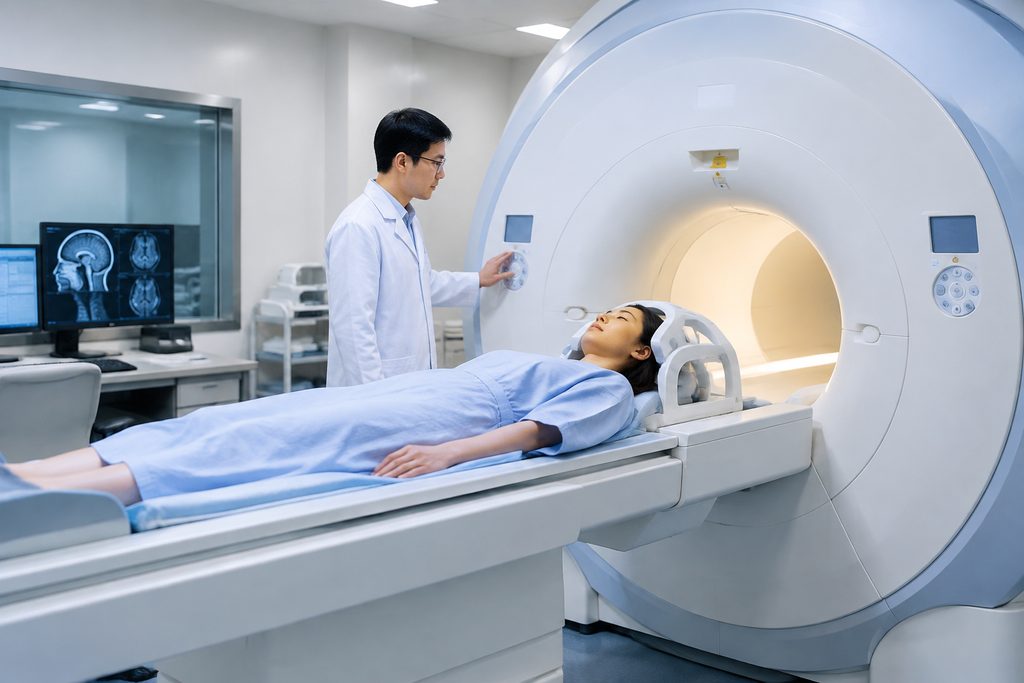
MRI in China: One Machine or Several at a Top Hospital?
Most large Chinese tertiary hospitals do not run a single MRI scanner. They run a fleet — commonly five to fifteen units spread across buildings, and the biggest centers operate twenty or more. That single fact explains a lot about why an mri scan cost China patients pay often lands far below what the same study costs in the United States, and why the practical question is rarely “is there a machine?” but “which machine, at which hospital, and how do I get on its schedule?”
An MRI, in plain terms, is a scan that uses a strong magnetic field and radio waves — no X-rays — to build detailed pictures of soft tissue: brain, spine, joints, organs. Nothing is injected unless contrast dye is needed. You lie still inside a tube-shaped magnet for 20 to 60 minutes, and a radiologist reads the images afterward. That is the whole procedure.
What complicates the simple answer is that China’s hospital system is enormous and unevenly equipped. A top-tier hospital in Shanghai may have more MRI capacity than some national health systems. A county-level hospital two hours away may have one machine and a three-week queue. Where you land matters more than the country you land in.
How Many MRI Machines in a Chinese Hospital: The Short Answer
Capacity scales with rank. China has roughly 35,000 hospitals. The top 5%, ranked by the Fudan Hospital Ranking and JCI accreditation, concentrate the newest 3.0T and 1.5T magnets — the field strengths that matter for neurological, musculoskeletal, and oncology imaging. A flagship facility like West China Hospital in Chengdu or Ruijin Hospital in Shanghai processes tens of thousands of outpatient visits daily, and imaging is one of its heaviest departments.
That volume cuts both ways. Plenty of machines means shorter waits than you might expect. But it also means the scheduling system is built for domestic patients who queue in person, not for someone emailing from abroad.
Key takeaway: the bottleneck for international patients is almost never scanner availability. It is access — getting into the booking system, getting a Chinese-language requisition accepted, and getting your images and report explained to you afterward.
Who This Is Right For — and Who It Isn’t
MRI in China suits some travelers and genuinely does not suit others. Being honest about that saves everyone time.
Typically a good fit:
- You have a referral or a clear clinical question and need the scan done within days, not months.
- You are already traveling to China, or combining imaging with a specialist consultation.
- You are price-sensitive — a private MRI in the US can run $1,000 to $3,000 or more without insurance, and you are paying cash.
- You want a second read on images taken elsewhere, or a scan your home system has declined to authorize.
- You need advanced sequences — cardiac MRI, MRCP for bile ducts, functional brain imaging — that your local center does not offer.
Probably not a good fit:
- You have a pacemaker, cochlear implant, or certain metallic implants. MRI may be contraindicated. This is a hard stop unless a radiologist clears you.
- You are claustrophobic to the point of needing sedation — sedation protocols for foreign patients add coordination layers worth weighing.
- You need emergency imaging. Go to the nearest emergency department wherever you are.
- Your condition is stable and your home insurer will cover the scan. Sometimes staying put is simply the better call.
- You cannot tolerate a 30- to 60-minute scan without moving, and no open or wide-bore option is available at your chosen hospital.
The Options, Compared
Here is how the realistic paths stack up. Figures are typical ranges and vary by hospital, body part, and whether contrast is used.
| Option | Typical Cost (USD) | Wait Time | English Support | Best For |
|---|---|---|---|---|
| US hospital, cash pay | $1,000–$3,000+ | Days to weeks | Yes | Insured patients, urgent cases |
| China public tertiary hospital, standard channel | $80–$250 | Same day to 1 week | Limited | Budget-focused, self-navigating |
| China public hospital, international/VIP department | $250–$600 | 1–5 days | Yes | Foreign patients wanting speed and clarity |
| Private international hospital (JCI) | $500–$1,200 | 1–3 days | Yes, full service | Direct insurance billing, Western-style care |
| Health checkup package including MRI | $400–$1,500 | Booked in advance | Varies | Preventive screening, executive exams |
Which column fits you? If you are paying cash and can navigate a Chinese-language hospital, the standard public channel is remarkable value. If you need an English-speaking radiologist’s report you can hand to your doctor back home, the international department or a private hospital is worth the premium. And if your goal is a broad health screen rather than a single targeted scan, a checkup package bundles imaging with labs at a lower combined price.
MRI Price Shanghai vs Beijing: What Actually Drives the Difference
This is the question readers ask most, and the honest answer is: less than you would think.
For a standard brain or lumbar spine MRI without contrast, public tertiary hospital pricing in both cities sits in a similar band — roughly $80 to $250 for the scan itself. Shanghai and Beijing are both Tier-1 cities with comparable cost structures and comparable concentrations of top hospitals. Beijing has the most Fudan Top 100 hospitals of any city (21), Shanghai is second (18). Neither has a meaningful price advantage over the other.
Where the difference shows up is at the top end. International departments and private hospitals in both cities charge $250 to $1,200 depending on the facility, the sequences ordered, and whether a specialist consultation is bundled. A Shanghai private hospital with direct insurance billing may quote higher than a Beijing public hospital’s VIP wing — but you are buying different things.
Three variables move the number more than geography does. Field strength: a 3.0T scan costs more than 1.5T. Contrast: gadolinium adds $50 to $150. And report language: a translated, English-language radiology report sometimes carries its own fee.
Tip: ask for the itemized quote in writing before you commit. “MRI brain, 3.0T, with and without contrast, English report” is a precise request. “MRI” is not, and vague requests invite vague pricing.
Is MRI in China Safe for Foreigners?
Yes, with the same caveats that apply anywhere. MRI safety is a physics question, not a national one — the magnetic field does not care about your passport. China’s top hospitals operate equipment from Siemens, GE, and Philips, the same manufacturers used in Europe and North America, and their radiologists are trained to international protocols.
The real risks for foreign patients are logistical, not clinical. Screening forms are usually in Chinese, and a mistranslated answer about an implanted device is a genuine hazard. Consent discussions happen fast, in a language you may not speak. And if you have a reaction to contrast dye, you need someone who can explain what is happening and advocate for you in real time.
Caution: never proceed with an MRI if you are unsure whether you have metallic implants, clips, or a device. Resolve that question with a radiologist before the appointment, not in the scanning room.
This is precisely where a bilingual medical companion earns their fee. Not to make the scan “safer” in a technical sense, but to make sure the screening is accurate, the consent is understood, and nothing gets lost in translation.
How to Book MRI Appointment China Hospital: The Practical Sequence
Booking is where most foreign patients hit a wall, so here is the honest picture.
Standard outpatient MRI at a public hospital generally cannot be reserved from overseas in advance. You register on the day, queue, and get scheduled — that is the standard rule across public tertiary hospitals. The exception is the international or VIP department, which can often arrange imaging in advance for foreign patients, at roughly 1.5 to 2 times the standard channel price.
What you will need: your passport, prior imaging and reports if you have them, a referral or clinical question in writing, and payment. Public hospitals require prepayment; private international hospitals often bill your insurer directly.
Timing runs faster than most Western patients expect. Once you are in the system, a routine MRI is often done within the same week, sometimes the same day. The slow part is the front end — deciding which hospital, getting your records translated, and confirming the appointment. Our team handles that coordination through the hospital’s official international department, and you can see how the process works on our patient consultation page.
For context on which facilities concentrate the strongest imaging and specialist backup, browse the Fudan-ranked top hospitals by city, or look up the specific specialty you need through our department rankings.
What It Costs, and What the Price Includes
Expect $80 to $250 for a standard public-hospital MRI, $250 to $600 through an international department, and $500 to $1,200 at a private JCI-accredited facility. A bundled checkup with MRI runs $400 to $1,500.
What is usually included: the scan itself, the radiologist’s report, and basic images. What is often extra: contrast dye, English translation of the report, a disc or digital copy of the raw images, and any follow-up consultation with a specialist. Ask specifically about each.
Travel and logistics sit outside the scan price entirely. Airport transfers run around $200 round-trip through our service, and a bilingual medical companion is from $300 per day. For patients who want a specialist’s opinion before committing to travel, a written second opinion runs $300 to $500, and any consultation fee is credited in full toward on-the-ground coordination if you proceed within 90 days.
Frequently Asked Questions
Sometimes, but do not count on it. Public hospitals generally require same-day registration and queue-based scheduling, and popular slots fill early. International departments can often arrange imaging within a few days. If your timeline is tight, book through a hospital’s international channel rather than arriving unannounced.
Not by default at public hospitals. Reports are written in Chinese. International departments and private hospitals typically provide English reports, sometimes for an added fee. If you need to hand the report to a doctor at home, confirm the language in advance — this is one of the most common oversights.
Then you need a specialist, not just images. This is the real reason to think about your pathway before you fly: a scan without a clinician to interpret it in context is only half the value. Top Chinese hospitals can usually arrange a specialist consultation quickly, but it is a separate appointment and a separate fee. Plan for the possibility rather than assuming the scan is the end of the process.
Only if it bundles things you actually need — imaging plus a specialist consult plus translation, for instance. A scan alone is cheap enough in China that a package markup rarely makes sense. Read what is included line by line, and be skeptical of anything that promises a specific specialist or a guaranteed appointment date.
For a short imaging trip, foreign patients typically use the S2 visa category, which covers short-stay medical treatment and private affairs, subject to the latest embassy or consulate requirements and supporting hospital documents. Accompanying family members apply under the same category. Note that the M visa is for commercial and trade activities and is not the right category for medical travel. Always confirm current requirements with the relevant embassy before booking flights.
Your Next Step
The short answer to the title question is that a top Chinese hospital runs many MRI machines, not one — and that capacity is exactly why waits are short and prices are low. What is scarce is not the scanner. It is clear navigation: the right hospital, the right department, an accurate screening form, and a report you can actually use.
We are a medical concierge service, not a hospital. We do not diagnose, and we do not treat. What we do is coordinate — hospital matching, appointment scheduling through official international departments, bilingual accompaniment, and visa guidance — so that a straightforward scan does not become a week of confusion.
If you are weighing an MRI in China, start with a conversation rather than a booking. Tell us what you need scanned and why, and we will tell you honestly whether China makes sense for your case.
For more medical information and treatment options in China, visit chinamedservices.com (China Medical Services).
