Multiple Myeloma Care in China: How the Pathway Works
Key Takeaways
- Multiple myeloma care in China usually begins with a records review, not a flight: a hematology team reads existing blood work, bone marrow and imaging reports and returns a written opinion before any travel is booked.
- China’s largest public hospitals treat very high volumes of plasma cell disorders, and several are ranked among the country’s top ten for hematology on the Fudan specialty reputation list.
- The real barrier is access architecture, not medicine: ordinary outpatient registration at top public hospitals is generally not bookable from overseas in advance, and international departments charge roughly 1.5 to 2 times standard rates.
- Nothing here is a treatment recommendation. Myeloma regimens are highly individual, and any plan must be confirmed by a qualified hematologist who has reviewed the full record.
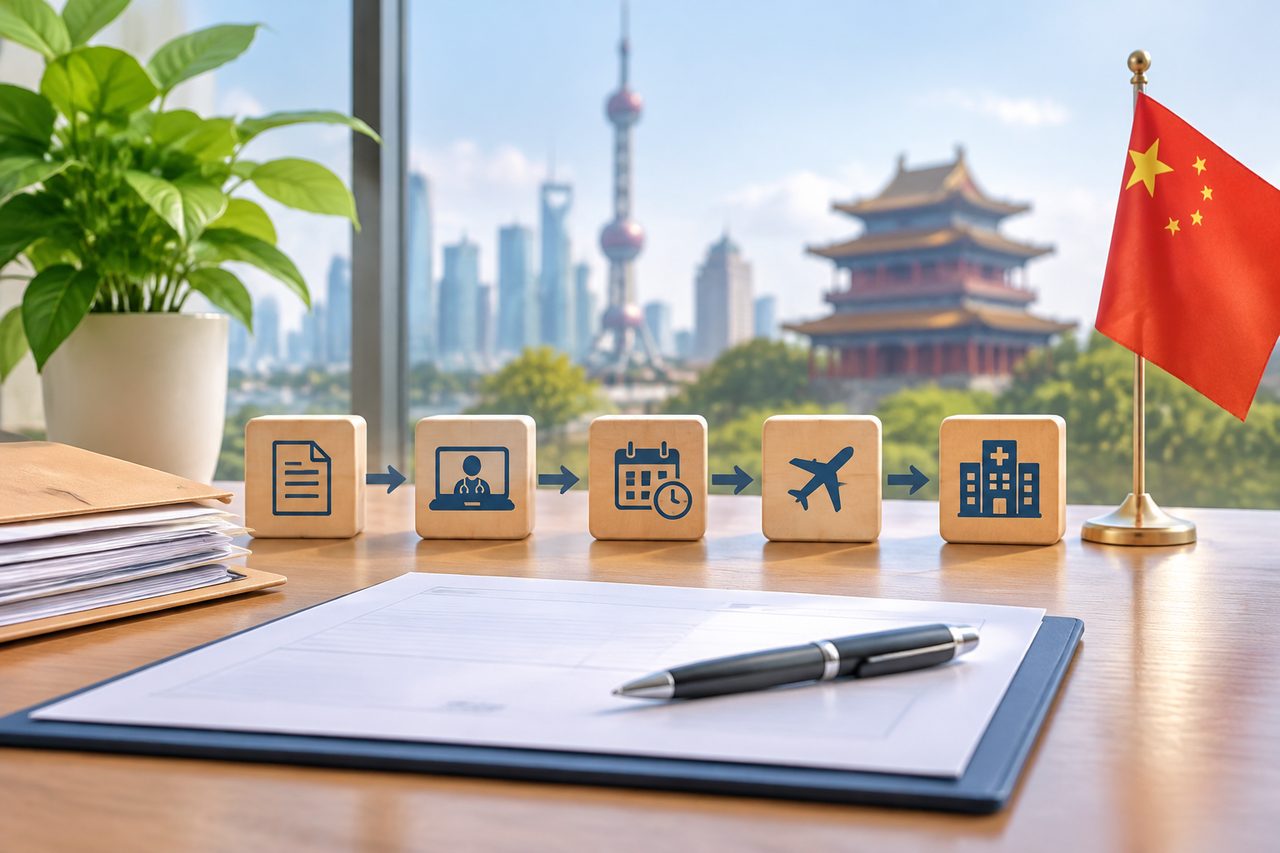
Multiple myeloma care in China follows a staged pathway: gather and translate the existing record, obtain a written hematology second opinion or video consultation, agree on a feasible plan, then coordinate an S2 visa, an appointment through the hospital’s international or VIP channel, and bilingual support on the ground. Treatment itself is delivered by the hospital’s hematology department — not by any agency. The sequence matters because it lets a patient test the quality of the medical conversation before committing to travel, and it matches how Chinese public hospitals actually accept foreign patients.
This guide explains each stage honestly, including the parts that are inconvenient. It is written for patients and families outside China who already have a diagnosis of multiple myeloma, smoldering myeloma or MGUS and are weighing whether to seek evaluation or treatment in China.
The Problem: A Rare Cancer With a Crowded, Expensive Treatment Calendar
Multiple myeloma accounts for roughly 1 percent of all cancers and about 10 percent of hematologic malignancies in Western populations, according to the American Cancer Society’s statistics on multiple myeloma. It is not a disease you can manage with a single appointment. Modern care involves induction therapy, often a triplet or quadruplet regimen, consideration of autologous stem cell transplant in eligible patients, and then continuous or maintenance treatment, with imaging and lab monitoring threaded through every phase.
That calendar is where the friction sits. A patient may be told that a transplant is not recommended, or that a clinical trial slot is unavailable, or that a drug combination is funded only after several lines of prior therapy. Second opinions are common in myeloma precisely because the disease is heterogeneous and because treatment sequencing decisions carry years of consequence. Yet in many systems, a specialist second opinion means another wait of weeks to months, another set of records duplicated, and another insurer conversation.
Cost adds a second layer. Myeloma is among the more expensive cancers to treat over time, not because of one procedure but because of sustained drug exposure and monitoring. Patients searching for alternatives are usually not looking for a miracle; they are looking for a clear, affordable, well-documented plan and a system that will actually see them.
Why China Is a Serious Option for Hematology Evaluation
Volume and specialty depth in hematology
China’s largest academic medical centers run dedicated hematology departments that see plasma cell disorders continuously rather than occasionally. The Fudan University Hospital Rankings publish a specialty reputation list covering 45 specialties, including hematology, with a top ten in each. Being listed in that top ten reflects peer reputation among Chinese specialists, not a global ranking, and it should be read that way. For a patient, the practical value is narrower and more useful: it identifies a shortlist of departments where myeloma is routine work.
Our hospital database covers 340+ top-ranked hospitals across 37 cities, drawn from institutions in the top 5 percent of China’s 35,000+ hospitals as ranked by Fudan and JCI. You can browse the hematology and oncology listings under departments ranked by specialty, or start from the city pages for Beijing and Shanghai, which together host the densest concentration of Fudan Top 100 hospitals.
Diagnostics and drug access within one institution
Myeloma workup requires serum and urine protein electrophoresis with immunofixation, serum free light chain assay, bone marrow aspirate and biopsy with fluorescence in situ hybridization for risk stratification, and low-dose whole-body imaging, typically CT or MRI depending on availability. In a large Chinese academic center these sit within one campus, which shortens the loop between testing and a hematologist’s interpretation. That is an operational advantage, not a claim about superiority.
Drug availability is the question that needs the most careful checking. Novel agents used internationally are not automatically stocked or funded at every Chinese hospital, and access varies by institution and by whether a product is on the national reimbursement list. This is exactly the kind of question a written second opinion should answer before anyone books a flight.
Cost structure, stated carefully
Chinese public hospital charges for diagnostics, bed days and many generic drugs are typically lower than equivalent charges in the United States, largely because of labor economics and centralized procurement. But myeloma care is drug-heavy, and innovative agents can be expensive anywhere. Any figure quoted to you before a hematologist has reviewed your record is a guess. Ask for a written breakdown by component — diagnostics, drugs, bed and nursing, procedures — and treat a single all-in number with suspicion.
How the Multiple Myeloma Care Pathway Actually Works, Step by Step
This is the sequence we use, and it is deliberately front-loaded with low-commitment steps.
Step 1 — Assemble the record. Collect the diagnostic bone marrow report and FISH results, all serum and urine electrophoresis and free light chain results with dates, imaging reports, a medication and treatment history with start and stop dates and responses, and a recent complete blood count, renal panel, calcium and albumin. Scanned PDFs are fine; a photograph of a printed report usually is not.
Step 2 — Written second opinion. The relevant Chinese specialty reviews the translated record and returns written analysis, treatment suggestions and direction. This is a document for your own physicians to discuss with you. It is for reference only and is not a prescription.
Step 3 — Video consultation. If the written opinion raises questions, a video consultation lets you speak with the specialty team directly, describe symptoms and goals, and hear their recommendations in context. A top-specialist video consultation or a multidisciplinary team discussion is available for more complex sequencing questions.
Step 4 — Decide whether to travel. Only after steps 1 to 3 does it make sense to discuss dates, visas and logistics. Many patients stop at step 2 or 3, and that is a legitimate outcome.
Step 5 — Appointment and arrival. If a plan is agreed, we assist with hospital appointment coordination, arrival support and bilingual accompaniment. Admission and scheduling remain subject to hospital rules and the treating department’s judgment.
Hospital Choice, Channel Choice, and Who This Path Does Not Suit
There is no honest single figure. Myeloma costs are dominated by drug choice and number of cycles, and prices differ by hospital, by whether a product is centrally procured, and by channel. Ask for a component-level written estimate after a hematologist has reviewed your record. Service fees for consultations and coordination are billed separately from hospital medical charges, and they are not credited against later treatment costs.
Plans change in myeloma routinely, and that is a clinical decision made by the treating hematologist, not by any coordinator. Before traveling, ask who the named treating physician will be, how after-hours concerns are handled, and what the hospital’s process is for urgent complications. Keep your home hematologist informed throughout so that a return handover is straightforward. We coordinate logistics and communication; we do not provide diagnoses or influence clinical decisions.
Your Next Step
The core message is simple: in myeloma, the medical conversation should come before the travel booking, and a written review of your existing records is the cheapest way to find out whether China adds anything to your options. China Medical Services is a coordination service, not a hospital and not a source of medical advice — we arrange records review, consultations, appointment coordination and bilingual support on the ground. If you would like to start with a records review, you can request a free consultation and our team will explain what to send and what each stage involves. You can also browse the full China Medical Services hospital database to see which cities and departments fit your case.
This article is for general information only and does not constitute medical advice. Multiple myeloma treatment decisions must be made by a qualified hematologist who has reviewed the individual patient’s full medical record.
For more medical information and treatment options in China, visit chinamedservices.com (China Medical Services).
