Nanchang University First Affiliated Hospital: Inside Jiangxi’s Largest Academic Medical Center
Key Takeaways
- Nanchang University First Affiliated Hospital handles over 3.5 million outpatient visits annually across its two massive campuses, making it the undisputed clinical heavyweight of Jiangxi province.
- As a university-affiliated academic center, it integrates research, teaching, and clinical care—meaning treatment protocols are often shaped by the physicians writing China’s national medical guidelines.
- Navigating this hospital without Mandarin fluency is extremely difficult; its sheer scale and fully Chinese-language administrative systems can overwhelm an international patient traveling alone.
- Costs for complex procedures here typically run 70–85% lower than US private-pay rates, but true price transparency requires working through the hospital’s official international liaison channels, not the standard public registration desk.
The Problem: The Global Search for High-Volume, Research-Driven Care Without the Wait
A patient in London waits 18 weeks for a gastroenterology consult. A family in Toronto faces a 14-month queue for orthopedic spine surgery. These are not anomalies. They are the structural reality of public health systems stretched thin across Western nations. When a diagnosis is serious, waiting feels like a gamble. And private alternatives often carry price tags that wipe out savings—$45,000 for a joint replacement in the US, $28,000 in Australia. The search for a third path leads many to look east. But not to the obvious megacities. Some look deeper, to centers where clinical volume meets academic rigor in a less saturated environment. That brings us to a specific question: is there a top hospital in Nanchang China that can actually deliver complex, guideline-driven care comparable to what you would find in Shanghai or Beijing?
The short answer is yes. But the longer answer requires understanding what an “academic medical center” truly means in the Chinese healthcare hierarchy. It is not just a teaching hospital. It is a system where the surgeon who operates on you on Tuesday is the same person publishing the landmark trial that changes clinical practice on Thursday. Nanchang University First Affiliated Hospital sits squarely in that category. Founded in 1939, it has grown into the largest comprehensive hospital in Jiangxi province—a province of 45 million people. It is the clinical engine for Nanchang University’s medical college, ranked among China’s top-tier research institutions. For international patients, this represents a specific value proposition: access to physician-scientists who see rare pathology at scale, without the extreme cost and logistical congestion of Beijing or Shanghai’s most famous names.
Who We Are
We are China Medical Services. We are not a hospital. We do not provide medical treatment, clinical diagnoses, or second opinions ourselves. We are your logistical architects—a team of bilingual coordinators who bridge the gap between you and China’s top-tier medical institutions. Our database covers over 340 top-ranked hospitals across 37 cities, representing the top 5% of China’s 35,000+ hospitals as ranked by the Fudan University hospital rankings and JCI accreditation standards. We handle appointment coordination, medical document translation, visa guidance, bilingual in-person escorting, and post-operative recovery logistics. Our role is to make sure you never stand confused in a 10,000-patient-per-day hospital lobby holding a registration slip you cannot read. We connect you with the right department, the right specialist, and the right pathway—whether that is through a hospital’s international VIP channel or its standard expert clinic. We do this honestly. We tell you what is possible, what is difficult, and what simply cannot be done. Then we make the possible happen.
Why Nanchang University First Affiliated Hospital Delivers Results
Most international patients researching medical travel to China gravitate toward the obvious: Peking Union Medical College Hospital in Beijing, Zhongshan Hospital in Shanghai, West China Hospital in Chengdu. These are extraordinary institutions. But they are also crowded, expensive, and increasingly difficult to access for foreign patients without a six-month lead time. Nanchang University First Affiliated Hospital offers a structurally different equation. It is a top hospital in Nanchang China that competes on clinical outcomes with the national giants, but operates in a city where the cost base—and the competition for specialist time—is significantly lower. This is not a downgrade. It is a strategic alternative.
Clinical Volume That Rivals National Leaders
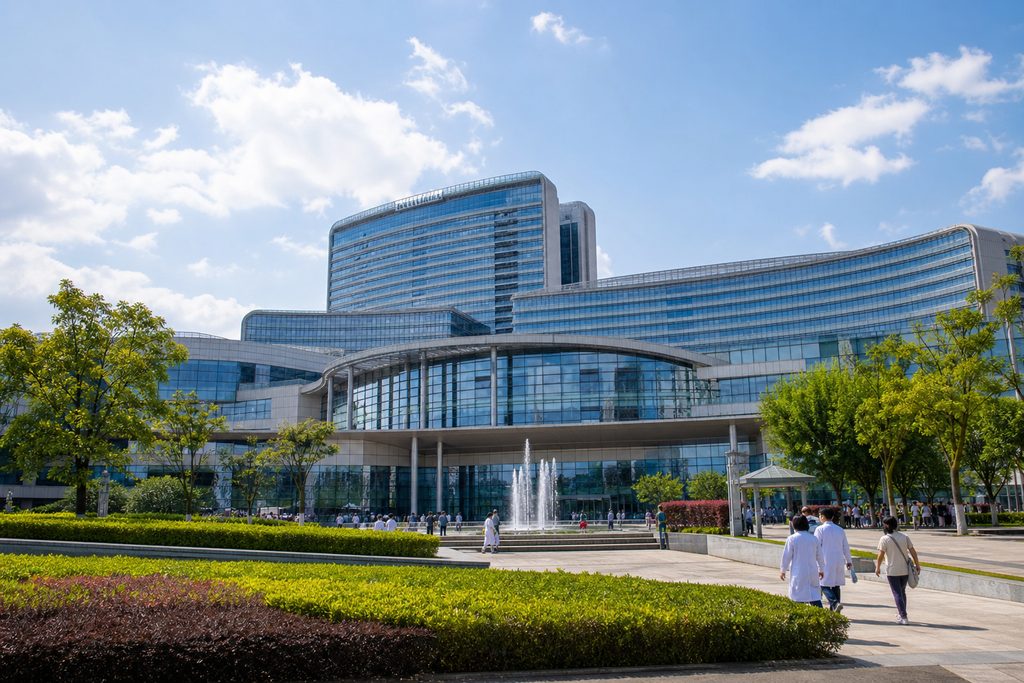
Volume matters in surgery. The relationship between procedural volume and patient outcomes is well-documented across specialties—from Whipple procedures to total knee replacements. Nanchang University First Affiliated Hospital operates two campuses: the original Donghu campus and the newer Xianghu campus, which opened in 2019. Together they house over 6,100 beds. The hospital records more than 3.5 million outpatient visits and over 180,000 inpatient discharges annually. Its surgical volume exceeds 80,000 operations per year. These numbers put it in the same league as many nationally ranked centers. The Department of Gastroenterology alone performs over 60,000 endoscopic procedures annually—a volume that ensures attending physicians have seen and managed virtually every variant of GI pathology. For a patient coming from a system where their specialist might perform a particular procedure 20 times a year, the difference in experiential depth is significant.
The hospital’s burn and plastic surgery unit is a designated national key clinical specialty. Its organ transplant program—covering liver, kidney, and pancreas—is one of the most active in central China. And its cardiovascular medicine department manages one of the largest acute MI intervention programs in the province. These are not niche programs. They are high-acuity, high-volume service lines where outcomes depend on team coordination and accumulated institutional experience.
Academic Infrastructure That Shapes Treatment Protocols
Nanchang University First Affiliated Hospital is not merely a place where doctors practice medicine. It is where they define it. The hospital is directly integrated with Nanchang University’s medical research apparatus. It hosts multiple national-level key laboratories, including facilities focused on translational cancer research and molecular imaging. Its physicians hold editorial positions on major Chinese medical journals. They author the clinical practice guidelines that hospitals across China follow. This matters for an international patient because it means the treatment algorithms applied here are current—often ahead of the published curve. When you consult a specialist at this hospital, you are consulting someone who may have contributed to the evidence base that defines standard care for your condition.
The hospital is also a major clinical trial site. For patients with advanced or refractory disease—particularly in oncology—this opens access pathways to investigational therapies that are not yet available outside China. CAR-T cell therapy trials, novel PD-1 inhibitor combinations, and next-generation targeted agents for EGFR-mutant lung cancers are all active areas of research here. Access requires careful navigation and candidacy evaluation. But the option exists in a way it does not at non-academic centers.
Cost Advantage Without Quality Compromise
Let us address the obvious question directly: is the lower cost a reflection of lower quality? No. The cost differential between Chinese academic hospitals and their Western counterparts is structural, not qualitative. It reflects differences in labor economics, hospital operational models, and pharmaceutical pricing within China’s national procurement system—not differences in surgical skill or technology. A complex liver resection that might cost $120,000 at a US academic medical center can be performed at Nanchang University First Affiliated Hospital for approximately $15,000–22,000. A total hip replacement: $8,000–12,000 compared to $40,000–65,000 in the United States. Cardiac ablation for atrial fibrillation: $6,000–10,000 versus $30,000–50,000.
These are not bargain-basement prices. They reflect the hospital’s standard international patient rates, which are typically 1.5 to 2 times the domestic Chinese rate—a premium that buys English-language coordination, priority scheduling, and private or semi-private inpatient accommodations. The hospital’s international department manages this pricing structure transparently. You receive a detailed cost estimate before travel. You pay upfront. And you receive a formal invoice suitable for submission to your home country insurer for reimbursement. Is this as seamless as direct-billing at a JCI-accredited private hospital in Shanghai? No. But the cost differential is substantial enough that many self-paying patients find the tradeoff acceptable.
What You Need to Know Before Going Alone
We need to be direct about this. Nanchang University First Affiliated Hospital is a public Chinese hospital. It is not designed for international patients. Its systems, signage, registration kiosks, medical records, and discharge instructions are in Mandarin. Its outpatient halls process over 10,000 patients daily. The noise, density, and pace can be overwhelming even for locals. For a foreign patient with no Chinese language ability, attempting to navigate this environment independently is not just difficult—it risks clinical errors, missed appointments, and profound frustration. Here are the specific barriers:
- Hospital Registration Requires a Chinese ID-Linked System: The hospital’s standard outpatient registration system is built on WeChat mini-programs and self-service kiosks that require a Chinese national ID number or a local phone number. Foreign passport holders cannot use these systems independently. Registration must be processed through the hospital’s international department or a third-party coordinator with direct access to the hospital’s VIP scheduling desk.
- No Walk-In Access to Senior Specialists: The public registration channel—the one used by millions of local patients—does not allow you to book a specific named specialist in advance. You register for a department, queue on the day, and see whichever attending physician is assigned. To lock in a specific senior specialist for a pre-scheduled consultation, you must go through the international or special-needs clinic pathway. This requires advance coordination and typically costs 300–800 RMB per consultation, paid upfront.
- Payment Is Prepaid and Cash-Based for Foreigners: The hospital’s standard billing system integrates with Chinese domestic health insurance and Alipay/WeChat Pay. International credit cards are not accepted at the public cashier windows. The international department can process wire transfers or card payments for pre-arranged packages, but walking in with a Visa card and expecting to pay as you go will not work. You need a payment intermediary or coordinator who can front the cash and reconcile later.
- Medical Records Are Not Issued in English by Default: Your inpatient discharge summary, pathology report, imaging reports, and operative notes will be issued in Chinese. Certified English translation requires a separate process—either through the hospital’s medical records department (slow, bureaucratic) or through an external certified translation service coordinated by your liaison. Without this, your home country physician will have no usable documentation of your treatment.
How We Help You Navigate This
These barriers exist for structural reasons—not because the hospital is hostile to foreigners, but because its primary mandate is serving Jiangxi’s 45 million residents. International patients represent a tiny fraction of its volume. The systems simply were not built for you. Our job is to build a bridge.
We start with a free consultation. You tell us your diagnosis, your medical history, and what you are hoping to achieve. We match you with the appropriate department and specialist at Nanchang University First Affiliated Hospital—or, if your condition would be better served elsewhere, we tell you that honestly and recommend an alternative from our network of 340+ hospitals. Once a clinical pathway is agreed upon, we handle everything before you leave home: translation of your medical records into Chinese for the receiving physician, scheduling of your initial consultation with a named senior specialist through the hospital’s international channel, and a detailed cost estimate that covers the consultation, diagnostics, and any planned procedure.
When you arrive in Nanchang, a bilingual medical companion meets you. This person is not a doctor. They are a trained logistics coordinator who speaks fluent English and Mandarin and knows the hospital’s layout, registration workflows, and unwritten rules. They queue for you. They handle payment at the cashier. They sit with you during your consultation and translate in real time—ensuring you understand what the physician is saying and that the physician understands your questions fully. They escort you to blood draws, imaging suites, and pre-operative assessments. They collect your reports and ensure they are translated into English before you leave. After discharge, they coordinate follow-up teleconsultations and ensure your home physician receives a complete, translated medical record.
For patients considering medical tourism packages to Nanchang China, we also handle the non-clinical logistics: airport transfers, hotel or serviced-apartment bookings near the hospital, and visa support documentation. The visa category for medical treatment in China is the S2 visa, annotated for medical purposes. Accompanying family members also apply for S2 visas. We provide the invitation letter and hospital confirmation documents required for the application. We do not process the visa—you apply at your local Chinese embassy or consulate—but we ensure you have exactly the paperwork needed to avoid rejection.
The cost of surgery at Jiangxi largest hospital varies significantly by procedure and complexity. A straightforward laparoscopic cholecystectomy might run $3,000–5,000. A complex cardiac valve replacement could reach $25,000–35,000. Our coordination fee for hospital appointment scheduling starts from $300, and bilingual companion services start from $200 per day. These are separate from hospital charges. We quote our fees transparently before you commit to anything. And any consultation or coordination fees you pay are credited in full toward our on-the-ground coordination service if you proceed with treatment within 90 days—a one-time credit applied to our coordination fee only, never to hospital treatment charges.
Frequently Asked Questions
Yes, particularly for gastrointestinal cancers, hepatobiliary tumors, and certain hematologic malignancies. The hospital’s oncology department is a nationally designated key clinical specialty with active clinical trial programs in immunotherapy and targeted therapy. Its tumor board model brings together surgeons, medical oncologists, radiation oncologists, and interventional radiologists for treatment planning. For rare or highly complex cancers, we sometimes recommend patients also consider dedicated cancer centers in Shanghai or Beijing—and we facilitate that referral if needed. But for common solid tumors managed with guideline-directed therapy, the oncology service here is strong and significantly less costly than comparable Western care.
Formal published reviews from international patients are limited—this hospital does not have the decades-long inbound medical tourism track record of a Peking Union or a United Family. What we observe from our own coordinated cases is consistent: patients report high satisfaction with physician expertise and surgical outcomes, and significant frustration with the administrative and language barriers when they attempt any step independently. The clinical care is excellent. The patient experience infrastructure is thin. That is the honest tradeoff. Our role exists precisely because the hospital’s international service layer is still developing. We fill that gap.
You cannot book a specific senior specialist through the public online registration system without a Chinese ID. The correct pathway is to contact the hospital’s International Medical Service Center directly—or work through a coordinator like us who has an established relationship with that office. The international center can schedule a named specialist consultation, typically with 1–2 weeks’ notice, provided you submit your medical records and imaging in advance for physician review. Walk-in attempts without pre-arrangement will almost certainly fail to connect you with the appropriate specialist.
Nanchang is not a developed medical tourism destination in the way Shanghai or Hainan is. There are no all-inclusive “packages” marketed by the hospital itself. What we construct for our clients is a customized coordination package: specialist matching, appointment scheduling, document translation, airport transfer, accommodation booking near the hospital, daily bilingual companion service during your hospital visits, and post-discharge follow-up coordination. The total cost for our coordination services typically ranges from $2,000–6,000 depending on case complexity and duration, entirely separate from hospital charges. This is not a fixed-price package you can buy off a website. It is built around your specific medical needs.
This is the question every patient should ask. The hospital has standard risk management protocols, an intensive care unit, and emergency response capabilities appropriate for a 6,100-bed academic center. But as a foreign patient, you need to understand that medical liability and recourse operate differently in China than in Western jurisdictions. The hospital carries medical liability insurance, but the claims process is Chinese-language and Chinese-law based. We strongly recommend that all international patients carry their own medical travel insurance with coverage for complications, extended hospital stays, and medical evacuation. We are not a clinical provider and cannot intervene in medical outcomes. What we can do is ensure you are never alone in the hospital without a translator who can escalate concerns to the attending team in real time. In our experience, this proactive communication prevents most of the misunderstandings that lead to poor perceived outcomes.
Your Next Step
Nanchang University First Affiliated Hospital is not the right choice for every international patient. If you need a fully English-language environment with Western-style amenities and direct insurance billing, you are better served at a JCI-accredited private hospital in Shanghai or Beijing—and we can connect you with those options through our private international hospital network. But if you are seeking high-volume, research-driven clinical care from a top hospital in Nanchang China at a cost that makes self-pay treatment feasible, this institution deserves serious consideration. The clinical expertise is real. The barriers are real too. Our job is to handle the barriers so you can access the expertise. If you want to understand what treatment here would look like for your specific situation—cost, timeline, specialist availability—start with a conversation. It costs nothing. It obligates you to nothing. It simply gives you the information you need to make a clear-eyed decision.
Get a free consultation today—tell us your diagnosis and what you are looking for, and we will tell you honestly whether Nanchang University First Affiliated Hospital is the right fit.
For more medical information and treatment options in China, visit chinamedservices.com (China Medical Services).
