Nanjing BenQ Hospital International Patient Service: Taiwan Private Care Near Shanghai
While a cardiac bypass in the United States averages over $120,000, the same procedure at a top-tier Chinese facility can range from $12,000 to $20,000. That is a 90% differential. But cost is only half the equation. For international patients in East China, the real challenge is finding a facility that pairs Western care standards with true linguistic and cultural fluency—without the chaos of a massive public hospital. Nanjing BenQ Hospital occupies this exact niche. It is a Taiwan-managed, JCI-accredited private institution 90 minutes from Shanghai by high-speed rail. Our team at China Medical Services has coordinated care there for dozens of patients from the US, Europe, and Southeast Asia. We know what the hospital’s website does not tell you: how the billing actually works, which departments excel, and what the experience feels like on the ground.
Key Takeaways
- Nanjing BenQ Hospital is a fully JCI-accredited private hospital managed by a Taiwan healthcare group, offering a Western-standard care model within mainland China’s cost structure.
- The hospital’s international patient price list positions major surgeries at roughly 50-70% below US private hospital rates, with transparent package pricing uncommon in Chinese public hospitals.
- While English-speaking staff and Taiwan-trained physicians reduce the language barrier significantly, navigating admission, visa documentation, and specialist scheduling still requires local coordination—this is not a walk-in international department like Bangkok’s top private hospitals.
- Patients should understand that “private care” in China still operates within a distinct regulatory and payment ecosystem; direct insurance billing is possible but limited to specific international insurers, and pre-authorization is non-negotiable.
The Problem: Finding Private, English-Speaking Care in China That Does Not Cost a Fortune
Shanghai has excellent international hospitals. ParkwayHealth, Jiahui, United Family—these names come up in every expat forum. But their pricing is calibrated to the city’s premium commercial insurance market. A straightforward laparoscopic cholecystectomy at a top Shanghai private hospital can run $15,000 to $22,000. An MRI with contrast might bill at $1,200. For patients paying out-of-pocket, or those with high-deductible international plans, these figures are brutal.
The alternative—Shanghai’s famed public hospitals like Zhongshan or Huashan—offers world-class clinical expertise at a fraction of the cost. But their international departments are perpetually overwhelmed. Wait times stretch. Communication often defaults to Mandarin. The patient experience is efficient but industrial. There is a gap. That gap is where Nanjing BenQ Hospital sits: a genuine private hospital with Taiwan-style management, JCI accreditation, and a cost structure that reflects Nanjing’s lower operating expenses rather than Shanghai’s premium market positioning. For patients searching for a Taiwan private hospital near Shanghai cost advantage, this geography-arbitrage model is the core value proposition.
Who We Are
We are not a hospital. We do not provide medical treatment, clinical diagnoses, or second opinions. China Medical Services is a medical concierge organization—we are the logistical bridge between international patients and China’s top 5% of hospitals. Our database covers over 340 ranked institutions across 37 cities. For Nanjing BenQ Hospital specifically, we handle appointment coordination, bilingual medical companion services, visa documentation support, and price list interpretation. We translate the opaque into the actionable. That is our only job.
Why Nanjing BenQ Hospital Delivers a Different Model of Care
The hospital opened in 2008 as a joint venture between BenQ Group—a major Taiwan-based technology and healthcare conglomerate—and mainland investors. This is not a public hospital with a small VIP wing bolted on. It is a purpose-built private facility with 1,000 beds, designed from the ground up around a patient-flow philosophy that prioritizes appointment-based scheduling, private rooms, and physician-patient communication time. The Taiwan connection is the defining feature. Many senior physicians trained or practiced in Taiwan’s hospital system, which itself was heavily influenced by US medical education models. The nursing protocols, the emphasis on patient privacy, the documentation standards—these reflect a Taiwan approach to hospital management that is distinct from mainland China’s high-volume public model.
JCI Accreditation and What That Actually Means for You
A common question we field: is Nanjing BenQ Hospital JCI accredited? Yes. It earned initial Joint Commission International accreditation in 2013 and has maintained it through subsequent re-surveys. JCI is not a marketing badge. It means the hospital undergoes rigorous, unannounced audits of over 1,200 measurable elements covering patient assessment, medication management, infection control, surgical safety checklists, and credentialing. For an international patient, the practical implications are concrete: medication reconciliation happens at every transition point; surgical time-outs are mandatory; informed consent is documented to an international standard. These are the safety nets you assume exist everywhere. They do not. In China’s 35,000+ hospitals, only a small fraction hold active JCI accreditation. Nanjing BenQ is one of them.
The Taiwan-Managed Difference in Daily Operations
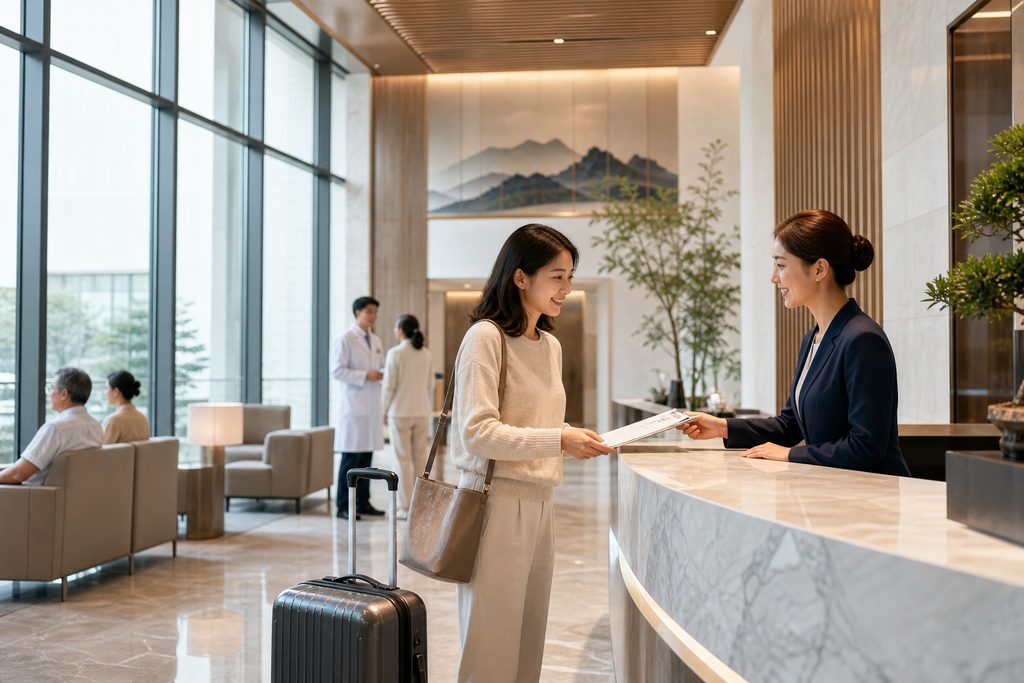
Walk into the hospital lobby. The signage is bilingual Chinese-English. The patient service center handles international registration. The default room is a private single with a dedicated bathroom—not a shared ward you upgrade from. This matters enormously when you are recovering from surgery in a foreign country. The nursing ratio is higher than what you would encounter in a typical Chinese public hospital, where family members are often expected to provide bedside care. At Nanjing BenQ, the nursing staff handles medication administration, wound care, and monitoring directly. Family can be present, but they are not conscripted into caregiving. This is the Taiwan private hospital model: clinical responsibility stays with the clinical team.
Cost Structure: What the Nanjing BenQ Hospital International Patient Price List Reveals
Let us address the search intent directly. Patients looking for a Nanjing BenQ Hospital international patient price list want real numbers. The hospital does publish package pricing for common procedures through its international patient center. These are not estimates—they are fixed-price packages that include surgeon fees, anesthesia, standard hospital stay, and routine medications for the bundled period. Based on cases we have coordinated and publicly available hospital materials, here is what the landscape looks like:
| Procedure | Nanjing BenQ (Package Est.) | Shanghai Private Hospital (Est.) | US Average (Benchmark) |
|---|---|---|---|
| Total Hip Replacement (unilateral) | $14,000 – $18,000 | $28,000 – $38,000 | $40,000+ |
| Laparoscopic Cholecystectomy | $4,000 – $6,000 | $15,000 – $22,000 | $13,000+ |
| Cardiac Catheterization with Stent (1 DES) | $8,000 – $12,000 | $20,000 – $30,000 | $30,000+ |
| Comprehensive Health Screening (Executive) | $800 – $1,500 | $1,500 – $3,000 | $2,500+ |
These figures vary by case complexity and implant selection. A drug-eluting stent from a US manufacturer costs more than a domestic equivalent. But the structural advantage is clear: Nanjing’s real estate, labor, and operational costs are significantly lower than Shanghai’s. BenQ passes that through. For patients researching medical tourism packages Shanghai with Taiwan doctors, the Nanjing option effectively delivers the same clinical philosophy—Taiwan-trained physicians, private-room care, JCI protocols—at a 30-50% discount to Shanghai private hospital pricing. The trade-off is location. You are not in Shanghai. For many of our patients, that trade-off is worth tens of thousands of dollars.
What You Need to Know Before Booking Treatment at Nanjing BenQ Hospital
The hospital’s international patient service is legitimate and well-intentioned. But it is not a fully-globalized intake machine like Bumrungrad in Bangkok. There are friction points that catch patients off guard. Here is what we have learned coordinating cases there:
- Visa Documentation: The hospital can issue a medical treatment invitation letter required for the S2 visa application. But the letter alone does not guarantee visa approval. Chinese consular officers will scrutinize the completeness of your application package—proof of funds, itinerary, accommodation, and a clear treatment plan are all expected. A vague letter stating “patient seeks consultation” is often rejected. The letter must specify the diagnosis, the proposed treatment, and the estimated duration of stay.
- Payment and Deposits: Nanjing BenQ requires a substantial upfront deposit for international patients—typically 50-70% of the estimated procedure cost, wired before admission. This is standard practice in China’s private hospitals and is not a red flag. But it creates a logistical hurdle: international wire transfers take 3-5 business days, and some banks flag large medical payments to China for compliance review. We advise patients to initiate the transfer at least two weeks before their scheduled admission date.
- Insurance Direct Billing: The hospital has direct billing agreements with several international insurers, including major carriers like Cigna, Aetna International, and Allianz. But—and this is critical—direct billing requires pre-authorization from your insurer before treatment begins. If you arrive assuming your insurance will be billed directly without prior approval, you will be asked to pay the deposit out-of-pocket. Always obtain a written guarantee of payment from your insurer before travel.
- Medical Records and Translation: The hospital’s international staff can work with English-language records. But if your records are in German, French, Arabic, or Russian, you will need certified translations. The hospital does not provide this service. Radiology images must be in DICOM format on a CD or USB drive—printed films are not sufficient for surgical planning.
How to Book Medical Treatment at Nanjing BenQ Hospital: The Real Process
Patients searching how to book medical treatment at Nanjing BenQ Hospital often expect an online portal or a simple email exchange. The reality is more involved. The international patient center does accept direct inquiries, and their English-language response time is reasonable—typically 48-72 hours. But the intake process requires you to submit a detailed medical summary, imaging reports, and a clear statement of what procedure or consultation you are seeking. The hospital’s specialists then review your case and determine whether they can accept it. This is not a rejection filter; it is a capacity and scope check. If the required subspecialty is unavailable, or if your case is too complex for their current surgical team, they will decline. That is actually a good sign—it means they are not accepting cases they cannot handle well.
Once your case is accepted, the hospital will issue a treatment proposal with a price quote. This is where the Nanjing BenQ Hospital international patient price list becomes concrete: you will receive a line-item breakdown of surgeon fees, anesthesia, implant costs (if applicable), hospital stay, and estimated medication. Review this carefully. Ask about exclusions. Post-discharge rehabilitation, for example, is typically not included in surgical packages. Nor are complications that extend your stay beyond the standard recovery window. These are standard exclusions in any private hospital package globally, but they must be understood upfront.
After you accept the proposal and wire the deposit, the hospital confirms your admission date. This is when the visa process begins in earnest. The hospital issues the invitation letter. You apply for the S2 visa at your local Chinese consulate. Processing times range from 4 to 10 business days depending on the consulate and your nationality. We have seen US and EU passport holders receive S2 visas in under a week. Applicants from certain countries face longer review periods. Plan for the worst case.
The On-the-Ground Experience: What Treatment Feels Like
You land at Nanjing Lukou International Airport. It is about 40 minutes by car to the hospital. The hospital campus is in the Hexi district, a newer part of Nanjing with wide boulevards and modern infrastructure. It does not feel like the dense, chaotic urban China many first-time visitors expect. Check-in at the international ward is handled by English-speaking admitting staff. Your private room has a sofa bed for a family member, a small refrigerator, and a bathroom with a walk-in shower. Nursing rounds are regular. Physicians round in the morning, and the attending surgeon will visit you pre- and post-operatively with a translator if needed—though many speak functional medical English directly.
For patients seeking the best English speaking hospital Nanjing for foreigners, the answer is nuanced. Nanjing BenQ is almost certainly the top private option. Its English capability exceeds any public hospital in the city. But it is not a fully bilingual environment. Housekeeping staff, some nursing assistants, and the CT technician may speak only Mandarin. This is where a bilingual medical companion becomes valuable—not for grand medical translations, but for the hundred small interactions that make up a hospital day: ordering meals, adjusting the room temperature, confirming medication timing, understanding discharge instructions precisely.
Discharge planning is thorough. The hospital pharmacy fills your discharge medications. You receive a detailed discharge summary in English, along with imaging on CD. Follow-up is scheduled before you leave. The international patient center can help arrange a recovery stay at a nearby serviced apartment if you need to remain in Nanjing for wound checks or early rehabilitation before flying home.
Frequently Asked Questions
You can initiate contact directly, and the international patient center will respond. But “booking surgery” is not how the process works. You submit your medical records. The relevant specialist reviews them. If the case is accepted, you receive a treatment proposal and price quote. Only after you accept and pay the deposit is a surgical date confirmed. This is a medical intake, not a hotel reservation. Expect the review process to take 5-10 business days depending on case complexity and specialist availability.
This is the question every patient should ask. Nanjing BenQ Hospital carries liability insurance and has protocols for managing surgical complications, including transfer to ICU-level care within the facility. The hospital has a blood bank, an interventional radiology suite for emergency embolization, and 24-hour in-house surgical coverage. For ultra-complex complications requiring subspecialty input not available on-site—such as advanced neurosurgical intervention or ECMO—the hospital has transfer agreements with larger centers in Nanjing. Your international insurance should include medical evacuation coverage as a backstop. We strongly recommend this regardless of where you seek treatment abroad.
“Better” is not a useful framing. The difference is in practice style and communication. Taiwan’s medical education system emphasizes patient-centered communication, shared decision-making, and systematic clinical documentation in a way that aligns closely with Western expectations. Mainland China produces extraordinary clinicians, particularly in high-volume surgical fields, but the communication culture in public hospitals is often more hierarchical and less patient-explanatory. At Nanjing BenQ, the Taiwan influence means you are more likely to have a detailed pre-operative discussion, a clear explanation of treatment alternatives, and a discharge conversation you can actually follow. That does not mean the surgeon’s technical skill is superior to a top Shanghai public hospital surgeon—it means the overall experience is more navigable for a Western patient.
Most US domestic health insurance plans—including Medicare and standard employer PPOs—do not provide coverage for elective treatment in China. Some expatriate-focused plans and international health insurance policies do. If you hold a plan from Cigna Global, Aetna International, Allianz Worldwide Care, or similar, Nanjing BenQ can likely bill directly after pre-authorization. Check with your insurer before assuming anything. If your plan reimburses rather than pays directly, you will need to pay the hospital upfront and submit claims yourself. The hospital provides detailed English-language invoices and discharge summaries suitable for insurance reimbursement submission.
Taiwan’s hospitals—such as Taiwan University Hospital or Chang Gung Memorial—are outstanding. But Taiwan has strict regulations on medical tourism from mainland China, and for non-Chinese nationals, the visa process and cost structure differ. Treatment in Taiwan is generally more expensive than at Nanjing BenQ, though still below US prices. The advantage of Nanjing BenQ is geographic: if your life or business is anchored in Shanghai or East China, Nanjing is a 90-minute train ride. Taiwan is an international flight. For a procedure requiring follow-up visits, the Nanjing option is logistically simpler. The clinical philosophy is similar. The cost is lower. But Taiwan offers a deeper bench of subspecialty expertise. For a rare or extremely complex condition, Taiwan may be the better medical choice. For a standard major procedure—joint replacement, cardiac intervention, general surgery—Nanjing BenQ delivers the Taiwan care model without the travel burden.
Your Next Step
Nanjing BenQ Hospital represents a specific and valuable option in China’s healthcare landscape: private, JCI-accredited, Taiwan-managed care at a cost that reflects Nanjing rather than Shanghai. It is not the right fit for every case. But for patients who need predictable pricing, English-speaking physicians, private rooms, and a care model that feels familiar, it fills a gap that few other hospitals in mainland China address. The logistics of getting there—visa, payment, records, scheduling—are navigable with proper preparation. That preparation is exactly what we do. If you are considering treatment at Nanjing BenQ, or if you want to understand whether this hospital matches your specific medical needs, we are here to help you evaluate the option without pressure or obligation.
For more medical information and treatment options in China, visit chinamedservices.com (China Medical Services).
