Organ Transplant Urgent Transfer China: Time-Critical Matching & Transport
Key Takeaways
- China’s organ allocation system now operates under a strictly regulated, computerized national framework — over 50,000 transplants were performed in 2023 alone, creating unmatched clinical volume.
- A time-critical organ transfer demands a pre-established logistical chain: the viability window for a heart is just 4-6 hours, and for a lung, 6-8 hours. Every minute counts.
- International patients face a legally mandated waiting period and cannot simply “book” an urgent transplant. The process requires medical residency in China and a registered need on the national list.
- You are not buying an organ. You are paying for coordination, transport, surgical expertise, and post-operative care. Understanding this distinction is the first step toward a safe, ethical transplant journey.
The Problem: A Clock You Cannot Control
End-stage organ failure does not wait for a convenient moment. In the United States, over 100,000 people currently sit on the national transplant waiting list. Roughly 17 of them die each day. A patient needing a heart in the UK might wait 18 to 24 months. In Canada, the median wait time for a kidney transplant stretches beyond four years. These are not statistics. They are death sentences for people who run out of time.
When a compatible organ becomes available, a brutal biological clock starts ticking. A heart remains viable outside the body for only 4 to 6 hours. A lung, 6 to 8 hours. A liver, 12 to 15 hours. The window is terrifyingly short. For patients and families, the question shifts from “Will I get an organ?” to “Can the organ reach me in time?” This is where the concept of an urgent organ transplant transport China cost becomes a life-or-death calculation, not just a financial one.
Who We Are
We are not a hospital. We do not provide medical treatment, and we absolutely do not source organs — that would be illegal and unethical. Our team at China Medical Services functions as your logistical architects. We bridge the gap between you and China’s most advanced transplant centers. When a patient needs a time-critical organ matching service China demands precision logistics, we step in. We coordinate medical flights, ensure the surgical team is prepared, handle the visa paperwork for the S2 medical visa, and place a bilingual medical companion by your side. We manage the chaos so the surgeons can focus on the organ.
Why China’s Transplant Infrastructure Delivers Results
China performs more organ transplants annually than almost any other nation, second only to the United States in total volume. The China Organ Transplant Response System (COTRS) now governs all allocation. It is a computerized, transparent system. The clinical data behind it matters.
Surgical Volume Sharpens Skill
A transplant surgeon’s outcomes are directly tied to how many procedures they perform each year. At a top-tier Chinese center like the liver transplant program at Renji Hospital in Shanghai, a single team might complete over 800 adult and pediatric liver transplants annually. This is more than many entire countries perform. The result? Surgeons who have seen every possible complication. Anesthesiologists who manage the brutal hemodynamic swings of a transplant with muscle memory. Nursing teams who spot rejection before the labs come back. For a patient exploring how fast can I get an organ transplant in China, the answer lies partly in this institutional experience. Speed is not just about the flight. It is about a team that can execute the implantation flawlessly the moment the organ arrives.
The Logistics of a Medical Flight
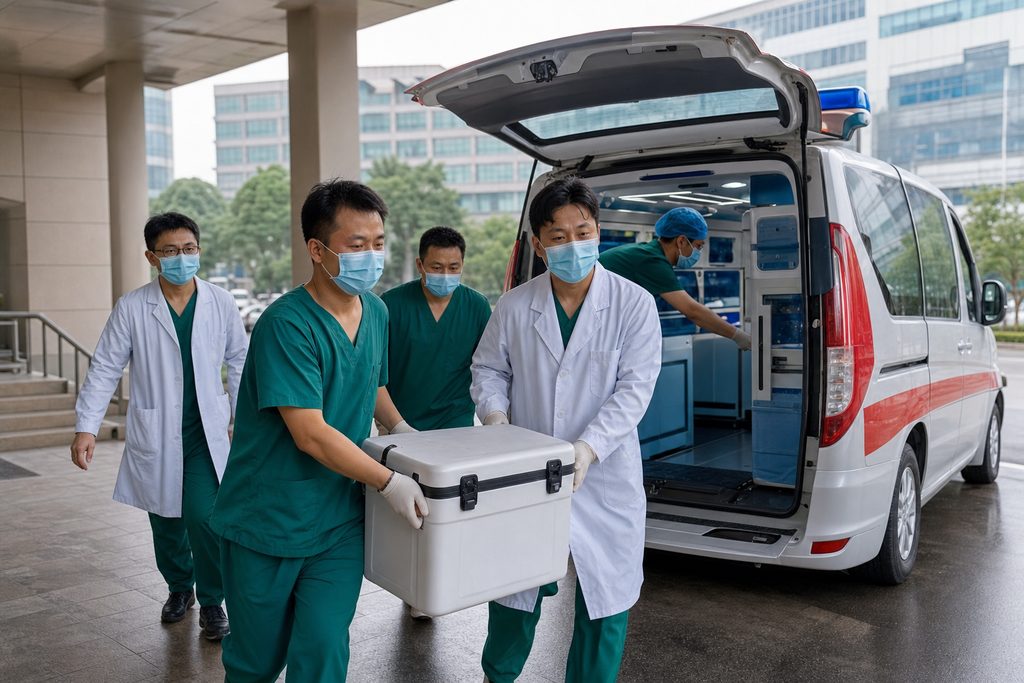
A medical flight for organ transplant China price reflects a complex choreography. The aircraft is not a standard air ambulance. It must be equipped for a dual-patient scenario: the recipient, often critically ill, and the transplant team. The cabin needs intensive care capabilities — ventilators, invasive monitoring, perfusion pumps, and a full pharmacy of immunosuppressants. The flight crew coordinates with air traffic control for priority routing. On the ground, two ambulances run staggered routes: one races the organ from the donor hospital to the aircraft, the other transfers the recipient from the aircraft to the transplant center. We have seen this synchronized dance save a liver with 23 minutes to spare. The cost is significant, but the alternative is unthinkable.
Cost Without Compromise
Let us address the elephant in the room. The urgent organ transplant transport China cost is a fraction of what you would pay in the West, but the reason is structural, not a quality cut. A heart transplant in the United States can exceed $1.6 million before insurance negotiations. In a top-tier Chinese public hospital, the surgical package, including the procedure and initial hospitalization, often falls between $80,000 and $120,000. The medical flight and ground coordination might add another $35,000 to $70,000 depending on distance. The cost difference comes from labor economics, hospital operational efficiency, and a system designed for high throughput. The immunosuppressive protocols are the same. The surgical techniques are the same. The price tag is not.
What You Need to Know Before Going Alone
Arranging this independently is not just difficult — it can be dangerous. We have seen patients arrive in Beijing on tourist visas, expecting a transplant the next week. They are always turned away. The barriers are real and non-negotiable.
- Visa and Legal Residency: You cannot enter China on a tourist visa (L) and receive a transplant. You need an S2 medical visa, which requires a formal invitation and treatment plan from a licensed Chinese hospital. More critically, foreign nationals must establish medical residency and register on the COTRS waiting list. This takes time. Anyone promising to bypass this is lying to you.
- Payment and Financial Clearance: Chinese public hospitals require a substantial deposit before a transplant is scheduled. We are talking about a wire transfer of $50,000 to $80,000 upfront, placed in the hospital’s financial account. International credit cards are often not accepted for these sums. The banking logistics alone can delay a case by a week if not handled correctly.
- The “Matching” Misconception: The international organ transfer China waiting time is not a fixed number. It depends on blood type, tissue compatibility, and the urgency score assigned by COTRS. You cannot pay to jump the queue. The system allocates based on medical urgency and match quality, full stop. Our role is to ensure you are correctly registered and that your case is accurately represented — not to manipulate the list.
How We Help You Navigate This
These barriers exist for good reasons. They protect the integrity of the allocation system. Our job is to navigate them without wasting a single day.
Before you travel, we secure your formal acceptance letter from a JCI-accredited or Fudan-ranked transplant center. We manage the S2 visa paperwork, translating your medical records into the precise format Chinese transplant boards require. We arrange a remote video consultation with the surgical team so you understand the plan before you board a plane. The cost for this initial coordination starts from $800, and if you proceed to ground services in China, that fee is credited in full.
During your transfer, we activate the medical flight protocol. We do not own aircraft — we contract with vetted international air ambulance providers and place a critical care flight nurse on board. Simultaneously, our ground team in China confirms the operating room block, the ICU bed, and the blood bank reserves. A bilingual medical companion meets you at the aircraft door. They do not leave your side through admission, pre-op, and into the recovery unit. They translate every consent form, every lab result, every surgeon’s update. When you are groggy from anesthesia and terrified, they make sure you understand what is happening.
After the transplant, the real work begins. Immunosuppressant levels must be drawn daily. Rejection must be caught early. We coordinate your follow-up appointments and, when you are stable enough to fly home, we arrange the medical repatriation flight and a comprehensive handover to your local transplant team.
Frequently Asked Questions
No. You cannot book urgent organ transplant China packages like a hotel room. This is the hardest truth we have to deliver. You must be physically present in China, medically evaluated, and officially listed on COTRS before an organ can be allocated to you. What we can do is compress the pre-listing evaluation phase — getting your diagnostics, consults, and paperwork completed in days instead of weeks — so you are active on the list as quickly as legally possible.
The medical flight for organ transplant China price typically ranges from $35,000 to $70,000 for a long-haul transfer with a full ICU setup. The surgical package itself varies by organ and hospital: a kidney transplant might run $40,000 to $60,000, a liver $70,000 to $100,000, and a heart $80,000 to $120,000. Our coordination fees, which cover visa processing, hospital liaison, and the bilingual companion, start from $5,000 for end-to-end support. These are estimates. The final figure always depends on your specific medical condition and the hospital’s current fee schedule.
This is a devastating scenario, and it happens. The surgical team assesses the organ on the back table before you are even anesthetized. If the organ is deemed non-viable, the transplant is aborted. The hospital will not charge the full surgical package, though you will still bear the cost of the medical flight, the operating room preparation, and the surgical team’s time. We then reset. You remain at the top of your urgency category on the waiting list, and we prepare for the next match. It is emotionally brutal. We have supported families through it. We will be there for the next call.
Yes, absolutely. China’s organ transplant system is legally open to foreign nationals, provided they follow the same strict allocation rules as Chinese citizens. The days of transplant tourism and paid donors are over. The COTRS system is audited and has been recognized by the World Health Organization for its reforms. You will receive an organ because you are the sickest, best-matched patient on the list — not because you paid the most.
Your Next Step
An organ transplant is the most logistically complex medical journey a human being can undertake. The clock is always against you. China’s transplant centers offer world-class surgical volume and a cost structure that can make the difference between treatment and bankruptcy, but the path to the operating table is paved with regulatory hurdles and paperwork that demand local expertise. You need a team that understands both the medicine and the bureaucracy.
If you or a loved one is facing end-stage organ failure and time is the enemy, let us talk. We will review your medical records, give you an honest assessment of your eligibility for the Chinese transplant system, and outline a timeline. There is no pressure. There is just a conversation about whether this path makes sense for you. Request a free, confidential consultation here.
For more medical information and treatment options in China, visit chinamedservices.com (China Medical Services).
