Orthodox Christian Patient Service in China: Fasting Calendar and Religious Care Support
Key Takeaways
- China’s top hospitals have treated thousands of international patients, yet fewer than 5% have formal protocols for religious dietary needs — planning ahead is essential.
- Orthodox fasting rules (abstaining from meat, dairy, eggs, fish, oil, and wine on designated days) can be accommodated in major Chinese cities, but not by default — you must arrange support before you arrive.
- Beijing and Shanghai each have active Orthodox parishes with clergy who can visit hospitalized patients, a resource most medical travelers never discover.
- Language barriers and hospital kitchen logistics mean bringing a printed fasting calendar and working with a bilingual coordinator dramatically improves outcomes.
The Problem: Navigating Orthodox Fasting While Hospitalized in a Foreign Country
Orthodox Christians observe roughly 180 to 200 fasting days each year. That is about half the calendar. The Nativity Fast alone spans 40 days. Great Lent stretches even longer. During these periods, the faithful abstain from meat, dairy, eggs, and on many days fish, oil, and wine. For a patient recovering from surgery in a Chinese hospital 8,000 kilometers from home, the question is not theological — it is intensely practical. What do you eat when the hospital tray arrives with pork dumplings and you are on day 17 of the Dormition Fast?
No centralized database tracks how many Orthodox patients travel to China for medical care annually. But we know this: China now receives over 300,000 medical tourists each year according to data from the China International Medical Tourism Association. A growing subset comes from Russia, Ukraine, Serbia, Greece, Ethiopia, and Eastern Europe — Orthodox-majority regions. These patients arrive for oncology treatments, cardiac surgeries, orthopedic procedures, and fertility care at hospitals ranked among the top 5% of China’s 35,000+ medical institutions. The clinical outcomes are excellent. The spiritual and dietary infrastructure? That requires deliberate effort.
Chinese hospital kitchens are not designed around the Orthodox liturgical calendar. They were built to serve a domestic patient population where religious fasting means something entirely different — Buddhist vegetarianism, perhaps, or the dietary restrictions of Chinese Muslims. An Orthodox Christian requesting a strict fast-day meal of boiled grains and vegetables without oil will encounter blank stares without preparation. This is not hostility. It is simply unfamiliarity. And it can be solved.
Who We Are
We are not a hospital. We do not provide medical treatment, clinical diagnoses, or spiritual counsel. Our team at China Medical Services functions as logistical architects for international patients — we bridge the gap between you and China’s top-tier hospitals. We coordinate hospital matching, appointment scheduling, visa guidance, bilingual medical companions, and yes, religious dietary accommodation. We have helped Orthodox patients from Russia, Serbia, and Ethiopia navigate fasting periods during hospital stays in Beijing, Shanghai, and Guangzhou. We know which hospitals have international department kitchens that can adapt. We know when to bring in outside meal services. And we know the parish priests who make hospital visits.
Why China Delivers Results for International Patients
Clinical Volume Drives Better Outcomes
Fuwai Hospital in Beijing performs over 14,000 cardiac surgeries annually — the highest volume of any heart center on the planet. A top Chinese orthopedic surgeon completes 200 to 500 joint replacements per year, compared to approximately 65 for the average US surgeon. This pattern repeats across oncology, neurosurgery, and transplant medicine. Volume matters. Studies published in The Lancet and BMJ have repeatedly shown that higher surgical volumes correlate with lower complication rates and better long-term survival. For an Orthodox patient facing a serious diagnosis, the clinical case for China is strong.
Cost Advantage Without Quality Compromise
A cardiac bypass procedure that costs $120,000 or more in the United States runs $12,000 to $20,000 at a top Chinese public hospital. That is roughly one-fifth to one-tenth the price. The cost differential holds across most major procedures. The reasons are structural: lower labor costs, higher patient throughput, and a hospital financing model that does not carry the administrative overhead of American insurance billing. Quality benchmarks at Fudan-ranked hospitals are comparable to Western centers. JCI-accredited international departments add another layer of verification. Lower cost does not mean lower quality here. It means a different economic model.
Technology and Efficiency at Scale
Chinese hospitals operate at a scale that is hard to visualize until you see it. A single public hospital may see 10,000 outpatient visits in a day. The imaging department runs 16 hours straight. Robotic surgery systems from da Vinci are deployed across dozens of hospitals. The efficiency is industrial. For patients, this means shorter waits for diagnostics and surgery dates — often measured in days or weeks, not months. That speed can matter enormously when a condition is progressing.
Orthodox Christian Patient Care Services in Chinese Hospitals
Let us address the central question directly: can an Orthodox Christian receive appropriate spiritual and dietary care during a hospital stay in China? The answer is yes — but only with preparation. No hospital in China advertises an “Orthodox patient program.” What exists instead is a patchwork of resources that a capable coordinator can assemble: hospital international departments with flexible kitchens, outside meal delivery services, and clergy from local Orthodox parishes.
How to Follow Orthodox Fast During Medical Treatment in China
The practical steps are straightforward but require advance work. First, obtain a printed copy of the Orthodox fasting calendar for the year of your travel — in English and, ideally, with simple Chinese translations of key terms like “no meat” (不吃肉), “no dairy” (不吃奶制品), and “fasting meal” (斋饭). Second, communicate your dietary requirements to the hospital’s international patient department at least two weeks before admission. Third, arrange a backup meal source. Here is what each step looks like in practice.
Hospital international departments in Beijing and Shanghai have dealt with Muslim halal requirements, Hindu vegetarianism, and kosher-adjacent requests. Orthodox fasting rules are less familiar but not incomprehensible. The key is specificity. Saying “I need vegetarian food” will get you vegetables cooked in pork broth — because the kitchen staff does not classify broth as meat. You must specify no animal products of any kind, no oil on strict fast days, and no fish with backbones during fasting seasons. A printed card with these restrictions in Chinese characters solves 80% of the problem before it starts.
For backup, meal delivery apps in major Chinese cities now include vegetarian and vegan restaurants that can deliver to hospital rooms. Some specialize in Buddhist temple cuisine — purely plant-based, oil-free dishes that align remarkably well with Orthodox fasting rules. A bilingual medical companion can manage these orders. The cost is modest: roughly $8 to $15 per meal delivered.
Can Orthodox Christians Get Lenten Meals in Chinese Hospitals?
This is the question we hear most often from Orthodox patients considering treatment in China. The short answer: yes, but not from the standard hospital kitchen. Here is the longer, more useful answer.
Standard ward kitchens in Chinese public hospitals serve a set rotation of meals designed for the domestic palate. They are not equipped to handle individual religious dietary requests. The international department or VIP ward is different. These units cater to foreign patients routinely. Their kitchens are smaller, more flexible, and accustomed to special requests. A patient admitted through the international department of Peking Union Medical College Hospital or Shanghai’s Huashan Hospital can reasonably expect the kitchen to prepare simple fast-compliant meals — steamed rice, boiled vegetables, plain congee, fresh fruit — if the requirements are communicated clearly and in advance.
During Great Lent or the Dormition Fast, when the restrictions tighten further, even international department kitchens may struggle. That is when outside food becomes essential. Several Orthodox parishes in China maintain informal networks for this exact situation. Parishioners in Beijing have been known to prepare and deliver Lenten meals to hospitalized Orthodox visitors. This is not a formal service. It is the Church being the Church. But accessing it requires a connection — which a knowledgeable coordinator can facilitate.
Religious Support for Orthodox Patients in Beijing Hospitals
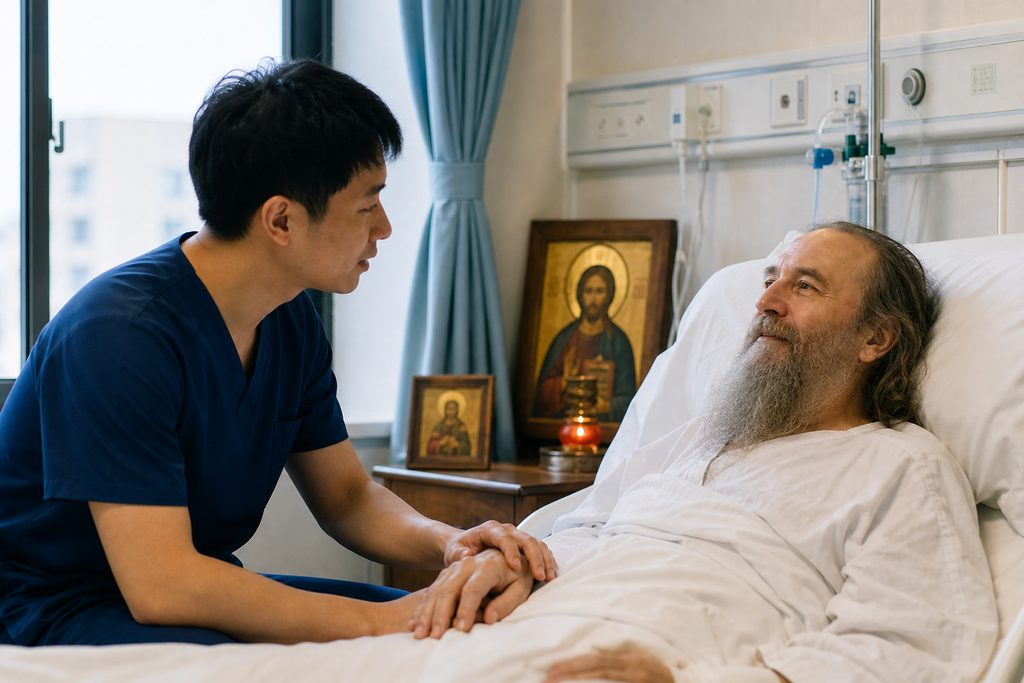
Beijing has two active Orthodox parishes: the Church of the Dormition of the Most Holy Theotokos on the grounds of the Russian Embassy, and the newer Church of the Holy Apostles Peter and Paul. Both have priests who speak Russian and some English. Both have clergy willing to visit hospitalized Orthodox patients for confession, communion, and prayer — provided the hospital permits it.
Hospital access for clergy varies by institution. International departments at major hospitals are generally accommodating. A priest in clerical attire with prior coordination can usually visit a patient’s room without issue. Standard public wards are more restrictive — visiting hours are short, and a foreign priest may draw confused questions from staff. Again, advance coordination with the hospital’s international liaison solves this. We have arranged pastoral visits for Orthodox patients at several Beijing hospitals, and the hospital staff were uniformly cooperative once they understood the purpose.
Shanghai has the Orthodox Church of the Holy Virgin, which serves a small but active community of Russian expatriates and visiting faithful. Guangzhou and Harbin also have Orthodox presences, though smaller. In cities without a parish, a visiting priest may need to travel — which is logistically complex but not impossible.
Orthodox Spiritual Care and Medical Tourism in China
In Beijing, Shanghai, and Harbin, yes — Orthodox priests are available and willing to visit hospitalized patients. In other cities, a priest may need to travel, which requires coordination and may involve travel costs. Hospital permission is generally granted when requested through the international department. We strongly recommend establishing contact with the parish before you travel.
This is a real limitation. Orthodox parishes in China are concentrated in a few cities. In Guangzhou, Shenzhen, Chengdu, or Wuhan, there is no resident Orthodox priest. Patients in these cities rely on prayer books, icons, and potentially a visiting priest if travel can be arranged. Lay Orthodox Christians can and do maintain their prayer rule independently during hospital stays. It is not ideal, but it is possible — and many have done it.
Bilingual medical companion services start from $200 per day. Hospital appointment coordination starts from $300. A full VIP end-to-end coordination package ranges from $5,000 to $8,000, depending on case complexity. These are coordination fees only — hospital treatment costs are separate. Any consultation fee is fully credited toward on-the-ground coordination if you proceed with treatment within 90 days. Final pricing always depends on your specific hospital, procedure, and length of stay.
Your Next Step
Traveling to China for medical treatment as an Orthodox Christian is not a leap into the unknown. It is a journey that thousands have made successfully — with proper preparation. The hospitals are world-class. The cost savings are substantial. The spiritual and dietary support exists, but it must be assembled deliberately. No one will hand it to you on arrival.
If you are considering treatment in China and want to understand how fasting accommodation, clergy visits, and spiritual care would work for your specific situation, speak with our coordination team. There is no charge for the initial conversation. We will tell you honestly what is possible, what is difficult, and what you should expect — so you can make an informed decision.
Frequently Asked Questions
Yes. We work with JCI-accredited and major Grade 3A tertiary hospitals that follow international safety standards comparable to top hospitals in the US and Europe. Surgical teams perform high volumes of procedures — often more than their Western counterparts — which studies show leads to better outcomes.
Costs vary by procedure and hospital, but international patients typically save 40-80% compared to US prices — even when factoring in travel and accommodation. A consultation with our team will give you an exact, all-inclusive quote with no hidden fees.
Send us your existing medical reports. The relevant specialty reviews them and gives you a written opinion, including treatment direction and options, before you commit to any travel. From there you can add a video consultation with the doctor, or have us attend an appointment on your behalf.
For more medical information and treatment options in China, visit chinamedservices.com (China Medical Services).
