Partial vs Total Knee Replacement: Cost, Recovery, and Choosing Right
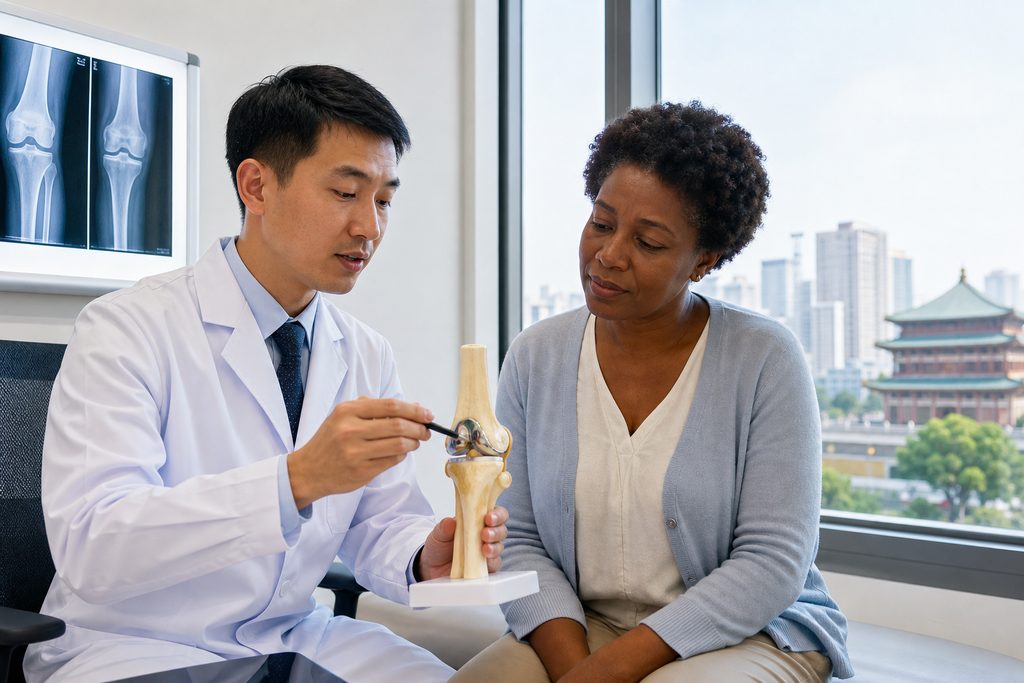
Partial vs Total Knee Replacement: What Is the Difference Between Partial and Total Knee?
A knee replacement does not always mean replacing the entire knee. That is the core answer to the question so many patients ask us: what is the difference between partial and total knee replacement? In a partial procedure — formally called unicompartmental knee arthroplasty — the surgeon resurfaces only the damaged compartment, usually the inner side. A total knee replacement resurfaces all three compartments. The right choice depends on where your arthritis lives.
For international patients weighing partial vs total knee replacement cost China, the distinction matters beyond anatomy. Partial procedures can mean shorter hospital stays and faster early recovery. But they are also less forgiving if arthritis spreads later. Our team at China Medical Services has helped patients from over a dozen countries evaluate both options with Chinese orthopedic departments that perform hundreds of these procedures annually.
So how do you actually decide? Let’s walk through it step by step.
How This Actually Works, Step by Step
You do not fly to China and immediately get surgery. Here is the real sequence.
First, you send us your existing knee X-rays and MRI reports. If the images are older than six months, a Chinese orthopedic team will likely request new standing X-rays — these show joint space narrowing under load. You also complete a brief history: pain location, stiffness pattern, prior injections, and what daily activities hurt most.
Second, the specialist reviews your imaging. This is the critical filter. A partial knee replacement only works when arthritis is confined to one compartment and your ligaments — especially the ACL — are intact. If the X-ray shows bone-on-bone contact in two or three compartments, the conversation shifts to total replacement.
Third, you receive a written assessment. It will state whether you are a candidate for partial, total, or neither. It will also flag any contraindications: inflammatory arthritis like rheumatoid disease, severe deformity, or prior ligament injury usually rule out a partial.
Fourth, if surgery is indicated, we coordinate a video consultation with the treating surgeon. You discuss implant type, surgical approach, and expected recovery milestones. Only after you agree does scheduling begin.
Fifth, we handle hospital registration, admission paperwork, and your S2 visa documentation. You arrive, undergo pre-operative clearance, and have surgery. A bilingual companion stays with you through discharge.
Partial vs Total Knee Replacement Cost China: What the Numbers Show
Cost is where China becomes compelling. A total knee replacement in the United States averages $35,000 to $50,000 before insurance. In China’s top-tier public hospitals, the same procedure typically runs $12,000 to $18,000. A partial knee replacement in China ranges from $10,000 to $15,000, depending on implant brand and hospital tier. Private international hospitals in Shanghai or Beijing charge more — often $25,000 to $40,000 — but offer direct insurance billing and English-speaking staff.
One common misconception: partial is always cheaper. Not necessarily. The implant costs less, but the surgical precision required is higher. Some hospitals price partial and total procedures similarly because operating time and instrumentation differ less than patients expect. Always ask for an itemized quote.
| Procedure | China Public Hospital (USD) | China Private International (USD) | USA Average (USD) |
|---|---|---|---|
| Partial knee replacement | $10,000 – $15,000 | $25,000 – $35,000 | $30,000 – $45,000 |
| Total knee replacement | $12,000 – $18,000 | $28,000 – $40,000 | $35,000 – $50,000 |
Prices vary by hospital and case complexity. Implant choice — ceramic, oxidized zirconium, or standard cobalt-chromium — shifts the quote significantly. Our coordination team obtains written estimates before you commit.
Is Partial Knee Replacement Better Than Total? The Honest Answer
For the right patient, yes. For the wrong patient, it leads to revision surgery within a few years. That is the honest answer to “is partial knee replacement better than total.”
Partial knee replacement preserves your native ligaments and the healthy compartments. Patients report a more natural-feeling knee. Range of motion recovers faster. Many walk without a cane within two to three weeks. The incision is smaller, blood loss is lower, and the risk of major complications like deep vein thrombosis drops.
But the revision rate is higher. Registry data from multiple countries shows partial knees are revised roughly twice as often as total knees at ten years. The reasons vary: arthritis progresses into previously healthy compartments, the implant loosens, or the polyethylene bearing wears. A total knee replacement, while more invasive, is the more durable solution for widespread arthritis.
So the question is not which procedure is universally better. The question is which matches your specific disease pattern.
A Realistic Timeline
Here is what the process actually looks like for an international patient coming to China for knee replacement.
| Stage | What Happens | Typical Duration |
|---|---|---|
| Week 1 | You send imaging and history; we translate documents into Chinese | 3–5 days |
| Week 2 | Specialist reviews imaging; written second opinion issued | 5–7 days |
| Week 3 | Video consultation with surgeon; surgical plan confirmed | 3–5 days |
| Week 4–5 | S2 visa application with hospital invitation letter; travel arrangements | 2–4 weeks |
| Week 6 | Arrival, pre-operative clearance (blood work, ECG, chest X-ray) | 2–3 days |
| Week 6–7 | Surgery and hospital stay | 3–7 days (partial: 2–4; total: 4–7) |
| Week 8–10 | In-country rehabilitation or discharge with home exercise plan | 1–3 weeks |
| Month 3 | Return to normal walking; follow-up X-ray via telemedicine | — |
People forget the document translation step. Chinese hospitals require all foreign medical records translated into Chinese before a specialist will formally review them. That alone can take a week if you have extensive imaging history.
Visa processing is the other variable. S2 visa timelines depend on your home country’s Chinese embassy or consulate. Some process in five business days. Others take three weeks. The hospital invitation letter helps, but it does not guarantee speed.
What Can Go Wrong — and What Happens Then
We would rather you know the failure modes before you book a flight.
The specialist rejects you for partial. This happens in roughly 30% of cases where patients arrive convinced they want a partial. The imaging shows more widespread damage than expected. What then? You either accept a total knee replacement recommendation or pursue non-surgical options. No reputable Chinese orthopedic department will perform a partial on a poor candidate just because the patient requests it.
Your visa is delayed. Surgery dates shift. We work with the hospital to reschedule, but peak seasons — spring and autumn — fill quickly. Booking a flexible travel window reduces this risk.
Intraoperative conversion to total. Rare, but real. If the surgeon opens the knee and finds unexpected damage in another compartment, they convert to a total replacement. You wake up with a different procedure than planned. This is why surgeons discuss both possibilities during informed consent.
Post-operative stiffness. Some patients — especially those who delayed surgery for years — develop significant stiffness. Chinese rehabilitation departments are aggressive with early mobilization. But if you return home too quickly, you miss that structured rehab window. We recommend staying at least two weeks after a partial and three weeks after a total.
Implant recall or specific brand issues. Chinese hospitals use internationally recognized implant systems — Zimmer Biomet, Stryker, DePuy Synthes, Smith & Nephew. Ask which system your surgeon uses and verify it is approved in your home country. This matters for future revision surgery at home.
Unicompartmental Knee Arthroplasty Price Shanghai: What Determines the Quote
Shanghai is where many international patients look first. The city hosts several hospitals with dedicated joint replacement centers, and unicompartmental knee arthroplasty price Shanghai varies more than most people expect.
Three factors drive the quote. First, hospital tier. A public top-ranked hospital like Zhongshan Hospital or Ruijin Hospital charges less than a private international facility like Jiahui or United Family. Second, implant selection. A standard fixed-bearing unicompartmental implant costs less than a custom or robotic-assisted option. Third, whether you use the hospital’s international VIP department — which adds English-speaking coordination and priority scheduling, typically at 1.5 to 2 times the standard rate.
Can you get partial knee replacement abroad? Yes — can I get partial knee replacement abroad is a question we answer frequently. The practical route is remote evaluation first, then travel for surgery. China’s advantage is the combination of surgical volume and price. A surgeon who performs 300 partial knees annually has seen complications a lower-volume surgeon rarely encounters.
Practical Considerations: Records, Visa, Payment, and Follow-Up
Bring standing X-rays, not just supine ones. A supine X-ray hides joint space narrowing. Chinese orthopedic surgeons will ask for weight-bearing AP, lateral, and skyline views. If you do not have them, you will repeat imaging on arrival — which is fine, but it adds a day to your pre-operative workup.
Visa category: S2, with the hospital’s invitation letter noting the purpose as medical treatment. Accompanying family members also apply for S2. We prepare the documentation package, but approval rests with the consulate.
Payment is upfront for public hospitals. You prepay an estimated deposit before admission, and the hospital settles the final bill at discharge. Insurance reimbursement is your responsibility — Chinese public hospitals do not bill international insurers directly. Private international hospitals do, but their prices are higher.
Language is the friction point most patients underestimate. A top Chinese hospital sees 10,000 outpatient visits daily. Signs are in Chinese. Registration kiosks are in Chinese. Nurses may not speak English. A bilingual companion is not a luxury — it is the difference between a smooth admission and a lost afternoon.
Follow-up at home: your surgeon will want X-rays at six weeks, three months, and one year. You can send these digitally for review. Most Chinese joint replacement teams offer telemedicine follow-up for international patients at no additional cost for the first year.
Frequently Asked Questions
Partial knee replacement recovery is faster in the first month. Most patients walk with a cane within two weeks and return to desk work in three to four weeks. Total knee replacement takes longer — expect four to six weeks before walking comfortably without assistance and eight to twelve weeks before returning to more demanding activity. Long-term outcomes at one year are similar for well-selected patients.
Age alone does not disqualify you. The concern is implant longevity. Younger, more active patients wear out implants faster. A partial knee replacement preserves bone stock for future revision, which is why some surgeons prefer it for patients in their 50s with isolated medial compartment arthritis. But if your arthritis is widespread, a total replacement at 55 may serve you better than a partial that needs revision at 62.
Look at volume and specialization. The best indicator is the number of joint replacements performed annually in that department. Ask directly: how many partial knee replacements does this surgeon do per year? A high-volume joint surgeon performs 200 or more total knees annually. For partials, even 50 to 100 per year signals meaningful experience. You can also check whether the department appears on China’s Fudan specialty rankings for orthopedics. Our department rankings list top orthopedic hospitals by specialty reputation.
Usually yes, but confirm before you travel. Some surgeons are reluctant to manage complications from procedures performed abroad. Others are fully cooperative. Bring your complete operative report, implant stickers, and discharge summary. These documents allow any competent orthopedic surgeon to provide ongoing care. If your home surgeon refuses, find one who will — that is a boundary issue, not a medical one.
Yes. Revision knee replacement is more complex than primary surgery and costs more — typically $18,000 to $25,000 in Chinese public hospitals. The same hospital that performed your primary surgery is usually best positioned for revision, since they have your full records and know the implant system. If you prefer revision at home, choose an implant system available in your country.
Your Next Step
Choosing between partial and total knee replacement is a decision your imaging should drive, not your preference. If arthritis is truly isolated to one compartment, a partial offers faster recovery and a more natural feel. If it has spread, a total replacement is the more durable answer. The key is getting an honest assessment from a surgeon who performs both procedures in high volume.
Our team coordinates remote evaluations, video consultations, and on-the-ground support for patients considering knee replacement in China. We do not perform surgery, and we do not promise outcomes. We connect you with experienced orthopedic teams and make the logistics manageable. When you are ready to get a specialist’s read on your X-rays, request a free consultation and we will map out the next step together.
For more medical information and treatment options in China, visit chinamedservices.com (China Medical Services).
