Pediatric Orthopedic Surgery in China: Real Costs, Top Hospitals, and What Parents Need to Know
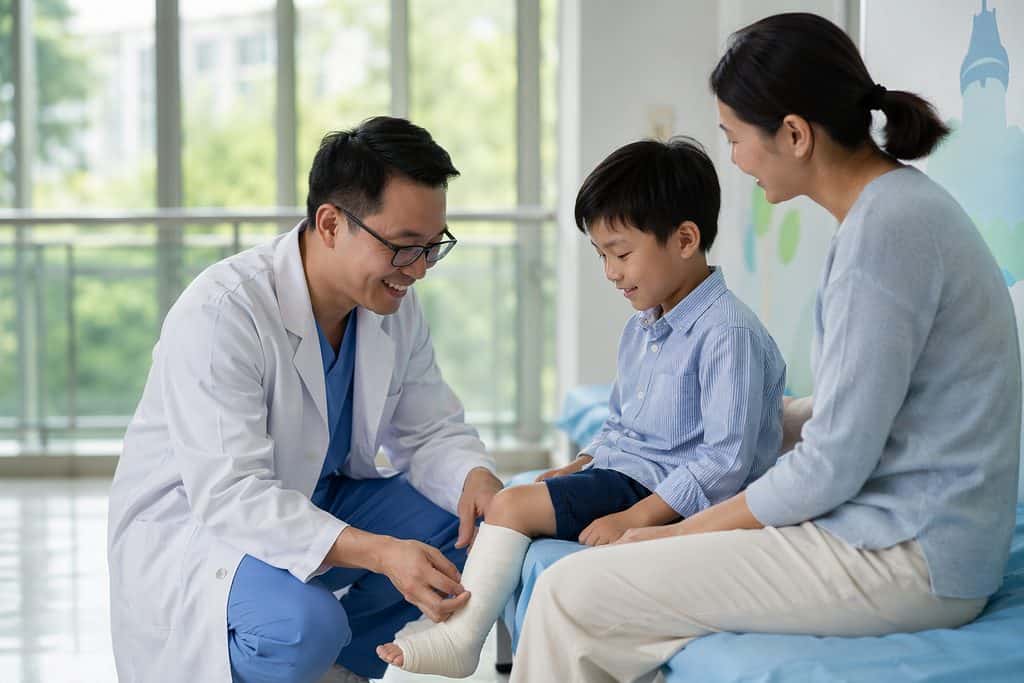
When 6-year-old Sofia was diagnosed with early-onset scoliosis, her parents in London faced a terrifying wait. The National Health Service queue stretched to 14 months for a first consultation. Watching their daughter’s curve progress by the week was unbearable. They started searching for alternatives and found a completely different reality in China. A surgical system built on immense volume, where a single pediatric orthopedic unit might handle more complex spinal fusions in a month than many Western hospitals do in a year. The path isn’t simple. But for families who understand how to navigate it, the combination of speed, surgical volume, and cost creates an option that simply doesn’t exist at home.
Key Takeaways
- Pediatric spinal fusion for scoliosis in a top Chinese public hospital ranges from $18,000 to $35,000, roughly one-fifth to one-tenth of the $150,000+ cost in the United States.
- China’s leading children’s orthopedic centers perform a volume of limb-lengthening and clubfoot procedures that directly correlates with lower complication rates and refined surgical protocols.
- The public hospital system requires an in-person consultation before scheduling surgery. There is no way to book a specific surgery date remotely without going through an international VIP coordination channel.
- Language is a non-negotiable barrier. A bilingual medical companion is not a luxury—it is the difference between a smooth clinical journey and a logistical breakdown at the registration counter.
The Problem: When the Wait at Home Becomes the Real Risk
Scoliosis affects approximately 2 to 3 percent of children globally. Most cases are mild. But for the subset requiring surgical intervention, timing is everything. A curve that progresses past 50 degrees in a growing child doesn’t just threaten posture. It can reduce pulmonary function. In the UK, Canada, and parts of Europe, the wait for a pediatric orthopedic consultation can stretch past a year. Surgery queues add another six to eight months. The scoliosis surgery cost China for kids becomes relevant precisely because families are running out of time.
Clubfoot presents a different urgency. The Ponseti method—serial casting and bracing—works brilliantly when started in the first weeks of life. Delays lead to more invasive surgeries. Limb length discrepancies, whether congenital or post-traumatic, carry their own psychological weight for a child. Waiting until adolescence to address a 4-centimeter leg difference means years of compensatory gait patterns and social discomfort. Parents don’t search for international options casually. They search because the system at home has told them to wait, and their child’s body isn’t waiting.
That’s the real driver. Not medical tourism for its own sake. A parent’s calculation of acceptable risk shifts when the status quo already carries a cost.
Who We Are
We are not a hospital. We do not provide medical treatment or clinical diagnoses. Our team at China Medical Services functions as your logistical architects—we bridge the gap between your family and China’s top-tier pediatric orthopedic expertise. We maintain a database of 340+ top-ranked hospitals across 37 cities, representing the top 5 percent of China’s 35,000+ medical institutions as ranked by the Fudan University Hospital Rankings and JCI accreditation standards. We handle hospital matching, appointment coordination, bilingual medical companionship, and visa guidance. We don’t make clinical decisions. We make sure you get to the right surgeon, understand every step, and never stand alone at a hospital counter holding the wrong paperwork.
Why Pediatric Orthopedic Surgery in China Delivers Results
Clinical Volume Drives Better Outcomes
There is a blunt, well-documented truth in orthopedic surgery: volume predicts outcomes. A 2022 analysis in The Lancet examining surgical case volumes across multiple countries found that hospitals performing more than 100 spinal deformity corrections annually had significantly lower revision rates than lower-volume centers. Many top-tier Chinese pediatric orthopedic departments operate at this threshold monthly, not annually.
Consider the numbers. A surgeon at the best pediatric orthopedic hospital Beijing can offer might complete 150 to 250 scoliosis fusions in a year. The average U.S. pediatric orthopedic surgeon performs roughly 20 to 30 spinal fusions annually. This isn’t a slight against Western surgeons. It’s a structural reality. China’s centralized hospital system funnels complex cases to a small number of high-volume centers. The repetition breeds refined technique. For parents, that translates to a surgical team that has seen your child’s condition—not once this quarter, but three times this week.
Technology and Efficiency at Scale
China’s top pediatric orthopedic units have invested heavily in intraoperative neuromonitoring, 3D-printed surgical guides, and navigation systems that reduce screw misplacement rates. The workflow is unlike what most Western parents expect. A pre-operative workup that might take three outpatient visits spread over two months in the U.S. often gets compressed into a single three-day inpatient admission. Blood work, imaging, pulmonary function tests, and cardiology clearance happen back-to-back.
This efficiency isn’t magic. It’s a system designed for throughput. The trade-off is that the pace can feel overwhelming. That’s where a bilingual companion becomes essential—not just for translation, but for helping a family understand what’s happening at each compressed step. The technology is world-class. The patient experience without guidance is disorienting.
Limb lengthening procedures illustrate this well. The shift from external fixators to internal magnetic lengthening nails (like the PRECICE system) has transformed recovery. Chinese orthopedic centers now routinely use these techniques. The question patients ask—is limb lengthening surgery safe in China—deserves a direct answer. In JCI-accredited and Fudan-ranked top-tier hospitals, the safety profile mirrors international benchmarks. The key variable isn’t the country. It’s the specific hospital and surgeon. A low-volume center anywhere carries higher risk. Our job is to steer you exclusively to the high-volume ones.
Cost Advantage Without Quality Compromise
Let’s address the elephant in the room directly. The scoliosis surgery cost China for kids ranges from $18,000 to $35,000 in a top public hospital’s international department. That includes the implant system, surgeon fees, anesthesia, and a 7- to 10-day inpatient stay. The same procedure in the United States typically runs $150,000 to $250,000. Even with airfare, accommodation, and our coordination services, families often spend 70 to 85 percent less.
Does lower cost mean lower quality? No. The structural reasons are mundane. Lower physician salaries relative to the U.S. (though top Chinese surgeons are well-compensated by local standards). Lower administrative overhead. Higher patient volumes spreading fixed costs. Implant costs that are lower when sourced through hospital tendering systems that purchase at scale. The clinical outcome data from China’s top-ranked pediatric orthopedics departments is published in peer-reviewed international journals and stands up to scrutiny.
What is the price of scoliosis treatment in Shanghai specifically? Shanghai’s top children’s hospitals, such as the pediatric orthopedic center at Xinhua Hospital affiliated with Shanghai Jiao Tong University, fall within the $20,000 to $30,000 range for a standard posterior spinal fusion. Complex revision cases or neuromuscular scoliosis run higher. These are real numbers families can budget against, not abstract estimates.
What You Need to Know Before Going Alone
We want to be completely direct about what you face if you attempt to arrange treatment independently. These barriers are real. Knowing them upfront saves heartbreak later.
- Visa Requirements Are Specific and Unforgiving: Medical treatment in China requires an S2 visa, annotated specifically for medical purposes. Accompanying family members also need S2 visas. The M visa is for commercial business and will be rejected if the stated purpose is medical treatment. Embassy officers scrutinize the invitation letter from the hospital. Obtaining that letter without a local contact is difficult. Public hospital international departments can issue them, but only after you have a confirmed consultation—and you can’t get a consultation without being in the country for many departments. This circular problem stops many families cold.
- The Public Registration System Was Not Built for Foreigners: China’s public hospitals use real-name registration linked to a Chinese ID or passport. The online booking platforms are in Chinese. Payment systems like WeChat Pay and Alipay often reject foreign credit cards. Even arriving at the hospital, you’ll face a queue system that assumes you know which window handles international patients. One wrong queue means an hour lost and a missed appointment slot. We’ve seen it happen.
- Medical Records and Imaging Must Be Properly Prepared: Chinese surgeons expect a specific format for outside medical records. Scattered PDFs and CDs from multiple providers won’t work. Full-spine standing X-rays, bending films, and MRI images need to be organized, translated where relevant, and presented in a way that allows a surgeon to make a surgical decision in a 15-minute consultation. Getting this wrong means the surgeon can’t give you a definitive answer, and you’ve traveled 6,000 miles for ambiguity.
How We Help You Navigate This
The barriers we just described exist for structural reasons. They aren’t personal. They also aren’t going away. What changes the equation is having someone on the ground who has solved these problems hundreds of times before.
Before you travel, we translate and format your child’s complete medical dossier—imaging, clinical notes, prior surgical reports—and present it to the appropriate department head at a hospital matched to the specific condition. We don’t send a generic inquiry to a general orthopedics department. We know which surgeon at which hospital specializes in congenital scoliosis versus neuromuscular scoliosis versus idiopathic adolescent curves. We secure the invitation letter needed for the S2 visa application and walk you through the consular process step by step.
On the ground, our bilingual medical companions meet you at the hospital entrance. They handle registration, queue management, payment processing, and real-time translation during the consultation. When the surgeon explains the fusion levels, the implant choice, and the neuromonitoring plan, you hear it in English—not a garbled translation app approximation. During the post-operative stay, they help you communicate with nursing staff, understand medication schedules, and navigate the discharge process. If you’re exploring the possibility to book limb correction surgery China package through a coordinated channel, this is the infrastructure that makes it possible—not a website checkout, but a human-managed process of hospital coordination, schedule alignment, and pre-operative clearance.
After discharge, we don’t disappear. We arrange follow-up imaging if needed, facilitate communication with the surgeon for post-operative questions, and help with the documentation required for continued care back home. Our video consultation services, starting from $100, allow for remote follow-up with the same surgical team. Any consultation fee is credited in full toward on-the-ground coordination services within 90 days, should you decide to return for a planned second-stage procedure or a sibling’s treatment.
Recovery timelines vary, but families often ask how long is recovery for clubfoot surgery abroad. For the Ponseti method’s tenotomy—a minor percutaneous procedure—recovery is measured in weeks of casting, not months. For more extensive posteromedial releases in older children with neglected clubfoot, expect a 6-to-8-week casting period followed by bracing. We help you plan accommodation accordingly, whether that means a short stay near the hospital or a longer-term serviced apartment for the casting phase. The logistics are manageable when they’re mapped out in advance.
Frequently Asked Questions
You can get a detailed estimate with a narrow range, but not a fixed price. Why? Because the surgeon needs to see your child in person, review imaging, and assess factors like curve rigidity and pulmonary function before finalizing the surgical plan. The implant system choice and number of fusion levels affect cost. What we provide is a binding estimate based on your pre-submitted records, and we flag any variables that could shift the final number. Families typically find the final cost lands within 10 to 15 percent of the estimate.
In a top-tier pediatric orthopedic center with a dedicated limb reconstruction unit, the safety profile is comparable to major Western centers. The critical factor is the surgeon’s specific experience with the technique being used—whether external fixation or internal lengthening nails—and the hospital’s protocol for monitoring for complications like pin-site infections or premature consolidation. We only match families to surgeons who perform these procedures at high volume and who publish their outcomes. The procedure is safe when those conditions are met. It carries unacceptable risk in low-volume settings. Our entire value is ensuring you never end up in one.
This is the hardest question, and it deserves a direct answer. China’s top hospitals have ICU capabilities, infection control protocols, and revision surgery expertise that meet international standards. A surgical complication would be managed by the same team that performed the index procedure, with full access to the implant system and institutional resources needed. That said, you are far from home. The emotional weight of managing a complication in a foreign country is real. We stay with you throughout. We facilitate communication with the care team, help you understand the clinical situation without language distortion, and coordinate with your home-country physician if transfer of care becomes necessary. We cannot eliminate risk. We can ensure you never face it alone in a system you don’t understand.
We rely on the Fudan University Hospital Rankings, which evaluate China’s hospitals by specialty reputation. For pediatric orthopedics, Beijing Children’s Hospital and Peking University Third Hospital consistently rank among the top in the nation. The ranking methodology surveys thousands of clinicians and assesses clinical volume, outcomes, and academic output. We cross-reference this with JCI accreditation status and our own experience coordinating cases. A hospital that ranks well on paper but has a dysfunctional international patient office creates a miserable experience. We know which ones work smoothly. That institutional knowledge is what you’re paying for when you work with us—not just a list of names you could Google yourself.
Your Next Step
This is not a decision to make lightly. Putting your child through major orthopedic surgery thousands of miles from home requires a level of trust that no website can earn by itself. What we can offer is transparency: real costs, real hospital names, real descriptions of what the experience is like—including the hard parts. We’ve walked this path with families from London, Dubai, Moscow, and Sydney. The common thread is that they were out of time and out of acceptable options at home. They found a solution here. Your next step is a conversation. Tell us about your child’s condition, send the records you have, and we’ll tell you honestly whether a Chinese pediatric orthopedic center makes sense for your specific situation. No pressure. Just information, clearly delivered. Visit our patient coordination page to start that conversation.
For more medical information and treatment options in China, visit chinamedservices.com (China Medical Services).
