Pediatric Tracheostomy Care in China: Complex Airway Support for Ventilator-Dependent Children
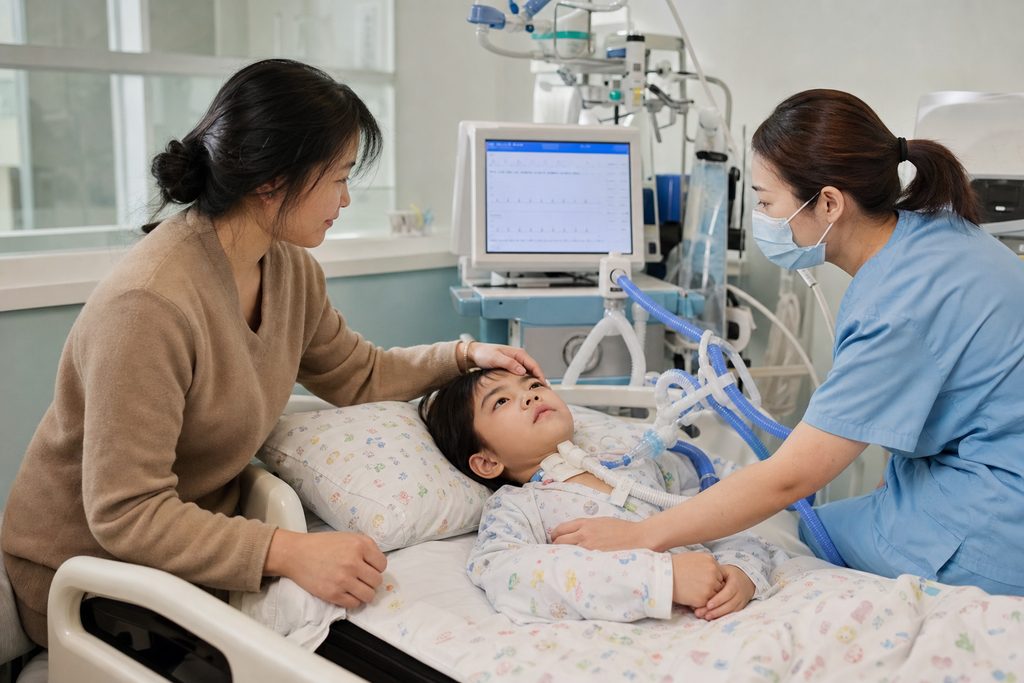
In the United States, a single uncomplicated pediatric tracheostomy can generate hospital charges exceeding $400,000, with home ventilator care adding another $5,000 to $10,000 per month. At Shanghai Children’s Medical Center, our team has coordinated comprehensive surgical and rehabilitation packages that reduce that financial load by an estimated 60% to 75%, without cutting corners on clinical quality. The gap is stark. And for families watching a child struggle with a compromised airway, the math matters less than the outcome. What matters most is finding a team that can handle the complexity.
Key Takeaways
- China’s top children’s hospitals perform a high volume of complex airway reconstructions annually, with ventilator weaning protocols that match international best practices.
- The all-in cost for pediatric tracheostomy and initial ventilator care in China typically ranges from $18,000 to $45,000 — a fraction of Western pricing for comparable clinical pathways.
- Language barriers and hospital navigation are real obstacles. Without a bilingual medical coordinator, the logistical friction can delay care and increase stress for international families.
- Long-term support for a ventilator-dependent child requires a clear discharge plan, home equipment sourcing, and follow-up telehealth — all of which must be arranged before you leave your home country.
The Problem: When a Child’s Airway Requires Lifelong Vigilance
Approximately 4,800 pediatric tracheostomies are performed each year in the United States. A significant subset of those children become ventilator-dependent, requiring round-the-clock respiratory support and a care ecosystem that most families never anticipated needing. The financial strain is immediate. The emotional toll compounds every month.
Parents quickly discover that their local health system may excel at the acute surgical phase but falter on the long arc of rehabilitation. Wait times for a pediatric pulmonology follow-up can stretch to three or four months in parts of Canada and the UK. Home nursing coverage for ventilator-dependent children is patchy, even in well-resourced countries. Families burn through savings. They leave careers. They search for alternatives that do not force them to choose between clinical quality and financial survival.
Who We Are
We are not a hospital. Our team at China Medical Services does not provide medical treatment, clinical diagnoses, or direct patient care. We function as your logistical architects — bridging the gap between your family and China’s 340+ top-ranked hospitals across 37 cities. We handle hospital matching, appointment coordination, bilingual medical companion services, visa guidance, and accommodation planning. When a family contacts us about pediatric tracheostomy care cost China options, we start by understanding the child’s specific airway pathology, ventilator dependency level, and long-term rehabilitation goals. Then we map those needs to the right clinical team.
Why China Delivers Results for Complex Pediatric Airway Cases
China’s pediatric tertiary hospitals manage airway cases at a volume that is difficult to replicate in most Western centers. That volume translates into procedural fluency. A surgeon who performs 80 pediatric tracheostomies annually — not an unusual caseload at a top Chinese children’s hospital — has encountered and managed the rare complications that a lower-volume surgeon might see once in a career.
Clinical Volume Drives Better Outcomes
Consider the data. A 2021 multi-center study published in the International Journal of Pediatric Otorhinolaryngology found that hospitals performing more than 50 pediatric tracheostomies per year had significantly lower rates of accidental decannulation and tracheocutaneous fistula formation compared to lower-volume centers. Several Chinese hospitals in our network exceed that threshold comfortably. Shanghai Children’s Medical Center and Beijing Children’s Hospital each manage large cohorts of children with congenital airway anomalies, acquired subglottic stenosis, and prolonged ventilator dependency. Their multidisciplinary airway teams include pediatric otolaryngologists, pulmonologists, intensivists, speech-language pathologists, and dedicated tracheostomy nurse specialists — a configuration that mirrors the top programs at Boston Children’s or Great Ormond Street, but at a substantially different price point.
Technology and Efficiency at Scale
What makes a complex airway child support program Shanghai effective is not just the surgery. It is the integrated pathway that begins before the first incision and extends months beyond discharge. In practice, this means a child arriving for tracheostomy receives a preoperative airway endoscopy, a coordinated surgical plan that may include simultaneous supraglottoplasty or laryngotracheal reconstruction if indicated, and a ventilator management protocol tailored to the child’s pulmonary mechanics.
Post-operatively, the child transitions to a dedicated pediatric respiratory care unit where nurses are trained specifically in tracheostomy tube changes, cuff pressure management, and early mobilization with portable ventilators. The weaning process is protocol-driven — daily spontaneous breathing trials, progressive reductions in pressure support, and continuous capnography monitoring. This is not fundamentally different from what a top Western PICU offers. The difference is the cost structure that makes a three-week inpatient weaning admission financially feasible for an international family paying out of pocket.
Cost Advantage Without Quality Compromise
The pediatric tracheostomy care cost China advantage is real, but it requires honest framing. A full surgical admission with tracheostomy placement, initial ventilator management, and a two-week inpatient stay typically ranges from $18,000 to $30,000 at a top-tier Chinese public hospital’s international department. Complex cases requiring concurrent airway reconstruction may reach $40,000 to $55,000. Compare this to the United States, where the same episode can easily exceed $400,000 in billed charges, or to the UK where NHS wait times for non-emergency pediatric airway surgery can extend beyond six months.
Lower cost does not mean lower quality. It reflects structural economics: lower physician and nursing labor costs, higher patient throughput, and hospital-owned equipment that eliminates the facility fees that dominate Western hospital bills. Clinical outcomes for pediatric tracheostomy at major Chinese centers are tracked and published. Infection rates, decannulation success rates, and readmission metrics are comparable to international benchmarks.
What You Need to Know Before Going Alone
Arranging pediatric airway surgery in China independently is possible in theory. In practice, the barriers are significant and can delay care for weeks or months. We want families to understand these challenges clearly before they commit to the journey.
- Visa Requirements: Medical treatment in China requires an S2 visa with a treatment purpose annotation. The application demands a formal invitation letter from the treating hospital, confirmed admission dates, and documentation of the child’s condition. Most hospitals will not issue this letter until a face-to-face consultation has occurred — creating a circular problem that our team resolves by coordinating a preliminary video consultation and securing the documentation through the hospital’s international department.
- Hospital Registration Systems: Chinese public hospitals do not allow international patients to pre-book surgeries through their general outpatient departments. Walk-in registration is the norm for domestic patients. International families must navigate the hospital’s VIP or international medical department, which operates on a different scheduling system entirely. Without local representation, you cannot secure a surgical slot before arriving.
- Equipment and Supply Continuity: A ventilator-dependent child requires specific tracheostomy tubes, suction catheters, humidification systems, and backup ventilators. Chinese hospitals stock domestic brands that may differ from what your child uses at home. Ensuring supply compatibility, sourcing equivalent devices, and arranging export-compatible equipment for the return journey requires advance coordination that most families cannot manage remotely.
How We Help You Navigate This
These barriers exist for structural reasons, not because anyone intends to obstruct care. Our role is to clear the path. When a family contacts us about ventilator dependent child treatment in China, we begin with a detailed intake: the child’s diagnosis, current ventilator settings, airway anatomy, previous surgeries, and rehabilitation goals. We translate and format these records for review by the relevant department heads at our partner hospitals.
Once a clinical team accepts the case, we coordinate a video consultation — priced from $100 to $300 depending on the specialist level — so the family can speak directly with the surgeon and intensivist before traveling. That consultation fee is fully credited toward our coordination service if the family proceeds with treatment within 90 days. We then manage the invitation letter, visa documentation, hospital admission scheduling, airport transfer, and accommodation near the hospital. During the inpatient stay, our bilingual medical companions attend rounds, translate care discussions, and ensure the family understands every decision. After discharge, we arrange equipment for the journey home and coordinate a telehealth follow-up with the treating team.
The goal is continuity. A child who arrives intubated and dependent should leave with a stable airway, a calibrated home ventilator, and parents who feel competent to manage the tracheostomy. That outcome depends as much on coordination as on surgical skill.
Frequently Asked Questions
The clinical protocols are fundamentally similar — preoperative assessment, surgical technique, post-operative ventilator management, and weaning pathways follow international guidelines. The tangible differences are scale and cost. Chinese children’s hospitals manage higher patient volumes, which builds deep clinical experience among the nursing and medical teams. The facilities in international departments are modern, with private rooms, parent accommodation, and English-speaking staff. The less tangible difference is the pace: decisions happen faster, discharge planning starts earlier, and the system is designed for throughput rather than prolonged inpatient stays.
For a complete episode — tracheostomy surgery, initial ventilator setup, two to three weeks of inpatient weaning, and discharge equipment — families should budget $25,000 to $45,000 at a top-tier Chinese hospital’s international department. This is an all-in estimate covering hospital charges, physician fees, and standard respiratory therapy. It does not include international flights, accommodation for accompanying family members, or extended rehabilitation beyond the initial admission. Cases requiring concurrent laryngotracheal reconstruction may reach the higher end of that range. Compared to the $400,000+ billed charges for a comparable admission in the United States, the savings are substantial even after accounting for travel costs.
Several centers stand out. Shanghai Children’s Medical Center, affiliated with Shanghai Jiao Tong University School of Medicine, runs a dedicated pediatric airway program with integrated ENT, pulmonology, and intensive care teams. Beijing Children’s Hospital, part of the National Center for Children’s Health, manages one of the largest cohorts of tracheostomy-dependent children in the country. Both hospitals are ranked among China’s top pediatric facilities and maintain international departments equipped for foreign families. The right choice depends on the child’s specific airway anatomy, comorbidities, and whether additional reconstruction procedures are needed. We help families match their case to the appropriate surgical team rather than defaulting to the most famous name.
Many children can, but not all. The weaning trajectory depends on the underlying reason for ventilator dependency. Children with isolated upper airway obstruction who receive a tracheostomy often wean within days to weeks. Children with chronic lung disease, neuromuscular disorders, or central hypoventilation syndromes may require prolonged weaning over months, or may remain ventilator-dependent long-term. The Chinese hospitals we work with will give an honest prognosis during the initial video consultation. They will not promise a weaning timeline they cannot deliver.
This is the question every parent should ask. Our team arranges a structured handover to the child’s home medical team before discharge, including translated discharge summaries, ventilator settings, and a direct contact pathway for the treating surgeon. We coordinate at least one post-discharge telehealth follow-up, typically at the two-week mark. If an urgent airway issue arises — a plugged tube, accidental decannulation, or signs of infection — the family must present to their nearest emergency department immediately. No remote consultation can manage an acute airway emergency. The Chinese team remains available for non-urgent follow-up questions, but emergency care must happen locally.
Your Next Step
A child with a complex airway needs more than a surgeon. They need a system that holds together from the first consultation through the flight home. China’s top pediatric hospitals offer that system — high surgical volume, integrated rehabilitation, and a cost structure that makes long-term ventilator care financially sustainable for families paying out of pocket. The challenge is accessing it without getting lost in translation.
If your child is tracheostomy-dependent or facing airway surgery, and you want to understand your options in China, our team is ready to walk you through the specifics of your case. There is no cost for the initial conversation, and no pressure to commit. Visit our patient coordination page to start a free consultation. We will help you determine whether this path makes sense for your family — clinically, logistically, and financially.
For more medical information and treatment options in China, visit chinamedservices.com (China Medical Services).
