Personalized Cancer Vaccine Trial Access Service China: Neoantigen Therapy Coordination
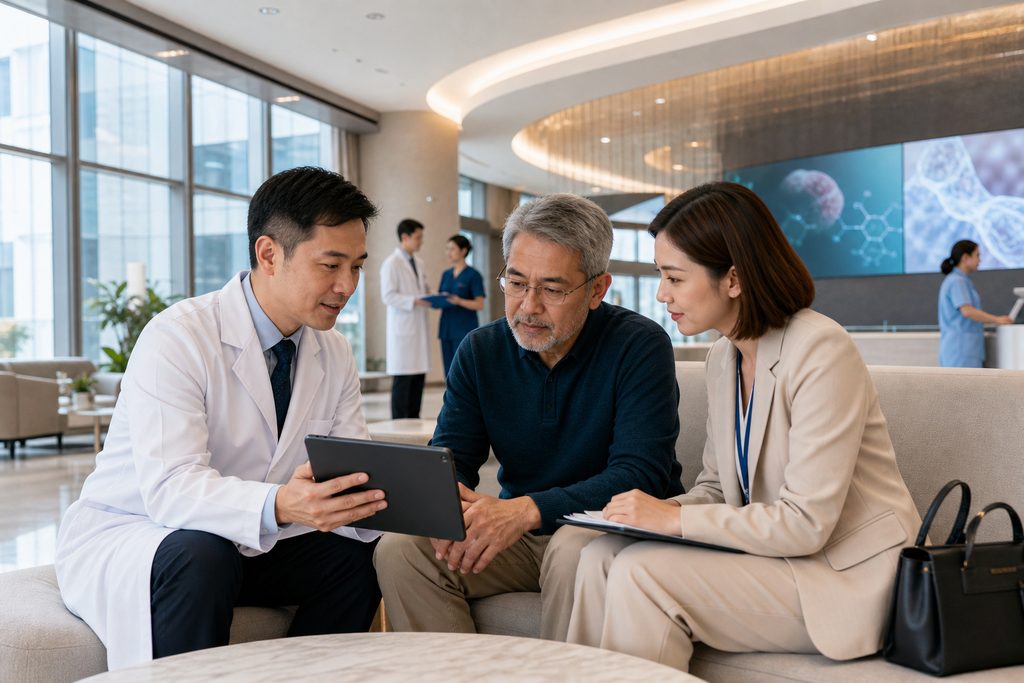
What if the next breakthrough in cancer treatment was not a generic drug, but a vaccine designed exclusively for your own tumor’s DNA? That reality is no longer theoretical. Across China’s top-tier oncology centers, researchers are actively enrolling patients in clinical trials for personalized neoantigen-based cancer vaccines. The challenge for international patients is not finding the science. The science is robust and published in journals like *Nature Medicine*. The challenge is navigating the enrollment logistics, the language barrier, and the opaque hospital systems from half a world away. We exist to solve that logistical puzzle.
Key Takeaways
- Personalized neoantigen vaccines target mutations unique to your tumor—this is not a one-size-fits-all immunotherapy. China has over 340 top-ranked hospitals, many running active Phase I/II trials with a focus on solid tumors like pancreatic, lung, and liver cancer.
- Enrollment requires fresh tumor tissue, specific HLA typing, and sequencing—a process that demands precise on-the-ground coordination with a hospital’s pathology and biobanking departments.
- Without local representation, international patients face a near-zero chance of successfully navigating the Mandarin-language informed consent, visa logistics, and tissue sample handling requirements independently.
- The personalized cancer vaccine China cost for trial participation is often covered by the sponsoring institution, but the logistical support—translation, tissue couriering, accommodation—must be self-funded and meticulously planned.
The Problem: When Standard Therapy Stops Working
Approximately 90% of cancer deaths are caused by metastasis or treatment-resistant relapse. For a patient with late-stage pancreatic ductal adenocarcinoma, the five-year survival rate stubbornly sits below 10% in Western countries. Standard chemotherapy and even first-generation checkpoint inhibitors often plateau. The tumor mutates. It finds workarounds. You sit in an oncologist’s office in London or Los Angeles and hear that the next line of therapy offers, at best, a marginal progression-free survival benefit of two or three months. That is the moment families start searching for something fundamentally different.
A neoantigen cancer vaccine flips the script. It does not carpet-bomb rapidly dividing cells. It trains your own T-cells to recognize the specific mutant peptides—neoantigens—that exist only on your cancer cells. Think of it as handing the immune system a high-resolution photo of the enemy. The process starts with a biopsy. Researchers sequence the tumor’s exome and compare it to your healthy DNA. Algorithms predict which mutations will look most foreign to your immune system. A vaccine encoding those predictions is manufactured and injected. The goal is not just remission. The goal is immune memory that prevents recurrence.
Who We Are
We are not a hospital. We do not provide medical treatment or clinical diagnoses. We are your logistical architects—we bridge the gap between you and China’s top-tier medical expertise. Our team operates as a bilingual medical concierge, connecting international patients with the specific oncology departments across China’s 340+ top-ranked hospitals that are actively recruiting for neoantigen therapy clinical trials. We handle the non-clinical barriers that prevent enrollment: medical document translation, visa invitation letters, fresh tissue logistics, and the complex informed consent process. We do not promise miracle cures. We promise transparent, efficient access to a system that is otherwise inaccessible to non-Mandarin speakers.
Why China’s Approach to Neoantigen Vaccines Delivers Results
Clinical Trial Volume and Speed
China’s regulatory framework for advanced therapy medicinal products has accelerated dramatically. The sheer patient volume at a single top-tier Chinese cancer center is staggering. A hospital like Fudan University Shanghai Cancer Center treats over 15,000 new cancer patients annually from across Asia. For a trial requiring 30 eligible patients with a specific HLA subtype and rare mutation profile, a Western center might screen for eighteen months. A Shanghai-based center can often complete recruitment in a quarter of that time. This is not about cutting corners. It is about statistical reality. More patients screened means faster trial completion. Faster completion means faster data readouts. For a patient with progressing disease, that speed is everything.
Manufacturing and Bioengineering Capabilities
Personalized vaccines are a logistics nightmare. Each vaccine is a batch of one. You need a Good Manufacturing Practice facility that can synthesize long peptide sequences or mRNA constructs within weeks of receiving the sequencing data, not months. The Shanghai Zhangjiang Hi-Tech Park and Suzhou BioBay house some of the world’s most advanced biomanufacturing clusters. These facilities have invested billions in rapid-turnaround personalized medicine pipelines. Where a Western academic center might outsource synthesis and face a 12-week manufacturing delay, the integrated centers in China can often compress the vein-to-vein time—from biopsy to injection—to under eight weeks. In a metastatic setting, a four-week difference is clinically meaningful.
Cost Structure Without Quality Compromise
Let’s address the obvious question: what is the price of neoantigen therapy in Shanghai? If you are participating in an investigator-initiated clinical trial, the investigational product itself is typically provided without charge by the sponsor. The personalized cancer vaccine China cost therefore shifts to the supporting medical services—hospital admission, imaging, laboratory monitoring, and physician fees. A comprehensive inpatient workup and monitoring cycle at a public hospital’s international VIP wing often ranges from $8,000 to $15,000. That is a fraction of the $50,000 to $100,000 you might budget for a similar experimental protocol at a private US cancer center. The lower cost does not reflect lower quality. It reflects structural economic differences in hospital administration, physician salaries, and the public-health mandate that subsidizes academic research. The surgical suites and sequencing labs at Fudan or Peking University Cancer Hospital use the same Illumina NovaSeq machines and ISO-certified cleanrooms you would find in Houston or Heidelberg.
How Does a Neoantigen Cancer Vaccine Work? The Biology in Plain Language
Every cancer cell is a genetic disaster zone. Random mutations accumulate during cell division. Some of those mutations create abnormal protein fragments—neoantigens—that get displayed on the cell surface by HLA molecules. Your immune system’s T-cells can theoretically see these neon signs and kill the cancer. But tumors are sneaky. They suppress the immune response. They exhaust the T-cells. A checkpoint inhibitor like pembrolizumab takes the brakes off the immune system, but it does not tell the T-cells where to aim. The neoantigen vaccine provides the target coordinates.
The workflow is precise. First, a tumor biopsy is flash-frozen or placed in RNA-stabilizing solution. It must be viable tissue, not a paraffin block from an old surgery. Second, whole-exome sequencing compares tumor DNA to blood DNA to identify somatic mutations. Third, computational algorithms rank these mutations by their predicted binding affinity to your specific HLA alleles. Fourth, a vaccine encoding the top 10 to 20 predicted neoantigens is synthesized—either as synthetic long peptides mixed with an adjuvant, or as an mRNA-lipid nanoparticle formulation. Fifth, the vaccine is injected subcutaneously over a priming and boosting schedule. The goal is to expand the population of neoantigen-specific T-cells and drive them into the tumor microenvironment.
What You Need to Know Before Going Alone
We have seen patients attempt this independently. It rarely ends well. The barriers are not intellectual—they are structural and linguistic. Here is what you are up against:
- Fresh Tissue Logistics: A neoantigen therapy clinical trial in China will almost certainly require a fresh core needle biopsy performed at the enrolling hospital. The tissue must be processed within 30 minutes of excision. You cannot courier a sample from a local hospital abroad. You must be physically present for the biopsy. Scheduling that biopsy requires a hospital-registered physician to issue the order and a pathology department to receive the sample under a specific trial protocol number. None of this happens via email in English.
- Visa and Registration: Foreign nationals seeking medical treatment in China require an S2 visa with a formal invitation letter from a Chinese hospital. The hospital’s international medical department must stamp and issue this letter. They will not issue it without a confirmed patient record and a preliminary acceptance by the principal investigator. Obtaining that acceptance without a Mandarin-speaking advocate inside the system is extraordinarily difficult. We have seen applications stall for weeks over a single missing stamp.
- Informed Consent and Adverse Event Reporting: The informed consent document for a personalized vaccine trial can run 30 pages. It details the risk of cytokine release syndrome, injection site reactions, and the theoretical risk of off-target autoimmunity. You must sign a Chinese-language consent form. A verbal translation is not legally sufficient. The hospital’s ethics committee requires a documented, witnessed consent process. If you experience a grade 3 adverse event, you need someone who can immediately communicate with the attending physician and the clinical research coordinator in their native language. Google Translate is not appropriate for a medical emergency.
How We Help You Navigate This
These barriers exist for structural reasons. They are not designed to exclude foreigners—they exist to protect patient safety and data integrity in a complex regulatory environment. Our job is to solve each one. We start with a remote assessment. You send us your pathology reports, imaging, and treatment history. Our medical translation team renders these into clinical-grade Chinese. We then query our network of oncology departments—spanning the top 5% of China’s 35,000+ hospitals—to identify active trials with open slots matching your diagnosis, stage, and prior lines of therapy. We do not just send a list. We confirm the inclusion and exclusion criteria with the trial coordinator before we present an option to you.
Once a suitable trial is identified at a center like Fudan University Shanghai Cancer Center or Sun Yat-sen University Cancer Center in Guangzhou, we coordinate the invitation letter for your S2 visa. We arrange your airport transfer and accommodation near the hospital. Our bilingual medical companion meets you on the first morning, guides you through registration, and sits with you during the physician consultation. They ensure the biopsy is correctly labeled and routed to the sequencing core. They translate the informed consent line by line. They are present for every vaccine injection, monitoring you for immediate adverse reactions and communicating with the nursing staff.
The process typically spans six to eight weeks for the priming phase, with follow-up visits that can be coordinated with your home oncologist. We manage the discharge summary translation and ensure your medical records are formatted for your home country’s physicians. This is not a drop-off service. We stay engaged through the entire active treatment period.
Frequently Asked Questions
The personalized cancer vaccine China cost varies significantly based on whether you enroll in a clinical trial or pursue a compassionate-use protocol. In a trial, the investigational vaccine is typically sponsor-funded. Your out-of-pocket costs cover hospital admission, imaging, laboratory work, and physician fees—generally between $8,000 and $15,000 for a full treatment cycle at a public hospital international wing. Compassionate use outside a trial, if available, can range from $30,000 to $60,000 depending on the manufacturing complexity. We always provide a detailed cost breakdown before you commit to travel. The coordination fee for our case management is credited in full toward any future on-the-ground service within 90 days.
Checkpoint inhibitors like nivolumab block the PD-1/PD-L1 pathway, releasing the brakes on exhausted T-cells. They work well in tumors with high mutational burden—melanoma, MSI-high colorectal cancer. But they are passive. They do not direct the immune system to a specific target. A neoantigen vaccine is an active intervention. It primes new T-cells against specific mutations. Many of the most promising trials in China combine a personalized vaccine with a PD-1 inhibitor. The vaccine provides the target; the checkpoint inhibitor keeps the T-cells functional inside the tumor microenvironment. Early-phase data published by Chinese research teams show this combination can induce durable, mutation-specific T-cell responses in pancreatic cancer patients—a tumor type historically resistant to immunotherapy.
Many Phase I trials specifically enroll patients with refractory solid tumors who have progressed on at least one prior line of systemic therapy. The key requirement is adequate organ function and a performance status that allows for a fresh biopsy and the physical demands of international travel. We will ask for your most recent complete blood count, liver and kidney function tests, and a physician’s assessment of your ECOG performance status. If you are bedbound or have rapidly progressing liver metastases, enrollment is unlikely—and travel would be medically unsafe. We are honest about this. We will not facilitate a trip that puts you at risk of decompensating far from home.
This is the hardest scenario. The manufacturing window—typically six to eight weeks—is a vulnerable period. You will be under the care of the enrolling oncologist during this time. They may recommend a bridging chemotherapy regimen to stabilize disease. The trial protocol will specify allowed concurrent therapies. We ensure you understand this risk before you travel. No one can guarantee that a tumor will wait for the vaccine. But we can ensure you are monitored closely and that communication with your clinical team is immediate and clear.
Your Next Step
Accessing a personalized cancer vaccine trial in China is not a simple transaction. It is a coordinated medical journey that demands precision, local knowledge, and relentless attention to detail. The science is real. The trials are active. The barrier is not medicine—it is logistics. If you have a solid tumor and are exploring next-line options beyond standard therapy, we can help you understand whether a neoantigen approach is viable for your specific case. Reach out for a free consultation. We will review your records, explain the landscape honestly, and map out a path forward if one exists. You deserve a clear answer, not a sales pitch.
For more medical information and treatment options in China, visit chinamedservices.com (China Medical Services).
