Bringing Your Pet to China for Medical Treatment: A Complete Guide for Long-Stay Patients
Key Takeaways
- China permits one companion animal per traveler, but the import process requires at least 30 days of preparation before departure — last-minute arrangements are not possible.
- Official quarantine and customs clearance happen at the port of entry, taking 30 minutes to several hours. Your animal will not be seized or placed in extended isolation if your paperwork is correct.
- Return logistics are equally complex. Each destination country has distinct re-entry rules, and China’s export health certificate is only valid for 14 days.
- Veterinary infrastructure in major Chinese cities has improved dramatically since 2020. You can find English-speaking vets in Beijing, Shanghai, Guangzhou, and Shenzhen, but access drops sharply in smaller cities.
The Problem: A Medical Journey That Does Not Fit a Boarding Kennel
About 1 in 5 international patients who contact us for hospital coordination in China asks the same question within the first ten minutes: “Can I bring my dog?” Or cat. Or, in one memorable case, a cockatoo. These are not casual pet owners. They are people facing a six-week oncology protocol at a top-tier Chinese hospital. Or a parent bringing a child for three months of scoliosis treatment. A two-week boarding facility at home does not solve their problem. They need a pet import service China for medical tourists that works for stays measured in months, not days.
The anxiety is real. A 2023 survey by the International Pet and Animal Transportation Association found that 68% of pet owners reported moderate to severe stress when considering long-term separation from their animals during medical travel. That stress is layered on top of an already difficult health situation. You are already navigating visa paperwork, hospital selection, and treatment timelines. Adding animal import logistics feels overwhelming. But the alternative — leaving a companion of ten years with a sitter for half a year — simply is not acceptable for many people.
Who We Are
China Medical Services is not a veterinary clinic. We do not provide pet transportation, animal health certificates, or customs brokerage directly. We are a medical concierge organization that connects international patients with China’s top-ranked hospitals. Our team handles hospital matching, appointment coordination, bilingual medical companions, and visa guidance. But we have seen enough long-stay patients struggle with the animal import question that we built a knowledge base and a network of trusted pet relocation partners. This article shares what we have learned. We also touch on the medical side because, honestly, the two are connected. If you are coming to China for treatment at one of our 340+ top-ranked hospitals, you need a clear picture of the full logistics chain — including what happens to your animal at customs.
Why China’s Pet Import Rules Actually Work for Medical Tourists
The system is bureaucratic. There is no way around that. But it is also predictable. Once you understand the sequence, the process becomes manageable. China’s General Administration of Customs (GAC) has harmonized its animal import rules with international standards over the past decade. The requirements are documented, and the outcome is not random.
One Pet Per Person: The Hard Limit
Chinese customs regulations permit exactly one companion animal — a dog or a cat — per traveler entering the country. Not two. Not a dog and a cat together. One. If you have multiple animals, only one can enter under the companion animal pathway. The others would require a commercial import permit, which is a different and substantially more difficult process involving a Chinese importing company, a designated quarantine facility, and a 30-day isolation period. That route is rarely practical for individual medical tourists. We tell patients with multiple pets: choose one, and make arrangements for the others at home. This is the single most common disappointment we have to deliver, and we deliver it early.
Microchip, Rabies Titer, and the 30-Day Clock
Your dog or cat needs an ISO 11784/11785 compliant 15-digit microchip. This must be implanted before the rabies vaccination. If the vaccine was given first and the chip came later, the vaccination does not count for import purposes. The animal then needs a rabies antibody titer test from an approved laboratory, with a result of at least 0.5 IU/ml. The blood draw for that test must occur at least 30 days after the rabies vaccination. And you cannot enter China until 30 days have passed from the date the blood sample was drawn. That means the absolute minimum preparation window is about 60 days: vaccination, wait 30 days, blood draw, wait another 30 days, travel. Most people need closer to 90 days to manage the paperwork without panic. If you are asking how to bring my dog to China for long term medical stay, start here. Start early.
Quarantine: What Actually Happens at the Airport
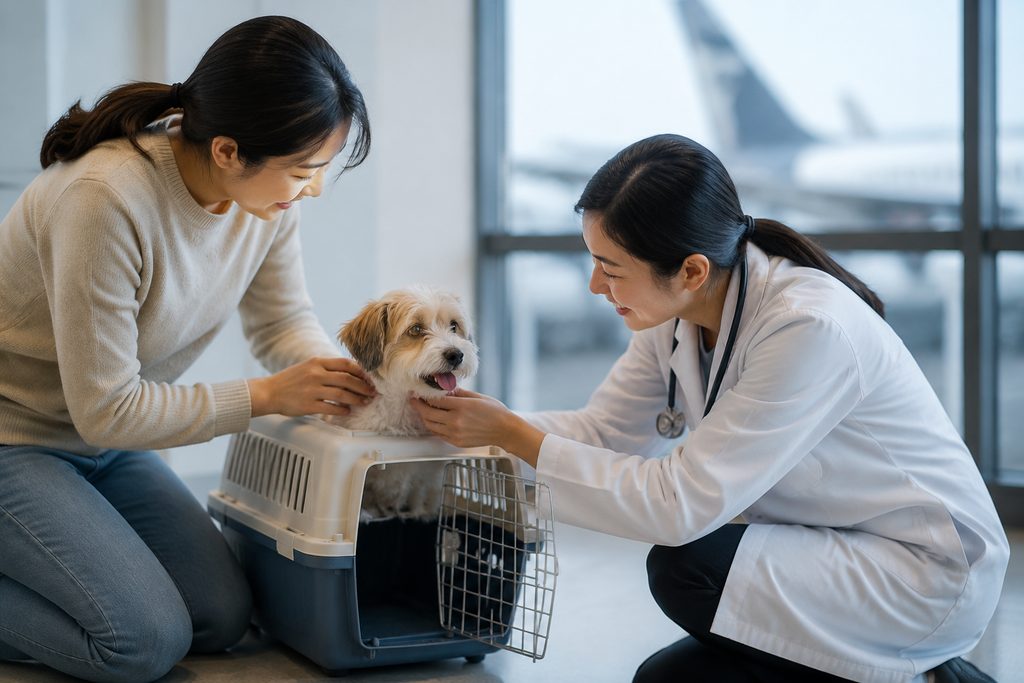
This is where fear outpaces reality. Many people imagine their animal being taken to a concrete facility for weeks. That is not what happens. When you land, a customs officer inspects your animal’s paperwork and performs a visual health check. If everything is in order — valid health certificate, correct microchip, passing titer test, and the animal appears healthy — the officer stamps your documents and you walk out. The whole process takes 30 minutes to a few hours, depending on the airport and the queue. Your animal stays with you. This is the animal quarantine rules China medical tourism reality: it is a document check, not a confiscation. The exception is if your paperwork is incomplete or the animal shows signs of infectious disease. In that case, the animal may be held for observation or, in rare cases, returned or euthanized. This is why preparation matters.
What You Need to Know Before Going Alone
We have watched patients attempt this process independently. Some succeed. Many call us halfway through, frustrated and behind schedule. Here are the barriers that trip people up most often.
- Veterinary Health Certificate Timing: The USDA-accredited (or equivalent in your country) veterinarian must examine your animal and issue the international health certificate within 14 days of your departure date. Not 15 days. Fourteen. If your flight gets delayed and the certificate expires, you need a new exam and a new certificate. This tight window causes more last-minute panic than any other single requirement.
- Endorsement by the Competent Authority: The health certificate must be endorsed — stamped and signed — by the official government veterinary authority of your country. In the US, that is the USDA APHIS office. In the UK, it is the APHA. In Australia, the Department of Agriculture. This is not your local vet. This is a government office with its own processing times, mailing requirements, and fees. Some offices accept digital submissions. Others require physical documents sent by courier. Plan for at least 5-7 business days for endorsement, and longer during holiday periods.
- Port of Entry Restrictions: Not every Chinese airport accepts live animal imports. Your animal must enter through a designated port with animal quarantine facilities. Major entry points include Beijing Capital (PEK), Shanghai Pudong (PVG), Guangzhou Baiyun (CAN), and a handful of others. If you fly into a smaller city, you may need to land at a major port first, clear customs there, and then take a domestic connection. Domestic flights have their own pet transport rules, and they are often stricter than international ones.
- Finding a pet relocation agency China medical treatment abroad That Understands Your Timeline: Most pet shipping companies are built around corporate relocations or military moves — predictable schedules with months of lead time. Medical travel is different. Your treatment date may shift. A surgeon’s schedule opens up unexpectedly. You need a relocation partner who can adapt. Not all agencies can. Ask specifically: “What happens if my travel date changes with two weeks’ notice?” The answer will tell you everything.
What This Costs: A Realistic Breakdown
The cost to import cat to China for surgery stay — or a dog — ranges from approximately $1,500 to $6,000, depending on your origin country, the size of your animal, and how much of the process you handle yourself. Here is a realistic breakdown for a medium-sized dog coming from the United States.
| Expense Item | Estimated Cost (USD) | Notes |
|---|---|---|
| ISO microchip implantation | $25–75 | One-time; most rescue animals already have one |
| Rabies vaccination | $30–60 | Must be administered after microchip |
| Rabies titer test (FAVN) | $200–400 | Lab fee + vet blood draw; processing takes 3-6 weeks |
| Health certificate + exam | $150–300 | Must be within 14 days of departure |
| USDA endorsement fee | $38–121 | Varies by submission method and urgency |
| Airline cargo fee (medium dog) | $800–2,500 | Depends on airline, route, and crate size |
| IATA-compliant travel crate | $100–400 | Must meet airline specifications |
| Customs clearance agent (optional) | $200–600 | Recommended for first-timers at Chinese port of entry |
| Total estimated range | $1,543–4,456 | Does not include return export costs |
Return costs are separate. Exporting your animal from China back to your home country requires a Chinese health certificate (valid for 14 days), an export quarantine inspection, and compliance with your destination country’s import rules. Budget an additional $800–2,000 for the return journey. If you are working with a pet relocation agency China medical treatment abroad, ask for a door-to-door quote that covers both directions. Some agencies offer a bundled rate that is 15-20% lower than booking each leg separately.
Living with Your Pet During a Medical Stay in China
Once your animal clears customs, daily life begins. This part is often easier than people expect — in the right cities.
Beijing, Shanghai, Guangzhou, and Shenzhen all have established expatriate veterinary clinics with English-speaking staff. Clinics like International Center for Veterinary Services (ICVS) in Beijing and PAW Veterinary Clinic in Shanghai offer Western-standard care, vaccination services, and health certificate preparation for your return trip. Many also provide 24-hour emergency services. Outside these major hubs, English-speaking veterinary care becomes scarce. If your treatment takes you to a hospital in Chengdu or Wuhan, you may need to travel to a larger city for veterinary needs. Our team can help you locate appropriate clinics near your treatment hospital — this is part of the logistical support we provide to long-stay patients.
Housing is the other practical consideration. Not all apartments or hotels accept pets. Serviced apartments in expatriate areas are the most reliable option. Expect to pay a pet deposit of RMB 2,000–5,000 (approximately $280–700) and possibly a small monthly pet fee. Some long-stay patients find that serviced apartments near international hospitals offer better pet policies than standard hotels. If you are coordinating treatment at a private hospital in Shanghai or Beijing, we can recommend neighborhoods with both good hospital access and pet-friendly housing.
The Question Everyone Asks: Can I Take My Pet to China for Extended Hospital Treatment?
Yes. The short answer to can I take my pet to China for extended hospital treatment is yes — with preparation, with paperwork, and with realistic expectations about what daily life looks like. You will not be able to bring your dog into the hospital. Chinese hospitals, like hospitals everywhere, restrict animals for infection control reasons. Your pet will stay in your accommodation while you are at appointments. That means you need a plan for care during long treatment days. Some patients traveling with a partner or family member split responsibilities: one person stays with the animal while the other attends consultations. Solo travelers sometimes arrange local pet-sitting through expatriate networks or veterinary clinics that offer boarding services.
We have also seen patients whose treatment involves a two-week inpatient stay followed by outpatient follow-ups. For the inpatient period, they board their animal at a trusted veterinary clinic, then bring the animal back to their apartment for the outpatient phase. It works. It requires planning. But it works.
Frequently Asked Questions
Your animal cannot enter China through the companion animal pathway. You will need to re-vaccinate, wait 30 days, and re-test. This resets your timeline by at least 6-8 weeks. If your medical treatment cannot wait that long, you may need to make alternative arrangements for your pet at home and bring them later, or travel without them. We have seen this happen to about 5% of the patients we advise. It is frustrating, but there is no waiver or workaround.
Your pet’s legal status in China is tied to your own. The animal enters under your passport and visa. If you extend your stay through a visa renewal (which is possible for medical reasons with supporting hospital documentation), your pet can remain with you. There is no separate “pet visa” that expires independently. However, the export health certificate for your return journey must be obtained fresh — within 14 days of departure — regardless of how long you have been in the country.
China does not maintain a national breed ban for imported companion animals in the same way some countries do. However, individual cities may have local restrictions on certain large or aggressive breeds. Beijing, for example, prohibits certain breeds including Tibetan Mastiffs and some bully breeds within the urban area. If you are bringing a large guardian breed, check the specific regulations of the city where you will be staying. This is not a customs issue — it is a municipal housing and public safety regulation.
Veterinary care in major Chinese cities is accessible and improving rapidly. Expatriate-focused clinics in Beijing and Shanghai offer diagnostics, surgery, and emergency care that meet international standards. Costs are generally lower than in the US or Europe — a standard consultation runs $40–80, and emergency visits $100–200. We recommend identifying a veterinary clinic near your accommodation before you arrive, and saving their emergency number. Our team can provide a list of English-speaking clinics in your destination city as part of your pre-arrival coordination.
The companion animal import pathway is limited to dogs and cats. Birds, rabbits, reptiles, and other animals require a commercial import permit and are subject to different quarantine rules — often including a mandatory 30-day isolation period at a designated facility. For a medical stay of a few months, this is rarely practical. If your emotional support animal is not a dog or cat, we recommend exploring alternative support arrangements during your treatment.
Your Next Step
Bringing a pet to China for a long medical stay is not simple. But it is also not mysterious. The rules are published, the sequence is known, and thousands of people do it successfully every year. The difference between a smooth entry and a customs crisis is almost always preparation time — starting early, double-checking every document, and having a contingency plan if dates shift. That is true whether you are coordinating pet import or hospital appointments. Both require the same mindset: respect the process, and do not cut corners on paperwork.
If you are planning a medical journey to China and need help navigating the full picture — hospital selection, visa guidance, bilingual companions, and yes, connecting with reliable pet relocation partners — our team is here. We do not transport animals ourselves, but we know who does, and we can point you toward agencies we have seen perform well under the unpredictable timelines of medical travel. Start with a conversation. No pressure. Just clarity on what is possible.
For more medical information and treatment options in China, visit chinamedservices.com (China Medical Services).
