Professional Whitening in China: What to Expect, Cost & Safety
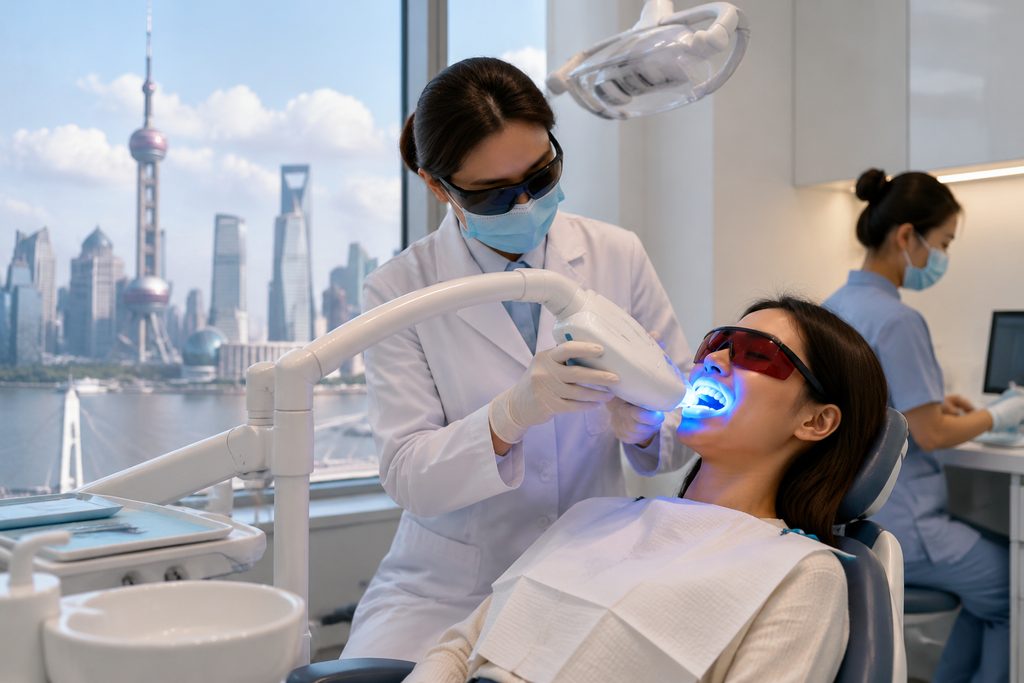
Professional Whitening in China: What to Expect
Professional teeth whitening is a dentist-supervised bleaching procedure that lifts stains from enamel and dentin using controlled concentrations of hydrogen peroxide or carbamide peroxide. It is not the same as the whitening strips you buy at a pharmacy. In China, the teeth whitening cost typically lands between $150 and $600 at a reputable private or international dental clinic — a fraction of what the same procedure runs in London, New York, or Sydney. The catch is knowing where to go, who is holding the curing light, and what paperwork you need before you sit in the chair.
That is what this guide covers. We work with international patients navigating China’s medical system every week, and dental care is one of the most common requests we field. Here is the honest picture.
How This Actually Works, Step by Step
The process starts long before you land. You send us your dental history — recent X-rays if you have them, notes on crowns, veneers, fillings, or sensitivity issues, and a photo of your current smile in natural light. A coordinating dentist at the clinic reviews this and flags anything that would make whitening unsafe or ineffective. Deep decay, exposed roots, untreated gum disease, and existing composite fillings all change the plan.
From there, three things get confirmed in writing:
- The clinic and the treating dentist, with their credentials and English proficiency
- The whitening method — in-chair LED-accelerated, take-home custom trays, or a combination
- The quoted price, in USD, valid for a set window
You then book a date. Most clinics in Shanghai, Beijing, and Guangzhou can hold an appointment within 3–7 days. If you need a visa, you apply for an S2 short-stay visa for medical treatment or private affairs, supported by a hospital or clinic invitation letter. Not an M visa — that is for commercial and trade activity and has nothing to do with dental care.
On the day, expect a 60–90 minute visit. Shade matching first, then gum isolation, then the gel and light cycles. You walk out with a result. A follow-up check happens 48 hours later, usually by photo if you have already flown home.
What Professional Whitening in China Actually Costs
Price is where China’s dental sector separates sharply from the West. A single in-chair session at a private international clinic in Shanghai averages $300–$500. The same session at a Western dental practice runs $650–$1,200. Take-home tray kits, which use lower-concentration gel over 10–14 nights, sit lower at $150–$300.
| Procedure | China (private/international clinic) | US / UK / Australia |
|---|---|---|
| Single in-chair whitening session | $300–$500 | $650–$1,200 |
| Take-home custom tray kit | $150–$300 | $400–$800 |
| Combined in-chair + trays | $450–$700 | $900–$1,500 |
| Pre-whitening exam & X-rays | $40–$120 | $150–$400 |
These are ranges. Final quotes vary by hospital and case complexity — a patient with four crowns needs a different plan than someone with untouched enamel. And the price you are quoted should include the shade guide, the gum barrier, and the post-treatment desensitizing gel. If a clinic quotes you $80 flat, ask what is missing.
A Realistic Timeline
Most patients underestimate the front-end paperwork. Here is how the calendar actually runs for someone traveling from Europe or North America.
| Stage | What Happens | Duration |
|---|---|---|
| Records sent | Photos, X-rays, dental history uploaded | Day 1 |
| Clinical review | Dentist assesses suitability, flags risks | 1–3 business days |
| Quote & scheduling | Written plan and price confirmed | 2–5 days |
| Visa application (if needed) | S2 visa with clinic invitation letter | 4–10 business days |
| Travel & appointment | Arrival, in-chair session | 60–90 minutes in chair |
| 48-hour check | Photo review or in-person follow-up | Day 3 post-treatment |
| Long-term maintenance | Touch-up trays every 6–12 months | Ongoing |
Total realistic window from first contact to whitened smile: 2–4 weeks if a visa is required, or as little as 5–7 days if you are already in Asia and visa-exempt.
What Can Go Wrong — and What Happens Then
Whitening is low-risk, but it is not risk-free. The most common issue is transient tooth sensitivity, reported by roughly half of patients in the first 48 hours. It fades. Clinics manage it with potassium nitrate desensitizers and, if needed, a lower-concentration follow-up.
More serious problems come from poor screening. If a dentist whitens over active decay or untreated gum recession, you can end up with sharp, persistent pain and a cavity that now needs a filling. This is why the pre-treatment exam is not optional.
Uneven results are the second complaint. Existing fillings, crowns, and veneers do not bleach. If you have a front composite filling from ten years ago, it will stay its current shade while the surrounding enamel lightens — and the mismatch becomes visible. The fix is replacing the restoration after whitening, which adds cost.
What about recourse? Reputable international clinics in China offer a written treatment guarantee — typically a free touch-up if the shade does not improve by at least two levels on the Vita guide. Get that in writing before you pay. If a clinic refuses, that tells you something.
Is Professional Teeth Whitening Safe in China?
This is the question we hear most, and the answer depends entirely on where you go. China’s top-tier private and international dental clinics operate to JCI or equivalent standards, use FDA-cleared or CE-marked whitening agents, and employ dentists trained in Europe, the US, or at China’s top dental schools such as the Peking University School of Stomatology and Sichuan University’s West China School of Stomatology.
The regulatory picture matters too. China’s National Medical Products Administration (NMPA) regulates whitening gels as medical devices. Legitimate clinics use NMPA-registered products. Grey-market clinics in tourist areas sometimes do not — and that is where stories of burns and enamel damage originate.
So the safety question is really a provider question. A licensed dentist, a registered product, a proper exam, and a written plan: with those four in place, professional teeth whitening in China is as safe as it is anywhere in the world.
How to Evaluate a Clinic Before You Book
Credentials first. Ask for the dentist’s license number and where they trained. A clinic that hesitates is a clinic to skip.
Then product. Ask which whitening system they use — common legitimate brands include Opalescence, Zoom, and Beyond. If they cannot name the product, that is a problem.
Then process. A proper clinic will insist on a pre-treatment exam, take a shade record, and give you written aftercare instructions. They will also tell you what whitening cannot fix — intrinsic stains from tetracycline, for example, respond poorly to bleaching.
Finally, communication. If your Mandarin is limited, you need a clinic with genuine English-speaking staff or a bilingual companion. This is where most foreign patients get stuck, and it is exactly the gap our team fills. You can review vetted clinics through our private international hospital directory or explore dental departments listed under our specialty rankings.
Practical Considerations: Records, Visa, Payment, Follow-Up
Records. Bring any recent dental X-rays (within 12 months) and a list of current medications. Blood thinners and some antibiotics affect treatment planning.
Visa. If you are traveling specifically for dental treatment, apply for the S2 visa with a clinic invitation letter. Processing runs 4–10 business days depending on your consulate. Do not book flights before the visa is confirmed.
Payment. Private international clinics accept international credit cards and often bill insurance directly. Public hospital dental departments usually require prepayment, with reimbursement handled afterward by your insurer.
Insurance. Most Western insurers classify whitening as cosmetic and will not cover it. Check your policy — some cover the exam and X-rays even when they exclude the bleaching itself.
Follow-up. Ask for the shade record and a take-home touch-up kit before you leave. Whitening fades gradually, and having trays made in China costs a fraction of having them made at home later.
If you are combining dental work with a broader health check while in China, our guide to navigating China’s medical system as an international patient covers hospital selection, translation, and companion services.
Frequently Asked Questions
Typically 6 to 24 months, depending on your diet and habits. Coffee, tea, red wine, and smoking accelerate fading. Patients who maintain with a take-home tray every 6–12 months often hold their shade for two years or more.
Yes, at private and international clinics. Public hospital dental departments generally require an in-person exam first. For advance booking, you will need to send records and confirm a date. Our patient coordination team handles this end to end.
Some are, some are not. A legitimate package bundles the exam, the whitening session, and a follow-up. Be wary of packages that skip the exam or quote prices far below market — those usually cut corners on products or screening.
Properly supervised whitening does not remove enamel. It opens the enamel’s microscopic pores temporarily to release stains. Sensitivity is common and temporary. Damage occurs only when unlicensed providers use unregistered chemicals or over-bleach.
Your Next Step
Professional whitening in China is affordable, well-regulated at the top end, and genuinely safe when you choose the right clinic. The variable is not the country — it is the provider. Our team connects international patients with vetted dental clinics across China, coordinates appointments, and provides bilingual support on the day. We are not dentists and we do not give clinical advice; we handle the logistics so your dentist can focus on your teeth. If you would like a written quote and clinic recommendation based on your case, start with a free consultation.
This article is for informational purposes only and does not constitute medical or dental advice. Treatment suitability and outcomes vary by individual. Always consult a licensed dental professional before undergoing any procedure.
For more medical information and treatment options in China, visit chinamedservices.com (China Medical Services).
