Enlarged Prostate Treatment in Shanghai: Changhai Hospital Urology Laser Surgery Guide
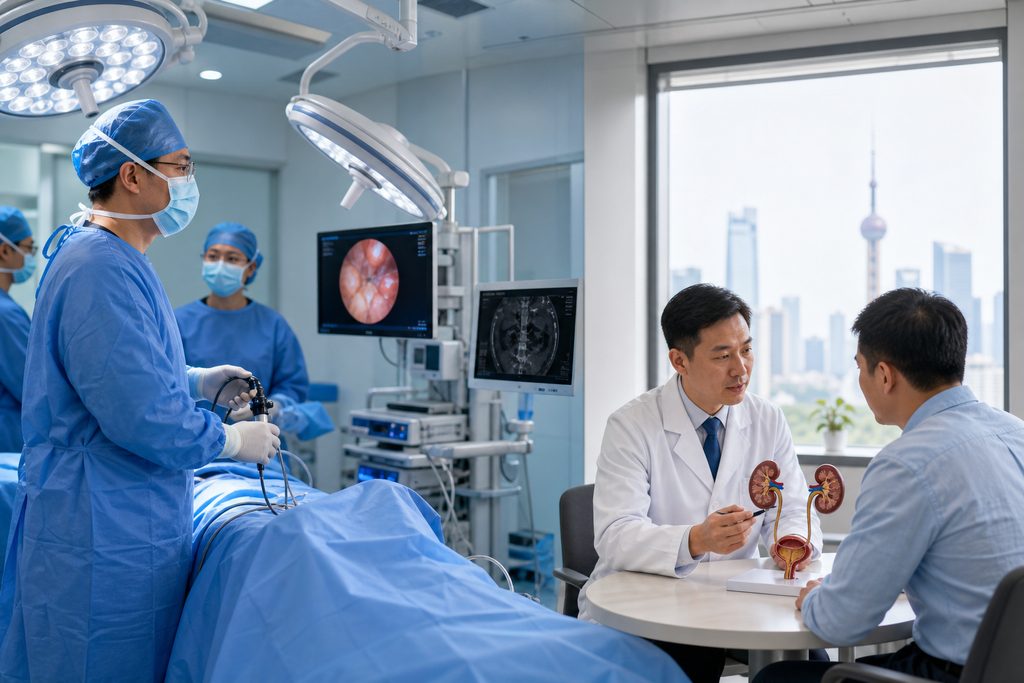
When 58-year-old David from Manchester first searched for solutions, he was getting up four times a night. The constant urgency was wearing him down. His local urologist had mentioned a TURP procedure, but the recovery time and potential side effects made him pause. Then a friend mentioned laser surgery in China. David had no idea where to start. The sheer volume of information was paralyzing. Our team gets inquiries like David’s every week. The question isn’t just about the procedure itself. It’s about the entire chain of events: understanding the Shanghai Changhai Hospital prostate laser surgery cost, navigating a foreign healthcare system, and figuring out if the travel is worth it. This guide walks through exactly what you need to know, from the technology used in Shanghai to the practical logistics of getting there.
How This Actually Works, Step by Step
The process of accessing care at a major Chinese public hospital is different from what many Western patients expect. You cannot simply book a surgery date online from overseas. The system requires a face-to-face consultation first. Here is the sequence we help patients navigate.
First, you send us your existing medical records. This includes a recent PSA test, a uroflowmetry report, a prostate volume measurement from an ultrasound or MRI, and a detailed symptom history. Our team translates these documents into clinical Chinese. We then submit them to the Urology Department’s international liaison office at Changhai Hospital for a preliminary review. A specialist will assess whether you are a likely candidate for the procedure.
The goal of this remote review is not to give a final treatment plan. It is to get a written second opinion that confirms the procedure is appropriate for your specific condition. This step costs between $300 and $500. It answers the critical question: is it worth getting on a plane?
If the feedback is positive, the next stage is scheduling an in-person consultation. We coordinate an appointment through the hospital’s VIP or international outpatient clinic. This is the only reliable way to lock in a specific time with a senior specialist without waiting in a general queue. Once the appointment date is set, you apply for your visa.
You arrive in Shanghai. Our bilingual medical companion meets you at the hospital. You see the urologist. The surgeon reviews your records, conducts a physical exam, and orders any final pre-operative tests. If everything aligns, the surgery is scheduled, often within the same week. You have the procedure, stay for observation, and then return home with a full discharge summary in English.
The Technology Behind the Treatment: HoLEP at Changhai Hospital
Changhai Hospital is not just another urology department. It is consistently ranked among the top urology centers in China, and its laser surgery program is one of the busiest in the country. The primary procedure for an enlarged prostate here is Holmium Laser Enucleation of the Prostate, or HoLEP.
HoLEP is fundamentally different from the traditional TURP (Transurethral Resection of the Prostate) that many patients are offered at home. In a TURP, the surgeon uses an electrical loop to shave away prostate tissue from the inside, like coring an apple piece by piece. HoLEP uses a high-powered laser to precisely dissect the entire central lobe of the prostate along its anatomical capsule. The enucleated tissue is then pushed into the bladder and removed by a morcellator.
Why does this matter? Because HoLEP is size-independent. A TURP is generally limited to prostates under 80 grams. For very large prostates, over 100 grams, an open surgery was historically the only option. HoLEP treats a 150-gram prostate as effectively as a 60-gram one. The laser also seals blood vessels as it cuts, which means significantly less bleeding. The catheter stays in for a shorter period, often less than 24 hours, compared to 2-3 days for a standard TURP. The long-term data shows a lower re-operation rate, too.
The urologists at Changhai Hospital have performed thousands of these procedures. The volume is a key factor. High-volume centers simply have more refined protocols. They know how to handle the unexpected. For an international patient, the question of “is laser prostate surgery safe in Shanghai” is best answered by looking at this experience. The safety profile of HoLEP at a major teaching hospital like Changhai is excellent, with complication rates comparable to or lower than those reported in major Western registries.
A Realistic Timeline
The timeline from initial contact to recovery is not a sprint. It is a process with several waiting periods that are easy to underestimate. Here is a realistic breakdown.
| Stage | What Happens | Typical Duration |
|---|---|---|
| Week 1-2 | You gather and send all medical records. Our team translates them and submits them to the hospital for a written second opinion. | 1-2 weeks |
| Week 3 | We receive the written assessment. If it is positive, you decide to proceed. We request a specific appointment slot with the urology team. | 3-5 business days to confirm a slot |
| Week 4-5 | Visa processing. You apply for an S2 visa at your local Chinese embassy or consulate with the invitation letter and hospital appointment confirmation we provide. | 1-2 weeks, varies by country |
| Week 6 | You fly to Shanghai. The in-person consultation happens, usually within 1-2 days of arrival. Pre-operative tests are completed. | 2-3 days |
| Week 6-7 | The HoLEP procedure. Hospital stay is typically 2-3 nights. The catheter is removed before discharge. | 3-4 days in hospital |
| Week 7-8 | Recovery in Shanghai. A follow-up visit to confirm everything is stable before you are cleared to fly home. | 5-7 days post-discharge |
The total time on the ground in Shanghai is usually between 10 and 14 days. The entire process, from first email to flying home, spans about two months. Trying to compress this into a three-week window is risky. Visa delays happen. A pre-operative test might reveal something that needs a short course of medication before surgery. Building in a buffer is the single best way to reduce stress.
What Can Go Wrong — and What Happens Then
A guide that only talks about success is not honest. Things can deviate from the plan. Here are the most common failure modes and the actual recourse for each.
The written second opinion might come back negative. The specialist may determine that your prostate anatomy, your overall health status, or your medication profile makes you a poor candidate for immediate HoLEP. This is not a failure of the system. It is the system working. In this case, the consultation fee is a sunk cost, but it has saved you a much larger investment in travel for a surgery that would not have happened. You return to your local urologist with a detailed explanation from a top Chinese specialist, which can inform your next steps at home.
The visa might be denied. This is rare with a proper medical invitation letter, but it is not zero. If it happens, any coordination fees we have charged that are tied to an appointment we could not deliver are refunded. The hospital’s own registration fees are subject to their administrative policy, but we work to recover whatever is possible.
You might arrive and, during the final pre-operative workup, the surgeon finds a reason to delay. An active urinary tract infection, for example, would need to be treated with antibiotics first. The surgery gets pushed back by a week. This is frustrating. But it is medically non-negotiable. Our team’s role here is to handle the logistics of the delay: rebooking the hospital admission, extending your accommodation, and managing the communication so you are not stranded with a language barrier.
The most feared complication of any prostate surgery is post-operative incontinence. With HoLEP, the risk of permanent, severe incontinence is very low, below 1% in most large series. Temporary leakage, however, is common. It can last for weeks or months. You need to know this before you go in. The discharge plan will include pelvic floor exercises and a clear protocol for what to do if it persists after you return home.
How to Evaluate the Real Cost of Care
The Shanghai Changhai Hospital prostate laser surgery cost is a number that sits inside a larger financial picture. Focusing only on the hospital bill misses the full calculation.
The hospital’s own charge for the HoLEP procedure, including the surgeon’s fee, anesthesia, operating room, and a 3-day stay in a private room on the international wing, typically falls in a range from $12,000 to $18,000. This varies by case complexity. A larger prostate that requires more operating time will be at the higher end.
That is the direct medical cost. Now add the surrounding expenses. Our coordination service for a full treatment episode, from document translation through to discharge, starts at $5,000. A bilingual medical companion for your key hospital days is from $300 per day. Round-trip airport transfers are $200. Your flights, a 14-night hotel or serviced apartment near the hospital in Shanghai’s Yangpu district, meals, and a contingency fund for the unexpected.
A total budget for the trip, all-in, is usually between $22,000 and $28,000.
Compare this to the self-pay price for a HoLEP procedure at a major U.S. academic medical center, where the hospital bill alone can run from $35,000 to $50,000. The cost difference is substantial, but it is not the only factor. The value proposition also includes access to a surgical team that performs this specific procedure at very high volume.
There is no “Changhai Hospital urology international patient package” in the sense of a fixed-price, all-inclusive tourist product. The hospital bills for its services. We bill for ours. They are separate. We provide a transparent estimate before you commit, but the final hospital invoice will reflect exactly what happened in the operating room.
Practical Considerations: Records, Visas, and Follow-Up
The success of a trip like this depends on the paperwork you bring and the plan you make for when you get home.
Your medical records are the foundation. A recent, quantified symptom score is essential. The International Prostate Symptom Score (IPSS) is the standard. If you have not filled one out, do it. A PSA level drawn within the last six months is mandatory to help rule out underlying prostate cancer. The most critical piece of data is the prostate volume. A transrectal ultrasound or an MRI that states the volume in cubic centimeters or grams is what the surgeon needs to plan the procedure. Records in any language are acceptable; we handle the translation.
For the visa, the category is S2. This is a short-term private visit visa. The supporting documents from the hospital will state the purpose of your visit as medical treatment. Do not apply for an M visa. That is for commercial business and will be rejected for a medical trip. Processing times vary by country, but four weeks of lead time is a safe minimum.
Payment at the hospital is required upfront. The international department accepts major credit cards and wire transfers. They do not directly bill foreign insurance. You pay, and then you submit the itemized receipt and discharge summary to your insurer for reimbursement. Check your policy’s out-of-network international coverage before you book anything.
The follow-up is the part most patients under-plan. You will be discharged with a catheter removed and instructions to avoid heavy lifting for two weeks. But the real follow-up is at home. You need a local urologist who is willing to see you for a post-operative check at the one-month and three-month marks. Arrange this before you leave for Shanghai. Get their agreement in principle. You will return home with a full operative report and a letter for your local doctor, but you need a doctor who is expecting you.
Frequently Asked Questions
The dominant laser procedure at top centers like Changhai Hospital is HoLEP. It removes the entire inner prostate lobe rather than shaving it down piece by piece. This leads to a lower re-operation rate over time and is effective for prostates of any size, including those well over 100 grams where a TURP would not be safe.
The hospital’s surgical fee, including a private room for 2-3 nights, typically falls between $12,000 and $18,000. The final number depends on the operating time and any specific medical needs that arise. This is separate from coordination, travel, and accommodation costs, which bring the total trip budget to approximately $22,000 to $28,000.
At a high-volume, university-affiliated center like Changhai Hospital, the safety record for HoLEP is strong. The surgical teams perform thousands of these cases. Complication rates for bleeding, infection, and long-term incontinence are low and in line with international benchmarks. The risk is not zero, but it is a known and well-managed quantity.
No. A remote written assessment can confirm you are a candidate, but no reputable Chinese public hospital will schedule a surgery without an in-person consultation and final pre-operative clearance. You must travel for an initial face-to-face appointment. The surgery is then scheduled shortly after.
You will leave with a complete operative report in English. The most critical step is to have already identified a local urologist who agrees to provide your post-operative follow-up. The vast majority of post-HoLEP issues, such as temporary urinary urgency or mild leakage, are managed conservatively by any competent urologist. Your local doctor becomes the primary point of care.
Your Next Step
The decision to travel for a prostate procedure is not a small one. It requires weighing the quality of the surgical team against the complexity of the logistics. The information here is a starting point. The next step is to find out if your specific case is a good fit for the program at Changhai Hospital. Our team handles the document translation, the hospital liaison, and the on-the-ground coordination so you are not navigating a massive Chinese public hospital alone. We do not perform medicine. We clear the path so you can focus on the treatment and recovery. If you want to start the process with a written second opinion, send us your records. We will take it from there.
For more medical information and treatment options in China, visit chinamedservices.com (China Medical Services).
