Remote Review: Real Doctors or Automated Reports? How We Verify
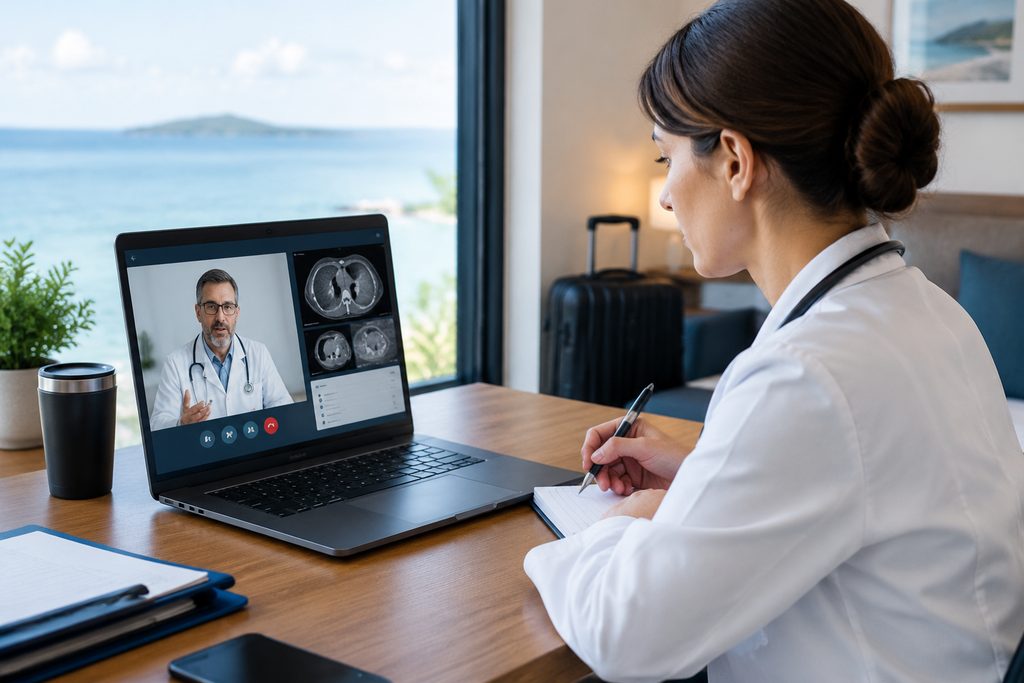
When you send medical records across the world, a fair question comes up: is the remote review real or automated? You are not wrong to ask. Plenty of online platforms run symptom checkers, AI triage bots, or algorithm-generated summaries and call it a “review.” That is not what we coordinate. At China Medical Services, every remote review we arrange involves a licensed physician — or a specialty team — reading your actual imaging, lab reports, and clinical notes. No chatbot. No template. A human specialist looks at your file and produces a written analysis or sits on a video call with you.
But the concern deserves more than a one-line answer. Let us walk through how remote reviews actually work, who reads your records, what the reports look like, and how you can tell the difference between a genuine specialist review and an automated output dressed up to look like one.
Key Takeaways
- Remote reviews we coordinate are performed by licensed physicians at China’s top-ranked hospitals — not by software, not by generalist case managers, and not by administrative staff.
- A written second opinion from a top-tier Chinese specialist costs $300–500 and includes a document you can take to your local doctor for discussion — it is for reference only, not a prescription.
- Video consultations let you speak directly with the reviewing specialist — you hear the reasoning, ask questions, and judge for yourself whether the analysis is real and specific to your case.
- Any consultation fee is credited in full toward on-the-ground coordination if you later travel to China within 90 days — so the remote review is not a sunk cost.
The Problem: You Cannot Verify Expertise Through a Web Form
A genuine written second opinion from a Chinese specialist is a document. It is typically one to three pages. It names the reviewing physician, their department, and their hospital. It references your actual records — the specific CT slice, the exact lab value, the date of your last scope. It raises questions your local team may not have considered. It recommends a direction, not a definitive prescription. And it often says something like “based on the materials provided, further evaluation of X is recommended before proceeding.”
An automated report reads differently. It is generic. It restates your diagnosis. It lists standard treatment options from a textbook. It never asks a question. It never says “I need to see the actual DICOM files, not just the radiology summary.” Those requests are the fingerprints of a real clinician.
Video Consultation Removes the Doubt Entirely
If you want certainty, book a video consultation. You sit face-to-face with the specialist — through a secure platform, with a bilingual coordinator on the line if needed. You watch them review your scans. You hear them think through your case. You ask questions and get answers in real time. An algorithm cannot do that. A junior staffer pretending to be a specialist cannot sustain a 30-minute clinical conversation with a knowledgeable patient. The format itself is the verification.
Video consultations with specialists at ordinary top-tier hospital international departments typically run $100–300. A consultation with a truly top-ranked specialist — the kind of physician who leads a department at a Fudan-ranked hospital — runs $500–800. Multidisciplinary team reviews, where several specialists review your case together, run $1,500–2,000. These are reference prices, and final quotes vary by hospital and case complexity.
How a Remote Review Actually Works: Step by Step
The process is not mysterious. Here is what happens when you request a written second opinion or video consultation through our team.
Step 1 — You send records. We need your existing medical documentation: imaging reports (and ideally the actual DICOM files on a CD or via secure upload), pathology reports, lab results, operative notes if you have had surgery, and a summary of your current condition and treatment history. The more complete the file, the more useful the review.
Step 2 — We translate and organize. A medical translator converts your records into Chinese for the reviewing specialist. This is not machine translation. Clinical terminology, lab units, and medication names must be accurate. A mistranslated pathology report can derail an entire review.
Step 3 — The specialist reviews your file. This takes time. A thorough review of a complex oncology or cardiac case can take one to two hours of focused clinical work. The specialist reads your imaging, studies your labs, and forms a clinical impression — the same work they would do for a patient sitting in their clinic.
Step 4 — You receive the written opinion or attend the video call. For written second opinions, you get a document in English. For video consultations, you get a scheduled session where you can ask questions directly. Either way, you leave with something concrete: a written analysis, a recommended direction, and specific questions to take back to your local doctor.
Step 5 — You decide what to do next. The remote review is a decision-making tool. It is not a commitment to travel to China. Many patients use the written opinion to have a more informed conversation with their local oncologist or surgeon. Some decide to proceed with treatment in China. Some decide to stay home. The review serves you either way.
Is the Remote Review Real or Automated? How to Tell the Difference
If you are evaluating any remote medical review service — ours or someone else’s — here are the questions to ask. The answers will tell you immediately whether you are dealing with a real specialist review or an automated process wearing a white coat.
Who exactly is reviewing my case? A real service names the physician — or at minimum the department and hospital. “Our oncology team” is not an answer. “Dr. [Name], Department of Thoracic Surgery, [Named Hospital]” is an answer. You should be able to verify the physician’s credentials on the hospital’s public website.
Will the reviewer ask follow-up questions? Real specialists almost always need clarification. They want the actual imaging files, not just the summary. They ask about symptoms you did not mention. They request a specific lab test. If the service accepts your records and returns a report without a single clarifying question, be suspicious.
Does the report reference my specific findings? A genuine review says things like “the 3.2 cm mass in the right upper lobe seen on the July CT” or “the hemoglobin of 9.4 g/dL noted in the June labs.” An automated report says “your condition may benefit from further evaluation.” Specificity is the tell.
Can I speak to the reviewer? If the answer is no — not through any channel, not even for a fee — that is a red flag. Real clinical work can be discussed. The physician may not be available for a long call, but a legitimate service can arrange at least a brief video session.
What happens if I disagree with the report? A real service will help you understand the reasoning. They may arrange a follow-up question. They will not just resend the same document. Automated systems have no mechanism for disagreement because there is no one to disagree with.
Practical tip: Before paying for any remote review, ask for a sample report with identifying details redacted. Read it. Does it look like a doctor wrote it? Does it reference specific clinical findings? Would you take it to your local specialist and feel confident discussing it? If the sample reads like a template, the real thing will too.
What the Numbers Mean: Comparing Your Remote Review Options
Remote medical review is not one product. It is a spectrum. Here is how the options we coordinate compare on cost, format, and what you actually receive.
| Service | Reference Price | Format | What You Receive | Best For |
|---|---|---|---|---|
| Written second opinion — top-tier hospital specialist | $300–500 | Written document, 1–3 pages | Clinical analysis of your records, treatment direction, questions for your local doctor | Patients who want a documented specialist perspective to discuss at home |
| Video consultation — standard international department | $100–300 | Live video call, 20–40 minutes | Direct conversation with a specialist, real-time Q&A | Patients with straightforward cases who want quick specialist input |
| Video consultation — top-ranked specialist | $500–800 | Live video call, 30–60 minutes | Direct conversation with a department-leading specialist at a Fudan-ranked hospital | Complex cases where the reviewing physician’s seniority matters most |
| Multidisciplinary team (MDT) video consultation | $1,500–2,000 | Live video call, multiple specialists | Coordinated opinion from several departments — e.g., oncology, surgery, radiology together | Cases where treatment decisions cross specialty boundaries |
Every one of these is a real clinical review by a licensed physician. The difference is depth, seniority, and interaction. And remember: any consultation fee is credited in full toward on-the-ground coordination if you decide to travel to China for treatment within 90 days. The remote review is not a separate expense — it is a down payment on the larger process if you move forward.
Practical Considerations: Records, Language, and Timing
If you are considering a remote review with a Chinese hospital, a few practical matters will shape the experience.
Medical records. You need them in digital form. Request the actual DICOM files from your imaging center — most will provide them on a CD or via a secure download link. Written reports alone are often insufficient. A specialist reviewing a lung nodule needs to see the CT slices, not just the radiologist’s summary. The same applies to pathology slides for oncology cases and echocardiogram loops for cardiac cases.
Translation. Your records must be translated into Chinese for the reviewing specialist. This is clinical translation, not general translation. Lab units need conversion. Medication names need to match Chinese pharmacopeia equivalents. Our team handles this as part of the coordination — but if you are arranging a review independently, budget for professional medical translation. It is not optional.
Visa. A remote review does not require a visa. You can complete a written second opinion or video consultation entirely from home. If you later decide to travel to China for in-person evaluation or treatment, you will apply for an S2 visa — the short-stay category used for medical treatment and private affairs. Family members accompanying you also apply for S2 visas. The M visa is for commercial and trade activities and is not appropriate for medical travel. Requirements vary by embassy, and you should confirm current rules with the Chinese consulate in your country. Hospital documentation supporting your treatment purpose is typically required.
Payment. Remote review fees are paid in advance. Chinese public hospitals require prepayment for international services, and the consultation fee is separate from any future treatment costs. If you have international health insurance, check whether remote second opinions are covered — some policies include them, most do not. Reimbursement is between you and your insurer.
Follow-up after the review. The written opinion or video call is not the end of the conversation. Good remote reviews generate follow-up questions. You may need to send additional records. You may want a second video session. You may want the specialist to speak with your local doctor. These are all possible — just ask.
Frequently Asked Questions
How do I know the person reviewing my records is actually a doctor?
You should receive the reviewing physician’s name, department, and hospital before the review takes place. You can verify their credentials on the hospital’s public website. During video consultations, you see and speak with them directly. For written opinions, the report should be signed and reference specific findings from your records — the kind of detail only a clinician who actually read your file could produce.
What if the remote review disagrees with my local doctor?
That happens, and it is often the most valuable outcome. A second opinion is not a rubber stamp. Chinese specialists at top-ranked hospitals see high volumes of complex cases and sometimes recommend different surgical timing, different treatment sequencing, or additional testing. You are not obligated to follow either opinion. Take both to your local doctor, discuss the differences, and make an informed decision. Disagreement is information, not a problem.
What happens if I pay for a review and the specialist cannot complete it?
If a scheduled video consultation cannot proceed due to the specialist’s availability, we reschedule or refund the fee. For written second opinions, if the reviewing physician determines your records are insufficient to form a meaningful opinion, we will tell you before the review is finalized — not after you have paid for a useless document. You would then have the option to send additional records or receive a refund. No one should pay for a review that never actually happens.
Your Next Step
The question “is the remote review real or automated” deserves a straight answer: the reviews we coordinate are real, performed by licensed physicians at China’s top-ranked hospitals, and documented in writing or conducted live on video. We are a coordination service — not a hospital, not a medical practice, and we do not provide diagnoses. Our team handles translation, hospital communication, and logistics so that a genuine specialist can review your case from across the world.
If you want to know whether a Chinese specialist’s perspective would help your situation, start with a conversation. Tell us about your diagnosis, send what records you have, and we will tell you honestly whether a remote review makes sense for your case. Request a free consultation — no commitment, just a clear answer about your options.
For more medical information and treatment options in China, visit chinamedservices.com (China Medical Services).
