Robotic Knee China Sri Lanka: Advanced Joint Access Without the Wait
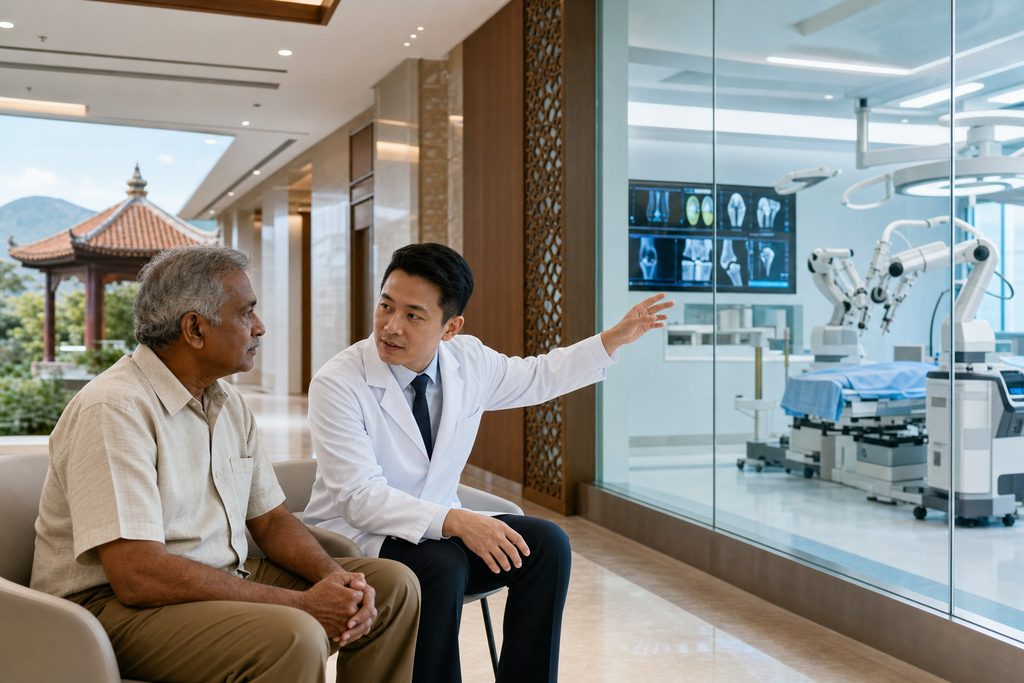
A robotic knee replacement sounds like science fiction. But in plain terms, it means a surgeon uses a robotic arm to remove only the damaged bone and cartilage, sparing healthy tissue. The robot doesn’t operate independently. It acts as a precision guide, letting the surgeon place the implant with sub-millimeter accuracy that a human hand alone struggles to match.
For patients in Sri Lanka, where advanced orthopedic robotics are still emerging, the math is straightforward. A knee that functions well for 20-plus years changes everything — walking without pain, climbing stairs, playing with grandchildren. The question isn’t whether the technology works. The question is where to access it, what the robotic knee replacement cost China actually looks like, and how to navigate the journey safely.
Our team has coordinated care for patients from Colombo, Kandy, Galle, and beyond. We’ve seen what works and what doesn’t. This guide lays out the facts.
How This Actually Works, Step by Step
The process starts with your existing medical records. You don’t need to book a flight and hope for the best. That’s the old way. The smarter path begins remotely.
First, you send us your recent knee X-rays and MRI scans. A brief medical history helps too — when the pain started, what treatments you’ve tried, any other health conditions. We translate these documents into Chinese and forward them to the orthopedic department at a top-tier hospital. Within 3 to 5 business days, you receive a written second opinion. This document tells you whether you’re a candidate for robotic surgery, which implant system fits your anatomy, and what the treatment plan looks like.
If the plan makes sense — and if you choose to proceed — we coordinate a video consultation with the surgical team. You speak directly with the doctors who would hold the instruments. You ask your questions. You see the faces behind the names.
After that, we handle the hospital appointment coordination, the visa invitation letter from the hospital, and the practical logistics. You arrive in China. You undergo a final in-person assessment. Surgery happens. You recover with physiotherapy support. You fly home.
No shortcuts. No promises we can’t keep. But a clear, staged process that lets you build confidence before committing to travel.
What the Robotic Knee Replacement Cost China Numbers Actually Mean
Let’s talk numbers. Patients searching for robotic knee replacement cost China usually find vague ranges or outdated figures. Here’s what we see in practice.
A unilateral robotic-assisted total knee replacement at a top public hospital in Beijing or Shanghai, using the Mako system, typically falls between $15,000 and $25,000 USD. This covers the surgeon’s fee, the robotic system usage, the implant itself, hospital stay of 5 to 7 days, and standard post-operative physiotherapy during admission.
Compare that to private hospitals in Sri Lanka offering robotic knee surgery. Where available, costs range from $12,000 to $18,000 USD. The gap seems narrow until you look at what you’re buying. The Chinese hospitals in our network perform hundreds of robotic knee procedures annually. A surgeon at a top orthopedic center may complete over 300 robotic knee cases per year. Volume drives skill. Skill drives outcomes.
And if you look further afield — Singapore, $35,000 to $50,000. Australia, $30,000 to $45,000. The United States, $50,000 to $70,000. The value proposition becomes stark.
But here’s the honest part. The robotic knee replacement cost China isn’t a fixed menu price. It varies by hospital tier, implant brand, length of stay, and whether any complications arise. Bilateral replacement — both knees in one trip — reduces the per-knee cost but increases surgical risk and recovery demands. We always advise patients to plan for the higher end of the range and treat anything lower as a welcome surprise.
| Country | Unilateral Robotic Knee (USD) | Annual Surgeon Case Volume (Typical) | Wait Time (from Decision to Surgery) |
|---|---|---|---|
| China (Top Public Hospital) | $15,000 – $25,000 | 200 – 400+ | 2 – 6 weeks |
| Sri Lanka (Private, Where Available) | $12,000 – $18,000 | 20 – 50 | 2 – 8 weeks |
| Singapore | $35,000 – $50,000 | 50 – 150 | 4 – 12 weeks |
| India (Top Private Chains) | $8,000 – $15,000 | 100 – 300 | 1 – 4 weeks |
| United States | $50,000 – $70,000 | 100 – 300 | 2 – 8 weeks |
Note: All figures are approximate ranges for international patients. Actual quotes depend on implant choice, hospital, surgeon, and case complexity. Always confirm with a formal treatment plan.
A Realistic Timeline
People imagine flying to China and having surgery the next day. That’s not how it works. Here’s the actual sequence, with the waiting steps nobody mentions.
| Stage | What Happens | Duration |
|---|---|---|
| Week 1 | You send medical records. We translate and submit them. | 2 – 3 business days |
| Week 2 | Written second opinion returned. You review and decide. | 3 – 5 business days |
| Week 3 – 4 | Video consultation scheduled and conducted. Treatment plan confirmed. | 1 – 2 weeks (depends on surgeon availability) |
| Week 4 – 6 | Hospital issues invitation letter. You apply for S2 visa at Chinese embassy in Colombo. | 5 – 10 business days for visa processing |
| Week 6 – 8 | Travel to China. In-person pre-op assessment. Surgery scheduled. | 2 – 5 days between arrival and surgery |
| Week 8 – 10 | Surgery + inpatient recovery + initial physiotherapy. | 5 – 10 days in hospital |
| Week 10 – 12 | Discharge. Outpatient physio if needed. Return to Sri Lanka. | 1 – 2 weeks local stay post-discharge |
The total is 8 to 12 weeks from first contact to returning home. Some cases move faster. Some slower — especially if the surgeon wants additional cardiac clearance or diabetes management before clearing you for anesthesia.
And yes, the S2 visa is the correct category. Not the M visa. The S2 covers private affairs including medical treatment. Your accompanying family member applies under the same category. The hospital provides a formal invitation letter that you submit with your application. We guide you through this. We don’t guarantee approval — that’s the embassy’s decision — but we’ve never seen a properly documented medical case rejected.
What Can Go Wrong — and What Happens Then
This section matters more than any cost comparison.
The most common failure mode is arriving with incomplete imaging. A surgeon needs weight-bearing X-rays, a recent MRI, and sometimes a CT scan to plan robotic surgery. If you show up with a blurry X-ray from five years ago, the pre-op assessment stalls. You wait. You pay for new scans. Your timeline extends by a week. We prevent this by reviewing your records before you book a flight.
Another risk: the surgeon examines you in person and decides robotic surgery isn’t suitable. Maybe your bone quality is worse than the MRI suggested. Maybe a soft-tissue issue needs addressing first. The robotic system isn’t magic. It’s a tool. If the surgeon recommends a conventional approach after seeing you, that’s not a failure — it’s good medicine. You still get the surgery. It just looks different than you pictured.
Infection risk exists. Deep joint infection after primary knee replacement occurs in approximately 1% to 2% of cases globally. Chinese top-tier hospitals report rates at the lower end of this range, but the risk is never zero. If it happens, you need revision surgery and extended antibiotics. This is rare. It’s also real. Plan for the possibility by ensuring your travel insurance or personal funds can cover an extended stay.
What if you’re unhappy with the outcome? The hospital’s international department handles post-operative concerns. We stay involved as your coordination point. Most issues — stiffness, swelling, pain management questions — resolve with remote physiotherapy guidance. But if a serious problem emerges after you return to Sri Lanka, you may need a local orthopedic surgeon to assess you. The Chinese surgical team can provide records and imaging for that local consultation. Continuity of care across borders is imperfect. We’re honest about that.
Is Robotic Knee Surgery in China Safe? What Sri Lankan Patients Need to Know
The short answer: yes, at the right hospitals. The longer answer requires understanding what “safe” means in this context.
Safety isn’t about the robot. The Mako system, manufactured by Stryker, has been used in over one million procedures worldwide. It’s FDA-cleared and subject to the same regulatory standards in China as elsewhere. The robot doesn’t make decisions. It executes the surgical plan that the surgeon programs into it, within defined safety boundaries. If the surgeon tries to cut outside the planned zone, the robotic arm stops.
Safety is about the ecosystem around the surgery. Infection control protocols. Anesthesia team quality. Nursing ratios in the recovery ward. Blood bank availability. Physiotherapy starting on day one post-op. These factors vary dramatically between hospitals.
The best robotic knee surgery hospitals China Sri Lanka patients should consider are those with dedicated international wards and high orthopedic volumes. Look for hospitals ranked in the Fudan University Hospital Rankings for orthopedics. These institutions typically perform over 1,000 joint replacements annually, with robotic cases representing a growing share. Their infection rates are audited. Their surgeons present at international conferences. Their implant choices include the same brands — Stryker, Zimmer Biomet, DePuy Synthes — used in Colombo’s best private hospitals and in Singapore.
One practical point: ask about the specific Mako robotic knee surgery China price before committing. Some hospitals bundle the robotic fee into the surgical package. Others charge it as a separate line item, typically $2,000 to $4,000 USD. You want this clarity in writing.
Practical Considerations: Records, Visa, Payment, and Follow-Up
Let’s cover the logistics that actually matter for a Sri Lankan patient.
Medical records must be in English or translated to Chinese. We handle the Chinese translation. You need to provide clear, recent imaging — ideally digital files on a CD or USB, or uploaded via a secure link. Paper printouts of X-rays are nearly useless for robotic planning. The system needs DICOM files.
The visa category is S2. You apply at the Chinese Embassy in Colombo. Processing takes 5 to 10 business days. You’ll need the hospital invitation letter, your passport with at least six months validity, a completed application form, and a passport photo. Your accompanying family member applies under the same category with the same supporting documents. Do not apply for an M visa. That’s for business visitors. Using the wrong category causes delays or rejection.
Payment is upfront. Chinese public hospitals require a deposit before admission, typically the full estimated treatment cost. International bank transfers work, but they take days. Some hospitals accept credit cards. We advise patients to confirm the payment method during the coordination phase so funds are cleared before you arrive.
Insurance is almost always reimbursement-based. Chinese public hospitals don’t do direct billing with Sri Lankan insurers. You pay. You submit the claim when you return home. Check with your insurer before traveling. Get pre-authorization if your policy requires it. Some international health plans with global coverage may have direct-billing arrangements with specific private hospitals in China, but this is the exception, not the rule.
Follow-up after you return to Sri Lanka requires a local orthopedic surgeon. The Chinese team will provide a discharge summary, implant details, and physiotherapy protocols. Your local doctor manages the long-term follow-up. X-rays at six weeks, three months, one year, and annually thereafter are standard. You send those images to the Chinese team for review if you want their input. Most surgeons are happy to provide remote follow-up commentary for their international patients.
Language during your stay: the international ward nurses speak English. Your surgeon may speak some English, but complex discussions happen through a translator. Our bilingual medical companion stays with you during consultations, pre-op preparation, and post-op rounds. You’re never alone trying to decipher medical Chinese.
Frequently Asked Questions
The total cost in China ranges from $15,000 to $25,000 USD for a single knee. In Colombo, where robotic systems are available at select private hospitals, expect $12,000 to $18,000. The Chinese option costs slightly more but typically offers higher surgeon volume and more mature robotic programs. The value isn’t in saving money — it’s in accessing a depth of experience that smaller markets can’t yet match.
Look for hospitals ranked in the top 10 for orthopedics in the Fudan University Hospital Rankings. These rankings are published annually and widely referenced. Also check whether the hospital has a dedicated international patient center and whether the orthopedic department publishes its surgical volumes. A center doing 500-plus robotic knees per year is in a different league from one doing 30. We can provide this data for specific hospitals during consultation.
Not exactly. You can’t book surgery like a hotel room. What you can do is initiate a remote evaluation process. We submit your records, get a written opinion, arrange a video consultation, and then coordinate the hospital appointment. The “package” — surgery, hospital stay, physiotherapy — gets defined after the surgeon reviews your case. Anyone offering a fixed-price surgical package without seeing your imaging first is cutting corners.
Generally yes, but clearance is mandatory. The pre-op assessment includes cardiac evaluation, blood work, and anesthesia review. If your diabetes is poorly controlled or your heart function is compromised, the surgeon may delay surgery until those issues are managed. This is standard practice everywhere. Chinese hospitals have strong internal medicine departments that can co-manage these conditions during your stay.
You can. The hospital keeps your records. The surgeon who did the primary replacement is usually the best person to handle a revision. But practically, most Sri Lankan patients prefer to have revisions done closer to home if possible. The implant brand used in China is globally available, so a competent orthopedic surgeon in Colombo can manage a revision using the same system. We recommend keeping your implant card — a small document listing the exact model and serial number — in a safe place.
Your Next Step
You’ve seen the costs, the timeline, the risks, and the safeguards. The decision to travel abroad for knee surgery isn’t small. It involves trust, money, and your body. We don’t push. We provide clarity.
Our team at China Medical Services connects Sri Lankan patients with top-tier Chinese orthopedic centers. We translate records, coordinate video consultations, handle hospital appointments, and provide bilingual companionship throughout your stay. We do not perform surgery. We do not guarantee outcomes. We do make a complicated process navigable.
If you’re ready to explore whether robotic knee replacement in China is right for you, start with a free consultation. Send your imaging. Let the data speak first. The rest follows from there.
For more medical information and treatment options in China, visit chinamedservices.com (China Medical Services).
