Root Canal Cost China: Can This Treatment Really Save Your Tooth?
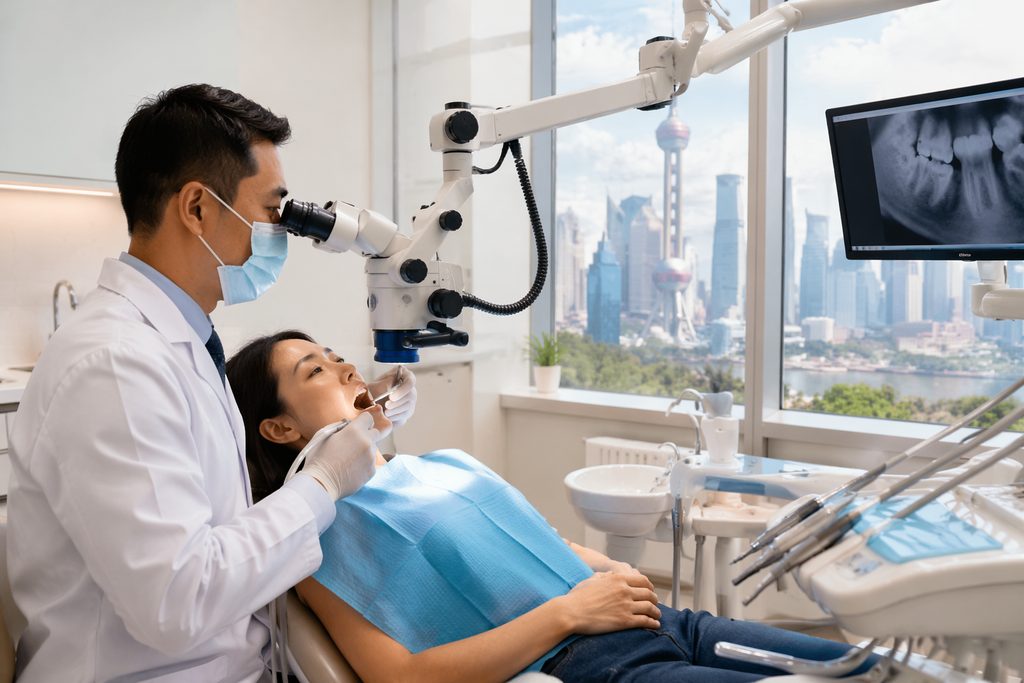
Let’s strip away the dental jargon for a second. A root canal — or endodontic treatment, as your dentist calls it — is a procedure that removes infected or dead pulp from inside your tooth. That pulp is the soft tissue holding nerves and blood vessels. When decay or trauma lets bacteria reach it, the pulp dies. The tooth itself can survive. A root canal cleans out the chamber, disinfects it, fills it, and seals the tooth so it keeps functioning. No extraction. No gap. No implant bill.
So can a root canal save an infected tooth? In most cases where the infection is confined to the pulp and hasn’t destroyed too much surrounding bone or tooth structure, yes. Success rates for first-time root canals on molars run 86–93% over ten years, according to long-term outcome studies in the Journal of Endodontics. The real question for many international patients isn’t whether the procedure works. It’s whether they can afford it at home — and what root canal cost China actually looks like compared to the quote sitting in their inbox.
Our team at China Medical Services regularly fields this exact question from patients in the US, UK, Australia, and the Gulf. They’ve been told they need a root canal and crown. The bill back home is staggering. They start searching for alternatives. Here’s what the data shows and how the process works if China becomes your option.
How This Actually Works, Step by Step
You’re sitting at home with a throbbing molar and a treatment plan from your local dentist. Maybe you’ve already had the diagnosis confirmed with an X-ray or CBCT scan. Here’s the sequence from where you are now to a completed procedure in China.
First, you send us your existing records. That means the panoramic X-ray or CBCT, the dentist’s clinical notes, and any treatment plan already written. We translate these into Chinese and forward them to the international department of an appropriate dental hospital. You don’t need to know which one yet — that’s part of what we sort out.
Second, a Chinese endodontist reviews the records. You get back a written assessment: whether a root canal is still viable for your tooth, how many canals are involved, whether a crown is needed afterward, and what the estimated treatment timeline looks like. This written second opinion costs from $300–500 and gives you a grounded answer before you book any flight.
Third, if you decide to proceed, we coordinate the appointment. Public hospital dental departments in China generally cannot be pre-booked from overseas for routine outpatient care. But the international or VIP dental channel can arrange a scheduled consultation. That’s the route we use. You arrive, meet the endodontist, confirm the plan in person, and treatment typically begins the same day or the next.
Fourth, the procedure itself usually takes one or two visits. A straightforward single-canal tooth — an incisor or premolar — may be completed in a single appointment of 60–90 minutes. A molar with three or four canals often needs two sessions, spaced a week apart, especially if there’s active infection requiring an antibiotic dressing between visits. The crown, if needed, adds another visit or two for impressions and fitting.
Can a Root Canal Save an Infected Tooth? What the Evidence Says
The short answer: yes, with caveats. Endodontic treatment exists precisely because extraction isn’t the only answer to deep infection. But the tooth has to still be structurally worth saving.
Three factors determine whether a root canal will work. The first is the extent of infection. If the abscess is localized to the pulp chamber and root canals, the prognosis is strong. If the infection has destroyed significant supporting bone or caused a large periapical lesion, the tooth may still be savable but with a lower success rate. The second factor is remaining tooth structure. A tooth that’s fractured below the gumline or has lost more than half its clinical crown may not hold a restoration even after a successful root canal. The third is periodontal health. A root canal fixes the inside of the tooth. It does nothing for gum disease destroying the outside support.
And here’s the thing many patients don’t hear at home: a root canal without a crown on a posterior tooth fails at nearly twice the rate of one with a crown. The crown isn’t optional decoration. It’s the structural reinforcement that keeps the treated tooth from splitting under chewing forces. When comparing root canal vs extraction price abroad, you need to include the crown. An extraction looks cheaper on paper. Add the implant, abutment, and crown to replace the missing tooth, and extraction is almost always the more expensive path — by a factor of two to three.
A Realistic Timeline
Here’s what the actual calendar looks like for an international patient traveling to China for a root canal. This assumes you’re starting with a confirmed diagnosis and existing X-rays.
| Stage | What Happens | Typical Duration |
|---|---|---|
| Day 1–3 | You send records; we translate and forward to dental hospital | 1–3 days |
| Day 4–10 | Endodontist reviews records and issues written opinion | 5–7 days |
| Day 11–25 | S2 visa application with hospital invitation letter | 1–2 weeks, varies by consulate |
| Day 26–30 | Arrival in China; first in-person consultation and X-ray | 1 day |
| Day 27–35 | Root canal procedure (1–2 visits depending on canals) | 1–10 days |
| Day 36–42 | Crown preparation, impression, temporary crown | 2–5 days |
| Week 6–8 | Permanent crown placement or shipped to home dentist for cementation | Varies |
The stage people forget is the visa. China does not have a dedicated medical visa for short stays. The S2 visa covers private affairs including medical treatment, but processing times vary by country and consulate. Some issue within five business days. Others take three weeks. The hospital’s international department provides a treatment invitation letter, but no one can guarantee consulate approval speed. Budget realistically.
Also note: if your tooth has an active abscess, you may need a short course of antibiotics before the procedure. That can shift the timeline by a few days. And if the endodontist finds a calcified canal or a missed canal on the cone-beam CT, the appointment runs longer. That’s normal, not a failure.
What Can Go Wrong — and What Happens Then
Root canals fail. Not often, but they fail. And you deserve to know what that looks like before you board a plane.
The most common failure mode is a missed canal. Molars, especially lower molars, sometimes have a fourth canal that’s easy to miss on a standard X-ray. A missed canal means bacteria stay behind, and the tooth re-infects within months. The fix is retreatment — reopening the tooth, finding the missed canal, and cleaning it. Retreatment success rates run 70–80%, lower than the first attempt. In China, cone-beam CT imaging is standard before molar root canals in reputable hospitals, which significantly reduces missed-canal risk. But it’s not zero.
Another failure mode is vertical root fracture. This happens when a tooth was already cracked, or when the patient delays the crown and the tooth splits under load. A vertically fractured root cannot be saved. Extraction is the only option. This is why honest endodontists will sometimes tell you a root canal isn’t worth attempting — the tooth is already compromised beyond repair. When that happens, the fallback is extraction plus implant or bridge. The written second opinion should flag this risk before you travel.
Post-operative pain is also part of the picture. Some patients expect zero discomfort after a root canal. In reality, 3–6% of patients experience significant post-operative flare-ups, usually from inflammation of the surrounding tissue. It settles with anti-inflammatories within a few days. If it doesn’t, you need a follow-up X-ray. If you’re back home by then, your local dentist handles it. That’s the reality of dental tourism: the procedure happens in China, but the follow-up happens wherever you live.
Root Canal Cost China: What You’ll Actually Pay
Here’s where the numbers get concrete. Root canal cost China varies by tooth type, clinic tier, and city. A single-canal incisor at a public hospital’s international department in a second-tier city might run $80–150. A three-canal molar at a top private international clinic in Shanghai or Beijing runs $250–500. Add a porcelain-fused-to-metal crown for $150–300, or a zirconia crown for $300–600.
| Procedure | China (International Dept / Private) | United States (Average) | United Kingdom (Private) |
|---|---|---|---|
| Root canal — incisor | $80–150 | $700–1,200 | $400–700 |
| Root canal — premolar | $120–220 | $800–1,400 | $500–800 |
| Root canal — molar | $250–500 | $1,200–2,000 | $700–1,200 |
| Zirconia crown | $300–600 | $1,000–2,500 | $600–1,100 |
| Total molar + crown | $550–1,100 | $2,200–4,500 | $1,300–2,300 |
So how much is a root canal in Shanghai? At a public hospital’s international department, a molar root canal plus zirconia crown typically lands between $600 and $1,000 all-in. At a premium private clinic like Jiahui or United Family, the same treatment runs $1,000–1,800. Still 50–70% below US private-pay rates. Prices always vary by hospital and case complexity — these are ranges, not quotes.
The deeper comparison is root canal vs extraction price abroad. Extracting the same molar in the US costs $200–600. Sounds cheaper. But then the implant: $3,000–6,000 including abutment and crown. Suddenly the root canal at $2,200–4,500 looks like the bargain it is. In China, the same logic holds. A root canal and crown at $600–1,000 beats an extraction and implant at $1,500–3,000. Saving the tooth is almost always the financially rational choice when it’s structurally possible.
Is Root Canal Treatment Painful in China? What to Expect
This question comes up in nearly every consultation. The honest answer: the procedure itself should not be painful. Modern endodontics relies on local anesthesia — usually articaine or lidocaine — and Chinese dental hospitals use the same anesthetic agents as Western clinics. The injection stings for a few seconds. After that, you should feel pressure and vibration but not sharp pain.
What surprises some international patients is the pace. Chinese endodontists work fast. A single-canal root canal may be finished in 40 minutes. That speed isn’t a quality compromise — it’s volume. Top Chinese dental hospitals treat enormous patient loads daily, and their endodontists perform more root canals in a month than many Western dentists do in a year. Repetition breeds efficiency.
Post-operative soreness is normal for 2–5 days, especially on a tooth that was actively infected. Over-the-counter ibuprofen handles it for most patients. If you need something stronger, the clinic prescribes it. And if you’re anxious, many international dental departments offer sedation options — discuss this during the written opinion stage so it’s arranged before you arrive.
Practical Considerations: Records, Visa, Payment, and Follow-Up
Bring everything. That means the initial X-ray, any CBCT scan files, your dentist’s written diagnosis, and a list of medications you take. Translation matters — we handle the medical translation, but you should bring your own summary in English too.
For the visa, the S2 category applies. The hospital’s international department issues an invitation letter confirming your treatment plan and dates. Your accompanying family member applies for their own S2. Processing times vary, so apply as soon as the written opinion confirms you’re proceeding. No one can guarantee approval, but a complete application with hospital documentation is straightforward in most consulates.
Payment is typically upfront at public hospitals — cash, UnionPay, or major international cards at international departments. Private clinics may accept direct insurance billing if they’re JCI-accredited and contracted with your insurer. Check before you commit. Most international patients pay out of pocket and claim reimbursement from their insurer afterward. Get itemized receipts in English from the clinic.
Follow-up at home is your responsibility. Your local dentist can take a final X-ray six months after the procedure to confirm healing. If you opt for a temporary crown in China and a permanent one at home, coordinate that before you leave. The Chinese clinic will send the crown specifications to your home dentist.
Frequently Asked Questions
Yes, in most cases. An abscess is a sign the infection has spread beyond the pulp, but the root canal removes the source of that infection. The abscess then heals over several weeks to months. Success rates drop if the abscess is very large or if significant bone has been destroyed, which is why a CBCT scan matters before deciding.
Beijing has two strong options. Public hospitals like Peking University School of Stomatology run international departments with experienced endodontists and modest pricing. Private JCI-accredited clinics like United Family and Raffles offer English-speaking staff, direct insurance billing, and shorter wait times at higher prices. The Beijing hospital guide on our site breaks down the differences. The right choice depends on your budget and how much hand-holding you want.
Ask your dentist three questions: Is the tooth structurally sound enough to hold a crown? Is the infection localized or has it spread? What’s the total cost of saving the tooth versus extraction plus replacement? If the tooth is sound and the infection is confined, a root canal is almost always the better long-term investment. If the tooth is fractured or too little structure remains, extraction may be the honest recommendation.
It depends entirely on your policy. Some international health insurance plans cover treatment abroad and will reimburse you after you submit itemized receipts. Others only cover emergency treatment overseas. US dental insurance typically does not cover treatment outside the US. Check with your insurer before booking. We provide English-language documentation to support your claim, but we cannot guarantee reimbursement.
Your Next Step
A root canal is one of the most common dental procedures in the world — and one of the most feared. The fear is mostly outdated. Modern anesthesia, cone-beam imaging, and experienced endodontists have made it routine. The real decision is financial and logistical: can you get it done well, at a price that makes sense, without burning a week of vacation on logistics?
That’s where we come in. China Medical Services connects international patients with top-tier Chinese dental hospitals. We handle record translation, specialist review, appointment coordination, and bilingual accompaniment. We do not perform treatment, and we do not promise specific outcomes. What we do is make the path clear. If you’re weighing a root canal abroad, start with a free consultation — send your X-rays, get an honest assessment, and decide from there.
For more medical information and treatment options in China, visit chinamedservices.com (China Medical Services).
