Same-Day Diagnosis in China: Test Results in Hours, Not Weeks
Key Takeaways
- Top-tier Chinese hospitals routinely return blood panels, CT scans, and MRI reports within 2–6 hours, often same-day.
- Executive health screening packages in Shanghai and Beijing start from $300–$800 and include full-body imaging plus lab work completed in one morning.
- Language barriers and unfamiliar hospital workflows are the biggest obstacles for foreign patients — not medical quality or speed.
- You cannot book most public hospital outpatient appointments from overseas. Same-day testing requires either walk-in registration or coordination through an international department.
The Problem: Waiting Weeks for Answers That Should Take Hours
When 42-year-old Michael from Manchester found a suspicious lump during a routine self-exam, his GP referred him for an ultrasound. The earliest appointment was 19 days out. The ultrasound results took another 8 days to reach his doctor. That is 27 days of uncertainty. Multiply Michael’s experience across millions of patients in the UK, Canada, Australia, and parts of the United States, and you see a systemic bottleneck that has nothing to do with medical expertise and everything to do with diagnostic capacity and scheduling inefficiency.
A 2023 survey by the Canadian Association of Radiologists reported median wait times for CT scans at 50–82 days depending on province. MRI waits stretched to 89 days in some regions. In the UK, NHS England data from January 2024 showed that over 1.6 million patients were waiting for diagnostic tests, with roughly 23% waiting more than six weeks. For patients with suspected cancer, every week of delay reduces five-year survival odds by measurable margins. The British Journal of Cancer published a widely cited analysis in 2020 estimating that a four-week delay in cancer treatment increases mortality risk by approximately 10% for many solid tumors.
So patients start looking elsewhere. They search for same day diagnosis China cost, 24 hour medical checkup Shanghai price, or how fast are blood test results in China hospitals. The underlying question is the same: can I get answers faster somewhere else without sacrificing accuracy?
The short answer is yes — with important caveats.
Why Chinese Hospitals Deliver Same-Day Diagnostic Results
China’s top-ranked hospitals operate at a scale that fundamentally changes turnaround times. A major public tertiary hospital in Shanghai or Beijing may process 10,000–15,000 outpatient visits per day. Fuwai Hospital in Beijing performs over 14,000 cardiac surgeries annually — the highest volume of any heart center globally. This volume forces operational efficiency. Radiology departments run MRI machines 16–18 hours daily. Laboratory automation handles tens of thousands of specimens per shift.
Volume Creates Speed — and Competence
A radiologist at a high-volume Chinese hospital reads more chest CTs in one week than many Western counterparts read in a month. That repetition sharpens pattern recognition. Shanghai Chest Hospital, for instance, performs approximately 20,000 CT-guided lung biopsies annually. The sheer repetition compresses both wait times and reporting intervals. Blood panels that take 3–5 days at a suburban American lab are often returned in 2–4 hours at a Chinese tertiary hospital lab running continuous automated lines.
But volume alone does not explain the speed.
Integrated Workflows: Lab, Imaging, and Clinician Under One Roof
Chinese public hospitals are vertically integrated. The lab, radiology suite, pharmacy, and specialist clinics sit in the same building or adjacent towers. When a doctor orders a complete blood count, liver panel, and tumor markers, the specimen travels by pneumatic tube or hospital courier — not across town to a third-party lab. Results post to the hospital’s electronic medical record system, and the ordering physician sees them on a workstation within hours. The patient collects a printed report from a self-service kiosk, often before leaving the hospital campus.
This integration is the structural reason why a same day diagnosis China cost is not just possible but routine. The workflow removes the handoffs that create delays in fragmented systems.
Cost Advantage Without Quality Compromise
Lower cost does not mean lower quality. It reflects different economics. Chinese hospital labs and imaging departments run at near-continuous utilization, spreading fixed costs across far more patients. Labor costs for technicians and support staff are lower than in the US or Europe. Equipment is often newer — many top hospitals run GE, Siemens, and Philips machines purchased within the last 5–7 years. The result: a comprehensive executive health screening in Shanghai, including chest CT, abdominal ultrasound, ECG, and full blood work, costs roughly $300–$800. A comparable package at a private London or New York clinic runs $2,500–$5,000 or more.
That price gap is not a quality gap. It is an efficiency and labor-cost gap.
What Same-Day Diagnosis Actually Looks Like in Practice
Here is a realistic timeline for a foreign patient walking into the international department of a top Shanghai hospital at 8:00 AM.
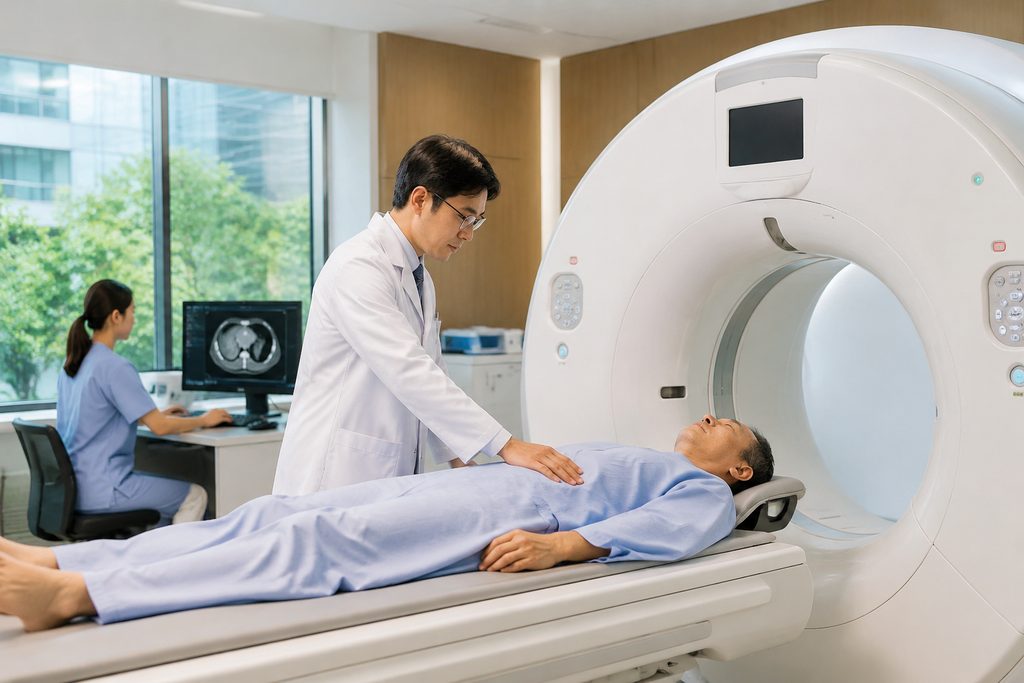
Registration takes 10–15 minutes with a bilingual coordinator. Blood draw happens by 8:30 AM. A chest CT is scheduled for 9:15 AM, completed by 9:30. Ultrasound follows at 10:00. By 11:30 AM, most blood results are posted. The radiologist’s preliminary CT read is available by 1:00 PM. A specialist consultation to review everything can be arranged for 2:00 PM the same afternoon.
This is not an exceptional scenario. It is the standard workflow at hospitals like Zhongshan Hospital Fudan University, Peking Union Medical College Hospital, and West China Hospital in Chengdu. The bottleneck is rarely the diagnostics — it is navigating the system without Chinese language skills.
How Fast Are Blood Test Results in China Hospitals?
Routine hematology and biochemistry panels: 1–3 hours. Tumor markers and hormone assays: 4–8 hours. Genetic or specialized immunology tests: 1–3 days. The fastest turnaround comes from hospital-based labs attached to large tertiary centers. External commercial labs, used by some smaller clinics, take longer — typically 24–72 hours.
Can I Get MRI Results Same Day in Beijing?
Yes, with planning. MRI slots at top Beijing hospitals are heavily booked. Walk-in same-day MRI is not guaranteed. But international department coordinators can often secure a same-day or next-day slot when a referring physician marks the request urgent. The scan itself takes 20–45 minutes. The radiologist’s written report is typically available 2–4 hours after the scan completes. Films and the report are provided digitally and in print.
Practical tip: Book MRI and CT slots in advance through a hospital’s international department. Walk-in imaging at public hospitals without prior coordination can mean waiting in line at 6:00 AM — or being told to return another day.
Comparing Your Options: Executive Screening vs. Targeted Diagnostics
Patients searching for rapid diagnosis medical tourism China packages often face two distinct paths. Understanding the difference saves money and time.
Executive health screening packages are comprehensive. They bundle full-body imaging, extensive lab panels, cardiac testing, and specialist review into one half-day or full-day visit. Prices vary by hospital tier and package depth.
Targeted diagnostics are problem-focused. You bring existing medical records, a suspected diagnosis, or specific symptoms. The hospital orders only the relevant tests. This is usually cheaper and faster than a full screening package, but requires a physician to determine what is medically necessary.
| Option | Typical Price Range (USD) | Time to Complete | Best For |
|---|---|---|---|
| Basic executive screening (Shanghai) | $300–$500 | Half day | General health check, routine labs, chest X-ray, ultrasound |
| Comprehensive executive screening (Beijing) | $600–$1,200 | Full day | Full-body CT, cardiac stress test, tumor markers, specialist review |
| Targeted diagnostic workup (e.g., lung nodule evaluation) | $400–$900 | 1–2 days | CT chest, lab panels, pulmonology consult |
| Written second opinion on existing imaging | $300–$500 | 3–7 days | Review of scans and reports without traveling |
Prices vary by hospital and case complexity. International department rates run 1.5–2 times standard public pricing, reflecting English-language coordination and expedited scheduling.
Who Should NOT Chase Same-Day Diagnosis in China
Same-day diagnostics solve a speed problem. They do not solve every problem. If your condition is stable and your home-country doctor is managing it appropriately, flying to China for faster test results may be unnecessary. The travel cost, time away from work, and coordination burden can outweigh the benefit.
Also, a Chinese hospital report is not automatically accepted by your home physician. Some Western doctors will want to repeat imaging or labs at their own facility. Before you book anything, ask your home doctor: will you accept a report and images from a Chinese hospital? If the answer is no, a written second opinion from a Chinese specialist reviewing your existing records may be a better first step.
Emergency conditions are another exclusion. If you are actively unstable — severe chest pain, neurological deficits, uncontrolled bleeding — do not board a plane. Seek local emergency care immediately. Medical tourism is for planned diagnostics and treatment, not acute crises.
Practical Considerations: Visas, Payment, and Records
Foreign nationals traveling to China for medical treatment typically apply for an S2 visa, which covers short-term private affairs including medical visits. Accompanying family members also apply for S2. For stays exceeding 180 days, an S1 visa applies. The M visa is for commercial and trade activities — it is not appropriate for medical travel. Chinese consulates generally require a letter from the receiving hospital confirming your appointment before issuing an S2 visa for medical purposes.
Payment at Chinese public hospitals is prepaid. You deposit funds at registration, and tests and consultations are deducted from that balance. International departments accept major credit cards and sometimes international insurance with direct billing. Standard public departments typically require cash or Chinese mobile payment (WeChat Pay or Alipay). If you do not have a Chinese bank account, this is a real friction point.
Bring all prior medical records: imaging on CD or USB, pathology slides if relevant, blood work, and a summary letter from your referring physician. Hospitals in China will want to see the full picture before ordering new tests. Records in English are generally accepted; records in other languages may require translation.
After returning home, follow-up is your responsibility. Chinese hospitals provide discharge summaries and test reports in English upon request from international departments. Share these with your home physician promptly.
Frequently Asked Questions
A targeted diagnostic workup — blood panels, one or two imaging studies, and a specialist consultation — typically runs $300 to $900 at a top public hospital’s international department. Comprehensive executive screening packages range from $500 to $1,200. Private international hospitals like United Family or Jiahui charge more, often $1,500 to $3,000 for similar packages, but offer Western-style service and direct insurance billing. Final pricing always depends on the hospital, the specific tests ordered, and case complexity.
Some will, some will not. Many Western physicians are unfamiliar with Chinese hospital accreditation and may prefer to repeat imaging or labs. Before committing to travel, ask your home doctor directly whether they will accept reports from a specific Chinese hospital. If they hesitate, consider a written second opinion from a Chinese specialist reviewing your existing records first — that costs $300 to $500 and gives you useful medical guidance without the travel commitment.
This is a legitimate concern, and it is why choosing a hospital with strong international coordination matters. If a Chinese physician identifies a serious condition, they will discuss treatment options with you. You are never obligated to pursue treatment in China. You can return home with the full report and images and continue care with your local doctors. Many patients use Chinese diagnostics to get answers fast, then decide on treatment location separately. A small number choose to stay for surgery or ongoing care, but that is a separate decision with its own planning process.
You cannot book most public hospital outpatient appointments directly from abroad. Public hospital registration systems are designed for domestic patients and typically require in-person registration. What you can do is coordinate through a hospital’s international department or a medical coordination service, which can pre-arrange your screening package, imaging slots, and specialist consultations before you arrive. Private international hospitals in Shanghai do accept direct overseas bookings for executive screenings.
For more detail on how hospital selection works across China’s top-ranked institutions, see our guide to Fudan-ranked hospitals by city. If you are weighing public versus private options, our comparison of JCI-accredited private international hospitals covers insurance billing and service differences. And for specialty-specific rankings — oncology, cardiac surgery, orthopedics — browse our department rankings across 45 specialties.
Your Next Step
Same-day diagnosis in China is real, measurable, and accessible — but it requires planning. The diagnostics are fast. The system is not intuitive for first-time foreign visitors. That is where preparation makes the difference between a smooth one-day workup and a frustrating week of queues and miscommunication. Our team at China Medical Services helps international patients navigate hospital selection, appointment coordination, and on-the-ground logistics. We are not a hospital and we do not provide medical diagnoses. We connect you with the right specialists and make sure your records, scheduling, and language support are handled before you land. When you are ready to explore whether same-day diagnostics in China fit your situation, start with a conversation.
For more medical information and treatment options in China, visit chinamedservices.com (China Medical Services).
