Same-Day MRI in China: How We Arrange Rapid Imaging for Foreigners
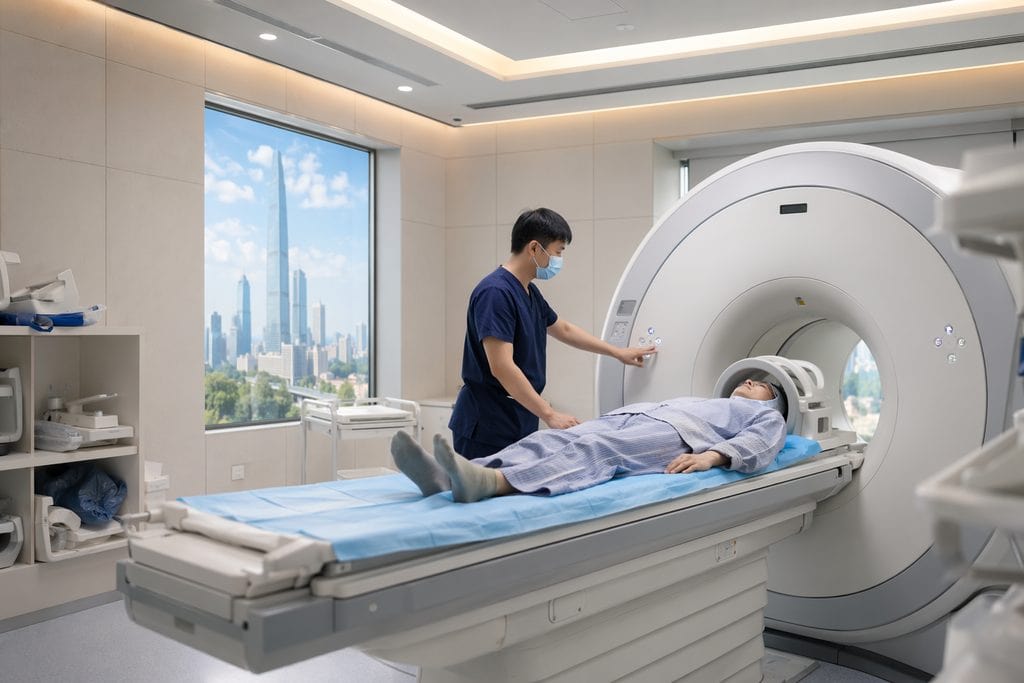
Getting an MRI in the United States often means waiting two to four weeks for a non-emergency scan. That delay can stretch even longer in Canada, where the median wait for an MRI reached 50 days in 2024 according to the Fraser Institute. Now consider the same day MRI cost China offers: typically between $150 and $450 depending on the body region and hospital tier. The economics and the timeline both shift dramatically when you cross the Pacific.
Our team at China Medical Services coordinates imaging appointments for international patients every week. We know exactly which hospitals can accommodate a foreign patient on short notice, what documentation you need, and how to avoid the common mistakes that waste a day or a trip. This guide explains the process from first inquiry to walking out with your images and report.
Key Takeaways
- Same-day MRI in China typically costs $150–$450, compared to $1,200–$3,000+ in the United States before insurance.
- Top-tier Chinese hospitals operate MRI machines 16–18 hours daily, seven days a week, enabling genuinely rapid scheduling.
- Foreigners cannot simply walk into a public hospital and demand a same-day scan — you need a doctor’s referral and proper registration.
- Private international hospitals in Beijing and Shanghai offer the fastest access for self-paying patients, often with English-speaking staff.
The Problem: MRI Wait Times Are a Global Bottleneck
Wait times for MRI scans have become a quiet crisis across Western healthcare systems. The Canadian Medical Association reported in 2023 that patients waited a median of 10.6 weeks between referral and scan. In the UK’s NHS, the target is six weeks, but more than 30% of patients waited longer than that in 2024. American patients with private insurance fare better on average, but even they face scheduling friction: prior authorization requirements add 3–7 business days, and popular imaging centers in major metros routinely book two to three weeks out.
What does that delay actually cost? For a patient with persistent back pain, waiting a month for a lumbar MRI means a month of uncertainty, a month of pain medication, and a month before a surgical consult can even be scheduled. For a patient with suspected neurological symptoms, the stakes are higher. The wait is not just inconvenient — it changes clinical pathways. A 2022 study in the Journal of the American College of Radiology found that delayed imaging contributed to 12% of missed or delayed diagnoses in outpatient settings.
So patients start looking elsewhere. Thailand, Singapore, Turkey, and increasingly China have built medical infrastructure specifically designed to absorb international demand. China’s advantage is scale: with over 35,000 hospitals nationwide, the top 5% — roughly 340+ top-ranked institutions — operate imaging departments that would be unrecognizable to someone used to a Western community hospital.
Why China Delivers Rapid MRI Access Without Sacrificing Quality
Machine Density and Operating Hours
China has more MRI machines per urban population center than almost any other country. According to OECD data, China installed over 15,000 MRI units by 2023, and the number keeps climbing. Major hospitals in Shanghai and Beijing operate multiple machines simultaneously — not one or two, but five, eight, sometimes ten scanners running in parallel across different buildings. That volume changes everything about scheduling.
Most public tertiary hospitals in China run imaging departments from 7:00 AM to 10:00 PM, seven days a week. Some extend to midnight during peak seasons. A hospital performing 400–600 MRI scans per day can absorb a same-day or next-day request far more easily than a Western facility doing 40. That is the structural reason why how fast can I get an MRI in Shanghai has a much better answer than most patients expect: often within 24–48 hours at a private international hospital, and sometimes the same day at a public hospital’s international department.
Radiologist Availability and Reporting Speed
An MRI without a radiologist’s read is just a very expensive photograph. Chinese top-tier hospitals employ large radiology teams, often 50–100 radiologists per institution, with subspecialty readers for neuroimaging, musculoskeletal, cardiovascular, and abdominal studies. In many international departments, preliminary verbal results are available within two to four hours. The formal written report — in English if requested — typically follows within 24 hours.
This speed does not come at the expense of accuracy. Fudan University’s hospital rankings, which evaluate clinical quality across 45 specialties, consistently place Chinese radiology departments among the strongest in Asia. Many top hospitals also hold JCI accreditation, meaning their imaging protocols meet international safety and quality standards.
Cost Structure: Why the Same-Day MRI Cost in China Is a Fraction of Western Prices
Let us address the obvious question: how can a high-quality MRI cost $150 when the same scan bills at $2,600 in a US hospital? The answer is structural, not a compromise on quality. Chinese hospitals operate on much lower labor costs — a senior radiologist in Shanghai earns a fraction of what a comparable specialist earns in Boston or London. Equipment costs are amortized across vastly higher patient volumes. Administrative overhead is lower. And crucially, the pricing model for self-paying international patients is transparent: hospitals publish fee schedules, and there is no insurance-driven price inflation.
The table below shows typical self-pay MRI prices for international patients in China compared to US list prices.
| MRI Type | China (Self-Pay, USD) | United States (List Price, USD) | Typical China Wait Time |
|---|---|---|---|
| Brain MRI (without contrast) | $150–$280 | $1,200–$3,500 | Same day – 48 hours |
| Lumbar Spine MRI | $180–$350 | $1,500–$4,000 | Same day – 72 hours |
| Knee MRI | $160–$300 | $900–$2,800 | Same day – 48 hours |
| Full Body MRI (screening) | $500–$900 | $3,000–$8,000 | 1–3 days |
Prices vary by hospital tier, city, and whether contrast material is required. Private international hospitals in Beijing and Shanghai sit at the higher end of these ranges but offer the smoothest experience for English-speaking patients.
How to Book a Same-Day MRI in China: The Step-by-Step Process
Here is what actually happens when a foreign patient wants rapid imaging in China. The process is not complicated, but it does require specific documents and the right entry point. Skipping a step is the most common reason a “same-day” plan falls apart.
Step 1: Get a Referral or Clinical Justification
Chinese hospitals — public and private alike — will not perform an MRI without a doctor’s order. This is a legal and clinical requirement, not bureaucratic friction. If you already have a referral from your home-country physician, that document must be translated into Chinese (or English, for international departments) and include the clinical question, suspected diagnosis, and body region to be scanned. No referral? Some hospitals allow you to see a specialist first, who then orders the scan. That adds a few hours but keeps everything above board.
Step 2: Choose the Right Hospital Category
You have three realistic options for rapid imaging as a foreigner:
Private international hospitals — such as United Family, Jiahui, and Parkway in Shanghai and Beijing — are designed for exactly this scenario. English-speaking staff, self-pay pricing, and same-day or next-day MRI slots are standard. Private MRI scan price Beijing at these facilities typically runs $250–$450. They also handle direct insurance billing with many international insurers.
Public hospital international departments — top-tier public hospitals like Peking Union Medical College Hospital and Zhongshan Hospital operate dedicated international wings. These offer the same equipment and radiologists as the main hospital, with English coordination and priority scheduling. Prices are 1.5–2 times the standard public rate, which still lands far below Western costs.
Standard public hospital imaging departments — the cheapest option, but the least practical for a foreigner on a short timeline. Registration requires a Chinese ID or passport, a local phone number, and navigating a system designed for domestic patients. Without Chinese language ability, this path is genuinely difficult. Our bilingual companions exist precisely for patients who need this option.
Step 3: Prepare Your Documents
Bring your passport, your translated referral, any prior imaging (CDs or films), and a list of current medications. If you have metal implants, stents, or claustrophobia concerns, disclose these in advance. Some hospitals require a creatinine blood test before contrast-enhanced MRI if you are over 60 or have kidney risk factors — this can be done on-site in under an hour.
Step 4: Arrive, Register, Scan, Receive
On the day of your scan, registration at an international department takes 15–30 minutes. The MRI itself runs 20–45 minutes depending on the region and protocol. Preliminary findings are often discussed the same day. The formal English report arrives within 24 hours, and images are provided on CD, USB, or via secure download link.
Can Foreigners Get Immediate MRI in China? Eligibility and Realistic Timelines
The short answer: yes, foreigners can get an MRI in China, and “immediate” is genuinely possible in the right setting. But the honest answer requires nuance. Can foreigners get immediate MRI in China depends on three factors: which hospital category you choose, whether you have a valid referral, and whether you need contrast.
At a private international hospital in Shanghai, a self-paying patient with a clear referral can often be scanned the same afternoon. We have coordinated same-day brain MRIs for patients who landed at Pudong Airport at 9 AM and had images in hand by 5 PM. That is not a guarantee — it is what the system can do when everything aligns.
At a public hospital’s international department, same-day is sometimes possible for non-contrast studies if you arrive before noon. Contrast studies require a blood test first, which pushes the scan to the next morning in most cases. Standard public departments, without coordination, should be planned as a 2–3 day process at minimum.
One more consideration: if you are traveling to China specifically for imaging, you need the correct visa. Foreigners seeking medical treatment apply for an S2 visa, which covers short-term private affairs including medical care. Your hospital appointment confirmation and referral documents support the application. The M visa is for commercial and trade activities only — it is not the right category for medical travel, and using it for that purpose can create problems at the border.
MRI Scan Package for International Patients in China: What Is Included and What to Watch For
Several hospitals and medical facilitation agencies now offer MRI scan package for international patients China travelers can book in advance. These packages bundle the scan itself with coordination services, and they vary significantly in value.
A typical package includes: appointment scheduling, English-speaking coordination, the MRI scan, radiologist interpretation, and an English report. Some add airport pickup, hotel recommendations, or a follow-up consultation with a specialist. Prices for packages run from $350 to $1,200 depending on the hospital and the level of service.
What should you watch for? First, confirm whether the package price includes the radiologist’s formal report or only the images. Second, ask whether a specialist consultation is included or billed separately. Third, verify which hospital the scan will be performed at — some packages use lower-tier facilities rather than the top-ranked institutions patients assume they are getting. If a package seems too cheap, ask for the hospital name and check it against the Fudan-ranked hospital database.
Important: A package that promises a specific scan time at a specific top-tier hospital without seeing your referral first is a red flag. Legitimate coordination requires your clinical documents before any appointment can be confirmed.
Practical Considerations: Documentation, Payment, and Follow-Up
If you are planning to book urgent MRI scan China medical tourism packages for, there are several practical matters to handle before you fly. None of them are complicated, but each one can derail a tight timeline if ignored.
Medical records and translation. Your referral must be in English or Chinese. Most international patients have English referrals, which are accepted at international departments and private hospitals. If your referral is in another language, arrange translation before you travel. Prior imaging is extremely valuable — bring the actual images, not just the reports. A Chinese radiologist will want to compare new and old scans directly.
Payment. Chinese hospitals require payment at the time of service for self-paying international patients. Credit cards are accepted at international departments and private hospitals, though UnionPay is more universally accepted than Visa or Mastercard. Cash in RMB works everywhere. Wire transfer in advance is possible for packages. Keep all receipts — your home insurer may reimburse you even though the Chinese hospital does not bill them directly.
Insurance. Some international insurers have direct billing arrangements with private hospitals like United Family and Jiahui. If your plan includes these networks, your out-of-pocket cost could be minimal. For public hospital international departments, you will pay upfront and submit for reimbursement. Request an itemized invoice and a copy of the radiologist’s report in English — both are required by most insurers.
Language. Private international hospitals operate in English. Public hospital international departments have English-speaking coordinators. Standard public departments do not. If you need to access the cheapest option, a bilingual companion is not a luxury — it is the difference between a smooth scan and a lost afternoon. Our team provides this service daily, and we have seen exactly how much friction it removes.
After you return home. Your Chinese MRI images are in DICOM format, which any Western radiologist can read. The English report is written to international standards. If your home physician wants a second read, that is easily done — and often recommended, since your treatment will be managed at home.
Frequently Asked Questions
Yes. Chinese hospitals require a clinical indication before performing an MRI. A referral from your home physician, translated into English or Chinese, is sufficient. If you do not have one, you can see a specialist at the hospital first, who will order the scan after evaluating you.
Top-tier Chinese hospitals use the same MRI equipment as leading Western institutions — Siemens, GE, and Philips machines are standard. Radiologists at Fudan-ranked hospitals are highly trained, and many have international fellowship experience. JCI-accredited facilities meet international quality and safety standards. The main variable is hospital tier: choose from the top 5% of institutions, not a random local clinic.
If the scan reveals a significant finding, the hospital can arrange a specialist consultation — often the same day or the next. You will leave with a clear diagnosis or differential, a recommended treatment plan, and all images and reports in English. You can then decide whether to pursue treatment in China or return home with the information your local doctors need.
Same-day is real, but conditional. At private international hospitals in Shanghai and Beijing, a self-paying patient with a clear referral and no contrast requirement can often be scanned within hours. Contrast studies, public hospital standard departments, and cases requiring specialist evaluation first may take 24–72 hours. Anyone promising same-day access without seeing your referral is not being honest with you.
Your Next Step
Rapid MRI access in China is not a secret — it is a structural advantage built on machine density, radiologist availability, and a pricing model that does not punish self-paying patients. If you need fast imaging and the wait at home is unacceptable, this is an option worth serious evaluation. We are China Medical Services, a coordination team that connects international patients with top-ranked Chinese hospitals. We are not a hospital and we do not provide diagnoses; we handle scheduling, documentation, translation, and on-the-ground support so you can focus on the scan and its results. When you are ready to explore specific hospitals and dates, request a free consultation and we will map out the fastest realistic path for your situation.
For more medical information and treatment options in China, visit chinamedservices.com (China Medical Services).
