Traveling to China for Surgery: Will My Family Need to Come With Me?
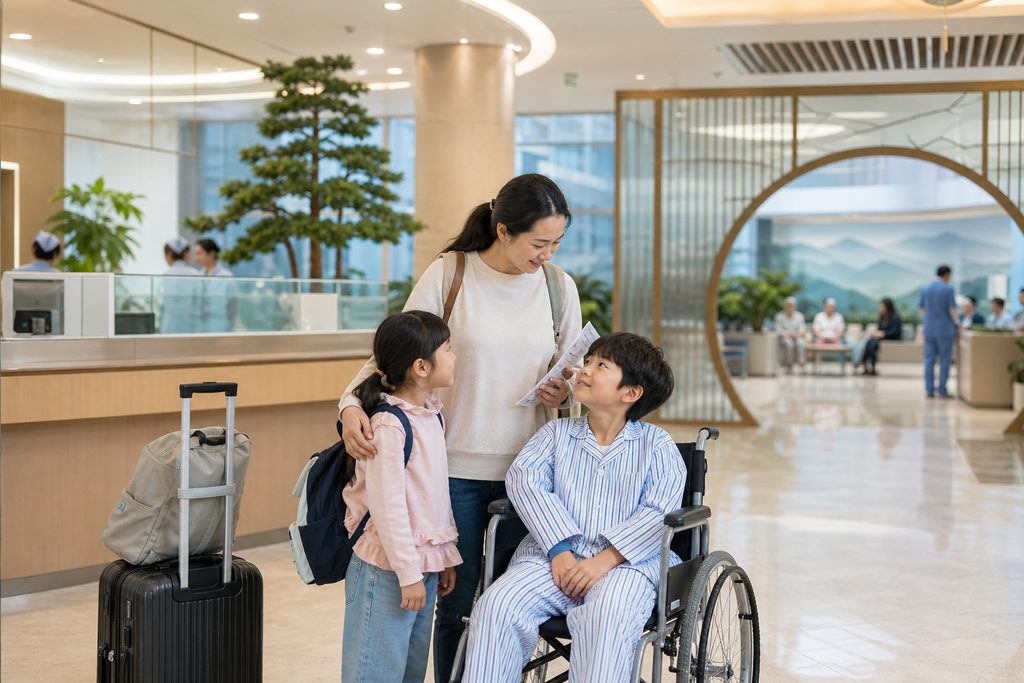
Family presence during a hospital stay is not a luxury. It is a clinical asset. Studies on surgical recovery consistently show that patients with an engaged support person report lower anxiety and better adherence to post-operative instructions. The question we hear most often from patients considering treatment at a top-ranked hospital in China is direct: can my spouse stay with me during surgery in China? The short answer is yes. The longer answer involves visa categories, hospital guest policies, and a realistic look at what solo travel actually requires.
We coordinate care for international patients across 340+ top-ranked hospitals in 37 cities. Our team has handled the logistics for spouses, adult children, professional caregivers, and patients who arrive alone. Each path works. Each has different trade-offs. This article explains what those are, how the process unfolds, and where the friction points hide.
How This Actually Works, Step by Step
You have a diagnosis. You have imaging, lab reports, and a treatment plan from your home physician. The sequence from that point to a hospital bed in China looks like this.
First, you send your medical records to us. We translate them into Simplified Chinese and route them to the appropriate department at a hospital matched to your condition. For a cardiac case, that might be Fuwai Hospital in Beijing. For oncology, a specialist center in Shanghai or Guangzhou. The reviewing physician responds with a written assessment: whether your case is appropriate for treatment in China, what additional tests are needed, and a proposed timeline.
Second, you decide on a service level. A written second opinion costs $300–500. A video consultation with a top specialist runs $500–800. These fees are credited in full toward on-the-ground coordination if you proceed within 90 days. This is where most patients confirm whether the family member will travel.
Third, the visa process begins. You and your spouse each apply for an S2 visa, the short-stay category used for medical treatment and private affairs. The hospital issues an invitation letter and treatment confirmation. Embassy processing times vary by country; plan for two to four weeks.
Fourth, you fly. Our team arranges airport pickup, hotel or hospital-adjacent accommodation, and the first face-to-face consultation. Surgery is never scheduled before that in-person evaluation. Public hospital rules in China require the attending physician to examine you directly. After that, the surgical date is set.
Can My Spouse Stay With Me During Surgery in China? Hospital Policies Explained
The honest answer depends on the hospital tier and the ward type. Public teaching hospitals in China operate under rules that differ from Western facilities. Standard multi-bed wards often restrict overnight visitors. A family member may sit with you during daytime visiting hours, typically 3:00 PM to 8:00 PM, but sleeping at the bedside is not always permitted.
International and VIP wards are different. These units, available at most top-tier public hospitals and all private international hospitals, commonly provide a private room with a sofa bed or an adjacent family suite. Your spouse can stay overnight. The cost is higher — roughly 1.5 to 2 times the standard ward rate — but the practical difference is significant. A spouse who can sleep in the room manages medication schedules, communicates with nurses, and provides the kind of continuous presence that standard wards cannot accommodate.
Private international hospitals like United Family, Jiahui, and Parkway operate under Western-style policies. Private rooms are standard. One family member staying overnight is routine. These facilities also carry JCI accreditation and employ English-speaking nursing staff, which reduces the translation burden on your spouse.
Ask the specific question before you book: “Does the room allow an overnight family member?” Do not assume. Ward policies vary even within the same hospital, between departments, and between standard and international sections.
A Realistic Timeline
| Stage | What Happens | Typical Duration |
|---|---|---|
| Day 1–7 | Medical records collected, translated, submitted to hospital | 5–7 days |
| Day 8–14 | Specialist review; written opinion or video consultation scheduled | 3–7 days |
| Day 15–21 | Treatment plan confirmed; hospital issues invitation letter | 3–5 days |
| Day 22–45 | S2 visa application for patient and spouse | 2–4 weeks |
| Day 46–50 | Travel to China; airport pickup; accommodation check-in | 2–3 days |
| Day 51–60 | In-person consultation; pre-operative tests; surgery scheduled | 5–10 days |
| Day 61–75 | Surgery and initial recovery in hospital | 5–14 days |
| Day 76–90 | Outpatient follow-up; discharge; return travel | 7–14 days |
These ranges assume no complications and a responsive embassy. Document translation is the step patients consistently underestimate. A 200-page oncology file takes time to translate accurately. Start early.
Visa processing is the other bottleneck. Some consulates issue S2 visas within a week. Others take a month. Your home country’s relationship with China, the completeness of your hospital documents, and the time of year all matter. We cannot guarantee approval. We can ensure the paperwork is correct the first time.
What Can Go Wrong — and What Happens Then
The visa is denied. It happens. The most common cause is an incomplete invitation letter or a mismatch between the stated purpose and the supporting documents. The recourse is to reapply with corrected paperwork. This adds two to four weeks. That is why we review every document before submission.
Your spouse cannot get time off work. This is the most frequent reason patients travel alone. The solution is a bilingual medical companion. Our companions handle registration, queueing, payment, translation, and navigation within the hospital. They are not nurses and they do not make medical decisions. They are logistics professionals who remove the language barrier. The cost starts at $300 per day.
The hospital changes the surgical date. This is common in public hospitals. Emergency cases take priority. Your accommodation booking should be flexible. Hotels near major hospitals in Beijing and Shanghai are accustomed to this; book refundable rates.
Post-operative complications extend the stay. Budget for a buffer. A planned 10-day hospital stay can become 20 days. Travel insurance with medical extension coverage is not optional.
Traveling Alone: Is It Safe to Travel Alone for Surgery in China?
Yes, with conditions. Thousands of international patients do it every year. The determining factors are the complexity of the procedure, your mobility after discharge, and your tolerance for managing recovery without a familiar face.
For minor procedures — a laparoscopic gallbladder removal, a diagnostic arthroscopy, a short-stay orthopedic procedure — solo travel is manageable. The hospital stay is brief. Our bilingual companion handles the difficult parts: registration, pharmacy runs, discharge paperwork. You focus on recovery.
For major surgery — cardiac bypass, complex oncology resection, spinal fusion — we strongly recommend a family member or a hired caregiver. The first week after discharge is when you need help with meals, medication, wound care, and transportation to follow-up appointments. A spouse is the default choice. But what support is available for international patients traveling alone to Shanghai? The answer includes professional nursing services, hotel-based recovery packages, and daily companion visits. These are arranged in advance, not improvised on arrival.
Practical Considerations: Visas, Accommodation, and Money
Visa category matters. The S2 visa covers medical treatment and private affairs. Your spouse applies under the same category, with the hospital invitation letter listing both names. Do not apply for an M visa. The M visa is for commercial and trade activities, not medical travel. Consulates reject M visa applications for hospital treatment with predictable speed.
Family accommodation near Beijing hospital for surgery is a solvable problem. Major hospitals like Peking Union Medical College Hospital and Fuwai Hospital sit in central districts with hotels at every price point. Budget $60–120 per night for a comfortable three-star hotel within walking distance. Serviced apartments with kitchenettes run $100–200 per night and make more sense for stays over two weeks. We arrange bookings and can negotiate hospital-adjacent rates through existing relationships.
Payment is pre-authorized. Public hospitals require a deposit before admission, typically 50–100% of the estimated surgical cost. International credit cards are accepted at international departments and private hospitals. Standard public wards may require a Chinese bank card or cash. We handle deposit logistics so you are not standing at a cashier window with a language barrier.
Insurance reimburses after the fact. Chinese public hospitals do not bill Western insurers directly. Private international hospitals do. Bring your policy documents, understand your out-of-pocket exposure, and keep every receipt. We provide itemized bilingual invoices for claims.
Language is the daily friction. Hospital staff in standard wards speak Mandarin. International wards have English-speaking coordinators, but radiology technicians, phlebotomists, and cafeteria staff often do not. Your spouse will not be able to read signs, menus, or pharmacy labels. A bilingual companion removes this friction. If your spouse travels, they need the same support you do.
Frequently Asked Questions
Yes. In international and VIP wards, overnight stays are typically permitted, often with a sofa bed in the room. In standard public wards, overnight visitors may be restricted. Confirm the specific ward policy before booking.
Family visitors are allowed during designated hours in all hospitals. International wards and private hospitals generally permit one family member to remain overnight. Standard wards enforce stricter visiting hours.
The caregiver applies for an S2 visa, the same category as the patient. The hospital invitation letter should list the caregiver by name. If a family member cannot travel, professional caregivers and bilingual companions can be arranged in advance.
For minor procedures, yes, with a bilingual companion to manage logistics. For major surgery, a family member or hired caregiver is strongly recommended, especially for the first week after discharge.
The companion handles registration, queueing, payment, translation, pharmacy runs, and navigation within the hospital. They do not provide medical care or make clinical decisions. The service starts at $300 per day.
Your Next Step
Deciding whether your family should travel with you is a practical question with a practical answer: for major surgery, bring someone. For minor procedures, solo travel with professional support is a reasonable path. What matters is that the decision is made with accurate information about ward policies, visa rules, and the real demands of recovery.
We are China Medical Services, a coordination team that connects international patients with 340+ top-ranked hospitals across 37 cities. We do not perform surgery, prescribe medication, or guarantee clinical outcomes. We handle the logistics — records translation, hospital matching, visa documentation, accommodation, and bilingual companionship — so you and your family can focus on treatment. If you are weighing these decisions, request a free consultation and we will walk through your specific case together.
For more medical information and treatment options in China, visit chinamedservices.com (China Medical Services).
