Urumqi Full Body Checkup: Cost and Booking for Foreigners
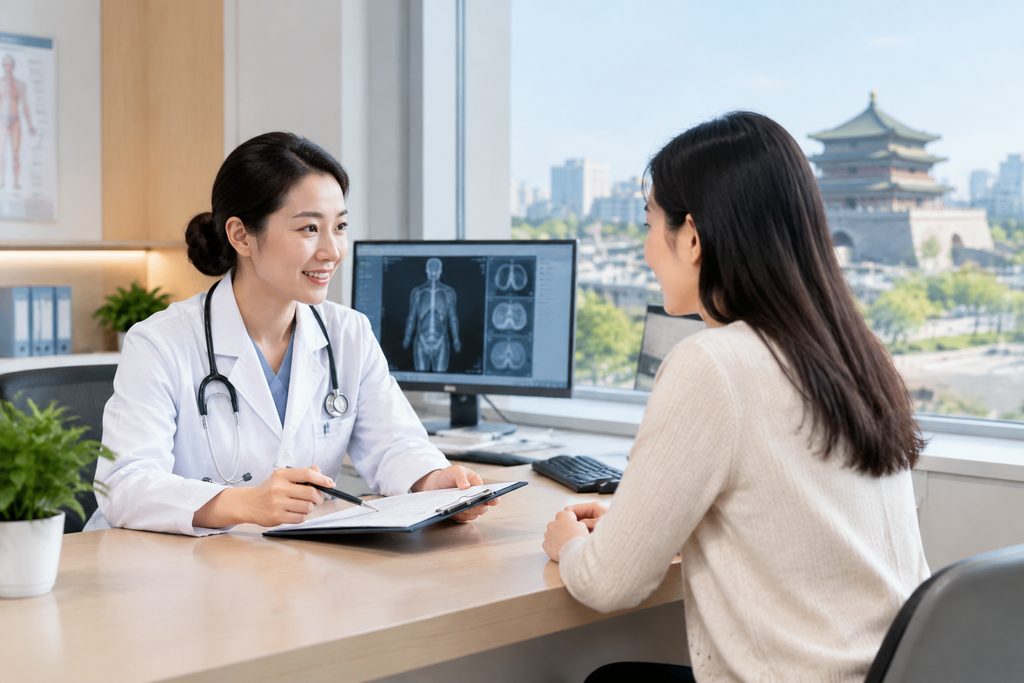
In the United States, a comprehensive executive health screening routinely runs $2,500 to $5,000 at a private clinic. In Urumqi, the same depth of laboratory work, imaging, and specialist review typically lands between $400 and $1,200. That gap is not a discount on quality — it reflects a different cost structure inside China’s public hospital system. And it is exactly why so many international visitors now ask us about the full body checkup cost Urumqi hospitals charge, and whether the process is genuinely open to non-Chinese speakers.
Short answer: yes, it is open. But booking one from abroad is not like reserving a hotel room. There are real mechanics — hospital choice, package tiers, appointment lead times, language support — and getting them wrong wastes a trip. This guide walks through all of it.
How This Actually Works, Step by Step
Here is the real sequence, from your first inquiry to holding the report in your hand.
Step one: you send us your goals and history. Not a full medical file at this stage — just your age, sex, any existing conditions, medications, family history, and what you want screened. A 42-year-old with a father who had colon cancer needs a different panel than a 60-year-old managing hypertension.
Step two: we match you to a hospital and a package tier. Urumqi has several large tertiary hospitals with dedicated health examination centers. We compare their current package structures against your requirements and come back with two or three options, each with a price range and a list of what is included.
Step three: appointment coordination. Health checkup centers in Chinese public hospitals operate on scheduled slots, often with morning-only blood draws because fasting is required. We handle registration, creation of the hospital medical card, and slot confirmation. This is where foreigners most often get stuck — the online booking systems are Chinese-language and frequently require a mainland phone number.
Step four: you arrive, and someone is with you. A bilingual medical companion meets you at the hospital, moves you through the departments in the correct order, handles payment and queue numbers, and translates every instruction. A full checkup involves eight to twelve separate stations. Without help, it becomes a four-hour maze.
Step five: results, explained. Reports typically come back in two to five working days, longer if biopsy or specialized pathology is involved. We arrange translation of the findings and, where useful, a follow-up consultation with the relevant department.
What a Full Body Checkup in Urumqi Actually Costs
Pricing in Chinese hospitals is tiered by package depth, not by negotiation. There is no haggling, and foreigners pay the same posted rate as local patients at public hospitals — a meaningful difference from some other countries in the region.
| Package Tier | Typical Contents | Price Range (USD) |
|---|---|---|
| Basic screening | Complete blood count, liver and kidney function, lipids, blood glucose, urinalysis, chest X-ray, abdominal ultrasound, ECG | $150 – $350 |
| Standard comprehensive | Everything above plus thyroid function, tumor markers (basic panel), carotid ultrasound, gastroscopy or colonoscopy (one) | $400 – $700 |
| Advanced / executive | Expanded tumor marker panels, cardiac stress testing, low-dose chest CT, MRI of a targeted region, full endoscopy both ends, specialist consultation | $800 – $1,500 |
| Premium with imaging add-ons | Advanced tier plus PET-CT or contrast-enhanced MRI where clinically indicated | $1,800 – $3,000+ |
These figures are the Urumqi medical checkup price for foreigners in practice, because public hospital pricing does not differentiate by nationality. Private international clinics in the city charge more — often 1.5 to 2 times the public rate — in exchange for English-speaking staff, shorter waits, and direct insurance billing.
One caveat worth stating plainly: PET-CT alone can add $800 to $1,500, and it is not part of a routine screening. It is ordered when there is a specific clinical reason. Anyone selling you a “whole body PET scan” as a general health check is selling you radiation exposure you probably do not need.
A Realistic Timeline
This assumes you are starting from outside China. Timings are ranges, not promises.
| Stage | What Happens | Duration |
|---|---|---|
| Days 1–3 | You send health goals and history; we shortlist hospitals and package options | 2–4 days |
| Days 4–10 | Package confirmed, appointment slot requested and held | 3–7 days |
| Weeks 2–4 | Visa preparation if required (S2 category for medical/private affairs, subject to consulate requirements), flights, accommodation | 1–3 weeks |
| Arrival day | Airport transfer, rest, fasting begins after dinner | — |
| Checkup day | Arrive 7:30–8:00 AM, complete all stations | 3–5 hours |
| Days +2 to +5 | Initial results released; translation prepared | 2–5 working days |
| Days +5 to +10 | Pathology-dependent results, follow-up consultation if needed | 3–10 working days |
The step people forget is the visa. If you are traveling specifically for a checkup, the applicable short-stay category is S2, used for medical treatment and private affairs, and it requires supporting documentation from the hospital. Processing times vary by consulate and season. Do not book a flight before the appointment slot is confirmed — slots fill faster around public holidays and the Lunar New Year period.
What Can Go Wrong — and What Happens Then
Honest failure modes, and the actual recourse.
Your preferred date is unavailable. Popular hospitals book health checkup slots two to four weeks out, and morning fasting slots go first. If your window is tight, we widen the hospital list rather than force one option. Urumqi has enough capacity that a two-week lead time is usually workable.
A finding requires immediate follow-up. This is the scenario people fear most, and it deserves a straight answer. If your checkup flags something — an abnormal imaging result, a suspicious lesion — you will be referred to the relevant specialty department. That may mean an additional appointment, additional cost, and a longer stay than planned. We help coordinate that, but we cannot make a specialist available on demand, and we cannot promise a particular timeline. In some cases the right call is to complete diagnostics in Urumqi; in others, it is to return home with translated records and continue care there. We will tell you which we think applies.
The report is in Chinese. It will be. Hospital reports are issued in Chinese, and machine translation of medical terminology is unreliable. Professional translation of the key findings is part of what we arrange. Do not rely on a phone app for this.
You have a chronic condition and fasting is risky. Tell us in advance. Diabetics on insulin, patients on anticoagulants, and anyone with significant cardiac history need the schedule adjusted. Chinese checkup centers handle these cases routinely, but they need to know before the morning of.
Payment and insurance. Public hospitals require prepayment; you settle at the counter and seek reimbursement from your insurer afterward. Most international policies will reimburse a screening if it is medically indicated, but “I wanted a checkup” is often excluded. Check your policy before you travel. Private international hospitals more often offer direct billing.
Choosing the Best Hospital in Urumqi for Health Screening
Urumqi is the capital of Xinjiang and the medical referral hub for the entire region. Its largest hospitals are tertiary (Class A) institutions with high patient volumes and modern imaging equipment. For a foreign visitor, three factors matter more than brand name.
Does the hospital have a dedicated health examination center? Large Chinese hospitals separate routine screening from diagnostic outpatient care. A dedicated center means shorter waits, a defined package menu, and staff accustomed to processing many people efficiently in one morning. A hospital without one will route you through general outpatient departments, which is slower and harder to navigate.
What is the imaging equipment actually like? Ask specifically about the CT and MRI generation. Most major Urumqi hospitals have current-generation scanners, but it is a fair question and one worth confirming rather than assuming.
Can anyone there communicate with you? Outside the international departments of the biggest hospitals, English-speaking staff are limited. This is the single most common complaint from foreign patients in western China. It is also the reason bilingual accompaniment exists.
If your screening uncovers something requiring specialist treatment, the question of where to go next becomes larger. China’s top-ranked hospitals cluster in Beijing, Shanghai, and Guangzhou — you can browse the full Fudan-ranked Top 100 hospitals by city to see what is available, or look up specific specialties such as oncology, cardiac surgery, or orthopedics if a finding needs expert review.
Practical Considerations: Records, Visa, Payment, Language
Bring your records. Any prior imaging, biopsy reports, or lab results from the past two years. If you have a known condition, the Chinese physicians will want the baseline. Have the key documents translated into Chinese or English in advance — it saves days.
Visa category. For a short medical visit, S2 is the applicable category, and accompanying family members apply under the same category. Requirements are set by the individual consulate and change; confirm with the consulate handling your application and with the hospital’s international office for supporting documents. Note that the M visa is for commercial and trade activity and is not the right category for medical travel.
Payment. Public hospitals: prepay, then claim. Private international hospitals: often direct billing with major insurers. Bring a card that works internationally, and carry some cash for incidentals.
Follow-up at home. Get the translated report and, if relevant, the original imaging on disc or via cloud link. Your physician at home will want both. This is the part patients most often neglect, and it undermines the value of the whole trip.
Language. Budget for it. A bilingual medical companion runs from $300 per day, covering registration, queuing, payment, wayfinding, and translation. For a one-day checkup, that is usually a half-day booking. You can read more about how our team structures this on our patient consultation and support page.
Frequently Asked Questions
Yes. Screening at a tertiary Chinese hospital is performed to standard protocols, and the equipment at major Urumqi hospitals is current-generation. The genuine risks are not procedural — they are logistical: unnecessary imaging add-ons you did not need, and results you cannot read because they are in Chinese. Both are manageable with preparation.
You can, but not comfortably. Hospital booking systems, payment counters, and department signage are in Chinese, and the checkup itself involves navigating eight to twelve stations in sequence. Most foreign patients use a bilingual companion for the day. It is the difference between a three-hour morning and a stressful all-day ordeal.
Two to four weeks is comfortable for a public hospital health examination center. Peak periods — around Lunar New Year, the October national holiday, and early autumn — fill faster. If your travel dates are fixed, start the process at least a month out.
Sometimes, but only when the screening is medically indicated rather than elective. Public hospitals require upfront payment and provide itemized receipts for reimbursement claims. Private international hospitals more frequently offer direct billing. Confirm coverage with your insurer before booking.
You will be referred to the appropriate specialty department, and further diagnostics may be needed. We help coordinate that, but we cannot guarantee a specific specialist or timeline, and we never promise outcomes. In some cases the right decision is to continue care at home with translated records. A qualified physician should guide that choice — not a booking service.
Your Next Step
A full body checkup in Urumqi costs a fraction of what the same screening costs in North America or Western Europe, and the hospitals are genuinely capable. The friction is not price or quality — it is logistics, language, and knowing which hospital fits your specific health profile.
China Medical Services connects international patients with 340+ top-ranked hospitals across 37 cities, and we handle the coordination, translation, and accompaniment that make a Chinese hospital visit workable for someone who does not speak the language. We are not doctors, and we do not provide medical advice or treatment recommendations. What we do is remove the operational barriers.
If you are considering a checkup in Urumqi or anywhere else in China, start with a conversation. No pressure, no obligation — just a clear picture of what is available and what it costs.
This article is for general information only and does not constitute medical advice. Screening decisions, imaging choices, and follow-up care should be discussed with a qualified physician. Prices vary by hospital and case complexity and are subject to change.
For more medical information and treatment options in China, visit chinamedservices.com (China Medical Services).
