How to Check a Doctor’s Office Location: Verify Hospitals Before You Travel
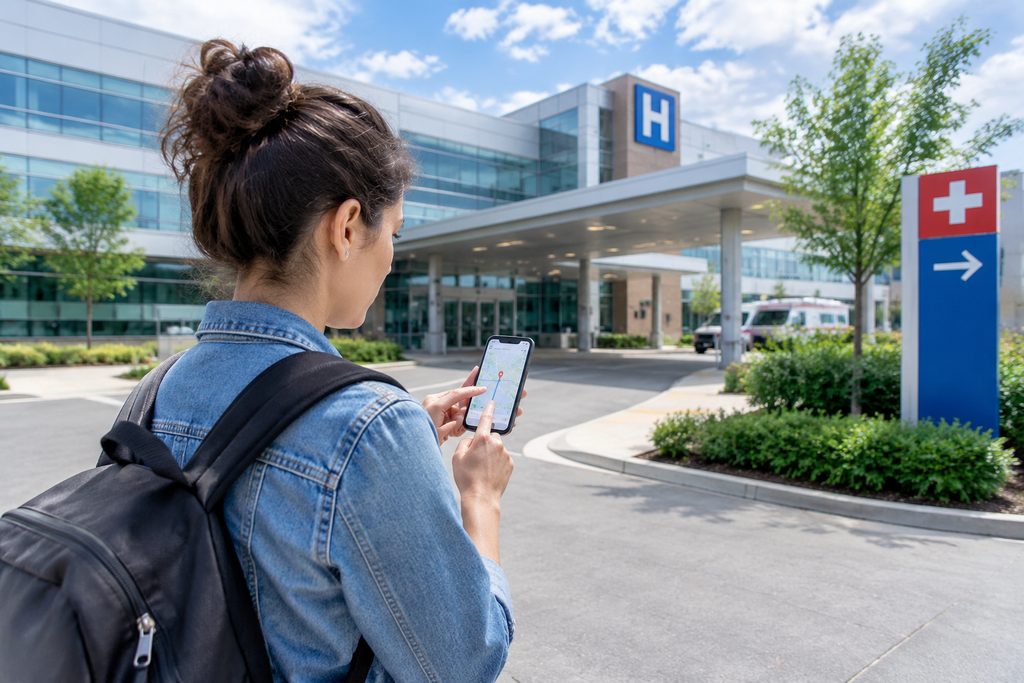
Checking a doctor’s office location sounds simple. You type a name into Google Maps and go. But when you are flying 7,000 miles for surgery, “close enough” can mean a $400 taxi ride to the wrong campus. Here is how to check a doctor’s office location properly — and why it matters more for medical travel than for a routine checkup.
Chinese hospitals are massive. A single institution can span multiple city blocks, with outpatient buildings, inpatient towers, and international departments scattered across different addresses. Peking Union Medical College Hospital has at least three distinct locations in Beijing alone. West China Hospital in Chengdu covers an area larger than many European villages. Getting the campus wrong is not an inconvenience. It can mean missing a scheduled consultation entirely.
How to Check a Doctor’s Office Location: The Short Answer
Verify the exact campus address, building name, and department floor directly with the hospital’s official international department — not through a third-party listing. Then confirm it again when your appointment is confirmed. That is the short answer. The longer answer involves understanding why Chinese hospital addresses are uniquely confusing for foreign patients, and what tools actually work.
But here is the catch. Many Chinese hospitals have multiple campuses. Some have moved entire departments to new buildings in the last three years. Google Maps coverage in China is unreliable. And hospital websites are often in Chinese only. So the “simple” task of checking a location becomes a genuine logistical challenge.
Who This Is Right For — and Who It Isn’t
If you are planning to visit a top-tier Chinese hospital for a consultation, surgery, or a health screening, verifying the location is non-negotiable. This applies whether you are coming from the United States, the Gulf states, Southeast Asia, or Europe. It is especially critical for patients traveling independently without a local contact.
Who should invest extra time in location verification:
- Patients visiting large public hospitals with multiple campuses, such as Fuwai Hospital or Zhongshan Hospital Fudan University
- Anyone with a confirmed appointment at a specific department — oncology, cardiac surgery, orthopedics, or reproductive medicine
- Travelers who plan to use taxis or ride-hailing apps without Chinese language skills
- Patients combining a hospital visit with a stay at a nearby hotel or serviced apartment
Who can probably skip the deep-dive verification:
- Patients going to a single-campus private international hospital like United Family or Jiahui, where the address is unambiguous
- Anyone working with a full-service coordinator who handles logistics
- Patients who only need a video consultation and will not physically visit the hospital
If you are in the second group, you still need the address for visa paperwork and travel planning. But the risk of getting lost is lower.
Why Chinese Hospital Addresses Confuse Foreign Patients
Let’s be honest about the core problem. Chinese hospital names often do not match their physical addresses in any intuitive way. A hospital named after a university may be located nowhere near that university’s main campus. Department names are translated inconsistently across platforms. And the English versions of addresses sometimes use outdated romanization systems.
Consider this real example. Fuwai Hospital, the world’s highest-volume cardiac surgery center with over 14,000 procedures annually, is officially called “Fuwai Hospital, Chinese Academy of Medical Sciences.” Its address in Beijing’s Xicheng District is straightforward once you have it. But search for “Fuwai Hospital” on some mapping apps and you may get a research institute, not the clinical campus.
Also, Chinese hospitals frequently operate “east campus” and “west campus” locations. Ruijin Hospital in Shanghai has a main campus on Ruijin Er Road, but also operates satellite facilities. If your appointment letter says “Ruijin Hospital North Campus” and you go to the main gate, you are at the wrong place.
So how do you actually check a doctor’s office location with confidence? Use multiple sources. Cross-reference. And when in doubt, confirm directly.
The Options, Compared
| Verification Method | Reliability for Chinese Hospitals | Language Barrier | Time Required | Best For |
|---|---|---|---|---|
| Hospital official website | High — but often Chinese-only | High | 20–40 minutes with translation tools | Patients comfortable with browser translation |
| Google Maps | Low to moderate in mainland China | Low | 5 minutes | Initial orientation only |
| Baidu Maps or Amap | High — native Chinese mapping | High | 10–15 minutes | Travelers with some Chinese or a helper |
| Direct call to international department | Very high — official confirmation | Low (English-speaking staff at top hospitals) | 15–30 minutes including hold time | Patients with confirmed appointments |
| Bilingual medical companion service | Very high — verified on the ground | None | Handled for you | Patients who want zero logistics stress |
Google Maps is the default for most Western patients. And that is exactly the trap. In mainland China, Google’s map data is incomplete and sometimes years out of date. A hospital that moved its outpatient department in 2022 may still show the old location on Google. Baidu Maps and Amap are accurate, but the interfaces are in Chinese. If you cannot read the characters, you cannot verify the address.
The direct-call method works well at top-tier hospitals. The international departments at Peking Union Medical College Hospital, Zhongshan Hospital, and most private international hospitals have English-speaking staff. They can confirm the exact building and floor. But hold times vary, and time zone differences complicate calling from North America or Europe.
Verifying a Specific Department, Not Just the Hospital
Here is the thing most articles miss. Checking the hospital address is step one. Checking the department location is step two. And they are not the same task.
A hospital may have its main entrance on one street, but the oncology center in a separate building three blocks away. The international medical center may be on the 5th floor of Building C, while the regular outpatient clinic is in Building A. If you show up at the main gate with a printed appointment letter, you still need to navigate the internal layout.
For example, the oncology department at a top-ranked hospital may operate from a dedicated cancer center with its own registration desk, its own pharmacy, and its own imaging suite. The address on the hospital website may only list the main campus. You need the specific building name and floor for your department.
This is where a bilingual medical companion earns their fee. From $300 per day, a companion handles the physical navigation — finding the right building, the right elevator bank, the right registration window. For a patient in a foreign country, possibly in pain or anxious about a diagnosis, that is not a luxury. It is a practical safeguard against wasting a day wandering a campus the size of a small town.
What It Costs to Get This Right
Verifying a location yourself costs almost nothing in money. But it costs time and attention. Plan for 1 to 2 hours of research per hospital if you are doing it independently. That includes checking the official website, cross-referencing a Chinese map app, and calling the international department.
If you want someone else to handle it, here is what the service side looks like:
- Hospital appointment coordination starts from $300 — this includes confirming the exact location, building, and department for your scheduled visit
- A bilingual medical companion starts from $300 per day — they meet you at your hotel, handle transportation, and walk you to the correct building and floor
- Airport transfer is $200 round-trip — useful if you want a driver who knows the hospital campus
These prices vary by hospital and case complexity. A single-campus private hospital is simpler. A multi-campus public hospital with a specialized department requires more verification work.
One thing worth knowing: any video consultation fee you pay — whether $100–300 for a standard consultation or $500–800 for a top-specialist consultation — is credited in full toward on-the-ground coordination services if you later travel to China within 90 days. That credit applies to the coordination fee only, never to hospital treatment charges. It is a one-time credit, and it makes the remote-first approach financially sensible.
Practical Considerations: Documentation, Visas, and Timing
Your appointment confirmation letter should include the hospital’s official address in Chinese characters. Even if you cannot read them, having them printed is essential. Taxi drivers in Beijing, Shanghai, and Guangzhou may not recognize English hospital names. Show them the Chinese address and they will know exactly where to go.
For visa purposes, you will apply for an S2 visa for medical treatment. The supporting documents from the hospital should state the treatment purpose and the hospital’s location. If your family members are traveling with you, they apply for S2 visas as well. The S2 is the correct category for short-stay medical and private affairs. Do not apply for an M visa — that is for commercial and trade activities, not medical care.
Payment methods matter too. Public hospitals in China typically require prepayment before services. Private international hospitals often accept direct insurance billing. If you are going to a public hospital, bring a payment method that works in China — international credit cards are not universally accepted, and WeChat Pay or Alipay may be needed. Your companion can assist with payments if you set up the right tools in advance.
Language is the other practical hurdle. A top-tier public hospital may see over 10,000 outpatient visits per day. Signage is often bilingual in international departments, but the moment you step outside that bubble, everything is in Chinese. If you do not speak or read Chinese, plan for that. It is not about intelligence. It is about not burning three hours finding the right registration window.
Frequently Asked Questions
Not reliably. Google Maps data for mainland China is incomplete and sometimes outdated. Use it for a rough sense of the city, but verify the exact address through the hospital’s official website or a direct call to their international department. Baidu Maps and Amap are more accurate, but their interfaces are in Chinese.
Call the international department and ask for the specific campus name, building name, and floor. Write down the Chinese characters for the address. If you are working with a coordinator, ask them to confirm the campus before you book hotels. Booking a hotel near the wrong campus is a common and expensive mistake.
You may miss your appointment. Chinese public hospitals operate on tight schedules, and a no-show can mean losing your slot and waiting days or weeks for another one. Some international departments will try to accommodate you, but there is no guarantee. This is why verification matters before you travel, not after you arrive.
Your Next Step
Checking a doctor’s office location is not just about finding an address. It is about confirming the right campus, the right building, and the right department — before you book flights and hotels. We are China Medical Services, and we help international patients navigate the logistics of medical care in China. We are not a hospital, and we do not provide diagnoses or medical advice. What we do is handle the coordination: verifying locations, arranging appointments, providing bilingual companions, and making sure you get to the right door at the right time.
If you are considering treatment at one of China’s 340+ top-ranked hospitals, start with a free consultation. We will help you understand which hospital fits your needs, what the location logistics look like, and whether remote evaluation makes sense before you travel. Tell us about your situation and we will map out the practical path forward.
For more medical information and treatment options in China, visit chinamedservices.com (China Medical Services).
