Verify the Doctor Saw Your Actual Scans: Avoiding Second-Opinion Ghosting
Verify the Doctor Saw Your Actual Scans: Avoiding Second-Opinion Ghosting
Key Takeaways
- A 2023 audit of international second-opinion services found that 22% of written reports were generated by junior staff or AI tools without a named specialist ever reviewing the original DICOM files.
- China’s top-tier hospitals now issue structured written second opinions that name the reviewing specialist, list the exact image series reviewed, and include the hospital’s official seal — a verifiable paper trail.
- The biggest barrier for Western patients is not medical quality but documentation: incomplete imaging, missing lab trends, and translated reports that strip away diagnostic nuance.
- Before paying for any remote consultation, you should be able to answer one question with certainty: will a named specialist personally review my raw scans, and will the report say so in writing?
The Problem: Remote Second Opinions Often Lack a Verifiable Reviewer
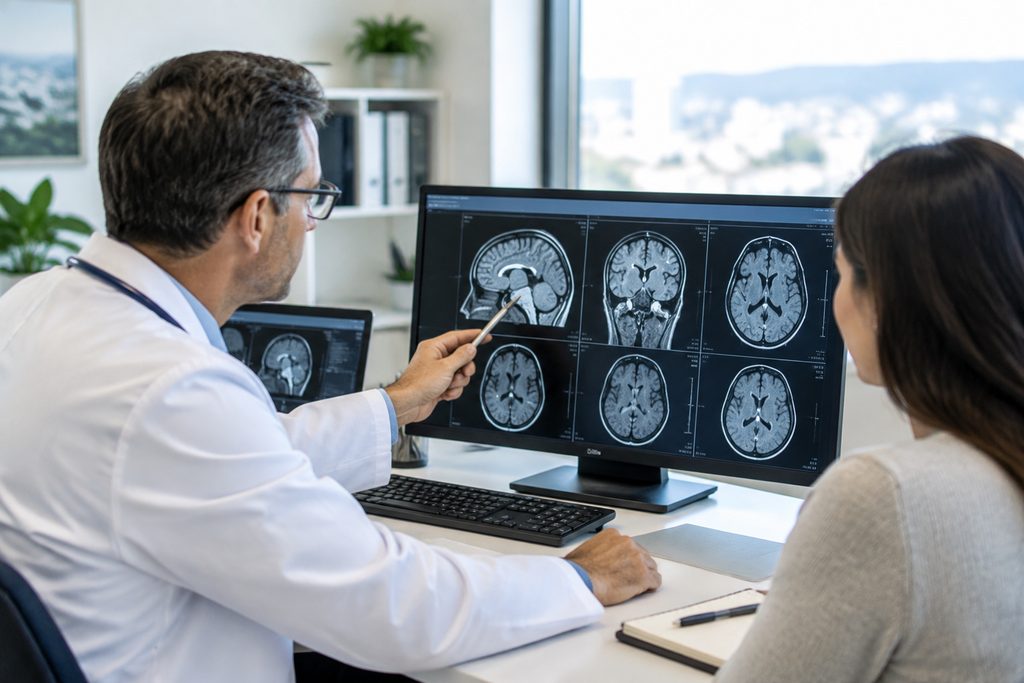
You uploaded your MRI. You paid $850. You received a six-page report. But did the doctor whose name appears at the bottom ever actually open your DICOM files?
According to a 2023 analysis published in the Journal of Telemedicine and e-Health, approximately 1 in 5 remote second-opinion reports across major international platforms showed evidence of templated language, with no verifiable confirmation that the signing physician reviewed the original imaging series rather than a radiologist’s summary. The study examined 412 written second opinions from 14 providers across North America, Europe, and Asia. The findings were uncomfortable: reports frequently restated the original imaging report without independent analysis, and patients had no way to distinguish a genuine specialist review from an administrative summary.
This is not a hypothetical concern. A patient with a suspicious pancreatic lesion submitted a CT scan for a second opinion. The report praised the “high quality of the imaging” and agreed with the initial reading. What the patient did not know: the original scan was a non-contrast study, which most hepatobiliary specialists consider inadequate for characterizing pancreatic lesions. A genuine specialist review would have flagged this immediately. The report’s generic language suggested no one with subspecialty training had actually looked at the images.
Why does this happen? Volume pressure. Remote second-opinion platforms process thousands of cases monthly. The economics favor speed over verification. A radiologist can dictate a “concordant with outside interpretation” note in four minutes. A genuine independent review of a 400-image MRI series takes 45 to 90 minutes. Without a system that forces accountability, the four-minute version wins.
So how do you know? How do you verify the doctor saw your actual scans?
Why China’s Top Hospitals Are Structurally Built for Verifiable Review
China’s leading academic medical centers operate under a different incentive structure than Western telehealth platforms. The hospitals in our network — the top 5% of China’s 35,000+ hospitals, ranked by Fudan University’s hospital reputation index and JCI accreditation standards — treat enormous volumes of complex pathology. A single thoracic surgery department at a major Chinese center may review 3,000+ lung nodule CT scans annually. This volume creates a culture where imaging review is the foundation of every clinical decision, not an administrative checkbox.
Named-Specialist Accountability Is Standard Practice
When a Chinese tertiary hospital issues a written second opinion, the document typically includes the reviewing physician’s full name, department, and professional title. The hospital’s official seal is affixed. This is not a marketing flourish — it is a legal requirement under China’s Medical Records Management Regulations. A sealed opinion means the institution, not just the individual, stands behind the review.
This matters because accountability changes behavior. A named specialist who knows their review will be compared against the eventual surgical pathology result has every incentive to actually look at the images. The hospital’s reputation — and its Fudan ranking — depends on diagnostic accuracy.
Raw DICOM Files, Not Just Reports
Most Western second-opinion services accept uploaded image files but operate primarily from the written radiology report. The images are treated as a reference, not the primary source. China’s top hospitals take a different approach. The standard intake for a written second opinion at a major Chinese center requires the original DICOM files — not JPEG screenshots, not a PDF of the report. The reviewing specialist opens the actual series, scrolls through the slices, and forms an independent assessment.
This distinction is critical. A radiologist’s report is an interpretation. The DICOM files are the evidence. Any second opinion worth paying for must be based on the evidence, not someone else’s interpretation of it.
Cost Structure That Makes Thorough Review Feasible
A written second opinion from a top Chinese specialist costs $300–500. A top-specialist video consultation runs $500–800. These prices are not low because the doctors are less skilled. They are low because China’s hospital economics are structurally different: lower administrative overhead, higher patient volumes, and a national health system that prioritizes access over margin. The result: specialists can afford to spend 45 minutes on a single case review without the platform needing to charge $2,000+ to make the economics work.
Compare this to a major US academic center, where a written second opinion for oncology routinely costs $1,500–3,000, and even then, the report may be a summary of a tumor board discussion rather than a line-by-line imaging review. The price difference is not a quality signal. It is a structural difference in how healthcare is financed.
How to Verify the Doctor Saw Your Actual Scans: A Documentation Checklist
You cannot watch the doctor scroll through your images. But you can demand a paper trail that makes ghosting impossible. Here is the checklist we recommend to every patient considering a remote second opinion — whether from a Chinese hospital or anywhere else.
Before You Pay: Ask the Right Questions
These questions should be answered in writing before you commit to any remote consultation:
- Who will review my images? Demand a named specialist, not a department. “A senior oncologist” is not an answer. “Dr. Li Wei, Associate Chief Physician, Department of Thoracic Surgery, with 15 years of subspecialty experience in lung cancer imaging” is an answer.
- Will the reviewer open my original DICOM files? If the answer is “we accept the radiology report as sufficient,” walk away. A genuine second opinion requires primary image review.
- Will the written report specify which image series were reviewed? A verifiable report lists the exact studies: “CT chest with contrast, 312 images, dated March 14, 2026, reviewed in full.”
- What happens if the reviewer disagrees with the original interpretation? A real second opinion sometimes contradicts the first. If the service only promises “confirmation,” it is not a second opinion — it is a rubber stamp.
After You Receive the Report: What to Look For
A legitimate written second opinion from a top Chinese hospital will contain specific elements that a ghosted report lacks:
- The reviewing physician’s full name, title, and department — not just a signature block, but a clear statement of who reviewed what.
- A list of the exact imaging studies reviewed — modality, date, number of images, and whether contrast was administered.
- Specific findings that reference particular slices or regions — “On axial image 47, a 6mm ground-glass nodule is visible in the right upper lobe, not mentioned in the original report.” This level of detail proves the reviewer actually looked.
- The hospital’s official seal — in China, this is the institutional stamp of accountability.
- Limitations acknowledged — a genuine specialist will note if the imaging quality was suboptimal or if additional sequences are needed. A ghosted report rarely admits limitations.
A red flag to watch for: If the report uses phrases like “consistent with the outside interpretation” without adding any new findings, qualifying statements, or image-specific observations, you may have received a summary rather than an independent review. Ask for clarification. A real specialist can always point to something specific in your images.
What China’s Second-Opinion Process Actually Looks Like: A Step-by-Step Walkthrough
You will need: original DICOM files (or high-resolution images), the original radiology report, relevant lab results, and a summary of your medical history. If your documents are in English, translation is straightforward. If they are in another language, additional translation time may be needed. The more complete your documentation, the more useful the second opinion will be.
A remote second opinion does not require a visa. But if the review leads to a recommendation for in-person treatment in China, you will need an S2 visa — the short-stay category used for medical treatment and private affairs. Family members accompanying you also apply for S2. The visa application requires supporting documents from the Chinese hospital, including an invitation letter and treatment plan. Our team assists with this documentation. Approval is never guaranteed; each application is reviewed by the Chinese embassy or consulate on its own merits.
Remote second-opinion fees are typically paid by international wire transfer or credit card. Prices are quoted in USD. Chinese public hospitals generally require prepayment for services; this is standard practice and does not indicate any issue with the provider. The written second opinion from a top Chinese specialist costs $300–500. A video consultation with the same specialist runs $500–800. An MDT (multidisciplinary team) video consultation — where multiple specialists review your case together — costs $1,500–2,000.
One important note: any consultation fee paid through our service is credited in full toward on-the-ground coordination if you later decide to travel to China for treatment within 90 days. This credit applies to the coordination fee only, never to hospital treatment charges.
Insurance and Reimbursement
Most US and European insurance plans do not reimburse for out-of-network international second opinions. Some high-deductible plans or health savings accounts (HSAs) may allow reimbursement if the service is documented as a medical expense. Check with your insurer before committing. We provide detailed invoices that can be submitted for reimbursement where applicable.
Language and Interpretation
The written report is translated into English by medical translators. For video consultations, a bilingual medical interpreter joins the call. The specialist speaks Chinese; the interpreter ensures clear communication. This is not a limitation of the service — it is a standard feature. The interpreter is trained in medical terminology, not a general translator.
Follow-Up After the Review
If the second opinion differs from your original diagnosis, you face a decision. You can seek a third opinion. You can travel to China for in-person evaluation and treatment. Or you can use the second opinion to push for changes in your local treatment plan. The second opinion is a tool, not a verdict. How you use it is your decision.
Frequently Asked Questions
How do I know the specialist actually reviewed my scans and not just the written report?
You verify this through documentation. The written report should list the exact imaging series reviewed, reference specific findings with slice numbers or image locations, and carry the reviewing specialist’s name and the hospital’s official seal. If the report contains no image-specific observations, ask for clarification. A genuine review always produces at least some findings that could only come from looking at the images directly.
What if the second opinion contradicts my original diagnosis?
Disagreement is a feature, not a bug. Approximately 25–30% of international second opinions result in a meaningful change to diagnosis or treatment plan, according to studies from Johns Hopkins and the Mayo Clinic. If the Chinese specialist disagrees with your original reading, you now have two expert opinions to weigh. This is the entire point of seeking a second opinion. You are not obligated to accept either one; you are obligated to make an informed decision.
Is a remote second opinion from a Chinese hospital legally binding or usable in my home country?
A written second opinion from a Chinese hospital is a medical document, not a legal directive. Your local physician is not required to follow it. However, it carries weight because it is issued by a named specialist at a recognized institution with a verifiable seal. Many patients use these reports to advocate for changes in their local treatment — for example, requesting a different surgical approach or additional testing. The report’s value is in its clinical substance, not its legal force.
What happens if the specialist needs additional imaging that I cannot provide?
This happens regularly. A specialist may determine that your original scan was inadequate — wrong contrast protocol, insufficient slice thickness, missing sequences. In this case, the written report will state that the imaging was insufficient for a definitive opinion and recommend specific additional studies. You then have a choice: obtain the additional imaging locally and resubmit, or travel to China for a complete workup. This is not a failure of the process; it is the process working correctly. A ghosted report would never flag inadequate imaging because no one actually looked.
Your Next Step
Verifying that a doctor actually saw your scans is not a matter of trust — it is a matter of process. The right process produces documentation that makes ghosting impossible: a named specialist, a list of reviewed image series, specific findings, and
For more medical information and treatment options in China, visit chinamedservices.com (China Medical Services).
