How to Verify a Doctor’s English Proficiency: A Patient’s Guide for China
When 47-year-old Daniel from Manchester scheduled a complex orthopedic consult in Shanghai, his first email to the hospital’s international department was blunt: “Can my doctor in China speak English?” He wasn’t asking about the receptionist. He wanted to know if the surgeon who might reconstruct his knee could discuss graft choices, failure rates, and rehab protocols without a translator between them. It’s the question every rational patient asks. The honest answer is more nuanced than a simple yes or no. Some doctors speak excellent English. Some speak textbook English but freeze under pressure. Many speak almost none. Your job is to figure out which one you’re getting before you commit to a procedure.
How This Actually Works, Step by Step
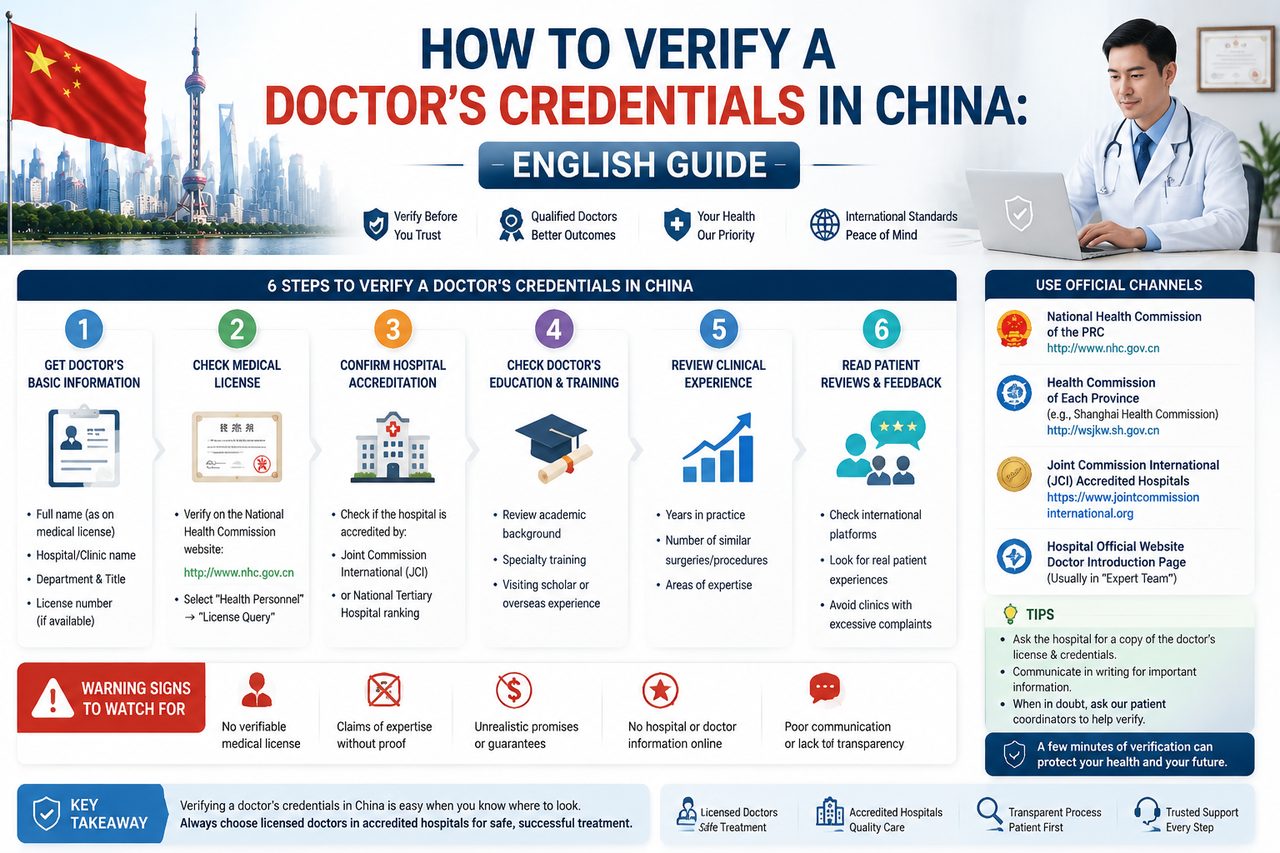
Verifying English proficiency isn’t a single phone call. It’s a short sequence of checks that together give you a reliable picture. Start with the hospital’s international department or VIP clinic. These units exist specifically for foreign patients, and their staff typically speak functional English. Ask them directly: which specialist handles your case, and what is that doctor’s English level? Request the doctor’s CV or profile — many Chinese hospitals now publish bilingual doctor profiles listing overseas training, fellowships, and published English-language research. Then request a brief video call before you travel. A 10-minute conversation will tell you more than any certificate. Finally, confirm whether the hospital provides a medical interpreter for consultations and whether that interpreter stays with you through surgery day. That last point matters more than most patients realize.
Can My Doctor in China Speak English? The Real Answer
The uncomfortable truth: English proficiency among Chinese physicians varies enormously. A 2022 study published in BMC Medical Education found that while roughly 70% of physicians at top-tier Chinese hospitals reported reading English medical literature regularly, only about 30% felt confident conducting a full clinical consultation in English. Reading and speaking are different skills. Many doctors can discuss your case using English medical terminology but struggle with casual conversation, nuanced consent discussions, or explaining risks in plain language. But here’s the encouraging part: the doctors at the 340+ top-ranked hospitals we work with — roughly the top 5% of China’s 35,000+ hospitals, ranked by Fudan University and JCI standards — are far more likely to have overseas training. Many completed fellowships at Johns Hopkins, Mayo Clinic, or European centers. Their English is often excellent. The gap between a top-tier teaching hospital in Beijing and a provincial hospital is substantial.
English Speaking Doctors Shanghai Hospital: Where to Look
Shanghai has the highest concentration of English-proficient specialists in mainland China. Hospitals like Zhongshan Hospital Fudan University, Ruijin Hospital, and Huashan Hospital all operate dedicated international medical centers with English-speaking coordinators. The city’s private international hospitals — United Family, Jiahui, Parkway — employ physicians who are often bilingual by hiring requirement. But the trade-off is cost. A consultation at a private international hospital in Shanghai typically runs $150–300, while the same specialist’s time at a public hospital’s VIP international department might cost $80–150. Neither guarantees fluent English, but both make it far more likely than a standard public outpatient clinic. If you search for “English speaking doctors Shanghai hospital” reviews online, be careful. Review platforms are heavily gamed. A better signal: check whether the doctor has published in English-language journals indexed on PubMed. If they have, they can almost certainly discuss your case in English — even if their accent takes an hour to adjust to.
A Realistic Timeline
| Stage | What Happens | Realistic Duration |
|---|---|---|
| Days 1–3 | Submit your medical records and imaging to the hospital’s international department; request doctor profiles and English proficiency confirmation | 2–3 days for initial response |
| Days 4–10 | Schedule a video consultation with the proposed specialist; use this call to assess English level directly | 5–10 days lead time at public hospitals |
| Days 11–20 | Request written treatment plan in English; confirm interpreter availability for all clinical encounters | 1–2 weeks for document translation and plan preparation |
| Days 21–35 | Apply for S2 visa with hospital invitation letter and treatment plan; arrange travel | 2–4 weeks standard visa processing |
| Day 36+ | Arrive in China; attend in-person consultation; proceed with treatment if both parties agree | Consultation same day; surgery scheduling varies by department |
Patients routinely underestimate the document translation step. Your MRI reports, pathology slides, and prior surgical notes all need certified English-to-Chinese translation before most hospital international departments will schedule a specialist consultation. Budget an extra week for this. Also note: S2 visa processing times vary by consulate and season. Summer and early autumn are peak periods.
What Can Go Wrong — and What Happens Then
The most common failure mode: the doctor you verified speaks English, but the anesthesiologist, nurses, and ward staff do not. You wake up from surgery unable to communicate your pain level or ask about the catheter. This is precisely why a bilingual medical companion matters. If you discover mid-consultation that the doctor’s English is not adequate for your needs, the recourse is straightforward: request a different specialist within the same department. Top hospitals usually have several senior doctors for any given procedure. You can also request that the hospital’s interpreter remain present for all encounters — including rounds. If the hospital cannot provide this, our bilingual medical companion service covers interpretation during consultations, rounds, and discharge instructions. Another failure mode: the doctor speaks English well, but you still misunderstand each other on critical points like medication dosing or post-op restrictions. Always get written discharge instructions in English. Never rely on verbal communication alone, even with a fluent doctor.
How to Check Doctor English Level China: A Practical Evaluation Framework
Rather than asking “do they speak English?” ask three specific questions. First: “Has this doctor completed clinical training in an English-speaking country?” A one-year fellowship at a US or UK hospital is a strong signal. Second: “Will this doctor conduct my consultation directly in English, or through an interpreter?” Direct conversation is non-negotiable for complex cases. Third: “Can I record our video consultation?” Most hospitals will allow this if you ask politely, and it gives you a reference to review later. During the video call itself, test comprehension deliberately. Ask the doctor to summarize your case back to you. Ask one open-ended question about risks. If they can explain a complication rate in their own words — not just nod along — that’s genuine functional English. If they keep deferring to a translator or repeating the same rehearsed phrases, you have your answer.
Also consider the distinction between speaking English and thinking in English. A doctor who learned English from textbooks may understand every word you say but process it through Chinese grammar structures, leading to subtle but dangerous miscommunications. The phrase “you don’t need to worry about that” might mean “this risk is negligible” or “I don’t want to discuss this now.” Cultural context matters as much as vocabulary. This is why some patients prefer to work with doctors who trained abroad, even if their English isn’t flawless — they understand how Western patients think about informed consent and shared decision-making.
Doctors in Beijing Who Speak English Reviews: What to Trust
Hospital-provided interpreters at public hospital international departments typically cost $50–100 per day, though some hospitals include this in their international patient package. Independent bilingual medical companions start from $300 per day and cover interpretation, queue management, payment processing, and navigation. For surgery, having a dedicated interpreter through discharge day is strongly recommended.
Request a different specialist within the same department. This happens more often than hospitals admit. You can also request that the hospital’s interpreter attend every encounter. If you used a coordination service, contact them immediately — they can often arrange a switch within 24–48 hours. Do not proceed with surgery if you cannot communicate effectively with your surgeon. That is a hard line.
Almost always, but read the fine print. Some private hospitals employ Chinese doctors who speak limited English for certain specialties. Ask for a specific doctor’s name and request a video call before booking. Private hospitals are generally more accommodating of these requests than public ones.
Yes. Hospitals generally allow this, though the interpreter may need to sign a confidentiality agreement. Your own interpreter works for you, not the hospital — which matters when you need someone to advocate for your interests during rounds or billing disputes.
Your Next Step
Verifying a doctor’s English proficiency before traveling to China takes time and persistence, but it’s the difference between a confident treatment experience and a stressful one. Our team at China Medical Services handles this verification as part of our coordination work — we confirm doctor English levels, arrange video consultations, and provide bilingual companions for the full treatment journey. We don’t treat patients; we connect you with doctors who can communicate with you clearly. If you’re considering treatment in China and want to know which specialists can actually speak English for your specific condition, start with a free consultation and we’ll help you sort through the options.
Frequently Asked Questions
Yes. The hospitals used for international patients are JCI-accredited and follow the same international safety standards as top hospitals in the US and Europe. Surgical teams perform high volumes of procedures — often more than their Western counterparts — which studies show leads to better outcomes.
Costs vary by procedure and hospital, but international patients typically save 40-80% compared to US prices — even when factoring in travel and accommodation. A consultation with our team will give you an exact, all-inclusive quote with no hidden fees.
Send us your existing medical reports to get started. We handle everything from hospital selection and appointment scheduling to visa assistance and post-operative recovery planning. Your medical records are reviewed by the specialist before you even book a flight.
For more medical information and treatment options in China, visit chinamedservices.com (China Medical Services).
