Verify You Aren’t Paying a Personal Account: Safe Hospital Payments in China
Verify You Aren’t Paying a Personal Account: How Legitimate Hospital Billing Works in China
When 42-year-old Michael from Houston started planning his cardiac procedure at a top Chinese hospital, he hit a wall he never expected. A “coordinator” he found online asked him to wire $8,000 to a personal bank account to “secure” his surgery slot. That request saved him thousands of dollars — because he stopped and asked the right question: verify you aren’t paying a personal account before sending money anywhere. Legitimate Chinese hospitals and their official international departments never ask patients to transfer funds to individual bank accounts. This article explains exactly how payment works when you pursue medical treatment in China, what red flags to watch for, and how to confirm you are dealing with the hospital itself rather than a middleman who may disappear with your money.
Our team at China Medical Services has guided international patients through this process for years. We have seen the scams, the near-misses, and the confusion that arises when Western patients encounter a payment system that operates differently from what they know at home. Understanding the legitimate flow of money — and who is allowed to collect it — is the single most important financial safeguard for anyone considering treatment abroad.
Key Takeaways
- Legitimate Chinese hospitals collect payment through official hospital accounts, never through personal bank accounts or private payment apps belonging to individuals.
- China’s top 5% of hospitals — 340+ ranked institutions across 37 cities — operate formal international departments with documented billing procedures.
- Any request to wire money to a personal account, use an unverified WeChat transfer, or pay cash to an individual “agent” is a red flag that demands immediate verification.
- Written second opinions, video consultations, and on-the-ground coordination are legitimate services with transparent pricing — but they should never be confused with hospital treatment fees.
The Problem: Payment Fraud Preys on Desperate Patients
Medical tourism fraud is not a minor nuisance. The International Medical Travel Journal reports that patients lose an estimated $1.5 billion annually to fraudulent medical travel schemes worldwide. A 2023 study published in the Journal of Medical Internet Research found that approximately 1 in 12 patients seeking care abroad encountered some form of financial irregularity, from inflated quotes to outright theft. When you are facing a serious diagnosis and a $120,000 quote at home versus a $18,000 option in China, the pressure to move quickly is enormous. Scammers know this. They exploit urgency.
Western patients are particularly vulnerable because they do not know what legitimate Chinese hospital billing looks like. They assume the process mirrors what they know — a hospital sends an invoice, you pay the hospital. But when a “facilitator” steps in and asks for payment to their personal account “on behalf of the hospital,” many patients do not question it. The facilitator seems helpful. They respond quickly. They have a website. So the patient wires the money. And then the facilitator stops answering emails.
This is not a hypothetical scenario. It happens regularly enough that Chinese hospital international departments now publish explicit warnings about it. Peking Union Medical College Hospital, Fuwai Hospital, and West China Hospital all state on their official websites that they do not authorize third parties to collect treatment deposits on their behalf. The hospital collects directly. Period.
Why China’s Hospital System Demands Direct Payment Verification
China’s top hospitals operate at a scale that most Western patients cannot imagine. A single day at a major institution like West China Hospital in Chengdu can see 20,000 outpatient visits. The administrative systems handling this volume are formalized, documented, and audited. That formality is your protection. It means there is always a paper trail, an official receipt, and a hospital-stamped invoice for every payment. It also means that any payment route outside the official system is, by definition, irregular.
Official International Departments Handle Foreign Patients
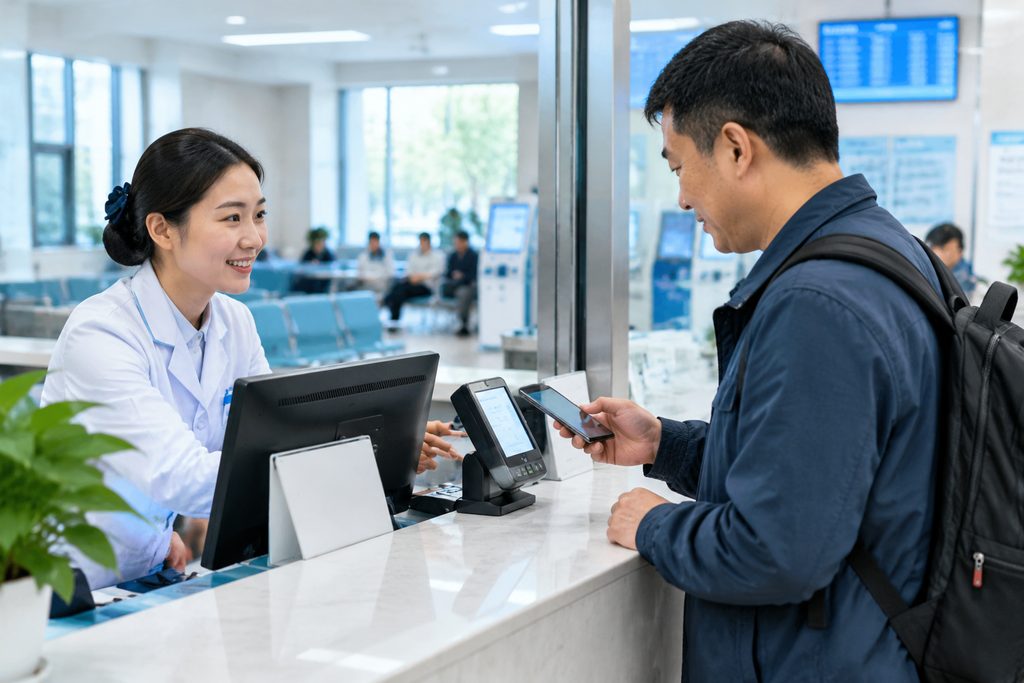
Every major Chinese hospital that accepts international patients has a dedicated international medical department or VIP clinic. These departments have English-speaking staff, published fee schedules, and documented procedures for foreign patients. When you pay for treatment, you pay at the hospital cashier or via an official hospital bank transfer. The receipt bears the hospital’s official stamp. The invoice is issued in the hospital’s name. There is no ambiguity about who received the money.
So when someone asks you to send money to a personal account, the question to ask is simple: why? The hospital has a documented system. A legitimate coordinator works within that system. They do not need your money in their personal account to do their job. If they claim they do, they are either incompetent or dishonest. Neither is acceptable when your health and savings are on the line.
Public Hospital Prepayment Is Standard — But Only to the Hospital
Chinese public hospitals require prepayment for inpatient care. You deposit funds with the hospital before admission, and the hospital deducts costs as they accrue. This is different from the US model where you receive a bill after treatment. The deposit goes to the hospital’s official account, not to anyone’s personal account. When you are discharged, the unused balance is refunded to you. The entire transaction happens between you and the hospital. A coordinator may help you navigate this process, but they should never be the recipient of your funds.
Verify You Aren’t Paying a Personal Account: The Red Flags and How to Check
This is the section you came for. Here is exactly what to look for and how to confirm you are dealing with a legitimate hospital billing process. The rule is simple: hospital treatment fees go to the hospital. Service fees for coordination, translation, or companionship go to the service provider — and those fees should be clearly separated from treatment costs.
Red Flag #1: Payment to an Individual’s Name
Any request to transfer money to a person’s name — whether via bank wire, PayPal, Western Union, or a Chinese payment app like WeChat Pay or Alipay — is a red flag. Legitimate hospital payments go to institutional accounts. The account name will be the hospital’s official name, not “Li Wei” or “Zhang Ming.” If the account name on the transfer instructions does not match the hospital’s registered name, stop. Do not send money. Contact the hospital’s international department directly and ask whether the requested payment route is legitimate.
Red Flag #2: Urgency and Pressure
Scammers create artificial deadlines. “The surgery slot will be gone tomorrow.” “The deposit must be paid today to hold the bed.” Real Chinese hospitals do not work this way. Yes, popular specialists have busy schedules. Yes, hospital beds fill up. But the hospital’s international department will confirm availability in writing before asking for payment. They will issue a formal admission notice and a payment instruction document. They will not pressure you to wire money within hours to a personal account.
Red Flag #3: No Official Receipt or Invoice
Every legitimate payment to a Chinese hospital generates an official receipt (发票, fapiao) or hospital-stamped payment confirmation. If someone takes your money and cannot produce a hospital-issued receipt bearing the hospital’s official stamp, you have a problem. Ask for the receipt before treatment begins. If the “coordinator” says they will handle it and you do not need to worry about paperwork, worry.
Warning: Never send money to a personal account for hospital treatment fees, surgery deposits, or “slot reservation” charges. Legitimate Chinese hospitals collect directly. If someone asks you to pay them personally “on behalf of the hospital,” contact the hospital’s international department to verify before taking any action.
How to Verify a Payment Request Is Legitimate
Verification is straightforward. Call the hospital’s international department directly. The phone number should come from the hospital’s official website — not from the person who asked you for money. Ask: “Does your hospital accept payment through [the method you were told to use]?” and “Is [the account name] an official hospital account?” Hospital staff will tell you. They have no reason to hide this information. If the person who requested payment discourages you from contacting the hospital directly, that is your answer.
You can also check the hospital’s official website for published payment policies. Major institutions like Peking Union Medical College Hospital and Zhongshan Hospital Fudan University publish billing information for international patients. The Fudan-ranked top hospitals in our database all have documented international patient procedures. If a payment request contradicts what the hospital publishes, trust the hospital, not the middleman.
Legitimate Service Fees vs. Hospital Treatment Fees: Know the Difference
Here is where confusion often arises. Legitimate medical facilitation services do charge fees. Our organization charges for coordination, translation, and companion services. That is how we operate. The critical distinction is that these service fees are separate from hospital treatment fees, they are disclosed upfront, and they are never described as hospital charges. When you work with a legitimate coordinator, you will receive two sets of financial information: the hospital’s fee schedule for treatment, and the coordinator’s fee schedule for services. They are not mixed together. You pay the hospital directly for treatment. You pay the coordinator separately for coordination.
| Fee Type | Who Collects It | Payment Method | Typical Range |
|---|---|---|---|
| Hospital treatment deposit | Hospital cashier or official hospital bank account | Bank transfer to hospital account, or card payment at hospital | Varies by procedure; heart bypass $12,000–20,000 at top public hospitals |
| Written second opinion | Service provider (coordination company) | Company account, clearly labeled service fee | $300–500 |
| Video consultation | Service provider or hospital international department | Company or hospital account | $100–300 for standard; $500–800 for top specialist |
| Bilingual medical companion | Service provider | Company account, daily rate | From $300/day |
| VIP end-to-end coordination | Service provider | Company account, staged payments | $5,000–8,000 |
Notice the pattern. Service fees are paid to the service provider’s company account. Treatment fees are paid to the hospital. No legitimate fee is ever paid to an individual’s personal account. If you are asked to pay a “coordination fee” to a person’s WeChat or personal bank account, that is not a legitimate business practice. It is a red flag that the person you are dealing with is not operating a registered business.
What Legitimate Hospital Payment Actually Looks Like in China
Let us walk through the real process so you know what to expect. When you pursue treatment at a Chinese hospital through proper channels, the financial flow follows a documented sequence. It starts with a formal evaluation, not a payment demand.
Step 1: Remote Evaluation Comes First
Before any significant payment, a legitimate hospital or its international department will review your medical records. This is the written second opinion or video consultation stage. You send your existing imaging, lab results, and medical history. The hospital’s specialists review them. They tell you whether treatment in China is appropriate for your case and what it would involve. This stage costs a modest fee — typically $100 to $500 for a written second opinion, or $500 to $800 for a video consultation with a top specialist. The fee is paid to the hospital or the coordination service, not to an individual.
Step 2: Formal Treatment Plan and Cost Estimate
If the remote evaluation confirms that treatment is appropriate, the hospital issues a formal treatment plan and cost estimate. This document comes from the hospital, bears the hospital’s name and stamp, and itemizes the expected costs: surgery, hospital stay, medications, examinations. You review this document before committing to anything. A legitimate coordinator helps you understand it. They do not pressure you to skip this step.
Step 3: Hospital Deposit, Paid to the Hospital
Once you agree to proceed, the hospital issues an admission notice and payment instruction. You transfer the deposit to the hospital’s official bank account, or you pay at the hospital cashier when you arrive. The account name matches the hospital’s registered name. You receive an official receipt. This deposit is held by the hospital and applied to your treatment costs. Any unused balance is refunded when you are discharged.
Step 4: Service Fees, Paid Separately
If you use a coordination service, you pay for that service separately. The fee covers what the service actually does: translating medical records, coordinating with the hospital’s international department, arranging a bilingual companion for your hospital visits, helping with visa documentation. These fees are disclosed before you commit. They are paid to the service provider’s company account. They are never mixed with hospital treatment fees.
Practical tip: Ask for a written breakdown that separates hospital fees from service fees before you pay anything. A legitimate provider will provide this without hesitation. If someone resists separating the two, treat that as a warning sign.
Why Patients Choose China Despite the Complexity
Given the payment risks, why do thousands of international patients still choose China for major medical treatment? The answer lies in the numbers. China’s top hospitals perform procedures at volumes that Western institutions rarely match. Fuwai Hospital in Beijing performs over 14,000 cardiac surgeries annually — the highest volume of any cardiac center in the world. The average cost of heart bypass surgery at a top Chinese public hospital runs $12,000 to $20,000, compared to $120,000 or more in the United States. That is a 5-to-1 to 10-to-1 cost advantage for comparable clinical quality.
The Fudan University hospital rankings identify the top 5% of China’s 35,000+ hospitals. Our database covers 340+ of these institutions across 37 cities. These are not obscure facilities. They are major academic medical centers with international departments, English-speaking staff, and documented procedures for foreign patients. The specialty rankings across 45 departments show Chinese hospitals ranking among the world’s best in oncology, cardiac surgery, orthopedics, and other fields. The quality is real. The cost advantage is real. The payment system is formal and documented — if you know how to navigate it.
But the complexity is also real. Language barriers, unfamiliar administrative procedures, and the sheer scale of Chinese hospitals can overwhelm a foreign patient who arrives without support. That is where legitimate coordination services add value. Not by collecting your hospital deposit into a personal account — that is never legitimate — but by helping you navigate the official system correctly.
Frequently Asked Questions
No. Legitimate Chinese hospitals collect treatment fees directly through their official cashier or official bank accounts. A third party may help you understand the payment process and coordinate logistics, but they should never be the recipient of hospital treatment funds. If a coordinator asks you to pay them so they can “pay the hospital for you,” that is not standard practice and should be verified directly with the hospital before any money changes hands.
Contact your bank or payment provider immediately and report the transaction as suspected fraud. Request a recall or chargeback if the payment method allows it. Then contact the hospital’s international department directly to confirm whether the person you dealt with has any legitimate affiliation. Document everything — emails, transfer receipts, chat messages. File a report with your local police and, if the payment involved a Chinese bank account, consider reporting it through the Chinese embassy or consulate in your country.
Ask for the company’s registered business name and verify it. A legitimate coordination service operates as a registered company with a verifiable business license. They will provide a company bank account for service fees, not a personal account. They will separate service fees from hospital fees in writing. They will not discourage you from contacting the hospital directly. If a provider cannot or will not provide verifiable business information, do not pay them anything.
For hospital treatment fees, yes — you can typically pay your deposit at the hospital cashier when you arrive. This is actually the safest approach for major treatment deposits. The hospital’s international department will confirm your admission and you can pay in person with a card or bank transfer. For service fees like written second opinions or video consultations, payment is typically required before the service is delivered, since the work happens before you travel. Those fees are modest — a few hundred dollars at most — and should be paid to a company account.
Your Next Step
The core message is simple: verify you aren’t paying a personal account before you send money to anyone for medical treatment in China. Hospital fees go to hospitals. Service fees go to registered companies. Personal accounts are for personal transactions, not medical deposits. Our team at China Medical Services helps international patients navigate the legitimate system — we coordinate with hospital international departments, arrange bilingual
For more medical information and treatment options in China, visit chinamedservices.com (China Medical Services).
