Women’s Checkup in China: Complete Guide to Costs and Top Hospitals
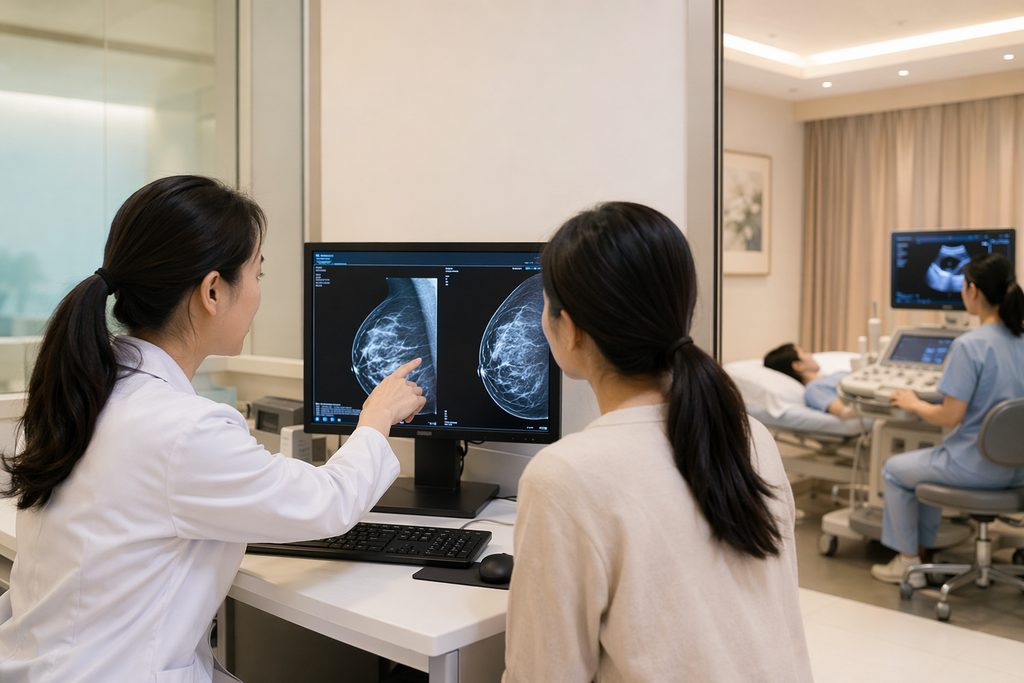
Key Takeaways
- A comprehensive women’s checkup in China typically runs $300 to $1,200 at top-tier hospitals — often 60-80% less than equivalent screening in the US or Western Europe.
- China’s best hospitals see extraordinary patient volumes, which means imaging equipment and lab capacity are built for scale, not scarcity. Appointments move fast once you’re in the system.
- The real friction isn’t medical quality — it’s navigation. Public hospital registration is same-day and Chinese-language, and there is no online booking for foreigners without help.
- Nothing should be booked before you understand what’s actually included in a package. Two “full body checkups” at different hospitals can differ by 40+ lab tests.
The Problem: Why Women Delay Screening — and What It Costs Them
According to the American Cancer Society, roughly 1 in 8 women in the US will develop invasive breast cancer in her lifetime. Cervical cancer screening rates have been falling for a decade. And a routine mammogram in the United States, without insurance, averages $100 to $250 — before the follow-up ultrasound, the biopsy, the specialist visit.
Cost is the quiet driver. A 2023 KFF survey found that nearly 4 in 10 American adults skipped or delayed recommended care because of price. For women over 40, that often means pushing off the mammogram another year. And another.
In the UK, the picture is different but not better. NHS waiting lists for diagnostic imaging have stretched past 6 weeks in many trusts, and private screening runs £500 to £1,500. In Canada, a routine ultrasound can take months to schedule outside of an emergency.
So women look elsewhere. Medical tourism checkup packages in China have quietly become one of the more practical answers — not because China is cheap in a cut-rate sense, but because the top hospitals there are genuinely world-class and the price structure is simply different.
Why China Delivers Results for Women’s Health Screening
The case isn’t about patriotism or marketing. It’s structural. Here’s what actually makes the difference.
Clinical Volume That Most Western Hospitals Can’t Match
China’s 35,000+ hospitals include a top 5% that handle patient volumes no European or American facility approaches. A single major hospital in Shanghai or Beijing may perform more breast ultrasounds in a week than a mid-sized US hospital does in a month.
That volume matters for two reasons. First, radiologists and sonographers see more cases, which sharpens diagnostic pattern recognition. Second, equipment utilization is high — meaning a 3T MRI or digital mammography unit is running constantly, not sitting idle waiting for a slot.
The practical result: you can often complete a full women’s screening panel — bloodwork, ultrasound, mammography, ECG, and specialist review — in a single morning.
Technology and Efficiency at Scale
Top Chinese hospitals are not using older machines. Fudan-ranked facilities and JCI-accredited private international hospitals run the same imaging platforms you’d find at Johns Hopkins or Charité — Siemens, GE, Philips.
What differs is the workflow. Public tertiary hospitals operate on a high-throughput model: registration, then a sequence of stations, then consolidated results. It’s not leisurely. But it’s fast.
Private international hospitals like United Family, Jiahui, and Parkway offer a slower, English-speaking, appointment-based experience — closer to what a Western patient expects. Both models are legitimate. They just serve different preferences.
Cost Advantage Without Quality Compromise
Here’s the honest explanation for why a women’s checkup package cost in China lands so much lower than in the West. It isn’t because the medicine is lesser. It’s labor economics, hospital scale, and lower administrative overhead.
Physician salaries in China are a fraction of US levels. Hospital administrative costs are lower. Equipment is purchased in enormous volumes. None of that changes the accuracy of a mammogram or the calibration of a blood analyzer.
What it changes is the invoice.
What a Women’s Checkup Package Actually Includes
This is where most patients get confused, so let’s be specific. A “women’s checkup” in China is not one product. It’s a tiered menu, and hospitals build packages around age, risk factors, and purpose.
Here’s a representative comparison of typical package tiers:
| Package Tier | Typical Contents | Price Range (USD) |
|---|---|---|
| Basic Women’s Screening | CBC, urinalysis, liver/kidney function, blood glucose, lipid panel, ECG, abdominal ultrasound, gynecological exam, breast ultrasound | $300 – $500 |
| Comprehensive Women’s Package | Everything above plus thyroid ultrasound, mammography (age 40+), cervical cytology (TCT), HPV testing, bone density, tumor markers (CA125, CA15-3) | $600 – $900 |
| Premium / Executive Women’s | Everything above plus low-dose chest CT, cardiac stress testing, gastroscopy, colonoscopy (age 45+), 3T MRI where indicated, specialist consultations | $1,000 – $1,800 |
| Private International Hospital | Similar scope, English-speaking staff, appointment-based scheduling, direct insurance billing | $800 – $2,500 |
Prices vary by hospital and case complexity. A top-ranked public hospital in Beijing will often sit near the lower end of each range; a JCI-accredited private facility in Shanghai sits higher.
If you want to see how specific hospitals compare, our ranked directory of China’s top hospitals by city groups them by Fudan ranking tier.
How to Book a Women’s Health Checkup in China as a Foreigner
This is the part nobody explains well, so here’s the unvarnished version.
Public tertiary hospitals in China do not offer online appointment booking for foreigners. Registration happens on the day, in person, in Chinese, at a physical window. You take a number. You wait.
That’s the standard channel. It works, and it’s cheap. But for a visitor with limited Mandarin and a tight schedule, it’s genuinely difficult.
The alternative is the hospital’s International Department or VIP channel. These exist specifically for foreign patients and higher-income domestic patients. You get an English-speaking coordinator, a scheduled appointment, and shorter waits. The cost is roughly 1.5 to 2 times the standard channel — still far below Western pricing.
Private international hospitals skip this distinction entirely. You book online, you arrive, someone speaks English. That’s the whole process.
Is a Health Checkup in China Safe for Foreigners?
Yes — with the right expectations. China’s top hospitals are subject to the same international accreditation standards as Western facilities. Many hold JCI accreditation. Equipment is modern. Sterilization protocols are strict.
The legitimate concerns aren’t safety. They’re these:
- Language. Outside international departments, almost nothing is in English — not signage, not forms, not the radiologist’s notes.
- Consent and communication. You need to understand what’s being tested and why. This is where interpretation matters.
- Results follow-up. Chinese hospitals typically release results in Chinese, sometimes as a printed booklet. Getting them translated and explained is essential.
- Payment. Public hospitals require prepayment. International insurance is usually reimbursed after the fact, not billed directly — except at private international hospitals, which often do direct billing.
None of these are reasons to avoid China. They’re reasons to plan properly.
For a broader look at how the system works, our specialty directory covering 45 medical departments shows which hospitals lead in each field, including reproductive medicine and oncology.
Practical Considerations Before You Book
A few things worth handling before you commit to a package or a date.
Visa. Medical treatment in China requires an S2 visa for short stays (under 180 days), with the purpose of visit noted as medical treatment. Stays over 180 days use S1. Accompanying family members also apply under S2. Requirements are set by the Chinese embassy or consulate in your country and change periodically — confirm current rules with the consulate directly. The M visa is for commercial and trade activities only and is not the correct category for medical travel.
Records. Bring your prior mammograms, ultrasound reports, and lab results if you have them. Comparison with prior imaging is one of the most valuable things a radiologist can do, and without your history, they’re starting from zero.
Timing. Cervical cytology and HPV testing should not be done during menstruation. Mammography is best scheduled in the first half of your cycle if you have breast tenderness. Plan around these.
Fasting. Most comprehensive packages require 8-12 hours of fasting for bloodwork and abdominal ultrasound. Morning appointments are standard.
Insurance. Check whether your policy covers overseas screening. Most don’t cover elective checkups, but some cover diagnostic imaging if symptoms are present. Read the fine print before you assume.
Frequently Asked Questions
Beijing and Shanghai are broadly comparable — both sit at the top of China’s medical hierarchy, and pricing reflects that. A comprehensive women’s package at a top public hospital in either city typically runs $600 to $900. Premium executive packages with CT and endoscopy reach $1,200 to $1,800. Private international hospitals in both cities charge more, generally $800 to $2,500 depending on scope.
At private international hospitals, yes — English is standard. At public hospitals, only through the International Department or with a bilingual companion. Standard public registration is entirely in Chinese, and staff generally do not speak English. This is the single biggest practical barrier for foreign patients.
This is the question that matters most, and it deserves a direct answer. If a screening finds something requiring follow-up, you’ll need a specialist consultation — and in China, that means a separate appointment, often on a different day. You cannot typically walk from a screening directly into a specialist consultation the same afternoon. Planning for this possibility, and having a way to get results explained and next steps coordinated, is the difference between a smooth experience and a stressful one.
Generally yes, but disclose everything. If you have a cardiac condition, a bleeding disorder, or take anticoagulants, tell the screening team in advance. Colonoscopy and gastroscopy carry small but real risks that need to be weighed against your specific situation. No screening package is one-size-fits-all, and any hospital that treats it that way should give you pause.
Your Next Step
China’s top hospitals offer genuinely excellent women’s health screening at a fraction of Western prices — the medicine is sound, the equipment is current, and the value is real. The challenge is navigation, not quality. We’re China Medical Services, a coordination service that connects international patients with 340+ top-ranked hospitals across 37 cities. We are not a hospital and we don’t provide diagnoses — we handle the logistics, the language, and the scheduling so you can focus on your health. If you’d like to explore what a women’s checkup in China would look like for your situation, you can start with a free consultation — no pressure, no obligation, just clear answers.
This article is for informational purposes only and does not constitute medical advice. Screening recommendations vary by age, history, and risk factors. Consult a qualified physician before making any healthcare decision.
For more medical information and treatment options in China, visit chinamedservices.com (China Medical Services).
