Should I Worry About Radiation From Scans? A Data-Driven Guide for Patients Abroad
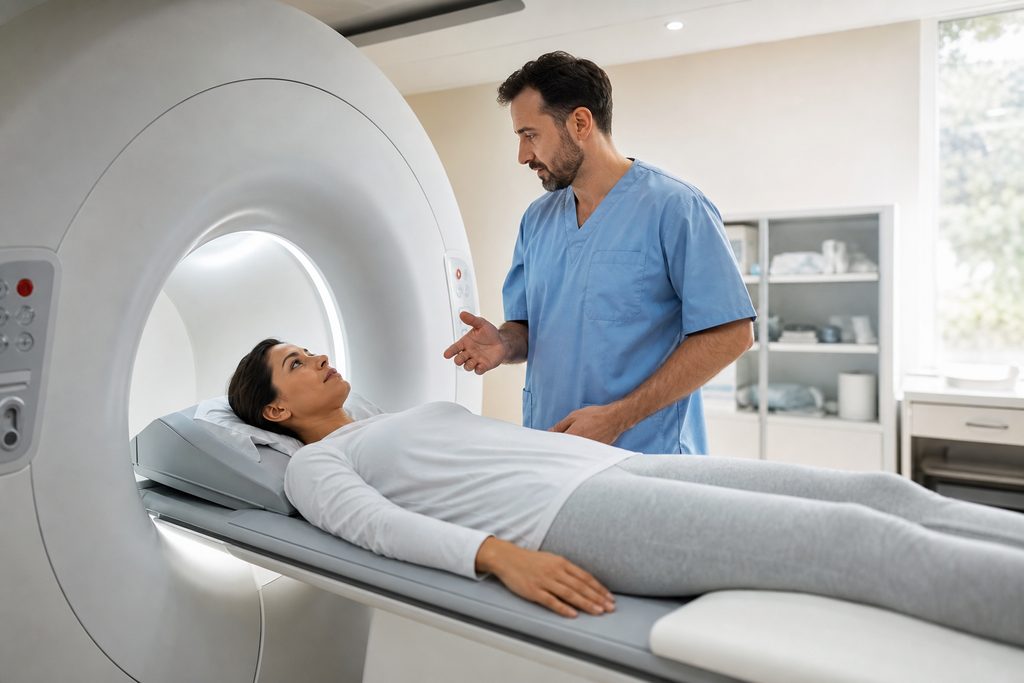
While the average American now receives six times more medical radiation than in 1980, patients at top Chinese hospitals often undergo the same CT scan at a fraction of the cost — and with radiation doses that meet or beat international safety benchmarks. A chest CT in Shanghai delivers roughly 7 mSv of effective dose. The same scan in London delivers about 6.6 mSv. The difference is negligible. But the anxiety patients feel? That is often the same everywhere. So should you worry about radiation from scans? The short answer: mostly no, but sometimes yes. Understanding the actual numbers behind CT scan radiation risk in China — and how modern low-dose protocols work at hospitals in Shanghai, Beijing, and Guangzhou — turns fear into informed decision-making.
Our team at China Medical Services regularly helps international patients schedule imaging at top-ranked Chinese hospitals where radiologists follow strict ALARA (As Low As Reasonably Achievable) principles. This guide explains what the radiation numbers mean, when you should push back, and how to find imaging departments that take dose reduction seriously.
How This Actually Works, Step by Step
You have a symptom. Your doctor orders a scan. You wonder if the scan itself could hurt you. Here is the sequence most patients go through when considering imaging abroad, including in China.
First, your physician determines which modality fits the clinical question. Not every scan uses ionizing radiation. Ultrasound and MRI use none. X-rays and CT scans do. PET scans involve a radioactive tracer plus a CT component. Knowing which category your scan falls into is step one.
Second, the imaging department calculates the dose. Modern CT scanners in Chinese tertiary hospitals — the same Siemens, GE, and Canon machines used in the US and Europe — automatically adjust radiation output based on your body size, the body region scanned, and the clinical indication. A head CT gives about 2 mSv. A chest CT gives about 7 mSv. A full-body PET-CT can reach 25 mSv. These numbers vary by protocol.
Third, you receive the images and the radiology report. Many international patients send us those files for a written second opinion or video consultation with a Chinese specialist. The report tells your referring doctor what the scan found. It rarely tells you the radiation dose you received. That is a gap worth closing.
Finally, you decide what comes next. If the scan was clean, you move on. If it found something, you may need follow-up imaging. That is where cumulative dose becomes a real conversation — and where choosing a hospital with documented low-dose protocols matters.
What the Radiation Numbers Actually Mean for CT Scan Risk
Radiation dose is measured in millisieverts, or mSv. That unit sounds clinical. But you need a frame of reference to make sense of it.
You receive about 3 mSv of background radiation every year just from living on Earth — cosmic rays, soil, even the potassium in bananas contributes a tiny fraction. A round-trip flight from New York to Beijing adds about 0.1 mSv. A chest X-ray adds 0.1 mSv. A mammogram adds 0.4 mSv.
Now compare that to CT. A head CT: 2 mSv. A chest CT: 7 mSv. An abdominal-pelvic CT: 10 mSv. That sounds like a lot. But the actual cancer risk from a single 10 mSv scan is estimated at roughly 1 in 2,000 — and that estimate is based on linear no-threshold models that many physicists consider overly conservative at low doses. The International Commission on Radiological Protection itself states that doses below 100 mSv produce no directly observable health effects in human populations.
So when a patient asks us whether is medical imaging radiation safe abroad, the honest answer is that safety depends on justification and optimization — not geography. A justified CT scan at a hospital in Shanghai is safer than avoiding a needed diagnosis out of fear. An unjustified full-body screening CT at a private clinic in any country is riskier than no scan at all.
A Realistic Timeline for Diagnostic Imaging in China
If you are considering traveling to China for imaging — whether for a second opinion, a health screening, or a specific diagnostic question — here is what the actual timeline looks like. Not the optimistic version. The real one.
| Stage | What Happens | Typical Duration |
|---|---|---|
| Day 1–3 | You send existing medical records, imaging files (DICOM preferred), and a summary of your clinical question to us or directly to the hospital’s international department | 2–3 days for document review |
| Day 4–7 | A specialist reviews your case and determines whether imaging in China adds value, or whether your existing scans are sufficient for a written second opinion | 3–4 days |
| Day 8–14 | If imaging is recommended, we coordinate the appointment at the appropriate department. Public hospital outpatient imaging often requires an in-person consultation first | 5–7 days lead time |
| Day 15–30 | Visa processing. S2 visa applications for medical treatment typically require an invitation letter or hospital appointment confirmation. Processing varies by consulate | 1–3 weeks |
| Day 31–35 | You arrive in China. Same-day or next-day imaging at most international departments. Results available within 24–48 hours | 2–3 days on the ground |
| Day 36–45 | Follow-up consultation with the interpreting radiologist or referring specialist. Written report and DICOM files provided for your home physician | 2–7 days after imaging |
One step people forget: document translation. If your existing records are not in English or Chinese, they need professional medical translation before any Chinese radiologist can review them. That adds 3–5 days. Plan for it.
What Can Go Wrong — and What Happens Then
Honest failure modes matter. Here are the ones we see most often with international imaging requests.
The hospital refuses to scan without an in-person consultation first. This is standard at Chinese public hospitals. The radiologist needs a clinical indication before exposing you to radiation. If that happens, we arrange the consultation — often same-week — and the scan follows. It is not a rejection. It is a safety gate.
Your existing images are incompatible. Some hospitals use proprietary PACS viewers. If your DICOM files are corrupted or incomplete, the Chinese radiologist cannot read them. The fix: request a clean export from your original imaging center before you travel. We check file integrity before you book a flight.
The scan finds something incidental. This happens in roughly 15–30% of chest CTs and abdominal CTs — a lung nodule, a liver cyst, an adrenal lesion. Most are benign. But now you need follow-up. Chinese hospitals handle this well: the radiologist flags the finding, the referring specialist decides whether a repeat scan in 3–6 months is warranted, and we coordinate that follow-up remotely if you have returned home.
You receive a higher dose than expected. This is rare at top Chinese hospitals, but it can happen at smaller facilities using older equipment. Ask for the dose report. Every modern CT scanner records the dose-length product (DLP) and effective dose for each scan. If the hospital cannot provide it, that is a red flag.
Low-Dose CT in Shanghai and Other Chinese Cities: What to Look For
China has invested heavily in low-dose imaging technology over the past decade. The result: many of the country’s top radiology departments now operate the same dual-source CT and photon-counting CT scanners found at Massachusetts General or Charité Berlin.
What does “low dose” actually mean in practice? A standard chest CT delivers 7 mSv. A low-dose chest CT — the kind used for lung cancer screening — delivers 1.5 mSv or less. That is less than half the annual background radiation. Some newer photon-counting detectors push that below 1 mSv. If you are seeking low dose CT scan hospitals Shanghai offers several options, including the international departments of major public institutions and JCI-accredited private facilities listed on our private international hospitals page.
How do you evaluate a hospital’s dose practices? Three questions to ask. First: what scanner model do you use? Second: do you use automatic exposure control and iterative reconstruction? Third: can you provide the dose report after the scan? A confident radiology department answers all three without hesitation.
Radiation-free imaging clinics in China are another option for patients who want to avoid ionizing radiation entirely. Ultrasound and MRI provide excellent diagnostic information for many conditions — liver lesions, thyroid nodules, joint injuries, brain abnormalities — with zero radiation dose. Many international patients specifically request MRI over CT for this reason, even though MRI takes longer and costs more. The tradeoff is worth it for some clinical questions.
And what about PET scans? A common question we hear: how much radiation from PET scan vs MRI? The answer is stark. MRI: zero ionizing radiation. PET-CT: 10–25 mSv depending on the tracer and scan range. That is 3–8 years of background radiation in one session. PET scans are powerful tools for cancer staging and treatment response assessment — but they should never be used for casual screening. If a clinic offers “full-body PET screening” to healthy patients, walk away. That is not medical care. That is radiation exposure without justification.
Practical Considerations: Records, Visas, Payment, and Follow-Up
At accredited hospitals, yes. Top Chinese hospitals use the same CT and MRI equipment as Western institutions and follow the same international dose-reduction guidelines. The key variable is not the country — it is the specific facility. Ask about scanner age, dose-reduction software, and whether the department provides dose reports. Accredited international departments answer these questions readily.
Yes. Ultrasound and MRI use no ionizing radiation and are widely available at major Chinese hospitals. MRI is particularly useful for brain, spine, joint, and soft tissue imaging. The tradeoff is longer scan times and higher cost compared to CT. For many clinical questions, MRI is the better choice — ask your referring physician whether it fits your case.
MRI delivers zero ionizing radiation. A PET-CT scan delivers 10–25 mSv depending on the tracer and scan range — equivalent to 3–8 years of background radiation. PET scans are valuable for cancer staging and treatment monitoring, but they are not appropriate for routine screening of healthy people.
Ask three questions: What scanner model do you use? Do you employ automatic exposure control and iterative reconstruction? Will you provide a dose report after the scan? Modern scanners from Siemens, GE, and Canon all include these features, but the hospital must activate and document them. A hospital that cannot answer these questions is not one you want performing your scan.
Your Next Step
Radiation from medical imaging is a manageable risk, not a reason to avoid diagnosis. The right scan at the right dose in the right facility answers your clinical question without meaningful long-term harm. At China Medical Services, we help international patients navigate that process — matching you with appropriate imaging departments, coordinating appointments, and providing bilingual support throughout your visit. We do not perform scans or interpret images. We connect you with the specialists who do. If you are considering diagnostic imaging in China, start with a free consultation at our patient services page. We will review your case and tell you honestly whether traveling for imaging makes sense for you.
You deserve clarity about your health — and about the tools used to assess it. Ask for the dose report. Question unnecessary scans. And when imaging is justified, get it done at a facility that treats radiation as a resource to be minimized, not an afterthought.
Frequently Asked Questions
Yes. The hospitals used for international patients are JCI-accredited and follow the same international safety standards as top hospitals in the US and Europe. Surgical teams perform high volumes of procedures — often more than their Western counterparts — which studies show leads to better outcomes.
Costs vary by procedure and hospital, but international patients typically save 40-80% compared to US prices — even when factoring in travel and accommodation. A consultation with our team will give you an exact, all-inclusive quote with no hidden fees.
Send us your existing medical reports to get started. We handle everything from hospital selection and appointment scheduling to visa assistance and post-operative recovery planning. Your medical records are reviewed by the specialist before you even book a flight.
For more medical information and treatment options in China, visit chinamedservices.com (China Medical Services).
