5G Remote Surgical Consultation China: Pre-Surgery Planning with Your Home Country Doctor
When 52-year-old David sat in his cardiologist’s office in Manchester, the recommendation was clear. He needed a complex mitral valve repair. The NHS wait time stretched to seven months. Private options in London started at £35,000. His local specialist had trained years ago with a team in Shanghai — a center performing over 3,000 valve procedures annually. The question lingered in the room: could his UK doctor and a Chinese surgical team examine his case together before he ever booked a flight?
That question is no longer theoretical.
5G remote surgical consultation in China has moved from pilot programs to operational reality across dozens of top-tier hospitals. For international patients, it reshapes the entire pre-surgery planning process. You are no longer choosing between a local doctor who knows your history and a distant specialist who does not. The technology creates a shared space where both can review imaging, discuss surgical approach, and build a coordinated care plan. The cost of a 5G remote surgery consultation in China is substantially lower than most patients expect — and it solves the hardest problem in medical travel: the leap of faith before you travel.
Key Takeaways
- A 5G remote surgical consultation in China typically costs between $300 and $800, with MDT sessions ranging from $1,500 to $2,000 — all creditable toward in-person coordination if you proceed with treatment.
- China’s top surgical centers perform case volumes that dwarf Western benchmarks. A hospital like Fuwai Hospital completes over 14,000 cardiac surgeries annually, creating a depth of clinical experience that directly impacts outcomes.
- Language barriers, visa requirements, and hospital registration systems make independent navigation genuinely difficult. You need a bilingual coordinator who understands both medical terminology and hospital workflows.
- Remote consultation is not a substitute for in-person evaluation. It is a structured first step that lets your home doctor participate in surgical planning — reducing uncertainty before you commit to travel.
The Problem: When Your Local Options Are Limited by Time, Cost, or Capability
Wait times for elective surgery in publicly funded health systems have stretched to breaking points. In Canada, the median wait between specialist consultation and treatment reached 27.7 weeks in 2023, according to the Fraser Institute. The UK’s NHS reported over 7.6 million people on waiting lists for treatment. For cardiac surgery, orthopedic procedures, and complex oncology cases, delays are not just inconvenient — they allow disease to progress.
Private alternatives within Western systems solve the time problem but create a cost crisis. A single coronary artery bypass graft in the United States averages $120,000 to $180,000. Many patients face an impossible choice: wait in pain and uncertainty, or drain retirement savings for timely care.
Medical travel offers a third path. But it comes with its own friction. You are evaluating hospitals in a country where you do not speak the language. You cannot easily verify surgical expertise. Your home doctor — the one who knows your case history, your comorbidities, your medication responses — is left out of the conversation entirely. You are asked to trust a system you have never seen, represented by people you have never met.
That gap is exactly where remote surgical consultation fits.
Who We Are
Our team at China Medical Services is not a hospital. We do not provide medical treatment, clinical diagnoses, or surgical recommendations. We are logistical architects — we bridge the gap between you and China’s 340+ top-ranked hospitals across 37 cities. We handle hospital matching, appointment coordination, bilingual medical interpretation, visa guidance, and the full operational chain that turns a remote consultation into a safe, coordinated treatment journey. Our role is to make sure the right people are in the same conversation, looking at the same data, speaking the same language — literally and clinically.
How 5G Remote Surgical Consultation Works for International Patients
The term sounds futuristic. The reality is practical. China’s major hospitals have invested heavily in 5G-enabled telemedicine platforms that support high-bandwidth, low-latency transmission of medical imaging. A full cardiac CT series — hundreds of thin-slice images — can be transmitted and reviewed in real time without compression artifacts. That matters. A surgeon assessing valve calcification or tumor margins cannot work with grainy video. They need diagnostic-quality resolution.
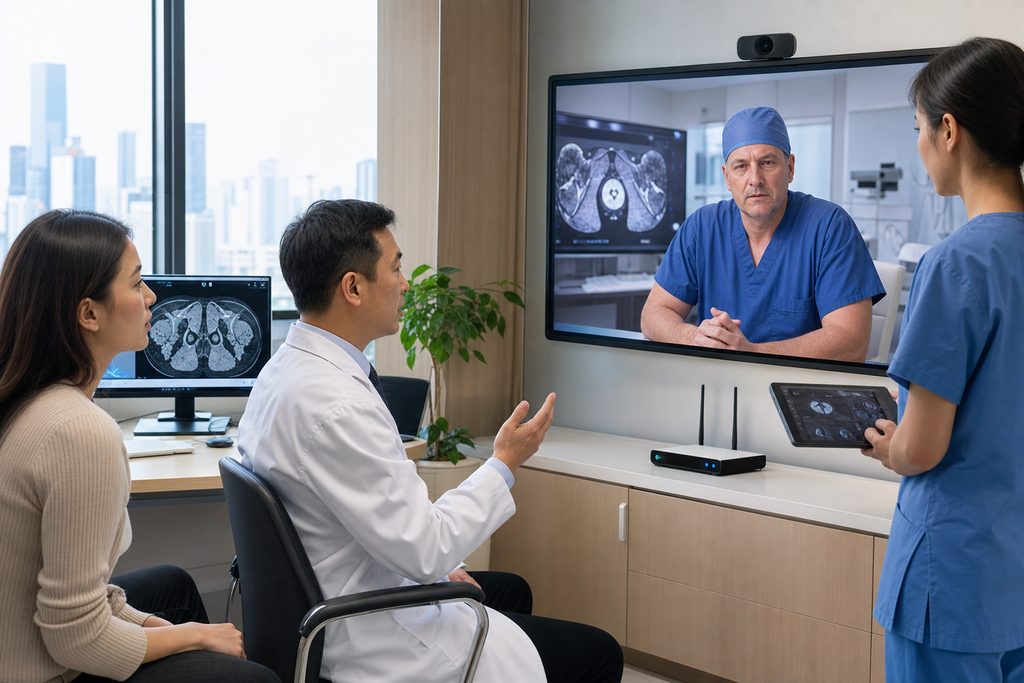
These platforms are not consumer-grade video calls. They integrate with hospital PACS (Picture Archiving and Communication Systems), support multi-party participation, and meet China’s medical data security regulations. For an international patient, the workflow typically looks like this: your home doctor uploads your imaging and clinical summary. A Chinese surgical team reviews the materials. A live consultation is scheduled — often with a bilingual medical interpreter present. Your home doctor can ask specific questions about surgical technique, implant selection, post-operative protocols, and expected recovery timelines. The Chinese team can clarify what additional pre-operative testing they require before accepting you as a surgical candidate.
This is not a second opinion in the traditional sense. It is pre-surgery planning with your home country doctor actively involved. The continuity is the point.
Why China’s Surgical Centers Deliver Results Worth Considering
There is a well-established relationship between procedural volume and patient outcomes. A 2017 study in The Lancet analyzing over 500,000 surgical patients found that hospitals performing high volumes of complex procedures had significantly lower mortality rates. China’s top surgical centers operate at volumes that are difficult to find elsewhere.
Fuwai Hospital in Beijing performs more than 14,000 cardiac surgeries each year — the highest volume of any cardiac center globally. A senior surgeon there may see more complex valve pathology in a single month than a competent Western surgeon encounters in a year. That pattern recognition translates into intraoperative decision-making that cannot be replicated through training alone. For orthopedic surgery, a top Chinese joint replacement surgeon completes 200 to 500 procedures annually, compared to roughly 65 for the average US orthopedic surgeon. When you are planning surgery with a local doctor, these volume differentials are the kind of data point they understand immediately.
Technology Infrastructure Built for Scale
China’s hospital systems were designed for high throughput from the ground up. Registration systems, imaging workflows, and surgical scheduling are optimized for volume — not as a compromise on quality, but as an engineering response to population-scale demand. The 5G remote consultation platforms are an extension of this logic. They are not experimental. They are integrated into daily clinical operations at major centers.
For international patients, this infrastructure means something concrete: your imaging can be reviewed within days, not weeks. A multi-disciplinary team consultation — involving a surgeon, an oncologist, a radiologist, and a pathologist — can be convened on a timeline that would require weeks of individual referrals in many Western systems. The cost of a 5G remote surgery consultation in China reflects this efficiency. A top-specialist video consultation ranges from $500 to $800. A full MDT session costs $1,500 to $2,000. These are not trivial sums. But compared to the cost of traveling for an in-person evaluation that may or may not lead to surgery, they represent a rational first step.
Cost Structure: Why Lower Price Does Not Signal Lower Quality
The cost differential between Chinese and Western surgical care is structural, not qualitative. A cardiac bypass that costs $120,000 in the United States might cost $12,000 to $20,000 at a top Chinese public hospital. The difference is not in the quality of the surgical team, the sterility of the operating theater, or the sophistication of the post-operative monitoring. It is in labor economics, hospital administrative overhead, pharmaceutical pricing, and the absence of a multi-layered insurance billing apparatus that adds roughly 25% to US healthcare costs by some estimates.
China’s top hospitals — those ranked in the top 5% of the country’s 35,000+ hospitals by the Fudan University ranking system and JCI accreditation — operate at standards comparable to international benchmarks. Many have dedicated international patient centers with English-speaking staff. The care is delivered in facilities that are often physically larger and more modern than their Western counterparts, simply because they were built more recently.
What you sacrifice is not clinical quality. It is familiarity. You are far from home. You do not speak the language. The food is different. Your family cannot easily visit. These are real costs that must be weighed honestly. Remote pre-surgery consultation does not eliminate them — but it reduces the uncertainty that makes them feel insurmountable.
What You Need to Know Before Attempting This Independently
It is possible to contact a Chinese hospital directly. It is also genuinely difficult. Here is what you will encounter:
- Hospital Registration Systems Are Not Designed for Foreign Patients: Public hospital outpatient departments require in-person registration with a Chinese ID or a local phone number. Walk-in registration queues at major hospitals can number in the thousands daily. The international patient pathway exists, but it operates separately from standard outpatient channels. Finding the right contact, in the right department, at the right hospital — without Chinese language ability — is a project measured in weeks, not days.
- Visa Requirements Are Specific and Non-Negotiable: Medical treatment in China requires an S2 visa with the purpose of medical treatment explicitly noted. Your accompanying family members also need S2 visas. The M visa is for commercial and trade activities — it cannot be used for medical treatment. Getting the visa category wrong causes problems at the border and inside the hospital registration system. The hospital will need to provide an invitation letter and treatment confirmation as part of your application.
- Medical Records Must Be Translated, Not Just Converted: A pathology report written in clinical shorthand, full of abbreviations and institution-specific terminology, cannot be run through a generic translation tool. It needs to be rendered into medical Chinese that a Chinese surgeon can act on. The same applies in reverse for post-operative reports that your home doctor will need to manage your follow-up care. This is specialized work, and errors in translation are clinical risks, not just inconveniences.
- Payment Systems Operate Differently: Public hospitals require pre-payment for procedures. You pay the hospital directly, then seek reimbursement from your insurance provider — if your policy covers international treatment at all. Private international hospitals like United Family or Jiahui can often bill your insurer directly, but their surgical pricing is higher. Understanding which model applies to your case, and what documentation you will need for reimbursement, requires advance planning.
How We Help You Navigate This Process
Our team exists because these barriers are structural, not incidental. A hospital designed to serve 10,000 outpatients daily cannot easily reconfigure itself for a single international patient. The friction is not hostility. It is a system optimized for a different population. Our job is to route you through the pathways that do work for international patients — the international medical centers, the VIP coordination channels, the bilingual clinical teams.
The process starts with your existing medical records. We arrange professional translation of your imaging reports, pathology results, and clinical summaries. We identify the hospitals and surgical departments that match your specific diagnosis — drawing on the Fudan University specialty rankings, which evaluate departments across 45 clinical specialties, and our own operational knowledge of which international centers are currently accepting foreign patients for particular procedures.
Then we coordinate the remote consultation itself. Your home doctor can participate. The session includes a bilingual medical interpreter who understands the clinical terminology of your specific condition — not a general translator, but someone who can accurately convey a discussion about surgical margins or valve sizing. The cost of a 5G remote surgery consultation in China through our coordination includes this interpretation, the technical setup, and the clinical summary that both your home doctor and the Chinese team receive afterward.
If the consultation confirms that surgery in China is appropriate, every dollar you spent on the remote session is credited toward our on-the-ground coordination fee. You do not pay twice. We then handle the hospital appointment scheduling, the visa invitation letter, the accommodation recommendations, and the bilingual medical companion who will be with you from your first in-person consultation through your discharge and follow-up. Our companion handles registration queues, payment counters, pharmacy pickup, and the thousand small interactions that a non-Chinese speaker cannot navigate alone.
The remote consultation is not the end of the process. It is the decision-quality step that makes everything else possible.
Frequently Asked Questions
Can I really plan surgery in China with my home doctor involved?
Yes. The 5G telemedicine platforms at major Chinese hospitals are designed to support multi-party consultations. Your home doctor can participate in the live session, review imaging with the Chinese surgical team, and discuss the proposed surgical plan. This is not a courtesy — it is a structured part of the pre-surgery planning process. Your home doctor’s clinical knowledge of your history is valuable input that the Chinese team actively wants. The goal is continuity of care, not a handoff into a black box.
What does a 5G remote surgery consultation in China cost, and what does that include?
A top-specialist video consultation typically costs between $500 and $800. A multi-disciplinary team consultation involving multiple specialists costs $1,500 to $2,000. These fees cover the clinical session itself, bilingual medical interpretation, technical coordination, and a written clinical summary. The cost varies by hospital and case complexity. If you proceed with in-person treatment coordination through us, the full consultation fee is credited toward your coordination service — so you are not paying an extra cost, you are making a deposit on the larger coordination process.
How does 5G surgical consultation work abroad in practical terms?
Your medical records and imaging are translated and transmitted to the Chinese hospital securely. A consultation date is scheduled. On the day of the session, you, your home doctor, the Chinese surgical team, and a bilingual medical interpreter join a secure video platform. The Chinese team has already reviewed your case. The discussion covers surgical candidacy, proposed technique, expected outcomes, post-operative protocols, and any additional pre-operative testing required. The session is not a sales pitch — it is a clinical evaluation. If the Chinese team determines you are not a good surgical candidate, they will say so directly. That outcome is valuable too. It saves you from traveling for an in-person evaluation that would reach the same conclusion.
What if something goes wrong during or after surgery in China?
This is the hardest question, and it deserves a direct answer. Surgical complications occur everywhere — in every country, at every hospital, with every surgeon. China’s top-tier hospitals have complication rates comparable to international benchmarks for the procedures they perform at high volume. What differs is the support system around you. You are far from home. Your family may not be present. Our bilingual medical companion remains with you throughout your hospitalization, serving as your communication link to the clinical team. We coordinate with your home doctor for post-discharge follow-up planning before you leave China. We do not downplay the difficulty of recovering in a foreign country. We work to reduce the practical burdens so you can focus on healing.
Is remote surgical consultation a substitute for an in-person pre-operative evaluation?
No. It is a screening and planning step. The Chinese surgical team will almost certainly require in-person pre-operative testing — blood work, cardiac clearance, updated imaging — before finalizing your surgical plan. The remote consultation determines whether it makes sense to travel for that evaluation. It answers the threshold question: is surgery in China a viable option for my specific case? If the answer is yes, the in-person steps follow with much greater clarity about what to expect.
Your Next Step
The decision to pursue surgery abroad is never simple. It involves clinical judgment, financial calculation, and emotional readiness. A remote surgical consultation does not make the decision for you. What it does is replace guesswork with information. You learn whether a Chinese surgical team considers your case appropriate. Your home doctor participates directly. You understand the proposed approach, the expected timeline, and the real costs — before you commit to travel.
If you want to explore whether this option fits your situation, our team can walk you through the specifics. We will explain which hospitals are relevant to your diagnosis, what the consultation process involves, and what the full treatment journey would look like. There is no cost for this initial conversation, and no pressure to commit to anything. You deserve clarity about your options. That is where we start.
Learn more about how we coordinate treatment journeys at our patient coordination page. If you are still evaluating which hospital might be right for your condition, our top-ranked hospital directory organizes China’s leading centers by city and specialty. For a deeper look at specific clinical departments, our specialty pages show which hospitals rank among China’s top 10 in oncology, cardiac surgery, orthopedics, and more than 40 other fields.
Good decisions start with good information. We are here to help you get it.
For more medical information and treatment options in China, visit chinamedservices.com (China Medical Services).
