Private Patient Wards in China: Which Hospitals Offer Them and What They Cost
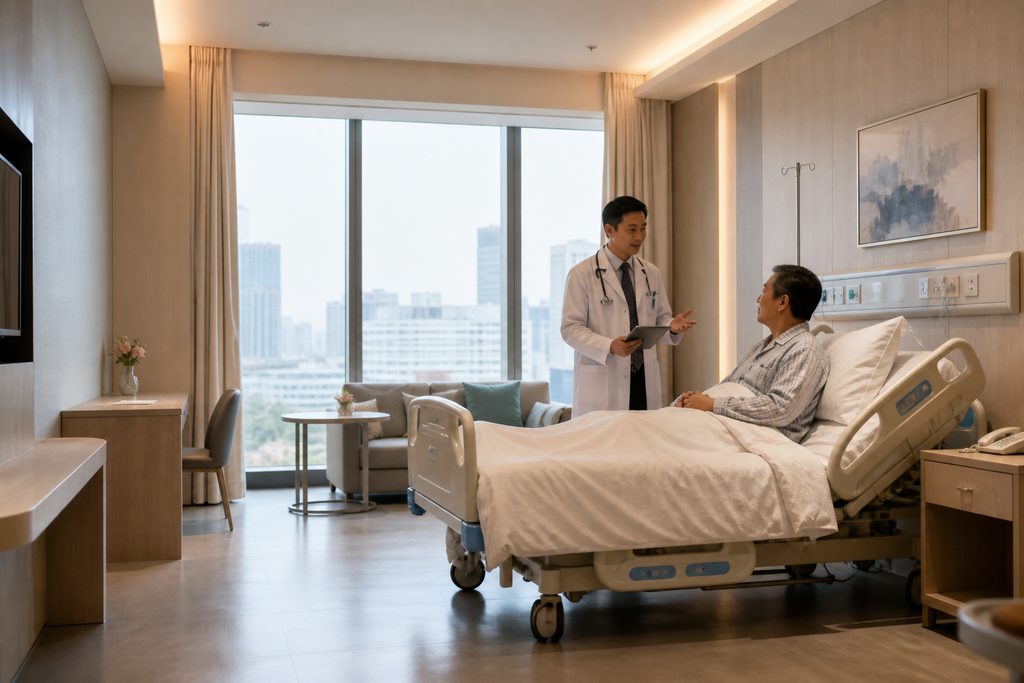
When 54-year-old Daniel from Manchester started researching knee replacement options abroad, the clinical data from Chinese hospitals impressed him. But one practical question kept nagging at him: after surgery, where would he actually sleep? He had heard stories about crowded open wards in public hospitals, and the thought of recovering in a noisy room with a dozen other patients made him hesitate. Daniel needed to know which hospital in China offers private patient wards, and what that would cost him. It is a question we hear constantly from international patients, and the answer is more nuanced — and more reassuring — than most people expect.
Key Takeaways
- Private patient wards in China’s top-tier public hospitals typically cost $80–$300 per night, while luxury international hospital suites run $400–$1,200 per night.
- Beijing and Shanghai host the highest concentration of hospitals with dedicated international wards featuring private rooms, English-speaking staff, and direct insurance billing.
- Public hospital VIP wards cost roughly 1.5–2 times standard ward rates, but still remain a fraction of comparable private rooms in the US or Europe.
- You cannot book a private ward directly from overseas through a standard public hospital channel — access typically requires coordination through the hospital’s international department or a service provider.
The Problem: Finding a Private Room in a System Built for Volume
China’s top public hospitals are enormous. Peking Union Medical College Hospital in Beijing sees over 10,000 outpatient visits on a single busy day. West China Hospital in Chengdu, one of the largest hospitals in the world by bed count, operates over 4,300 beds. These are not boutique facilities — they are medical cities designed to treat massive patient volumes efficiently.
For a Western patient accustomed to private rooms as standard, the default experience in a Chinese public hospital can feel jarring. Standard wards often house three to six patients per room, with shared bathrooms and limited privacy. Family members frequently sleep on fold-out cots beside the bed. The noise level is constant. Visiting hours are strictly controlled, sometimes limited to a single afternoon window.
But here is what most foreign patients do not realize: nearly every major teaching hospital in China operates a separate international medical center or VIP ward. These units function almost like a private hospital tucked inside the larger public facility. They offer single-occupancy rooms, dedicated nursing teams, expedited imaging and lab work, and physicians who are often department chairs or senior specialists. The challenge is not whether private wards exist — it is knowing which hospitals offer them, what they cost, and how to actually secure a bed.
Why China’s Private Patient Wards Deliver Value
What a VIP Ward Actually Includes
The term “VIP ward” in China does not mean velvet ropes and champagne. It means a private patient room with a dedicated bathroom, a fold-out bed for a family member, and direct access to senior physicians. In most public hospitals, the VIP ward operates on a separate floor with its own nursing station. The nurses in these units typically speak some English, and the hospital assigns a coordinator to handle scheduling and paperwork.
At Zhongshan Hospital in Shanghai, the international medical center occupies a dedicated building with private rooms, its own imaging suite, and a team of bilingual coordinators. At Fuwai Hospital in Beijing — the world’s largest cardiac surgery center with over 14,000 heart surgeries annually — the international ward provides private recovery rooms for foreign patients undergoing bypass surgery or valve replacement. The clinical team is the same one operating in the main hospital. The difference is the environment around the bed, not the hands doing the surgery.
Cost Structure: What You Actually Pay
Understanding the private patient room hospital China price requires separating the room charge from the procedure costs. In a top-tier public hospital’s international ward, a private room typically runs $80–$200 per night in cities like Guangzhou, Chengdu, or Wuhan. In Beijing and Shanghai, expect $150–$300 per night. These charges are billed separately from surgery, anesthesia, medications, and physician fees.
Private international hospitals operate on a different model. United Family Healthcare, Jiahui International Hospital, and Raffles Hospital in Shanghai offer private suites that resemble hotel rooms more than hospital wards. These rooms run $400–$800 per night, with premium suites reaching $1,200. The higher rate includes Western-style amenities, unrestricted visiting hours, and direct billing with major international insurers like Cigna, Aetna, and Allianz.
Consider a cardiac bypass surgery. At a top Chinese public hospital, the procedure itself costs $12,000–$20,000. A private room for a seven-day recovery adds roughly $1,050–$2,100. The same surgery at a private international hospital in Shanghai might total $35,000–$50,000, with the room charge bundled into the package. Both options remain dramatically cheaper than the $120,000+ bypass surgery bill in the United States.
How to Book a Private Ward in Shanghai or Beijing
This is where the process gets complicated. Public hospitals in China do not accept direct online booking for private wards from overseas patients. The standard outpatient registration system requires in-person queueing on the day of the appointment, and surgical scheduling only happens after a face-to-face consultation with the attending physician. There is no website where you can select a room type and enter a credit card number.
To book a private ward Shanghai hospital or secure a VIP ward hospital Beijing cost quote, you need to work through the hospital’s international medical department. Some hospitals accept email inquiries from abroad, but response times vary widely. Others require a Chinese phone number or a local contact to initiate the process. This is where a bilingual coordinator becomes valuable — not because access is impossible without one, but because the process is opaque, time-consuming, and full of administrative friction that English-speaking patients cannot easily navigate alone.
Never assume a private room is automatically available. International wards have limited bed counts — often 20 to 50 rooms per hospital. During peak seasons or when a senior specialist is in high demand, private rooms book out weeks in advance. Confirm room availability before finalizing travel dates.
Top Hospitals in China with Private Rooms: A Regional Breakdown
Our database covers 340+ top-ranked hospitals across 37 cities, all drawn from the top 5% of China’s 35,000+ hospitals as ranked by Fudan University and JCI accreditation. The following facilities are consistently requested by international patients seeking private accommodations.
| Hospital | City | Private Room Type | Approx. Nightly Rate (USD) |
|---|---|---|---|
| Peking Union Medical College Hospital | Beijing | International ward private room | $200–$300 |
| Fuwai Hospital | Beijing | International cardiac recovery room | $150–$250 |
| Zhongshan Hospital Fudan University | Shanghai | International medical center suite | $180–$280 |
| Ruijin Hospital | Shanghai | VIP ward private room | $150–$250 |
| West China Hospital | Chengdu | International ward private room | $100–$180 |
| United Family Healthcare | Beijing / Shanghai / Guangzhou | Private suite (JCI accredited) | $400–$800 |
| Jiahui International Hospital | Shanghai | Private suite | $500–$900 |
| Raffles Hospital | Shanghai | Luxury private suite | $600–$1,200 |
Rates vary by hospital and case complexity. The figures above represent standard private room charges, not procedure packages. Always request a detailed cost breakdown before committing.
How Much Is a Private Room in a Chinese Hospital Compared to the West?
The question “how much is a private room in a Chinese hospital” deserves a direct answer with context. A private room at a top Chinese public hospital costs $80–$300 per night. A private room at a US hospital averages $1,500–$3,000 per night before insurance negotiations. Even at the luxury end — a $1,200 suite at Raffles Hospital in Shanghai — you are paying less than a standard private room in New York or London.
The structural reasons are straightforward. Chinese hospitals operate at enormous scale, spreading fixed costs across far more patients. Labor costs for nurses and support staff are lower. And the hospital construction boom of the past two decades means many facilities are newer than their Western counterparts, with modern infrastructure that does not carry decades of deferred maintenance costs.
None of this means lower clinical quality. Fudan University’s hospital rankings, which evaluate clinical outcomes, research output, and reputation across 45 specialties, place Chinese institutions among the best in Asia. JCI accreditation — the same standard used by US hospitals — has been earned by over 100 Chinese facilities. The private room you book is a logistics decision, not a quality compromise.
Luxury Hospital Suites China for International Patients: What to Expect
For patients who want a hotel-like experience, the luxury hospital suites China for international patients offer go well beyond a standard private room. United Family’s Beijing flagship features suites with separate living areas, kitchenettes, and space for family members to stay overnight. Jiahui International Hospital in Shanghai was designed from the ground up with Western patient expectations in mind — private rooms with floor-to-ceiling windows, dedicated family zones, and on-site international cuisine options.
These facilities operate on a direct billing model with major international insurers. That means you present your insurance card at admission, and the hospital bills the insurer directly rather than requiring upfront payment and later reimbursement. For patients with comprehensive international health insurance, this eliminates the cash-flow problem entirely.
But there is a trade-off. Private international hospitals in China typically do not have the same case volume as public teaching hospitals. For complex procedures — cardiac surgery, neurosurgery, advanced oncology — the senior specialists with the deepest experience are concentrated in public hospitals like Fuwai, Zhongshan, and Peking Union Medical College. A patient needing a routine procedure with a strong preference for Western-style amenities may find a private international hospital ideal. A patient needing a highly complex surgery should prioritize the surgeon’s volume and outcomes, then arrange private accommodations at the public hospital’s international ward.
Practical Considerations: Booking, Payment, and Documentation
Securing a private room in a Chinese hospital requires preparation. The process looks different from booking a hospital bed in the US or UK.
Medical records first. Most international medical departments require translated medical records, imaging reports, and a referral letter from your home physician before they will schedule a consultation. Translation into Chinese is usually required; some hospitals accept English records for the initial review.
Visa timing matters. Medical treatment in China requires an S2 visa, which is the short-stay category used for private affairs including medical treatment. The hospital’s international department can provide an invitation letter that supports your visa application. Family members accompanying you also apply for S2 visas. Processing times vary by embassy, so begin the visa process at least 6–8 weeks before your planned travel.
Payment is typically upfront. Public hospitals in China require a deposit before admission, often covering the estimated cost of surgery plus several days of room charges. International wards accept credit cards and wire transfers. If you have insurance, you pay first and submit for reimbursement — unless you are at a private international hospital with direct billing.
Language support is not guaranteed. Even in international wards, not every nurse speaks fluent English. Shift changes mean you may encounter staff with limited English at 3 a.m. A bilingual medical companion who can translate during rounds, coordinate with the nursing station, and handle pharmacy runs makes a measurable difference in comfort and safety.
Ask for a written cost estimate before traveling. The international department should provide a line-item breakdown covering room charges, surgeon fees, anesthesia, medications, and estimated length of stay. This document is also useful for insurance pre-authorization.
Frequently Asked Questions
Direct booking is difficult. Most public hospitals require contact through their international medical department, and response times vary. A service coordinator familiar with the specific hospital’s process can typically confirm room availability and secure a reservation faster than an individual working through email alone.
Room rates at public hospital international wards are generally fixed. Private international hospitals may offer package pricing that bundles room charges with procedure fees, which can result in a lower effective nightly rate. Discounts are rarely advertised but sometimes available for extended stays.
Extensions are common and usually accommodated, but the room may not be available if the ward is fully booked. Your care team will advise on the medically appropriate discharge date. If you need to move rooms or transfer to a rehabilitation facility, the international department coordinates the transition.
Yes. A private patient room in a Chinese hospital’s international ward is single-occupancy with a dedicated bathroom. Family members can usually stay overnight on a fold-out bed. The level of privacy is comparable to a standard private room in a Western hospital, though the decor and amenities may be more utilitarian.
Your Next Step
If you are considering treatment in China and want to understand your private room options, start by identifying which hospitals are strongest for your specific condition, then confirm those facilities offer international wards with private accommodations. Our team at China Medical Services maintains a database of 340+ top-ranked hospitals across 37 cities and can help you narrow the options, request cost estimates, and coordinate the booking process. We are not a hospital and do not provide diagnoses — we handle the logistics so you can focus on recovery. Explore our ranked hospital database or request a free consultation to discuss your specific needs.
For more medical information and treatment options in China, visit chinamedservices.com (China Medical Services).
