Emergency Room Visit in China: What Foreigners Must Know About Costs and Care
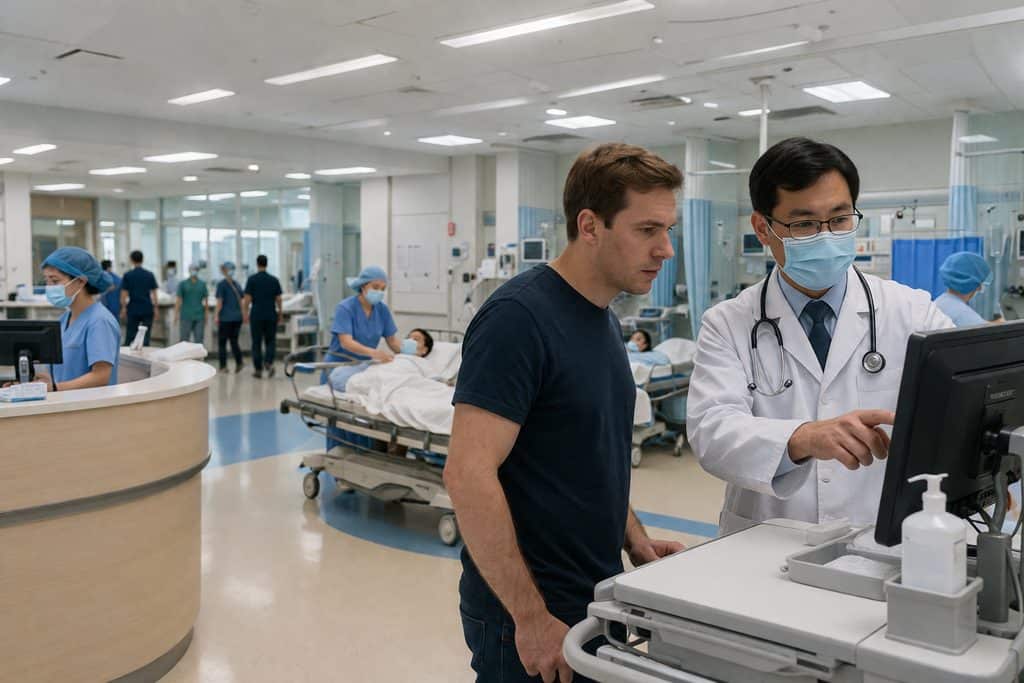
Have you ever found yourself in a foreign country, suddenly ill or injured, with no idea where to turn? The panic of a medical emergency abroad is compounded by unfamiliar systems, language barriers, and the fear of unknown costs. For visitors to China, understanding how an emergency visit works before you need one can transform a terrifying experience into a manageable process. This guide breaks down the emergency room cost for foreigners in China, the step-by-step process, and what separates a top-tier international hospital emergency department in Shanghai from a standard public facility in Beijing.
Key Takeaways
- Public hospital emergency rooms in China treat anyone who walks in, but expect cash or card payment upfront before most tests or treatments are administered.
- Private international hospitals offer English-speaking staff, direct insurance billing, and significantly shorter wait times, typically at 5 to 10 times the cost of public ERs.
- Calling 120 connects you to China’s ambulance dispatch, but ambulances are often basic transport vehicles with limited onboard medical equipment compared to Western standards.
- Foreigners can absolutely go to an emergency room in Beijing or any Chinese city, but without Chinese language skills or a bilingual companion, navigating the system is extremely difficult.
The Problem: A Medical Crisis in an Unfamiliar System
China receives over 30 million international visitors annually, according to the Ministry of Culture and Tourism. A meaningful percentage of those travelers will experience some form of medical issue during their stay, ranging from food poisoning to traffic accidents. When that happens, the emergency room cost for foreigners in China is only one of several concerns. The larger challenge is operational: where do you go, who do you talk to, and how do you ensure you receive appropriate care when you cannot read a single sign or form?
Public hospitals in major Chinese cities handle staggering patient volumes. A single tertiary hospital in Beijing may see more than 10,000 outpatient visits per day. Emergency departments at these facilities are functional but often chaotic, with long queues, shared examination rooms, and staff who may speak limited English. For a tourist experiencing chest pain or a broken bone, this environment is disorienting. But it does not have to be a crisis if you understand the system before you need it.
How to See a Doctor in China as a Tourist: The Emergency Pathway
The first thing to understand is that China’s healthcare system does not require proof of insurance or residency to receive emergency treatment. Walk into any public hospital emergency department, and you will be seen. The process, however, follows a specific sequence that differs from what most Westerners expect.
Step One: Registration and Triage
Upon arrival, you must register at the emergency reception desk. This requires your passport. The hospital will create a medical record and assign you a registration number. You pay a registration fee, typically between 50 and 200 RMB ($7 to $28), before seeing a doctor. Triage nurses assess your condition and assign a priority level. Severe trauma, cardiac symptoms, or stroke signs move you ahead of less urgent cases.
Step Two: Consultation and Payment
A doctor examines you and orders tests, imaging, or treatment. Here is the critical difference from Western systems: you must pay for each step before it happens. Blood tests, X-rays, CT scans, medications, and procedures are all billed separately, and you must settle each bill at the payment window before receiving the service. This pay-as-you-go model surprises many foreigners who are accustomed to receiving care first and receiving a consolidated bill weeks later.
Step Three: Admission or Discharge
If the doctor determines you need hospitalization, you will be asked to pay a deposit upfront. Public hospitals generally require a deposit of 5,000 to 20,000 RMB ($700 to $2,800) depending on the condition. If you are stable enough to be discharged, you collect your prescriptions from the hospital pharmacy and leave. There is no follow-up appointment system unless you arrange it yourself.
Practical tip: Always carry your passport when seeking medical care in China. Hospitals cannot officially register you without it. A photo of your passport on your phone is not sufficient at most public facilities.
Emergency Room Cost for Foreigners in China: What You Actually Pay
Let us address the financial question directly. The emergency room cost for foreigners in China is dramatically lower than in the United States or Western Europe, even at private international facilities. A public hospital ER visit for a minor condition, such as stitches or treatment for food poisoning, typically costs between 300 and 1,500 RMB ($42 to $210) including consultation, basic tests, and medications. A more complex visit involving CT imaging and specialist consultation might reach 3,000 to 8,000 RMB ($420 to $1,120).
| Service | Public Hospital ER (USD) | Private International Hospital ER (USD) | US Hospital ER (USD) |
|---|---|---|---|
| Registration & basic consultation | $7–$28 | $150–$300 | $200–$500 |
| Blood tests (basic panel) | $15–$50 | $80–$200 | $150–$400 |
| CT scan (single area) | $70–$150 | $300–$600 | $1,000–$3,000 |
| X-ray | $10–$40 | $80–$150 | $100–$300 |
| Minor procedure (stitches, splint) | $20–$80 | $150–$400 | $500–$1,500 |
| Overnight observation | $50–$150 | $400–$800 | $2,000–$4,000 |
Private international hospitals, such as United Family, Jiahui, and Raffles, charge significantly more because they operate on a Western model with English-speaking staff, JCI accreditation, and direct insurance billing. An emergency visit at one of these facilities typically starts at $150 and can reach $1,000 or more for comprehensive evaluation. Still, that is a fraction of what the same visit would cost in an American emergency department, where even a straightforward visit without admission averages over $2,000 according to a 2023 study published in JAMA Network Open.
International Hospital Emergency Department Shanghai: The Private Alternative
For foreigners who want a smoother experience, the international hospital emergency department in Shanghai and similar facilities in Beijing, Guangzhou, and Shenzhen represent the most accessible option. These hospitals are designed specifically for expatriates and international patients. Staff speak English, medical records are maintained in English, and the environment resembles a Western private clinic more than a Chinese public hospital.
Shanghai has the most developed private international hospital infrastructure in mainland China. United Family Healthcare operates a full-service hospital in the Changning district with a 24-hour emergency department. Jiahui International Hospital in Xuhui offers emergency services with emergency medicine physicians trained in the United States and Europe. Parkway Health and Raffles Medical also maintain 24-hour emergency clinics in central Shanghai. These facilities accept most major international insurance plans directly, meaning you may not need to pay out of pocket at all if your policy covers emergency treatment abroad.
But the trade-off is cost. A visit to an international hospital emergency department in Shanghai will cost five to ten times what the same treatment would cost at a public hospital. For travelers with comprehensive travel insurance or expatriate health plans, this is often a non-issue. For budget travelers or those without insurance, the public system remains the only realistic option.
Can Foreigners Go to Emergency Room in Beijing? Yes, With Caveats
The short answer is yes. Foreigners can go to an emergency room in Beijing without any special permission or documentation beyond a passport. The city’s top public hospitals, including Peking Union Medical College Hospital and Beijing Friendship Hospital, treat international patients daily in their emergency departments. These are the same facilities that serve Chinese citizens, and the care is the same quality.
The caveat is language. While major Beijing hospitals employ some English-speaking physicians, particularly specialists, the emergency department is not where you are likely to find them. Triage nurses, registration clerks, and technicians typically speak only Mandarin. Forms are in Chinese. Signage is in Chinese. Payment terminals display Chinese. Without a Chinese speaker accompanying you, even registering for care becomes a challenge.
This is where a bilingual medical companion proves valuable. A companion handles registration, translates between you and the medical staff, explains what is happening at each step, and ensures you understand your diagnosis and treatment plan. The service costs from $300 per day, which is a meaningful expense, but it transforms a potentially dangerous communication gap into a manageable experience. Many travelers find this preferable to relying on translation apps in a high-stress medical situation.
24 Hour Emergency Clinic for Expats in China: What to Expect
Expats living in China have a different set of needs than short-term tourists. A 24 hour emergency clinic for expats in China is typically a private facility that combines Western medical standards with Chinese convenience. These clinics are not full hospitals, but they handle urgent conditions that do not require surgery or intensive care: infections, minor fractures, allergic reactions, dehydration, and acute pain.
The major expat-focused clinics in China include the aforementioned United Family and Jiahui systems, plus International SOS clinics in Beijing, Shanghai, and Guangzhou. These facilities maintain 24-hour emergency lines and can dispatch Western-trained physicians to your location in some cases. They also coordinate with public hospitals when a patient needs services beyond their scope, such as cardiac catheterization or neurosurgery.
For expats, the decision framework is straightforward: if your condition is life-threatening, go to the nearest public hospital emergency department immediately. Speed matters more than comfort. If your condition is serious but stable, call your international clinic first. They can advise whether their facility can handle your case or whether you should proceed to a specific public hospital with a known international department.
What to Do in a Medical Emergency in China: A Practical Sequence
When a medical emergency strikes in China, your actions in the first ten minutes determine the quality of everything that follows. Here is the sequence we recommend based on years of coordinating care for international patients.
First, assess the severity. If someone is unconscious, bleeding profusely, experiencing chest pain, or showing stroke symptoms, call 120 immediately. China’s emergency dispatch is centralized, and operators may have access to English speakers, though this is not guaranteed. If you are in a hotel, call the front desk simultaneously and ask them to call 120 on your behalf and send someone to your room.
Second, gather essentials: passport, insurance card, cash, and a charged phone. Chinese ambulances are government-operated and charge a fee, typically 100 to 500 RMB ($14 to $70), payable on arrival at the hospital. The ambulance crew provides basic transport. Do not expect advanced life support equipment or paramedic-level interventions in most cities.
Third, choose your destination. If you have international insurance and your condition is stable, direct the ambulance to the nearest international hospital or a public hospital with a known international department. If your condition is critical, accept transport to the nearest facility. Stabilization comes first. Transfer to a preferred hospital can happen later if needed.
Fourth, contact your insurance provider as soon as practical. Many international policies require pre-authorization for anything beyond emergency stabilization, and some maintain 24-hour assistance lines that can coordinate directly with Chinese hospitals. Your insurer may also have preferred provider relationships that affect your out-of-pocket costs.
Practical Considerations: Documentation, Payment, and Follow-Up
Chinese hospitals generate paper records. After any emergency visit, you will leave with a sheaf of documents: registration forms, test results, prescriptions, and a discharge summary. Keep everything. These records are essential if you need follow-up care, if you return to your home country and need your doctors to understand what happened, or if you file an insurance claim. Chinese hospitals do not maintain accessible electronic records for foreign patients, so the paper in your hand is often the only copy that exists.
Payment methods deserve attention. Public hospitals accept cash, Chinese bank cards, and increasingly, international credit cards at major facilities in first-tier cities. However, smaller hospitals and clinics may be cash-only. Alipay and WeChat Pay are ubiquitous, but they require a Chinese bank account or an international version that many tourists do not have. Carry at least 2,000 RMB ($280) in cash as a buffer for any medical situation.
Insurance reimbursement works differently in China than in countries with single-payer or heavily regulated systems. Chinese hospitals do not bill international insurers directly, with the exception of private international hospitals. At public facilities, you pay everything upfront and file for reimbursement with your insurer afterward. Keep every receipt. Some insurers require itemized bills, which Chinese hospitals can provide upon request at the billing office, but you must ask before leaving.
For language support, translation apps like Google Translate or iTranslate work in a pinch but fail in high-stakes medical conversations. Medical terminology is precise, and mistranslation can have real consequences. If you do not have a Chinese-speaking companion, write down your key medical information in Chinese before your trip: allergies, medications, chronic conditions, blood type. Show this document to medical staff if you cannot communicate verbally.
Follow-up after an emergency visit is your responsibility. Chinese emergency departments do not schedule follow-up appointments or call to check on you. If you need continued care, you must arrange it yourself, either through a hospital’s international department or through a coordination service. For travelers returning home soon after an emergency, obtain a written summary of your diagnosis and treatment before leaving the hospital. Your home physician will need it.
Frequently Asked Questions
Public hospital emergency rooms in China do not bill insurance companies directly, regardless of whether the policy is foreign or domestic. You pay upfront and submit claims to your insurer afterward. Private international hospitals, by contrast, commonly have direct billing arrangements with major insurers like Cigna, Aetna, Allianz, and Bupa. Check your policy’s network before you travel, and keep all receipts if you use a public facility.
Chinese law requires hospitals to stabilize any patient with a life-threatening condition regardless of ability to pay. This applies to foreigners as well as citizens. However, once you are stabilized, the hospital will expect payment before further treatment or discharge. If you genuinely cannot pay, contact your embassy or consulate. They may be able to assist with emergency loans or contact family members who can transfer funds.
At top-tier public hospitals in Beijing, Shanghai, and Guangzhou, the clinical quality of emergency care is generally high. Chinese emergency physicians see enormous patient volumes and manage complex cases daily. The differences are in process and environment, not clinical competence. Expect longer waits, less privacy, and more self-advocacy required. At private international hospitals, the experience closely mirrors Western private care, but costs are higher.
Chinese hospitals dispense medications from their own pharmacies. A prescription from your home country is not valid at a Chinese pharmacy, and you cannot fill foreign prescriptions in China. If you need a medication refill, a Chinese doctor must prescribe it. This is another reason to carry an adequate supply of your regular medications when traveling, along with documentation of what you take and why.
Go to the nearest public hospital emergency department. Smaller cities have fewer English-speaking staff, so translation support becomes even more critical. Contact your insurer’s assistance line immediately; many have Chinese-speaking coordinators who can speak with hospital staff by phone. If your condition is serious, ask about transfer to a larger city once you are stable. Medical evacuation to Hong Kong, Singapore, or your home country is an option for critical cases, but costs are substantial and typically require pre-approval from your insurer.
Your Next Step
Understanding how an emergency visit works in China is the first step toward traveling with confidence. The system is navigable, the costs are manageable, and quality care is available when you know where to look. Our team at China Medical Services helps international patients prepare for and navigate medical situations across China, from emergency coordination to planned treatment at top-ranked hospitals. We are not a hospital and do not provide medical advice, but we can connect you with the right facility and ensure language is never a barrier. If you are planning travel to China or need support during a medical situation, contact us for a free consultation to discuss your needs.
For more medical information and treatment options in China, visit chinamedservices.com (China Medical Services).
