Rhinoplasty Recovery: A Timeline to Final Results and Costs
Key Takeaways
- Full rhinoplasty recovery takes 12-18 months for final tip refinement, though 80% of swelling resolves within the first 3 months.
- Rhinoplasty cost China runs $3,500-$8,000 at top-tier public hospitals, roughly one-fifth to one-third of US pricing.
- China’s leading plastic surgery departments perform thousands of nasal procedures annually, with Fudan-ranked units in Shanghai and Beijing matching international safety protocols.
- Language barriers and post-operative follow-up logistics are real challenges — remote monitoring works, but you need a structured plan before booking.
- Never commit to surgery without a video consultation and written surgical plan from the operating surgeon first.
You’ve probably heard that getting a nose job abroad means gambling with quality. The assumption runs deep: lower prices, looser standards, risky outcomes. But the numbers tell a different story. The global medical tourism market for cosmetic surgery exceeded $20 billion in 2024, and China’s top-tier plastic surgery departments now handle case volumes that dwarf most Western centers. Rhinoplasty cost China is not a story about cutting corners — it’s about structural economics. And recovery? Recovery follows the same biological timeline whether you’re in Beverly Hills or Shanghai.
The real question is not whether you can save money. The question is whether you understand what the next 18 months of your nose will actually look like.
Rhinoplasty Recovery: What Actually Happens Week by Week
“How long does rhinoplasty recovery take” is the most under-answered question in cosmetic surgery. Surgeons quote averages. Patients remember extremes. Here’s the honest timeline.
Days 1-7: The Splint Phase
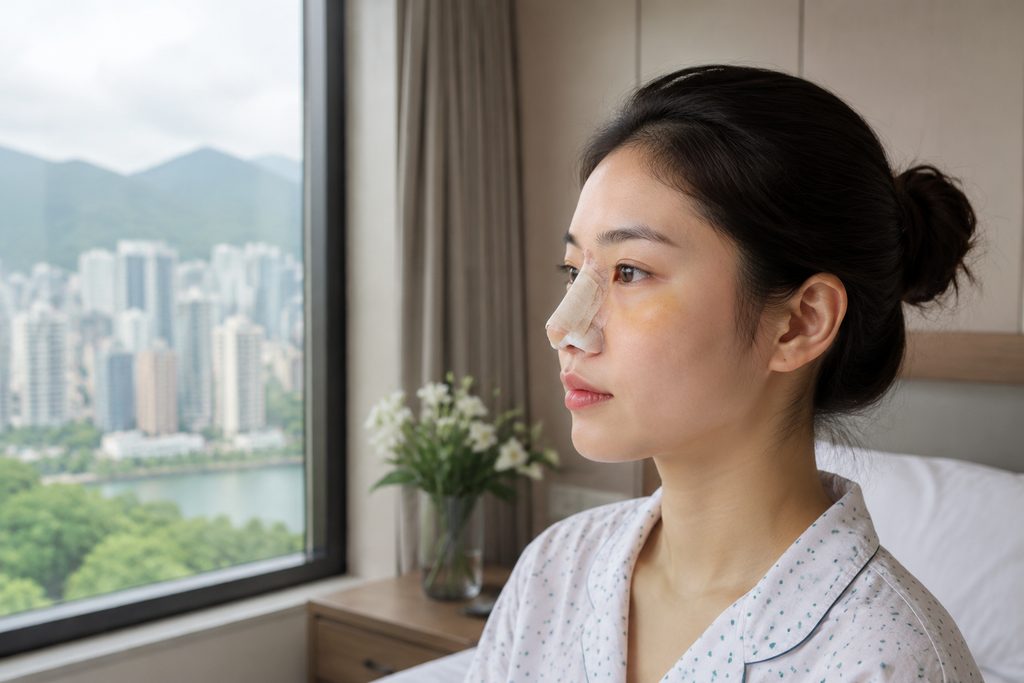
You wake up with an external splint on your nose and, in many cases, internal packing or silicone stents. Swelling peaks around day 3. Bruising under the eyes is normal and typically fades by day 10. Pain is usually manageable with oral medication — most patients rate it 3-4 out of 10.
Sleep upright. Ice your cheeks, not your nose. Expect nasal congestion that makes breathing through your nose nearly impossible. You will breathe through your mouth. This is normal.
Weeks 2-4: The Social Phase
The splint comes off around day 7-10. Your nose will look swollen, especially at the tip. You can return to work or social activities by week 2-3 if you don’t mind residual bruising. No glasses on the nasal bridge for at least 6 weeks. No contact sports for 3 months.
Around week 3, you’ll notice the swelling shifting downward. The upper bridge refines faster than the tip. This asymmetry in healing is why patients panic at week 3. Don’t.
Months 2-6: The Settling Phase
By month 3, approximately 80% of swelling has resolved. The tip remains firm and slightly enlarged. If your surgeon refined a bulbous tip or adjusted nostril shape, this is when you’ll start seeing the real contour. Internal scar tissue softens. Breathing improves significantly.
Months 6-18: Final Refinement
The last 10-15% of swelling — concentrated in the nasal tip — resolves slowly. Skin thickness matters enormously here. Thin skin shows refined results faster. Thick skin holds swelling longer. Final tip definition can take 18 months or more.
And here’s what most articles skip: revision decisions should wait until at least month 12. Judging your result at month 6 is like reviewing a film halfway through editing.
Why Rhinoplasty Cost China Makes Structural Sense
The price gap is not a quality gap. It’s a cost-structure gap. A primary rhinoplasty in the US runs $8,000-$15,000 in surgeon fees alone. Add anesthesia, facility fees, and follow-up care, and the total often lands between $12,000 and $20,000. The same procedure at a Fudan-ranked plastic surgery department in Shanghai or Beijing runs $3,500-$8,000 all-in.
Why? Three structural reasons.
Volume Creates Proficiency
A senior plastic surgeon at a top Chinese public hospital may perform 200-400 rhinoplasties annually. The average US plastic surgeon performs 50-80. Volume alone does not guarantee better outcomes — surgical judgment matters more. But high-volume surgeons see more anatomical variations, manage more complications, and refine their technique faster than low-volume peers.
This is not speculation. A 2023 analysis in the Aesthetic Surgery Journal found that surgeon volume correlated with lower revision rates in primary rhinoplasty across multiple international cohorts. The effect was most pronounced in surgeons exceeding 150 cases per year.
Hospital Economics Are Different
China’s top public hospitals operate on a scale that Western private surgical centers cannot match. A single plastic surgery department at Shanghai Ninth People’s Hospital — widely considered among the best nose job hospital Shanghai options and ranked in the top tier of Fudan’s specialty list — handles more than 30,000 outpatient consultations annually. Overhead is spread across massive patient volume. Equipment costs amortize differently. The result is lower per-case pricing without skimping on infrastructure.
No Insurance Middleman for Self-Pay Patients
International patients paying out of pocket bypass the administrative burden that drives up US pricing. Chinese hospitals quote self-pay rates directly. No prior authorizations. No negotiated insurance discounts that inflate sticker prices. You pay the hospital’s published international department rate, which is transparent and itemized.
Is Rhinoplasty Safe in China? What the Evidence Shows
Safety concerns are fair. “Is rhinoplasty safe in China” is a reasonable question, and the honest answer is: it depends on where you go. China’s hospital system is bifurcated. The top 5% — roughly 1,750 hospitals out of 35,000+ — meet international accreditation or Fudan ranking standards. The rest vary widely.
The hospitals that interest international patients are not the average ones. They are the 340+ top-ranked institutions covered in our hospital database, including Fudan-ranked plastic surgery departments and JCI-accredited private international hospitals. These facilities follow surgical safety protocols comparable to Western centers: standardized anesthesia monitoring, infection control audits, and structured post-operative follow-up.
What should you verify before booking? Three things.
- Surgeon credentials: Confirm the operating surgeon’s board certification, annual rhinoplasty volume, and revision rate. Ask directly. Reputable surgeons answer.
- Facility accreditation: JCI accreditation or inclusion in the Fudan specialty rankings is a meaningful signal. Not the only signal, but a strong one.
- Anesthesia safety: Confirm that a board-certified anesthesiologist — not a nurse — will manage your sedation or general anesthesia. This is standard at top-tier Chinese hospitals.
Complication rates for primary rhinoplasty in accredited Chinese centers are comparable to international benchmarks: infection below 2%, significant bleeding below 1%, revision rates in the 5-10% range depending on complexity. These numbers align with published data from US and European registries.
Comparing Nose Surgery Price Abroad: China vs. Turkey vs. South Korea vs. US
Medical tourists shopping for nose surgery price abroad typically compare four destinations. Here’s the landscape.
| Destination | All-In Price Range (USD) | Surgeon Volume (Typical Senior Surgeon) | Key Advantage | Key Risk |
|---|---|---|---|---|
| United States | $12,000 – $20,000 | 50-80 cases/year | Legal recourse, no travel | Highest cost |
| South Korea | $5,000 – $10,000 | 150-300 cases/year | Asian aesthetic expertise | Language barrier, clinic variability |
| Turkey | $3,000 – $7,000 | 100-200 cases/year | Lowest cost, high volume | Variable clinic standards, aggressive marketing |
| China (top-tier public) | $3,500 – $8,000 | 200-400 cases/year | Highest volume, strong hospital infrastructure | Language barrier, less tourism infrastructure |
China’s positioning is distinct. South Korea dominates East Asian aesthetic preferences — softer, more conservative dorsal profiles. Turkey competes on price and European proximity. China’s top plastic surgery departments combine Korean-level volume with hospital infrastructure that rivals US academic centers. For patients who want high-volume surgical expertise without Korean aesthetic bias or Turkish clinic variability, Chinese public hospitals offer a compelling middle path.
One more consideration: post-operative care. China’s top hospitals have structured follow-up protocols, but they expect you to stay in-country for 10-14 days after surgery. That’s longer than Turkey’s typical 7-day package but shorter than South Korea’s recommended 3-week stay for rhinoplasty.
How to Evaluate a Chinese Rhinoplasty Surgeon Before You Travel
You cannot assess surgical skill from a website. But you can assess transparency, communication, and process. Here’s what separates serious surgeons from marketing operations.
Ask for a Written Surgical Plan
A competent surgeon will review your photos and CT imaging, then provide a written plan: what they will change, how they will change it, what technique they recommend (open vs. closed), what implant material if any, and what risks apply to your specific anatomy. If a surgeon quotes you a price without seeing your nose or asking about your breathing, walk away.
Request Before/After Photos of Similar Noses
Not the clinic’s best 20 results. Ask for cases with your nose type — thick skin, dorsal hump, bulbous tip, previous trauma. A surgeon who cannot produce 5-10 relevant cases has not done enough of them.
Clarify Who Actually Operates
This matters in high-volume Chinese hospitals. The department director may consult on your case, but a junior surgeon may perform the operation. Ask directly: “Who will hold the scalpel?” Reputable international departments will name the operating surgeon in writing.
Video Consultation First
Never book surgery sight unseen. A video consultation — ideally with the operating surgeon, not just a coordinator — lets you assess communication, set expectations, and hear the surgeon’s honest assessment of what is achievable. Our team regularly arranges these for international patients considering top-ranked plastic surgery departments in Shanghai and Beijing.
Practical Considerations: Documentation, Visa, and Follow-Up
Planning rhinoplasty in China involves more than choosing a surgeon. Here’s what the logistics actually look like.
Medical Records You’ll Need
- Recent photographs: frontal, profile, three-quarter, and base views
- Any prior nasal imaging (CT or X-ray) if you have a history of trauma or breathing issues
- List of medications, allergies, and prior surgeries
- If you have sleep apnea or chronic sinusitis, bring relevant medical records
Visa Category
Foreign nationals traveling to China for medical treatment typically apply for an S2 visa, which covers short-term private affairs including medical treatment. The hospital’s international department will provide an invitation letter and treatment confirmation to support your application. Family members accompanying you also apply for S2 visas. Processing times vary by consulate — plan for 2-4 weeks. Requirements change, so always verify with your nearest Chinese embassy or consulate before applying.
Payment and Insurance
Chinese public hospitals require upfront payment for self-pay international patients. Most accept international credit cards, wire transfers, or cash. Private international hospitals like United Family or Jiahui — some of which offer plastic surgery — may bill your insurance directly if you have international coverage. Check with your insurer before booking. Most US and European insurers do not cover cosmetic rhinoplasty, but some cover functional components like septoplasty if documented as medically necessary.
Language and Interpretation
Top-tier Chinese public hospitals are not English-first environments. The international patient department will have English-speaking coordinators, but ward nurses, anesthesiologists, and junior staff may not. A bilingual medical companion — someone who can translate during consultations, clarify post-operative instructions, and advocate for you if something feels wrong — removes the single biggest source of stress for international patients. This is not a luxury. It’s the difference between feeling in control and feeling lost.
Follow-Up After You Return Home
Your surgeon will want to see photos at weeks 1, 2, 4, 8, 12, and 6 months. Most Chinese plastic surgery departments now support remote follow-up via WeChat or email. You send photos, they review and respond. If complications arise — infection, significant asymmetry, breathing obstruction — you’ll need a local ENT or plastic surgeon to evaluate you. Find one before you travel, not after. A local surgeon who knows you had surgery abroad is more willing to help than one who meets you for the first time with a complication.
Who Should Not Book Rhinoplasty in China
This option is not for everyone. Be honest with yourself.
If you need extensive revision rhinoplasty after multiple prior surgeries, the complexity rises significantly. China’s top surgeons handle revisions, but the communication burden is higher and the margin for misunderstanding is real. You need exceptional communication, not just exceptional surgery.
If you cannot stay in China for at least 10-14 days after surgery, do not book. Early post-operative care matters. Flying home on day 5 with a fresh rhinoplasty is a bad idea regardless of where you had surgery.
If you have unrealistic expectations about what a nose job can achieve, no surgeon in any country can help you. The best surgeons set honest expectations. The worst ones promise transformation and deliver disappointment.
And if the idea of navigating a foreign healthcare system without fluent English support causes you genuine anxiety, consider whether the savings justify the stress. The price advantage is real, but it is not free. You’re trading money for logistical complexity. Some people find that trade worthwhile. Others don’t.
Book Rhinoplasty Surgery China Package: What a Realistic Plan Looks Like
If you’re searching for how to book rhinoplasty surgery China package, understand that the best arrangements are not pre-packaged tourist products. They’re structured coordination plans built around your specific case. Here’s what a realistic sequence looks like.
Step 1: Remote consultation. You send photos, medical history, and any imaging. The surgeon reviews and provides a written assessment. This costs $300-$500 for a written second opinion or $500-$800 for a live video consultation with a top specialist. This is not a sales call — it’s a medical evaluation. A good surgeon will tell you if you’re a poor candidate.
Step 2: Surgical plan and quote. If the surgeon accepts your case, you receive a written surgical plan and itemized quote. Review it carefully. Ask questions. Get everything in writing.
Step 3: Travel coordination. You arrange your S2 visa with the hospital’s invitation letter, book flights, and secure accommodation near the hospital. Plan to arrive 2-3 days before surgery for in-person consultation and pre-operative testing.
Step 4: Surgery and in-country recovery. The procedure takes 2-4 hours. You stay in the hospital for 1-2 nights, then recover at a nearby hotel or serviced apartment. Your splint comes off around day 7. You fly home around day 10-14.
Step 5: Remote follow-up. Structured photo check-ins at weeks 1, 2, 4, 8, 12, and 6 months. Your local surgeon provides in-person backup if needed.
This is a medical process, not a vacation package. Anyone offering a “rhinoplasty package” that skips the remote consultation or promises a specific date before the surgeon reviews your case is selling you a product, not a medical service.
Frequently Asked Questions
Most patients look socially presentable by week 3, with residual bruising easily concealed. The nose looks approximately 80% settled by month 3. The final 10-15% of tip refinement continues through month 12-18. If you have thick skin, expect the longer end of that range.
Is rhinoplasty in China cheaper because the quality is lower?
No. The price difference reflects structural economics: lower labor costs, higher
For more medical information and treatment options in China, visit chinamedservices.com (China Medical Services).
