Wheelchair-Accessible Medical Service China: Care Without Barriers
Key Takeaways
- Top Chinese hospitals in 37 cities offer wheelchair-accessible infrastructure, but navigating them without local language support remains a genuine obstacle for approximately 15% of the global population living with some form of disability.
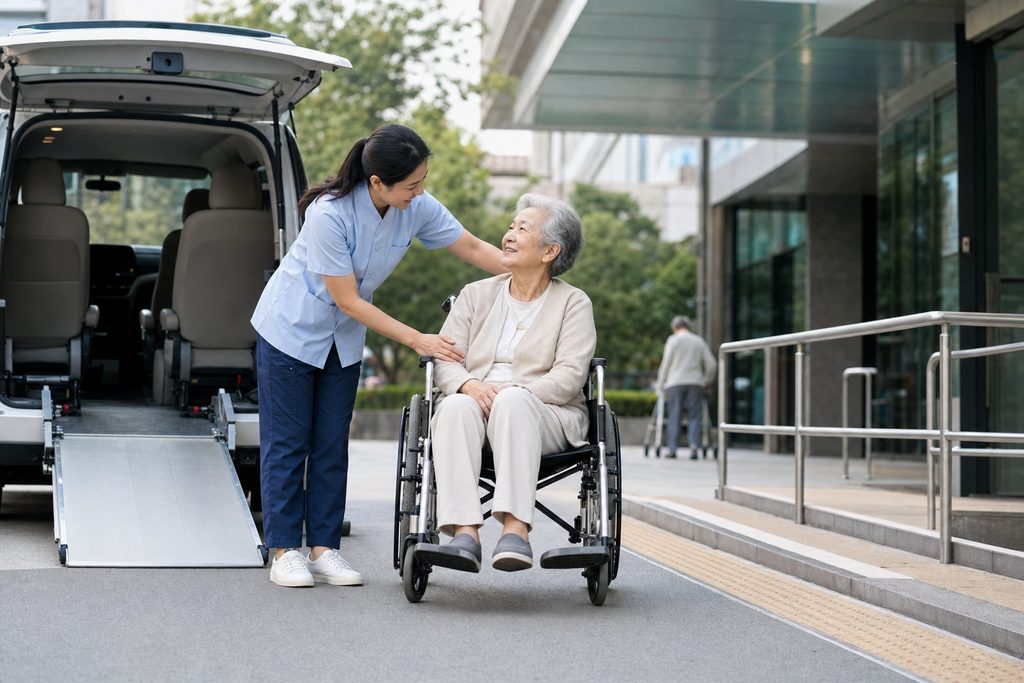
- A coordinated care package — including bilingual medical companions, accessible transport, and hospital pre-screening — transforms a high-risk solo journey into a structured, dignified medical experience.
- China’s accessibility standards vary dramatically between new international hospital wings built after 2012 and older public hospital buildings. Knowing which facility to choose makes all the difference.
- You cannot simply book an accessible hospital room online from overseas. The system requires on-the-ground coordination, which is where a local navigator becomes essential, not optional.
The Problem: Medical Travel Should Not Mean Leaving Your Dignity Behind
Around 1.3 billion people worldwide live with significant disability, according to the World Health Organization. That is roughly 1 in 6 of us. And yet, when these individuals search for cross-border medical options, the first question is rarely about surgical technique or hospital ranking. It is far more basic. Can I physically get into the building? Will the bathroom accommodate my chair? Who will help me transfer from a vehicle to a consultation room if the ramp is missing?
These are not hypothetical fears. They are daily realities for patients with spinal cord injuries, advanced multiple sclerosis, post-stroke mobility loss, cerebral palsy, and age-related frailty. The anxiety compounds when the destination is a country where you do not speak the language and cannot independently verify accessibility claims. A hospital website might show a ramp. It does not show whether that ramp leads to a locked door, a broken elevator, or a corridor too narrow for a turning radius. The gap between what is advertised and what exists on the ground can be punishing.
What happens if nothing changes? Patients either stay home and forgo treatment they need. Or they travel, white-knuckling the logistics, and arrive exhausted and vulnerable before the first consultation even begins. Neither outcome is acceptable.
Who We Are
We are not a hospital. We do not provide medical treatment, clinical diagnoses, or rehabilitation therapy. Our team functions as your logistical architects on the ground in China — we bridge the gap between you and the country’s top-tier medical expertise. That means we verify wheelchair accessibility before you book a flight. We coordinate medical transport that actually fits a chair. We place a bilingual companion beside you who knows which elevator works and which corridor dead-ends. We handle the friction so you can focus entirely on your health. We work across 340+ top-ranked hospitals in 37 cities. Humble about what we cannot do. Thorough about what we can.
Why China Delivers Results for Patients with Limited Mobility
Clinical Volume Drives Rehabilitation Expertise
China’s rehabilitation hospitals treat patient volumes that are difficult to grasp from a Western perspective. The China Rehabilitation Research Center in Beijing, one of the largest facilities of its kind globally, manages thousands of inpatient admissions annually focused specifically on spinal cord injury, stroke recovery, and amputation rehabilitation. A typical US inpatient rehabilitation facility might manage 200 to 400 admissions per year. The scale difference is not marginal. It is structural.
Why does volume matter for a wheelchair user? Because rehabilitation is a pattern-recognition discipline. A therapist who has guided 500 patients through post-stroke mobility recovery has seen variations a less experienced colleague simply has not encountered. That depth shows up in practical outcomes — faster problem-solving when a transfer technique is not working, quicker adaptation when a patient presents atypically. The top rehabilitation centers we connect patients with are ranked among China’s best by the Fudan University hospital rankings, specifically within the rehabilitation medicine specialty.
Infrastructure Built After 2012 Is Often World-Class
This is the nuance that matters. China’s older public hospital buildings — constructed in the 1980s and 1990s — frequently lack the accessibility features Western patients expect. Narrow doorways. High thresholds. Bathrooms that are simply not navigable in a chair. But the international medical wings and newly built private hospitals tell a different story entirely.
Facilities like Shanghai’s Jiahui International Hospital and the United Family Healthcare network across Beijing, Shanghai, and Guangzhou were designed from the ground up with international accessibility standards in mind. Wide automated doors. Roll-in showers. Height-adjusted examination beds. Corridor widths exceeding 1.5 meters. These are not retrofits bolted onto an old structure. They are purpose-built environments. The key is knowing which facility to choose before you travel — and that is where pre-travel verification by someone physically on-site becomes irreplaceable. You can explore our database of private international hospitals to understand what is available, but nothing substitutes for a boots-on-the-ground accessibility audit.
The Cost Equation Changes Everything
Let us address the question patients search for most directly: wheelchair accessible hospital China cost. A comprehensive inpatient rehabilitation program at a top-tier Chinese hospital — including daily physiotherapy, occupational therapy, and accessible accommodation — typically ranges from $8,000 to $25,000 per month depending on the facility tier and intensity of therapy. Comparable programs in the United States routinely exceed $40,000 to $60,000 per month. In the UK, private rehabilitation can run £25,000 to £45,000 monthly with significant wait times for admission.
The structural reasons for this gap are straightforward. Lower labor costs for skilled therapists. Higher patient throughput spreading fixed costs across more cases. Hospital-owned accommodation rather than third-party housing. These are economic efficiencies, not quality compromises. A physical therapist in Shanghai with 15 years of spinal cord injury experience earns less than a newly qualified counterpart in California. That is a labor market reality. It does not reflect skill differential. It reflects geography. For a patient paying out of pocket — and many international rehabilitation patients do — that arithmetic is life-changing.
| Rehabilitation Service | China (Top Hospital) | United States | United Kingdom (Private) |
|---|---|---|---|
| Inpatient Rehab (per month) | $8,000 – $25,000 | $40,000 – $60,000 | £25,000 – £45,000 |
| Outpatient Physiotherapy (per session) | $40 – $80 | $100 – $250 | £60 – £150 |
| Wheelchair-Accessible Medical Transport (round-trip) | From $200 | $300 – $600 | £200 – £400 |
| Bilingual Medical Companion (full day) | From $200 | N/A (rarely available) | N/A (rarely available) |
Prices vary by hospital and case complexity. These are reference ranges, not fixed quotes. But the direction is consistent. The savings are real.
What You Need to Know Before Going Alone
Honesty builds trust. So let us be direct about the barriers that exist — and they are significant.
- Accessible Transport Is Not On-Demand: Standard taxis and ride-hailing vehicles in China are almost never wheelchair-accessible. Didi, the dominant ride platform, has experimented with accessible vehicle options in select cities, but availability is sparse and unreliable. A dedicated medical transport vehicle with a ramp or lift must be pre-arranged. These vehicles exist in major cities like Beijing, Shanghai, and Guangzhou. They are not plentiful. Booking requires advance coordination and a local contact who can confirm the vehicle specifications and driver capability. This is not something you solve from an airport arrival hall.
- Hospital Accessibility Is Inconsistent Across Campuses: A single hospital system may operate multiple buildings on one campus. The new international wing might be fully accessible. The diagnostic imaging building two blocks away might have three steps at the entrance and no ramp. Our team has physically walked these routes. We know which buildings work and which do not. A patient arriving alone with a Google Maps screenshot does not have that information. They discover it the hard way — by encountering a barrier with an appointment time ticking down.
- Language Barriers Compound Every Physical Barrier: Picture this. You are in a wheelchair at the entrance of a Chinese public hospital. You need to find the elevator to the rehabilitation department on the fifth floor. The signage is entirely in Chinese characters. The information desk staff member speaks no English. Your phone battery is at 8 percent. This is not a hypothetical scenario. It is a Tuesday morning. A bilingual medical companion eliminates this entire category of stress. They read the signs. They ask the questions. They get you to the right floor, the right department, the right consultation room — without the cumulative exhaustion of navigating every small obstacle alone.
How We Help You Navigate This
Shanghai has some of China’s best accessible medical infrastructure, concentrated in its international hospital sector. Facilities like Jiahui International Hospital, Shanghai United Family Hospital, and the international wings of major public hospitals such as Huashan Hospital and Zhongshan Hospital offer genuine wheelchair accessibility — wide corridors, roll-in showers, height-adjustable examination tables. The challenge is that “wheelchair friendly” is not a standardized certification in China. You cannot rely on a badge or rating system. You need someone to physically verify the specific clinic, the specific building, the specific route from drop-off to consultation room. That verification is part of our pre-travel coordination. We do not rely on hospital marketing materials. We walk the path ourselves.
A coordinated care package typically includes hospital selection and accessibility verification, appointment scheduling through international patient channels, S2 visa support documentation, accessible airport transfers, daily medical transport with wheelchair-accessible vehicles, a bilingual medical companion for all appointments, and accommodation recommendations with verified accessibility. It is not a single product with a fixed price. It is a set of coordinated services assembled around your specific needs. Costs vary by duration, city, and complexity. Our role is to design the package and manage the execution. You can learn more about how we structure these arrangements through our patient coordination service.
Inpatient rehabilitation at a top Chinese center typically ranges from $8,000 to $25,000 per month. Outpatient physiotherapy sessions run $40 to $80 per visit. These are reference ranges. The final cost depends on the specific hospital, the intensity of therapy required, the duration of stay, and whether you are accessing care through a public hospital’s international wing or a private international hospital. Private facilities tend toward the higher end of the range but offer more predictable English-language support and direct insurance billing. Public hospital international wings are more cost-effective but require stronger on-the-ground coordination. We help you weigh these trade-offs based on your priorities and budget.
This is a question worth asking. Post-surgical swelling, medication side effects, or unexpected complications can shift mobility requirements quickly. Our team remains engaged throughout your stay. If you need a different wheelchair configuration, a hospital room with additional accessibility features, or a revised transport plan, we adjust in real time. The coordination does not stop after your first appointment. It continues until you are safely home.
Your Next Step
Traveling for medical care is always a significant decision. Doing so with limited mobility adds layers of complexity that most medical tourism advice simply ignores. But complexity is not the same as impossibility. With verified accessibility information, pre-arranged transport, and a human navigator beside you, China’s top hospitals become genuinely accessible — not just in principle, but in practice. The clinical expertise exists. The infrastructure, in the right facilities, exists. What bridges the gap is coordination.
If you are considering treatment or rehabilitation in China and need to understand what is realistically possible for your specific situation, reach out. No pressure. No hard sell. Just an honest conversation about what we can do and what we cannot. You deserve clarity before you commit to anything.
Frequently Asked Questions
Yes. We work with JCI-accredited and major Grade 3A tertiary hospitals that follow international safety standards comparable to top hospitals in the US and Europe. Surgical teams perform high volumes of procedures — often more than their Western counterparts — which studies show leads to better outcomes.
Costs vary by procedure and hospital, but international patients typically save 40-80% compared to US prices — even when factoring in travel and accommodation. A consultation with our team will give you an exact, all-inclusive quote with no hidden fees.
Send us your existing medical reports. The relevant specialty reviews them and gives you a written opinion, including treatment direction and options, before you commit to any travel. From there you can add a video consultation with the doctor, or have us attend an appointment on your behalf.
For more medical information and treatment options in China, visit chinamedservices.com (China Medical Services).
