How Do I Avoid Blood Clots After Joint Surgery: A Patient’s Guide
Blood Clot Prevention After Joint Surgery: The Short Answer
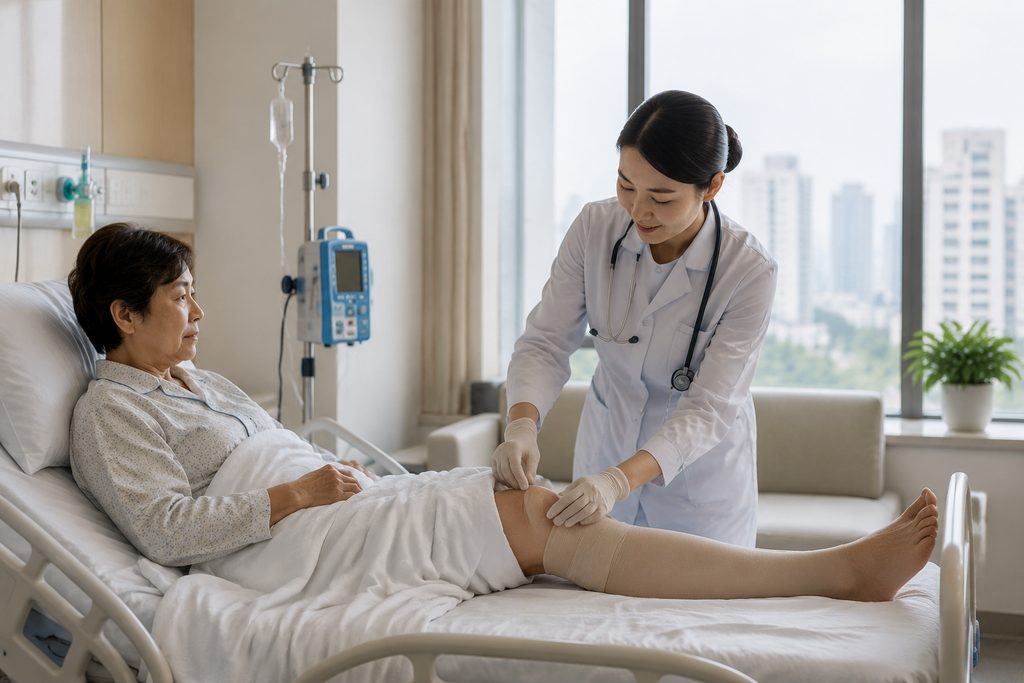
Blood clot prevention after knee replacement China protocols mirror global best practice: mechanical compression within hours of surgery, early mobilization often on day one, and anticoagulant medication for 14 to 35 days depending on your risk profile. Without prophylaxis, deep vein thrombosis occurs in roughly 40% to 60% of unprotected knee or hip replacement patients. With a proper protocol, symptomatic clots drop below 2%.
That gap is what matters. The risk is real, but it is also one of the most preventable complications in modern orthopedics. What makes it complicated is that no single protocol fits every patient. Your age, weight, history of clotting, type of anesthesia, and how quickly you get moving all shift the equation.
Who Needs Aggressive Prevention — and Who Doesn’t
Every joint replacement patient receives some form of prophylaxis. But the intensity varies. Some patients need only early walking and aspirin. Others need injectable blood thinners for a month.
You are typically a good candidate for standard prevention if you are under 65, at a healthy weight, have no personal or family history of clots, and can stand within 24 hours of surgery. Same goes if your operation was minimally invasive and short.
You need a more aggressive plan if any of these apply:
- Previous deep vein thrombosis or pulmonary embolism
- BMI above 30
- Age over 70
- Active cancer or recent cancer treatment
- Known clotting disorder such as Factor V Leiden
- Prolonged immobility before surgery
- Bilateral joint replacement in one operation
If you fall into that second group, do not fly long-haul within six weeks of surgery without discussing it with your surgeon first. The combination of recent surgery and cabin pressure changes raises risk.
The Options, Compared
Prevention is not one drug. It is a layered system. Here is how the main approaches compare for joint replacement patients.
| Method | Typical Duration | Effectiveness | Main Drawback |
|---|---|---|---|
| Early mobilization (standing/walking day 0-1) | Immediate, ongoing | Reduces DVT risk by up to 50% when combined with other methods | Requires physiotherapy support and pain control |
| Intermittent pneumatic compression devices | While in bed, usually 18-24 hrs/day in hospital | Reduces DVT risk by roughly 50-60% | Stops working once removed; compliance drops at home |
| Aspirin (low dose) | 14-35 days | Comparable to stronger agents for low-risk patients | Less effective for high-risk patients |
| Direct oral anticoagulants (rivaroxaban, apixaban) | 10-35 days | Highly effective; reduces DVT by 70-80% vs placebo | Higher bleeding risk; cost |
| Low molecular weight heparin (enoxaparin) | 10-14 days, sometimes longer | Gold standard for decades; highly effective | Daily injection; bruising; patient discomfort |
Low-risk patients often do fine with aspirin plus compression and early walking. High-risk patients usually need a direct oral anticoagulant or enoxaparin. The decision is not about which drug is “best” in general. It is about which matches your specific risk.
How Chinese Orthopedic Centers Handle Blood Clot Prevention After Knee Replacement China
Chinese joint replacement programs have one structural advantage: volume. A top orthopedic department in Shanghai or Beijing may perform several thousand joint replacements annually. That repetition produces standardized, protocol-driven care. You are less likely to encounter improvisation.
Typical protocol at a major Chinese teaching hospital looks like this: compression stockings or pneumatic devices applied in the operating room or recovery unit, first standing attempt within 6 to 12 hours, anticoagulation started 6 to 12 hours post-op if bleeding is controlled, and a discharge checklist that includes medication instructions, signs of DVT, and a follow-up ultrasound if symptoms appear.
What differs from some Western settings is the length of inpatient stay. In China, knee replacement patients often remain hospitalized for 5 to 10 days, compared with 1 to 3 days in many US centers. That longer stay means supervised mobilization and compression therapy continue for a full week, not a day. For patients worried about managing prevention at home, this can be reassuring.
But the question “is blood clot risk higher after surgery abroad” deserves an honest answer. The risk is not higher because you are abroad. It is higher if you fly too soon, if you miss medication doses due to language barriers, or if you do not understand your discharge instructions. Those are logistical risks, not clinical ones. They are manageable with preparation.
What Blood Clot Prevention Costs — and What Drives the Price
Medication costs for DVT prevention are modest compared with the surgery itself. A 14-day course of rivaroxaban in China typically runs from $80 to $200. Enoxaparin for two weeks costs roughly $100 to $250. Aspirin is negligible. Compression stockings cost $20 to $60.
Joint surgery thrombosis prevention cost China varies by hospital tier and whether you use the standard public channel or an international VIP department. The medication itself does not change much in price. What changes is the nursing time, the monitoring, and the coordination. International departments at hospitals like Huashan Hospital or Ruijin Hospital in Shanghai charge more for the same drug protocol because they provide English-speaking staff, private rooms, and faster access to specialists.
If you want to book hip replacement with post op care China, expect the post-operative component to include physiotherapy sessions, medication management, and sometimes a short rehabilitation stay. Physiotherapy in a Chinese public hospital typically costs $30 to $80 per session. A private rehabilitation center runs higher, often $100 to $200 per day.
Prices vary by hospital and case complexity. Always confirm what is included before committing.
Practical Considerations: Documentation, Visa, and Follow-Up
If you are planning joint replacement in China, your paperwork matters as much as your medication. Bring every prior imaging report, especially MRI and X-ray results from the last 12 months. Bring a list of current medications with generic names. Bring any history of clotting or bleeding. Chinese orthopedic surgeons will want to see this before finalizing your anticoagulation plan.
For visa purposes, medical travelers to China use the S2 visa for short stays, with the hospital’s invitation letter and treatment plan as supporting documents. Family members accompanying you also apply for S2. The M visa is for commercial and trade activities only — it has no role in medical travel. Check current embassy requirements before applying, as documentation rules shift.
Payment at Chinese public hospitals is generally prepaid. You deposit funds at admission and settle on discharge. International departments at private hospitals such as United Family or Jiahui may bill insurers directly. If you use a public hospital’s international wing, expect to pay upfront and claim reimbursement from your insurer afterward.
Language is the single biggest practical barrier. A standard public hospital ward may have no English-speaking nurses on night shift. Discharge instructions may be in Chinese. If you cannot read them, you cannot follow them. That is not a criticism of Chinese hospitals. It is a fact of any non-English-speaking healthcare system. Plan for interpretation before you need it.
Follow-up after returning home is straightforward for clot prevention: continue your prescribed medication for the full course, watch for calf swelling, warmth, or sudden shortness of breath, and see your local physician if anything feels wrong. Your Chinese surgical team should provide a discharge summary in English if you request it through the international department.
Frequently Asked Questions
The highest risk window is the first 2 weeks after surgery. Risk remains elevated for up to 35 days. Most protocols prescribe anticoagulation for 14 to 35 days depending on your risk factors. A clot can still form after stopping medication, so stay alert for symptoms for at least 6 weeks.
Most surgeons advise against long-haul flights within the first 2 to 6 weeks after joint replacement. The combination of immobility, cabin pressure, and recent surgery raises DVT risk. If you must fly, wear compression stockings, move your ankles frequently, stay hydrated, and discuss temporary anticoagulation with your surgeon.
For a leg clot: new swelling in one calf or thigh, warmth, redness, or pain that worsens when you flex your foot upward. For a lung clot: sudden shortness of breath, sharp chest pain that worsens with breathing, rapid heart rate, or coughing up blood. Any of these requires immediate medical attention. Do not wait to see if it passes.
For low-risk patients, low-dose aspirin is often sufficient and carries less bleeding risk. For high-risk patients — previous clot, obesity, cancer, clotting disorder — aspirin is not enough. Direct oral anticoagulants or enoxaparin are standard. Your surgeon should assess your risk before choosing.
Look for hospitals with high annual joint replacement volume and a dedicated orthopedic rehabilitation team. In Shanghai, major teaching hospitals such as Ruijin Hospital, Zhongshan Hospital, and Shanghai Sixth People’s Hospital have strong orthopedic departments. The best hospitals for joint replacement blood clot management Shanghai are those with standardized protocols, not just famous names. Ask about their DVT prophylaxis protocol before booking.
Your Next Step
Blood clot prevention after joint surgery is not complicated, but it is unforgiving of neglect. The protocol that works is the one you actually follow: medication on schedule, compression when resting, movement as early as possible. If you are considering joint replacement in China, review our database of top-ranked Chinese hospitals to understand where leading orthopedic departments are located. We are not a hospital and we do not provide diagnoses or treatment recommendations. What we do is help international patients navigate the Chinese medical system — hospital matching, appointment coordination, bilingual support, and practical logistics. When you are ready to explore your options, tell us about your situation and our team will help you understand what is possible.
For more medical information and treatment options in China, visit chinamedservices.com (China Medical Services).
