Spine Surgery Failed to Relieve Pain: Revision Options in China
How This Actually Works, Step by Step
You had spine surgery. The pain you hoped would disappear is still there — or it returned months later. Maybe it’s different now: burning in the leg, numbness, a deep ache that wasn’t there before. You’re not alone. Between 10% and 40% of lumbar spine surgeries result in what doctors call failed back surgery syndrome, or FBSS. The question isn’t whether you’re imagining it. The question is what to do next.
Here’s the sequence we see with international patients who come to us after a failed procedure elsewhere. You gather every record from your original surgery: operative notes, implant details, pre- and post-op MRI or CT scans, discharge summaries. You send those to us. Our team translates them into Chinese and routes them to the appropriate specialty — usually neurosurgery or orthopedic spine surgery at a Fudan-ranked hospital. A specialist reviews the imaging and records, then produces a written second opinion. That document tells you whether revision is feasible, what approach they’d recommend, and what the realistic outcome range looks like.
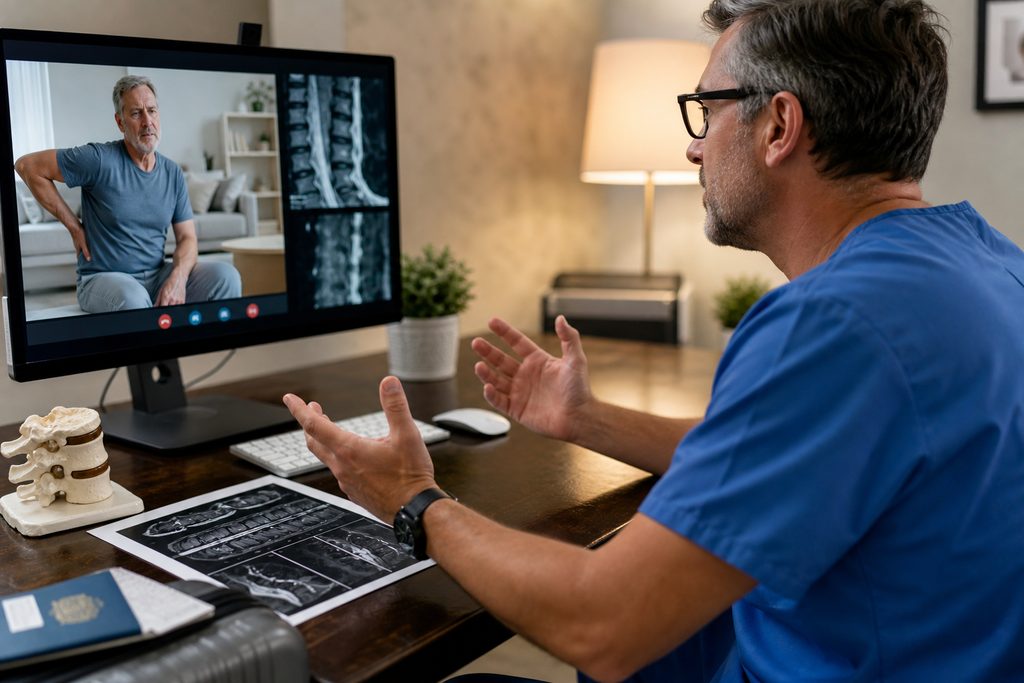
If you want more than paper, you schedule a video consultation with the same team. You talk directly. You ask the hard questions: Why did the first surgery fail? What would you do differently? What are my odds? Then, if you decide to proceed, we coordinate the hospital appointment, visa documentation, and on-the-ground logistics. You fly to China, meet the surgical team in person, and undergo pre-operative evaluation before any commitment to the operating table.
That’s the honest sequence. No shortcuts. No promises of guaranteed outcomes. Just a structured path from uncertainty to a decision you can defend.
What Failed Back Surgery Syndrome Actually Means
Some international health insurance policies cover treatment in China, especially at JCI-accredited private hospitals. Public hospital international departments are more variable. You’ll need to submit a pre-authorization request with the hospital’s treatment plan and cost estimate. Most patients pay upfront and file for reimbursement afterward. Check your policy’s wording on overseas surgical care before committing.
Most surgeons advise waiting 2 to 4 weeks after surgery before a long-haul flight. That allows initial wound healing and reduces the risk of blood clots. You’ll need to stand and walk periodically during the flight, and you may benefit from compression stockings and prescribed anticoagulation. The surgical team will clear you for travel before you book your return ticket.
Take that seriously. A surgeon who declines to operate on you is protecting you from a likely poor outcome. The written second opinion will outline alternative management strategies — spinal cord stimulation, targeted injections, or structured rehabilitation. You can pursue those options at home. The consultation still delivered value: it prevented an unnecessary operation.
You can book the evaluation package — records review, video consultation, and in-person assessment scheduling. You cannot book the surgery itself remotely. Chinese hospitals require an in-person pre-operative evaluation before scheduling any procedure. Anyone offering to book revision lumbar surgery China package deals that include a surgical date before you’ve been examined is not operating through legitimate channels.
Your Next Step
Failed spine surgery doesn’t mean you’re out of options. It means your next decision needs better information than your last one. A written second opinion from a high-volume revision center gives you that information without committing you to travel. If the opinion suggests surgery is worthwhile, the path to treatment in China is structured and transparent. If it doesn’t, you’ve saved yourself from a costly mistake.
We’re China Medical Services, a coordination team that connects international patients with top-ranked Chinese hospitals. We handle record translation, specialist matching, appointment scheduling, and on-the-ground support. We don’t perform surgery, and we don’t promise outcomes. What we do is make sure you’re evaluated by the right people before you spend money on travel or treatment. If you’d like to explore a written second opinion or video consultation, tell us about your case and we’ll map out the next step.
Frequently Asked Questions
Yes. The hospitals used for international patients are JCI-accredited and follow the same international safety standards as top hospitals in the US and Europe. Surgical teams perform high volumes of procedures — often more than their Western counterparts — which studies show leads to better outcomes.
Costs vary by procedure and hospital, but international patients typically save 40-80% compared to US prices — even when factoring in travel and accommodation. A consultation with our team will give you an exact, all-inclusive quote with no hidden fees.
Send us your existing medical reports to get started. We handle everything from hospital selection and appointment scheduling to visa assistance and post-operative recovery planning. Your medical records are reviewed by the specialist before you even book a flight.
For more medical information and treatment options in China, visit chinamedservices.com (China Medical Services).
