Health Checkup: Public vs Private Options for Foreigners in China
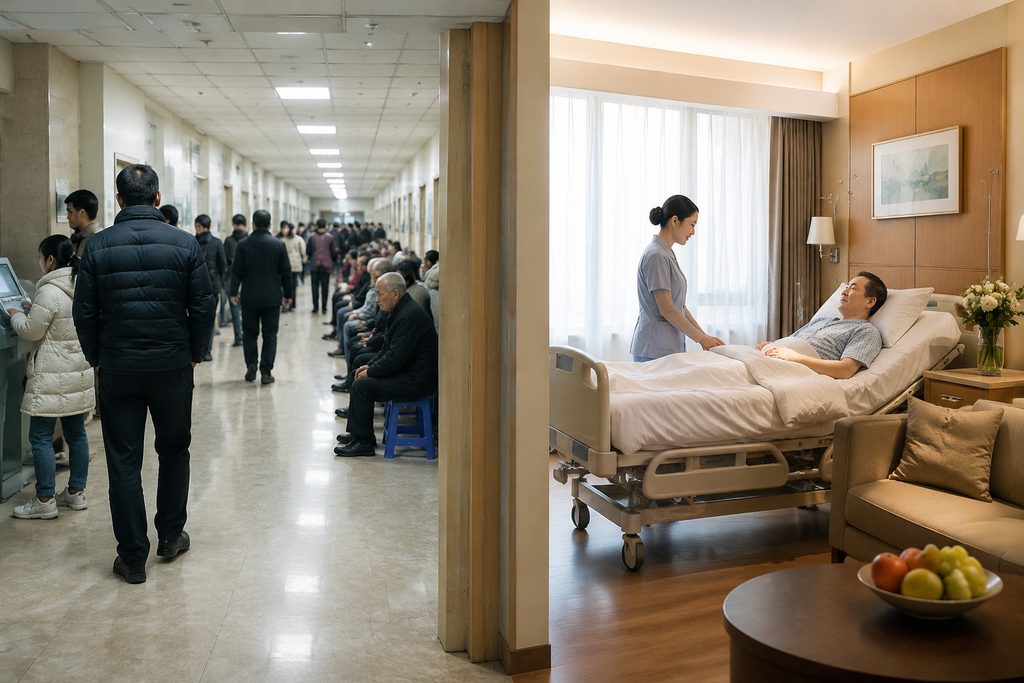
When 38-year-old Sarah from Manchester landed in Shanghai for a three-month work assignment, her employer required a comprehensive health screening within the first two weeks. She had no idea where to go. The public hospital near her apartment quoted her roughly $80 for a basic package but warned of language barriers and long queues. A private international clinic quoted $650 for a full-body executive panel with English reports. She was stuck. Which one made sense? That question — public versus private for health checkups in China — is one of the most common ones we help international patients answer.
If you are searching for the health checkup cost China private hospital ranges versus what public hospitals charge, the short answer is this: a basic public hospital screening runs from $50 to $150, while a comprehensive private or international clinic package typically starts around $300 and can exceed $1,500 for executive-level panels with same-day results and English-speaking physicians. The gap is real, but so is the difference in experience, speed, and documentation quality.
This guide breaks down what you actually get at each tier, where the hidden costs hide, and how to decide whether a private health screening in China is worth it for your specific situation. We have coordinated checkups for patients across Beijing, Shanghai, Guangzhou, and Chengdu, and the patterns are consistent.
How This Actually Works, Step by Step
The process differs sharply depending on which route you take. Here is the real sequence for both.
For a public hospital checkup, you typically walk in or book a same-week slot through the hospital’s own app — often in Chinese only. On the day, you queue at the registration desk with your passport, pay a deposit, and then move through a series of stations: blood draw, ultrasound, chest X-ray, ECG, and a basic physical exam. Results arrive in Chinese, usually within three to seven days, and you will need to get them translated yourself if your employer or home doctor requires English documentation. A bilingual companion can handle the registration, queue navigation, and translation for you, which is where services like ours come in.
For a private or international clinic checkup, you book online in English, choose a package, and arrive at a scheduled time. A nurse escorts you through each station. Most results are ready the same day or within 48 hours. The report comes in English, often with a doctor consultation included. You pay by card or direct insurance billing. No queues. No translation needed.
That is the core trade-off: money versus friction.
Health Checkup Cost China Private Hospital: What You Actually Pay
Let us put specific numbers on the table. These are ranges we have seen across our network of 340+ top-ranked hospitals and private international clinics in 37 cities. Prices vary by hospital and case complexity, but the tiers are stable.
| Checkup Type | Public Hospital (Top-Tier) | Private / International Clinic |
|---|---|---|
| Basic screening (blood, urine, chest X-ray, ECG) | $50–$150 | $300–$600 |
| Standard full-body (adds ultrasound, liver/kidney function) | $150–$300 | $600–$1,000 |
| Executive / VIP panel (adds CT, tumor markers, cardiology consult) | $300–$600 (VIP wing) | $1,000–$2,500+ |
| Cardiac-focused screening (echo, stress test, lipid panel) | $200–$400 | $800–$1,500 |
| Women’s health package (mammogram, pelvic ultrasound, HPV) | $150–$350 | $500–$1,200 |
These figures are what we see in major cities like Beijing, Shanghai, and Guangzhou. The public hospital prices reflect the standard outpatient channel. The VIP or international wing of a public hospital — which offers English support and priority scheduling — typically costs 1.5 to 2 times the standard rate, landing somewhere between the two columns.
So when someone asks us directly about the health checkup cost China private hospital versus public, the honest answer is: expect to pay three to five times more at a private clinic for the same clinical tests. What you are buying is not better machines. It is time, language, and documentation.
Public vs Private Hospital Checkup Shanghai: A Side-by-Side Look
Shanghai is where the contrast is sharpest, because the city has both world-class public hospitals and a dense cluster of JCI-accredited private clinics. If you search for public vs private hospital checkup Shanghai, here is what that comparison looks like in practice.
| Factor | Public Hospital (e.g., Zhongshan, Huashan) | Private Clinic (e.g., United Family, Jiahui) |
|---|---|---|
| Booking lead time | Same-day to 1 week | Same-day to 3 days |
| Language support | Limited English, mostly Chinese | Fluent English standard |
| Report language | Chinese (translation extra) | English included |
| Time on site | 3–6 hours, fragmented | 1.5–3 hours, guided |
| Insurance | Pay first, claim later | Direct billing common |
| Doctor consult included | Often not | Usually yes |
One thing that surprises many Western patients: the clinical quality at Shanghai’s top public hospitals is excellent. The same doctors who staff the public wards often rotate through the hospital’s VIP or international department. So the question is not whether the medicine is better at a private clinic. It is whether the logistics are worth the premium.
A Realistic Timeline
If you are planning a checkup from abroad or shortly after arrival, here is the timeline you should actually expect — including the steps people forget.
| Stage | Public Hospital | Private Clinic |
|---|---|---|
| Booking confirmation | 1–3 days (app-based, may need Chinese help) | Same day to 2 days |
| Pre-checkup preparation | 8–12 hour fasting, no prior guidance in English | Clear English instructions sent in advance |
| On-site completion | 3–6 hours | 1.5–3 hours |
| Results delivery | 3–7 days, Chinese only | Same day to 48 hours, English |
| Report translation (if public) | 2–5 extra days, $30–$80 | Not needed |
| Follow-up consultation | Separate booking, often weeks out | Included or within 1 week |
The forgotten step is translation. Many patients budget for the checkup itself but not for converting a Chinese report into something their home physician can read. And if you need the report for a visa extension or employer compliance, an untranslated document can stall the entire process.
What Can Go Wrong — and What Happens Then
We have seen the failure modes up close. They are rarely about medical error. They are about process.
The most common problem at public hospitals is arriving without the right preparation. You fasted, but the hospital requires a specific registration card you do not have. Or the ultrasound department closes at 11:30 and you arrived at 10:45 after three other stations. You come back the next day. That is another morning lost.
Language is the second failure point. A front-desk staff member may speak some English, but the lab technician who draws your blood probably does not. If you have a question about why an extra test was added, or what the doctor said during the physical exam, you may not get a clear answer on the spot.
Insurance is the third. Public hospitals in China generally operate on a pay-first model. You pay the full amount, receive a receipt and report, and submit both to your insurer later. Some international insurers do not reimburse public hospital checkups without itemized English invoices — which public hospitals do not provide by default. A bilingual companion can request and translate itemized receipts, but it adds a step.
At private clinics, the failure mode is different: cost creep. The advertised package price is often a base rate. Additional tests, specialist consults, or follow-up imaging are billed separately. A $600 package can easily become $1,100 once the doctor recommends a thyroid ultrasound or a cardiac stress test. Ask for an all-inclusive quote before you book.
Is Private Health Screening in China Worth It? Decision Criteria
This is the question behind the search query “is private health screening in China worth it” — and the answer is not the same for everyone.
Private screening is worth it if you need English documentation for an employer, insurer, or home physician. It is worth it if your time in China is short and you cannot afford to spend two mornings navigating a public hospital. It is worth it if you have a complex medical history and want a doctor who can discuss findings with you in your own language on the same day.
It is probably not worth it if you are healthy, flexible, and simply want a baseline set of labs. A public hospital checkup with a bilingual companion costs a fraction of the private rate, and the companion handles the language barrier and queue navigation for you. The tests themselves are the same quality.
And if you are asking how much is executive health checkup China, the honest range is $1,000 to $2,500 at private international clinics, and $300 to $600 at a public hospital’s VIP wing. The VIP wing is often the sweet spot: English support, priority scheduling, and a price that sits between the two extremes.
Practical Considerations: Records, Payment, and Follow-Up
Bring your passport. That is non-negotiable at every facility. If you have prior imaging or lab work from your home country, bring those too — a good physician will want to compare trends, not just snapshot values.
Payment is straightforward but worth planning. Public hospitals take cash, Chinese bank cards, and sometimes international cards at the VIP counter. Private clinics take international cards and often bill insurers directly. If you plan to claim reimbursement, request an itemized invoice in English before you leave the facility. At public hospitals, ask for the 发票 (invoice) — your companion can handle this.
For follow-up, make sure the report includes reference ranges. Chinese labs use slightly different units and ranges than Western labs in some cases. A good English report will convert these. A raw translation will not. If you plan to share results with a physician back home, the private clinic report is usually easier for them to interpret.
One more thing: if you are coming to China specifically for a checkup as part of a broader medical trip, your visa category matters. Medical treatment and private affairs fall under the S2 visa, not the M visa, which is for commercial and trade activities. We help patients understand the correct category and supporting documents before they travel.
Frequently Asked Questions
For a full body checkup price Beijing international clinic, expect to pay between $600 and $1,500 for a standard executive panel. Premium packages with advanced imaging, cardiac stress testing, and same-day specialist consults can run $2,000 to $2,500. Prices vary by clinic and what is included, so always request an itemized package before booking.
Yes. To book private health checkup Shanghai, you can contact the clinic directly or work with a coordinator who handles the scheduling for you. Most private clinics accept bookings one to two weeks in advance. Public hospital VIP wings also accept advance bookings through their international departments, though availability is tighter.
No. Top-tier public hospitals in China — especially those on the Fudan ranking — use the same or better equipment than most private clinics. The difference is service, language, speed of reporting, and documentation. The clinical quality is not the weak point.
If a checkup flags an abnormal finding, the next step is a follow-up consultation with a relevant specialist. At a private clinic, this is usually arranged within days. At a public hospital, you may need a separate appointment — sometimes weeks out. We help patients navigate this transition, including connecting them with the right department at one of our 45 specialty-ranked hospital departments.
If the checkup is the sole purpose of your trip, it falls under private affairs or medical treatment, which aligns with the S2 visa category. The M visa is for commercial and trade activities and is not appropriate for medical travel. Requirements change, so confirm with the Chinese embassy or consulate in your country before applying.
Your Next Step
The choice between public and private for a health checkup in China comes down to three things: your budget, your need for English documentation, and how much time you are willing to spend navigating the system. There is no universally right answer — but there is a right answer for your specific situation.
We help international patients figure that out. Our team matches you with the right facility, coordinates the booking, and provides a bilingual medical companion who handles registration, queue navigation, and translation on the day. We do not perform medical procedures or offer medical advice — we make the logistics disappear so you can focus on the results.
If you are planning a checkup in China and want a clear recommendation, start with a free consultation. Tell us what you need, and we will tell you what it will realistically cost and how to make it smooth.
The core message is simple: China offers excellent health screening at both public and private facilities. The public option is the value play. The private option is the convenience play. Choose based on what matters most to you — and do not overpay for language support you can get for a fraction of the cost through the right coordination.
For more medical information and treatment options in China, visit chinamedservices.com (China Medical Services).
