Heart Surgery Rehab: Getting Stronger After a Procedure in China
Heart Surgery Rehab: Getting Stronger After a Procedure in China
What if the hardest part of heart surgery isn’t the operation itself, but the months that follow? You’ve made it through the procedure. Now you’re lying in a hospital bed wondering when you’ll feel like yourself again. The honest answer: heart bypass surgery recovery time China varies, but most patients regain meaningful strength within 8 to 12 weeks when they follow a structured rehabilitation program. That timeline holds whether you had your procedure at Fuwai Hospital in Beijing or a private international facility in Shanghai.
Our team at China Medical Services has coordinated post-operative care for hundreds of international patients. We’ve seen what works. We’ve also seen what happens when patients skip rehab entirely. This guide walks through the actual recovery sequence, the realistic timeline, and the decisions that determine whether you bounce back in two months or struggle for six.
How This Actually Works, Step by Step
Recovery from cardiac surgery follows a predictable arc, but the logistics for an international patient add layers most people don’t anticipate. Here’s the actual sequence.
Before you leave the operating hospital, a cardiac rehabilitation specialist evaluates your baseline. They measure your ejection fraction, review your surgical notes, and perform a six-minute walk test. Those numbers become the benchmark for everything that follows. You receive a discharge summary — typically in Chinese — along with medication instructions and a follow-up schedule. This is where bilingual support matters most. A mistranslated dosage instruction is not a risk worth taking.
Phase one begins in the hospital. Within 24 to 48 hours after surgery, nurses get you sitting upright, then standing, then taking short walks down the corridor. This feels impossibly difficult at first. It is also non-negotiable. Early mobilization reduces the risk of pneumonia, blood clots, and muscle wasting.
Once discharged — usually 7 to 10 days after bypass surgery — phase two starts. You move to a rehabilitation setting: either a dedicated cardiac rehab center, a hotel near the hospital with outpatient visits, or home with remote monitoring. Each option has trade-offs. Staying near the hospital gives you immediate access to your surgical team if something feels wrong. Going home too early means a 12-hour flight when your sternum is still knitting together.
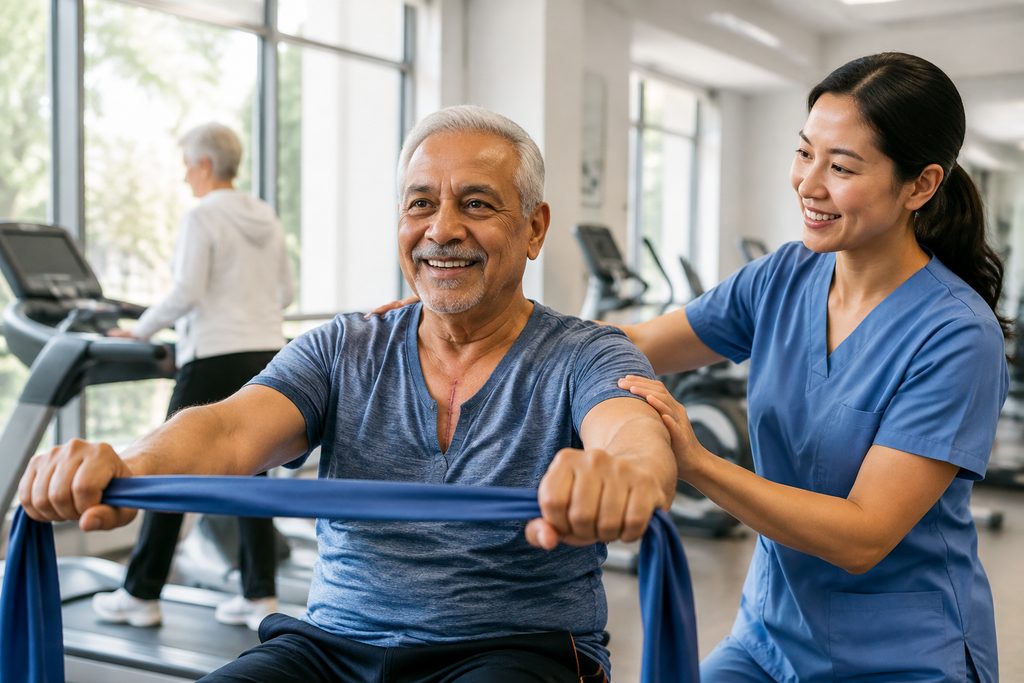
Phase two typically runs 6 to 12 weeks. You attend supervised exercise sessions three times per week. A physiotherapist monitors your heart rate, blood pressure, and oxygen saturation while you walk on a treadmill or ride a stationary bike. The intensity starts embarrassingly low — think 2.0 mph on a flat treadmill — and increases by roughly 10% each week. Alongside exercise, you work with a dietitian on cardiac nutrition and a pharmacist on medication adherence.
Phase three is the long game. After 12 weeks, you transition to independent exercise with periodic check-ins. Most patients are back to work, driving, and normal daily activities by this point. Full sternal healing takes 6 to 12 months, which is why contact sports and heavy lifting stay off-limits longer than most people expect.
Cardiac Rehab After Heart Surgery Abroad: What the Data Shows
The evidence for structured rehabilitation is overwhelming. A 2016 meta-analysis published in the Journal of the American Heart Association found that participation in cardiac rehabilitation reduced cardiovascular mortality by 26% and hospital readmissions by 18% compared to usual care. Those numbers hold across multiple countries and surgical types. The mechanism is straightforward: supervised exercise strengthens the heart muscle, improves endothelial function, and lowers resting blood pressure. Rehab also catches complications early. A patient who reports unusual chest tightness during a supervised session gets an ECG within minutes, not days.
China’s cardiac rehab infrastructure has expanded dramatically since 2018. Major cardiovascular centers now operate dedicated rehabilitation departments with equipment comparable to Western facilities. Fuwai Hospital, which performs over 14,000 cardiac surgeries annually, runs an integrated rehab program that begins before surgery and continues through outpatient phases. Zhongshan Hospital in Shanghai has a similar model. The advantage for international patients is volume: these centers see more post-bypass patients in a month than many Western hospitals see in a year.
But here’s the honest caveat. Cardiac rehab in Chinese public hospitals is typically delivered in Mandarin. Exercise physiologists and dietitians may not speak English fluently. That’s not a criticism — it’s a structural reality. Patients who book cardiac rehabilitation program China through an international coordination service get a bilingual companion who translates instructions, clarifies medication schedules, and ensures nothing gets lost between languages. The medical expertise is world-class. The language bridge is what makes it accessible.
A Realistic Timeline
Every patient heals differently. Age, pre-surgery fitness, surgical complexity, and comorbidities all shift the timeline. But a typical recovery for an international patient undergoing bypass surgery in China looks like this:
| Stage | Timeframe | What Happens | What People Forget |
|---|---|---|---|
| Pre-arrival preparation | 2–4 weeks before surgery | Medical records translated, S2 visa application submitted, hospital international department confirms admission | Visa processing alone can take 2–3 weeks. Start early. |
| Hospital stay | 7–10 days | Surgery, ICU monitoring, initial mobilization, discharge planning | Discharge summaries need certified translation for your home cardiologist |
| Early outpatient rehab | Weeks 2–4 | Supervised exercise 3x weekly, wound care, medication titration | Sternal precautions: no pushing, pulling, or lifting over 5 kg |
| Intensive rehab phase | Weeks 5–12 | Progressive exercise intensity, nutrition counseling, stress management | Energy fluctuates day to day. That’s normal, not failure. |
| Return home transition | Weeks 10–14 | Clearance for air travel, transfer of medical records, home exercise prescription | Long-haul flights increase DVT risk — compression stockings and movement breaks are essential |
| Long-term maintenance | Months 3–12 | Independent exercise, medication adherence, periodic cardiac check-ups | Full sternal healing takes up to a year. Contact sports wait. |
The takeaway: heart bypass surgery recovery time China typically spans 3 months to regain functional strength, with the first 4 weeks being the most physically and emotionally demanding. Patients who plan for a 12-week stay in China get the full benefit of supervised rehab. Those who fly home after 3 weeks miss the most critical adaptation window.
What Can Go Wrong — and What Happens Then
Recovery rarely follows a straight line. Complications happen. The difference between a minor setback and a serious problem often comes down to how quickly you get evaluated.
Sternal wound infection affects roughly 1–3% of bypass patients. The signs are redness, warmth, discharge, or fever. If caught early, oral antibiotics resolve most superficial infections. If ignored, a deep infection can require surgical debridement and months of wound care. The practical implication: check your incision daily, photograph it, and have a low threshold for contacting your surgical team. In China, your coordinating service can arrange same-day wound review at the operating hospital.
Atrial fibrillation occurs in 20–40% of patients after cardiac surgery. It usually appears between days 2 and 5 post-op. Most cases resolve with medication or electrical cardioversion. But new-onset AF increases stroke risk, which is why post-surgical monitoring matters. If you’re discharged before AF is fully controlled, you need a clear plan for anticoagulation and rhythm monitoring.
Pleural effusion — fluid around the lungs — affects up to 60% of bypass patients. Most effusions are small and resolve on their own. Larger ones cause shortness of breath and may require drainage. The symptom to watch: increasing breathlessness when lying flat, especially weeks after surgery when you expected to feel better.
Depression after cardiac surgery is underdiagnosed and undertreated. Roughly 20% of patients experience clinically significant depressive symptoms in the first 3 months. The combination of physical limitation, medication side effects, and confronting mortality hits hard. Cardiac rehab programs that include psychological support produce measurably better outcomes. If your program doesn’t screen for depression, ask why.
What happens when something goes wrong? In China’s top-tier hospitals, you have direct access to the surgical team that operated on you. That’s a structural advantage over flying home, where a new cardiologist reviews your records cold. The coordination service arranges the appointment, provides translation, and ensures the right specialist sees you — not just whoever is on duty.
Best Hospital for Heart Surgery Recovery Shanghai: How to Choose
Shanghai has several hospitals with strong cardiac rehabilitation programs, and the “best” choice depends on what you’re optimizing for. Are you prioritizing raw clinical volume, English-language support, or integrated rehab facilities?
Zhongshan Hospital, affiliated with Fudan University, ranks among China’s top cardiac surgery centers. Its rehabilitation department handles high volumes of post-bypass patients, which means the staff has seen every complication and every recovery trajectory. What it doesn’t offer is Western-style amenities. The environment is efficient, not luxurious. English proficiency among rehab staff varies.
For patients who want English-speaking care throughout recovery, Shanghai’s private international hospitals offer a different model. Facilities like Jiahui and United Family provide cardiac rehab with Western-trained physiotherapists, direct insurance billing, and a more familiar patient experience. The trade-off is cost — typically 1.5 to 2 times the public hospital rate, though still far below US prices.
The decision criteria we recommend: if your surgery was complex and you want the same surgical team managing your recovery, stay at the operating hospital’s rehab program. If you had a straightforward procedure and value language comfort and amenities, a private international facility makes sense. Some patients combine both — surgery at a public top-tier hospital, then outpatient rehab at a private facility with English-speaking therapists.
What matters more than the hospital’s reputation is the rehab program’s structure. Ask specific questions: How many supervised sessions per week? Who monitors exercise intensity — a physiotherapist or a nurse? Is there a dedicated cardiac dietitian? What’s the protocol if a patient reports chest pain during exercise? Vague answers are a red flag.
Practical Considerations: Records, Visa, Payment, and Follow-Up
Yes, but it’s not ideal. Most surgeons recommend waiting at least 10–14 days before long-haul flights to reduce DVT risk. Flying home at week 3 means missing the most intensive rehab phase. If you must return early, get a written exercise prescription and schedule home rehab before you leave.
Yes. Supervised cardiac rehab is safe and effective for patients in their 70s and 80s. Exercise intensity is individualized based on baseline testing. The supervision is the safety mechanism — trained staff monitor heart rhythm and blood pressure throughout each session.
Report it immediately to the supervising physiotherapist. The protocol in reputable programs is to stop exercise, obtain an ECG, and notify the cardiologist. Most episodes turn out to be musculoskeletal pain from sternal healing. But the evaluation happens first, and reassurance comes second.
Yes. The S2 visa covers medical treatment and rehabilitation stays up to 180 days. Your hospital provides supporting documentation. Family members accompanying you also need S2 visas. Processing takes 2–4 weeks depending on your home country’s Chinese embassy.
Your
Frequently Asked Questions
Is it safe to have surgery in China?
Yes. The hospitals used for international patients are JCI-accredited and follow the same international safety standards as top hospitals in the US and Europe. Surgical teams perform high volumes of procedures — often more than their Western counterparts — which studies show leads to better outcomes.
How much does medical treatment cost in China?
Costs vary by procedure and hospital, but international patients typically save 40-80% compared to US prices — even when factoring in travel and accommodation. A consultation with our team will give you an exact, all-inclusive quote with no hidden fees.
How do I start the process?
Send us your existing medical reports to get started. We handle everything from hospital selection and appointment scheduling to visa assistance and post-operative recovery planning. Your medical records are reviewed by the specialist before you even book a flight.
Frequently Asked Questions
Yes. The hospitals used for international patients are JCI-accredited and follow the same international safety standards as top hospitals in the US and Europe. Surgical teams perform high volumes of procedures — often more than their Western counterparts — which studies show leads to better outcomes.
Costs vary by procedure and hospital, but international patients typically save 40-80% compared to US prices — even when factoring in travel and accommodation. A consultation with our team will give you an exact, all-inclusive quote with no hidden fees.
Send us your existing medical reports to get started. We handle everything from hospital selection and appointment scheduling to visa assistance and post-operative recovery planning. Your medical records are reviewed by the specialist before you even book a flight.
For more medical information and treatment options in China, visit chinamedservices.com (China Medical Services).
