Hotel to Hospital Transfer in China: Daily Rides, Real Costs, and How to Book
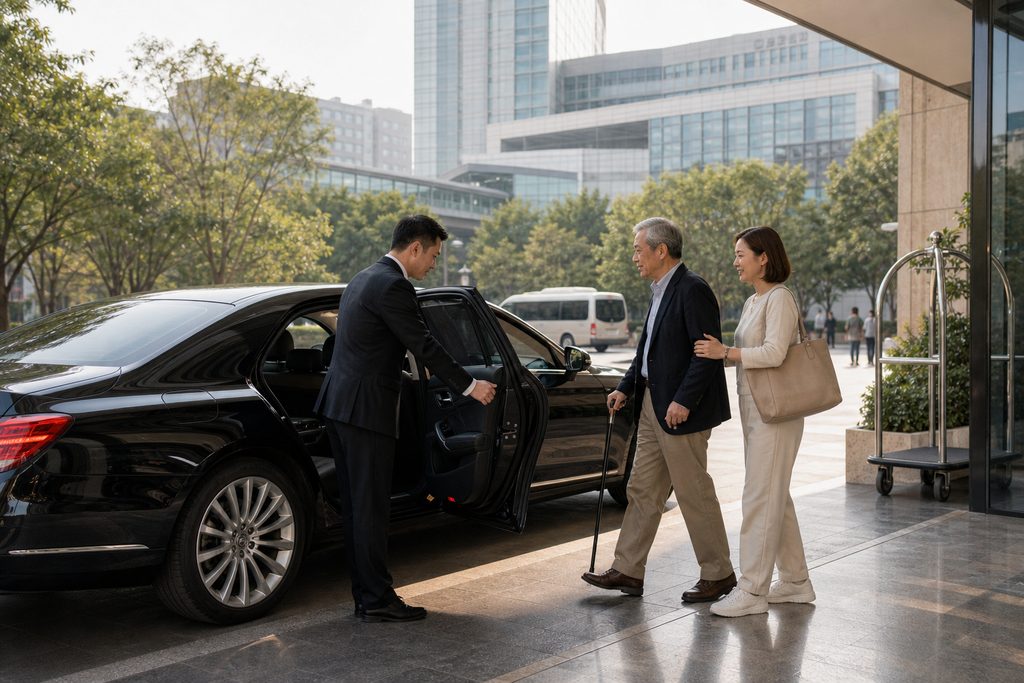
Have you ever landed in a foreign city for surgery and realized the hardest part isn’t the operation — it’s getting from your hotel bed to the hospital doors every single morning? You’re not alone. For international patients in Shanghai, the hotel to hospital transfer price Shanghai typically starts around $30 for a standard one-way private ride, with daily medical transport cost China ranging from $25 to $80 per trip depending on vehicle type, distance, and whether a bilingual escort is included. That sounds manageable. But the real question is whether daily transfers are bundled into your care package, or billed separately.
Most patients discover the answer only after arriving. This guide lays out the actual pricing, the booking mechanics, and the fine print before you commit to anything.
Hotel to Hospital Transfer in China: The Short Answer
Daily private rides between your hotel and a Shanghai hospital cost roughly $30–$80 per one-way trip. A hospital shuttle service for international patients Beijing runs in a similar range, though Beijing’s larger footprint pushes the upper end closer to $90 for distant routes. You can book each ride individually, or negotiate a weekly flat rate with a coordinator. The price variance comes down to four factors: vehicle class, distance, whether a bilingual staff member accompanies you, and whether the hospital’s international department operates its own shuttle.
The caveat: “transfer” means different things to different providers. Some quote only the car. Others bundle pickup coordination, wheelchair assistance, and a translator. Comparing quotes without comparing scope is how patients overpay.
Who This Is Right For — and Who It Isn’t
Daily hospital transfers make sense for a specific profile of medical traveler. You are a good candidate if:
- Your treatment requires daily outpatient visits — radiation therapy, wound care, dialysis, or post-surgical monitoring.
- You are staying more than 20 minutes from the hospital and public transit feels overwhelming in a foreign language.
- You have limited mobility after a procedure, or travel with heavy medical equipment.
- Your hotel is in a district with unreliable taxi access during peak hours.
But daily transfers are not for everyone. Skip them if your hospital is within walking distance, or if your treatment schedule is weekly rather than daily. Patients recovering from minor procedures who can use ride-hailing apps like Didi in English may not need a dedicated service. And if your budget is tight, public metro lines in Shanghai and Beijing are clean, safe, and cost under $1 per ride — though navigating them post-surgery is genuinely harder.
The Options, Compared
Not all hospital transfers are created equal. Here is what you are actually choosing between when you book in China:
| Option | Typical Cost (One-Way) | Booking Lead Time | Bilingual Staff | Best For |
|---|---|---|---|---|
| Standard private car (Didi/DiDi Premium) | $25–$40 | On-demand, 10–15 min | No | Independent travelers, short distances |
| Hotel-concierge arranged car | $35–$60 | 2–4 hours | Sometimes | Patients who want hotel accountability |
| Medical coordinator private transfer | $40–$80 | 24 hours | Yes, often | First-time patients, language barriers |
| Hospital international department shuttle | $0–$20 | Varies by hospital | Yes | Patients at hospitals with dedicated services |
| Weekly flat-rate package (5–7 rides) | $150–$400 total | 3–5 days | Depends on provider | Daily treatment schedules |
If you are a confident traveler who speaks some English and uses apps easily, the standard private car is the cheapest and most flexible. If you are arriving alone for major surgery, the medical coordinator transfer with bilingual support removes a layer of stress that is hard to price. The hospital shuttle — where it exists — is the hidden gem most patients never ask about. Always ask your hospital’s international department directly before booking anything external.
How Does Hotel to Hospital Transfer Work for Medical Tourists in China
The mechanics are simpler than most patients expect, but the sequence matters. You do not book a week of rides on day one and hope for the best. Here is the actual flow.
First, confirm your treatment schedule with the hospital. Daily radiation or dialysis runs on a fixed timetable. Surgeon follow-ups may shift. Your transfer provider needs the real schedule, not the tentative one.
Second, decide whether you want the same driver every day. Consistency costs slightly more but means the driver learns your hotel entrance, your preferred pickup point at the hospital, and your pace of walking. For patients with mobility issues, this matters more than the vehicle brand.
Third, clarify the waiting policy. Some providers include 15 minutes of free waiting time. Others start the meter the moment the car arrives. If your appointment runs long — and in Chinese public hospitals, appointments often run long — you could be paying for idle time. Ask before you book.
Fourth, understand the payment method. Many private transfer services in Shanghai and Beijing accept WeChat Pay or Alipay, which foreign patients often cannot set up easily without a Chinese bank card. International credit cards are not universally accepted for transport. A coordinator who invoices you in advance and handles driver payment on your behalf removes this friction entirely.
Is Daily Hospital Transport Included in Medical Tourism Packages China
Rarely by default. Most medical tourism packages in China quote hospital fees, surgical costs, and sometimes accommodation. Ground transport is usually an add-on line item. Some high-end international hospital packages — particularly at private facilities like United Family or Jiahui — include airport pickup and one or two transfers, but daily rides are almost always separate.
That means you should ask a direct question before signing anything: “Does this package include daily hotel-to-hospital transfers for the entire treatment period?” If the answer is vague, assume it does not. Budget for it separately. A two-week daily treatment course at $40 per one-way ride adds up to roughly $1,120. That is not pocket change, and it is rarely mentioned in initial quotes.
Some coordinators offer a bundled rate if you book transfers alongside hospital appointment coordination. For example, a package that includes book hotel to hospital rides for surgery in Shanghai plus appointment scheduling and a bilingual escort may come in lower than booking each service individually. But you have to ask for the bundle — it is not always offered proactively.
What It Costs: Hotel to Hospital Transfer Price Shanghai and Beyond
Let’s get specific. In Shanghai, a standard sedan from a hotel in Jing’an or Xuhui district to a major hospital like Zhongshan Hospital or Ruijin Hospital runs $25–$35 one-way. If you are staying in Pudong and your hospital is in Puxi, expect $40–$50 because of the river crossing and tunnel tolls.
In Beijing, distances are longer. A ride from the embassy district to Peking Union Medical College Hospital costs $30–$40. From outlying areas near the airport, it can hit $70–$90. The daily medical transport cost China for a patient staying near their hospital is on the lower end; patients who choose cheaper hotels farther from the medical district pay more in transport — sometimes enough to cancel out the hotel savings.
What is included in the price? Typically the vehicle, fuel, tolls, and driver. What is often not included: parking fees at the hospital (usually $1–$3), waiting time beyond the free allowance, and any bilingual escort service. A bilingual medical companion, if you want one, adds roughly $300 per day for a full 8-hour shift — but that person does far more than ride in the car. They handle registration, payment, translation, and navigation inside the hospital. For many patients, that is the better investment than a premium car.
Practical Considerations: Booking, Payment, and Safety
Before you book anything, confirm your visa status. Medical travelers to China use the S2 visa for short-term treatment, and your hospital invitation letter is part of that application. Transport is not part of the visa process, but having your treatment dates locked helps you book transfers with confidence.
Payment is the next hurdle. If you book through a coordinator, you can often pay by international bank transfer or credit card in advance. If you book directly with a local driver, you may be asked for cash in RMB or WeChat Pay. Foreign patients without Chinese payment apps should arrange this before arrival. Some hotels will settle the bill and add it to your room charge — convenient, but usually marked up 15–20%.
Safety is generally not a concern with registered private car services in Shanghai and Beijing. The bigger risk is miscommunication about pickup points. Chinese hospitals have multiple gates, and your driver may not know which one is closest to your department. A screenshot of the exact building entrance, sent in advance, saves 20 minutes of confusion. If you have a bilingual companion, this problem disappears.
After you return home, keep records of your transport expenses if your treatment is being reimbursed by insurance. Most insurers require itemized receipts. A weekly invoice from a coordinator is easier to submit than a pile of individual driver receipts.
Frequently Asked Questions
For a standard private sedan, expect $25–$40 per one-way trip within central Shanghai. Round-trip daily costs land between $50 and $80. If you need a larger vehicle, a bilingual escort, or are crossing the river between Pudong and Puxi, the price rises to $60–$100 per one-way ride.
Yes. Most coordinators and some hotels accept advance bookings with a 24–72 hour lead time. You will need your hotel address, the hospital name and department, and your appointment times. Pre-booking is strongly recommended for early-morning surgery check-ins, when on-demand cars are harder to secure.
Sometimes. A few hospitals with large international departments operate shuttle buses between partner hotels and their campuses, often free or at a nominal $5–$10 fee. But this is the exception, not the rule. Most public hospitals in Beijing do not run patient shuttles. Always ask the hospital’s international office directly — this information is rarely published online.
Most private transfer services include a 15–30 minute free waiting window. After that, waiting fees apply, typically $5–$10 per 30 minutes. If the driver leaves entirely, you will need to book a new ride. This is why patients with unpredictable appointment times often prefer a coordinator who can hold the driver or dispatch a replacement quickly.
For short, simple trips, ride-hailing apps are cheaper. But for daily treatment over two or more weeks, the consistency of a pre-booked service — same driver, same pickup point, no language barrier — reduces missed appointments and stress. The premium is not about the car. It is about removing daily uncertainty during an already difficult time.
Your Next Step
Daily hospital transfers are a small line item that can quietly become a major source of stress if left to chance. The fix is simple: ask the right questions before you arrive, compare quotes with scope in mind, and do not assume anything is included. We are China Medical Services, a coordination team that helps international patients arrange hospital appointments, bilingual companions, and ground logistics across 340+ top-ranked hospitals in 37 cities. We are not a hospital and we do not provide medical advice. If you want help sorting out your transfer needs alongside the rest of your treatment plan, tell us your situation and we will walk you through the options.
For more medical information and treatment options in China, visit chinamedservices.com (China Medical Services).
