NAD+ and Peptide Therapy in China: Coordinating Cellular Regeneration Treatment
Key Takeaways
- China’s top-tier hospitals now offer structured NAD+ and peptide protocols, with NAD+ IV therapy cost in China typically ranging from $300 to $800 per infusion—substantially less than comparable Western clinics.
- These therapies target cellular regeneration pathways. Peptide therapy works for cellular repair by signaling specific biological processes, not by overriding them.
- No foreign patient can simply book an NAD+ package online and show up. Public hospital protocols require in-person consultation first. The international department pathway is the only viable route for pre-arranged treatment.
- Coordination matters more than the infusion itself. Without bilingual support and hospital-grade oversight, you risk receiving unverified compounds in non-sterile environments.
The Problem: Searching for Regeneration in a Fragmented Market
You are probably reading this because you have already done the research. You know what cellular senescence means. You understand that nicotinamide adenine dinucleotide levels decline by as much as 50% between ages 40 and 60. You have read the 2013 Sinclair lab paper showing NAD+ restoration reversing mitochondrial decay in old mice. The science is not the question. Access is the question.
Finding a clinic that administers pharmaceutical-grade NAD+ under physician supervision—with transparent pricing, sterile compounding, and a protocol that does not feel like a spa menu—is genuinely difficult. In the United States, boutique IV lounges charge anywhere from $600 to $1,200 per infusion. Many operate in regulatory gray zones. In Europe, wait times for longevity clinics with actual medical directors stretch into months. And peptide therapy? That landscape is even murkier. Compounding pharmacies, telehealth prescribers, and wellness influencers all claim expertise. Very few have hospital affiliations.
This is the gap that drives people to look beyond their home markets.
Who We Are
We are not a clinic. We do not administer infusions, prescribe peptides, or make clinical recommendations. China Medical Services functions as your logistical bridge—we connect international patients with the specific hospital departments in China that have developed structured, physician-led cellular regeneration programs. Our team handles the pre-arrival coordination that makes treatment possible: hospital matching, appointment scheduling with English-speaking specialists, visa documentation, and bilingual medical companion support throughout your stay. We work with 340+ top-ranked hospitals across 37 cities. We know which departments run legitimate NAD+ protocols and which peptide therapy clinics in Shanghai operate under hospital pharmacy oversight rather than as standalone wellness centers.
Why China’s Cellular Regeneration Programs Are Drawing International Attention
Hospital-Grade Infrastructure, Not IV Lounge Aesthetics
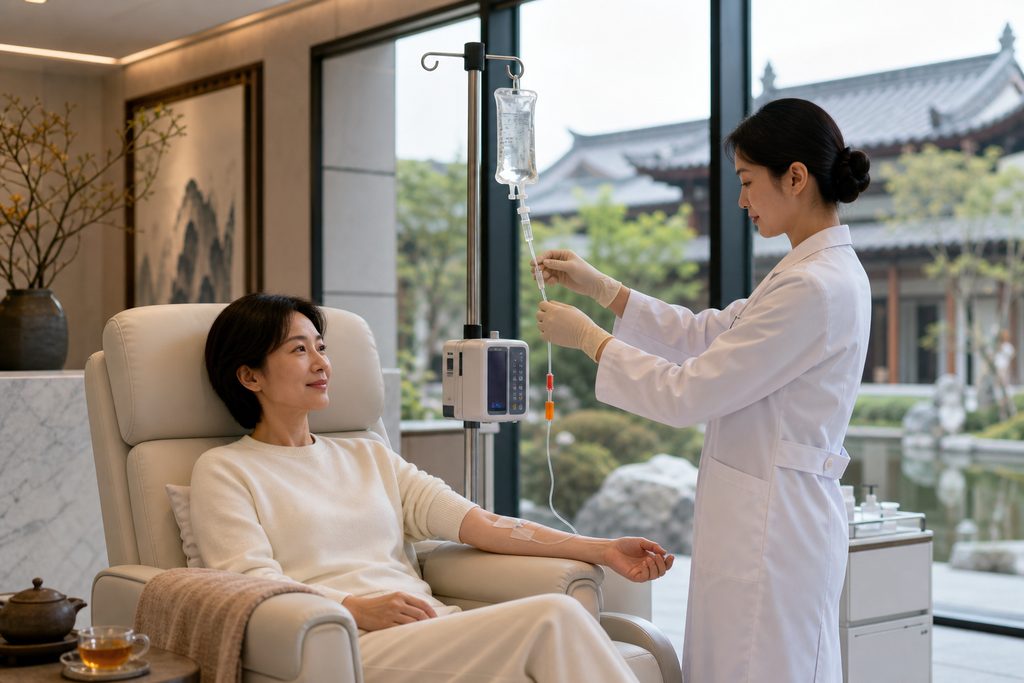
This distinction matters more than anything else you will read here. In many Western markets, NAD+ infusions are delivered in settings that prioritize ambiance over sterility. China’s approach inverts that. The hospitals we coordinate with administer NAD+ through their day-treatment units or international medical centers—the same facilities that handle chemotherapy infusions and post-surgical recovery. Pharmacy compounding happens in hospital cleanrooms. Adverse event protocols are identical to those for any intravenous therapy. You are not paying for a leather recliner and ambient music. You are paying for a clinical environment where an anaphylaxis cart is within arm’s reach and the physician who ordered your protocol trained in internal medicine, not aesthetic wellness.
This structural difference explains why some patients travel for what is essentially an infusion. Safety infrastructure is the product.
What Is NAD+ Anti-Aging Treatment, and Why Does Administration Method Matter?
NAD+—nicotinamide adenine dinucleotide—is a coenzyme present in every living cell. It shuttles electrons during metabolism. It activates sirtuins, the proteins that regulate cellular health and aging. It is a substrate for PARP enzymes that repair DNA damage. When levels drop, all three pathways suffer. This is not speculative. The biochemistry is settled.
What is NAD+ anti-aging treatment in practical terms? It is the intravenous administration of NAD+ to restore systemic levels that oral precursors like nicotinamide riboside or NMN cannot reliably achieve. Oral bioavailability is inconsistent. First-pass liver metabolism degrades a significant fraction. IV administration bypasses that entirely. But IV NAD+ is not benign—it can cause chest tightness, nausea, and significant discomfort during infusion if the rate is not carefully titrated. This is precisely why administration in a monitored clinical setting matters. The hospitals we coordinate with use programmable infusion pumps with step-up protocols over 2 to 4 hours. That is not how it works at an IV bar.
How Does Peptide Therapy Work for Cellular Repair, and Where Does China Fit?
Peptides are short chains of amino acids—essentially, small protein fragments—that bind to specific cell-surface receptors and trigger signaling cascades. Unlike hormones, which broadly affect multiple systems, peptides tend to have narrow, receptor-specific actions. BPC-157, a pentadecapeptide, promotes angiogenesis and accelerates tendon and ligament healing. Thymosin beta-4 (TB-500) regulates actin, a protein essential for cell migration and wound repair. Epitalon, a tetrapeptide, has been studied for its effects on telomerase activation and pineal function. GHK-Cu modulates collagen synthesis and has been shown to reset gene expression patterns in damaged tissue toward a healthier state.
How does peptide therapy work for cellular repair in a Chinese hospital context? The answer is not what most patients expect. China is not a free-for-all peptide market. The hospitals we coordinate with operate within China’s pharmaceutical regulatory framework, which means peptides are dispensed through hospital pharmacies, compounded under GMP standards, and administered with physician oversight. You will not find BPC-157 on a menu alongside vitamin drips. What you will find are structured protocols—often in sports medicine, rehabilitation, and integrative oncology departments—where peptide therapy is one component of a broader treatment plan. This is both a limitation and a safeguard. It means fewer peptides are available than in a compounding-pharmacy jurisdiction. It also means the ones that are available meet pharmaceutical-grade specifications.
Peptide Therapy Clinics Shanghai: The Hospital-Affiliated Model
Shanghai has emerged as a concentration point for this work. Several of the city’s top-tier hospitals—including those affiliated with Fudan University and Shanghai Jiao Tong University—have international medical centers that have developed experience with foreign patients seeking regenerative protocols. These are not standalone peptide therapy clinics in Shanghai. They are hospital departments that have integrated peptide-based interventions into broader treatment frameworks.
What does that mean for a patient? It means your initial consultation includes a full blood panel, liver and kidney function tests, and a physician assessment that may conclude peptide therapy is not appropriate for you. That possibility is real. It also means that if you are approved, your protocol is documented in a hospital electronic medical record, your peptides are dispensed by a hospital pharmacist, and your follow-up is scheduled before you leave. This is coordination-intensive. It requires Chinese-language medical documentation, in-person consultation, and navigation of hospital payment systems. That is what we handle.
Understanding the Real Costs
Transparent pricing is difficult in this space because costs vary by hospital tier, protocol complexity, and the specific peptides involved. What follows are ranges based on the hospitals we coordinate with. These are reference points, not quotes.
| Treatment Component | Estimated Cost Range (USD) | Notes |
|---|---|---|
| NAD+ IV infusion (single session, 500mg-1000mg) | $300 – $800 | Varies by hospital tier and dosage. Includes pharmacy compounding, infusion pump administration, and physician monitoring. |
| NAD+ multi-session package (5-10 infusions) | $1,200 – $4,500 | Package pricing typically includes initial consultation, blood work, and follow-up assessment. |
| Peptide therapy protocol (per month, hospital-dispensed) | $400 – $1,200 | Depends on peptide type, dosage frequency, and whether injectable or topical. Includes pharmacy dispensing and physician review. |
| Initial specialist consultation (international department) | $150 – $350 | Includes medical history review, physical assessment, and protocol recommendation. Credited toward treatment if you proceed. |
| Comprehensive pre-treatment lab panel | $100 – $300 | Required before any NAD+ or peptide protocol. Covers CBC, liver function, kidney function, and relevant biomarkers. |
The NAD+ IV therapy cost in China reflects structural economics, not quality compromises. Hospital labor costs are lower. Pharmacy compounding operates at scale. There is no wellness-industry markup layered onto the clinical service. Also, these prices are for hospital-based treatment. Standalone clinics exist in China as they do elsewhere, and their pricing and quality control vary widely. We do not coordinate with them.
What You Need to Know Before Going Alone
Several barriers make independent coordination genuinely difficult. We are direct about these because patients who understand them make better decisions.
- Visa Requirements: Medical treatment in China requires an S2 visa with a specific annotation for medical purposes. Your inviting entity must be the hospital or a recognized medical coordination service. A hotel booking or tourist itinerary will not support an S2 application. The hospital’s international department must issue an official invitation letter with your passport details, treatment purpose, and intended duration of stay. Without this document, the visa application stalls. We handle this documentation as part of our coordination, working directly with the hospital’s international office to generate the correct paperwork.
- Public Hospital Access Rules: China’s top public hospitals do not allow foreign patients to pre-book treatment online from overseas. The standard pathway requires in-person registration at the hospital, queuing for a ticket, and waiting for an available specialist—often the same day, sometimes days later. This system works for locals. It does not work for someone flying in for a specific protocol. The international department pathway bypasses this, but it requires advance coordination through channels that are not publicly listed. You cannot simply call the hospital switchboard and book an NAD+ infusion.
- Payment Systems: Chinese hospitals operate on a pre-payment model. You deposit funds at admission, and charges are deducted as services are rendered. International credit cards are not universally accepted. WeChat Pay and Alipay dominate, and linking a foreign card to these platforms is not always straightforward. Hospital international departments can process wire transfers, but the lead time is measured in days, not hours. We help patients structure payment in advance so they are not standing at a cashier window trying to authorize a foreign transaction on an unstable connection.
How We Help You Navigate This
These barriers are not accidental. They exist because China’s hospital system was built for a domestic patient population of 1.4 billion people, not for international medical travelers. That is not a flaw—it is a design choice. Our job is to bridge the gap between that system and your needs.
Before you travel, we identify the hospital department that matches your clinical goals. Not every top-ranked hospital runs NAD+ protocols. Not every international department has experience with peptide-based regenerative approaches. We know which ones do. We request the invitation letter, schedule your initial consultation, and arrange for an English-speaking physician to conduct your assessment. We also coordinate pre-arrival lab work if your home physician can draw and send results, so you do not spend your first day in a phlebotomy queue.
During your treatment, a bilingual medical companion accompanies you to every appointment. This person handles registration, payment processing, pharmacy pickup, and real-time translation during physician consultations. They also manage the logistical friction—finding the right building in a hospital complex that sees 10,000 outpatients daily, navigating the queue system, and ensuring your infusion is administered in the correct treatment unit. This is not concierge-level hand-holding. It is operational necessity in an environment where every sign, form, and verbal instruction is in Chinese.
After your protocol concludes, we coordinate follow-up documentation—your treatment summary, lab results, and discharge instructions—translated into English for your home physician. If your protocol requires a second visit, we schedule it before you leave. The goal is continuity, not a one-off transaction.
Medical Tourism Cellular Regeneration Beijing: A Parallel Pathway
Shanghai is not the only option. Beijing‘s concentration of Fudan-ranked top-100 hospitals—21 of them, the highest in any Chinese city—includes several institutions with active integrative and anti-aging medicine departments. Medical tourism cellular regeneration Beijing programs tend to operate through the international medical centers of major teaching hospitals, including those affiliated with Peking University Health Science Center and the Chinese Academy of Medical Sciences.
The Beijing pathway shares the same structural requirements as Shanghai: in-person consultation, hospital-based pharmacy, physician oversight. What differs is the institutional culture. Beijing hospitals tend to be more research-oriented, with protocols that may draw on clinical trial infrastructure. For patients interested in therapies that are closer to the academic frontier—where peptide protocols may be informed by ongoing institutional research—Beijing is worth considering. The trade-off is that Beijing’s international departments can be more bureaucratic, with longer lead times for appointment confirmation. We help patients weigh these factors against their clinical priorities and travel constraints.
Can You Book an NAD+ Peptide Package in China Online?
The short answer is no. Any website offering to book an NAD+ peptide package in China with a credit card and no prior consultation is either selling you something other than hospital-based treatment or misrepresenting what they can deliver. This is not a matter of policy preference. It is a structural reality of how Chinese hospitals operate.
What you can do—and what we facilitate—is initiate the coordination process remotely. That means we present your case to the relevant department, confirm that your clinical profile is appropriate for the protocol you are seeking, and schedule your initial consultation for a specific date. The hospital will not commit to treatment before seeing you. No legitimate institution would. But they will confirm that they have the relevant expertise and that your consultation is booked. That is the difference between pre-coordination and pre-booking. We do the former. We are honest about the latter.
Frequently Asked Questions
NAD+ IV therapy administered in a hospital setting with physician monitoring has a well-characterized safety profile. The most common side effects during infusion include chest tightness, a feeling of warmth or flushing, nausea, and lightheadedness—all of which are rate-dependent and manageable by slowing the infusion. Serious adverse events are rare when proper screening is performed. That screening is essential: patients with certain metabolic disorders, severe liver impairment, or active malignancies may not be candidates. This is why we insist on pre-treatment labs and physician assessment. No one should receive NAD+ without a medical workup first.
You do not—and you should not be the one making that determination. Peptide selection is a clinical decision that requires a physician who understands your full medical history, current medications, and treatment goals. The hospitals we coordinate with do not allow patients to self-select peptides from a menu. The consultation process involves a detailed assessment, and the physician recommends a protocol—or recommends against one—based on clinical judgment. If you arrive with a specific peptide in mind, the physician will evaluate whether it is appropriate, but the decision is theirs, not yours. This is how legitimate medicine works.
This is the strongest argument for hospital-based treatment. If you experience an adverse reaction during an NAD+ infusion in a hospital day-treatment unit, the response is immediate: the infusion stops, the attending physician is notified, and full emergency resources are available within the same facility. This is categorically different from having a reaction in a standalone IV clinic, where the response may involve calling an ambulance and transferring you to an emergency department. The hospitals we coordinate with have emergency departments, ICU capabilities, and pharmacy support on-site. The safety margin is structural, not aspirational.
This depends entirely on your protocol. A basic NAD+ course might involve 5 to 10 infusions over 2 to 3 weeks. Peptide protocols vary more widely—some require daily injections for a defined period, others are administered weekly. Your initial consultation will produce a recommended schedule. We advise patients to plan for at least 10 to 14 days in China for a first treatment course, but we also help patients who need longer stays arrange appropriate accommodations near the hospital. The schedule is always determined by the treating physician, not by our team.
Almost certainly not for NAD+ or peptide therapy specifically, as these are generally classified as elective or wellness treatments rather than medically necessary procedures. Some patients have successfully claimed portions of their treatment under broader international health insurance policies, particularly when the protocol is administered through a recognized hospital rather than a wellness clinic. We provide detailed invoices and treatment summaries coded appropriately for insurance submission, but we cannot guarantee reimbursement. You should assume you will be paying out of pocket and budget accordingly.
Your Next Step
Cellular regeneration therapies are moving from the research periphery into clinical practice. The science is accelerating. Access, however, remains uneven—fragmented between unregulated IV lounges, compounding-pharmacy gray markets, and a small number of legitimate hospital programs that are difficult for
For more medical information and treatment options in China, visit chinamedservices.com (China Medical Services).
