Sepsis Emergency in China: Critical Care for Severe Infections
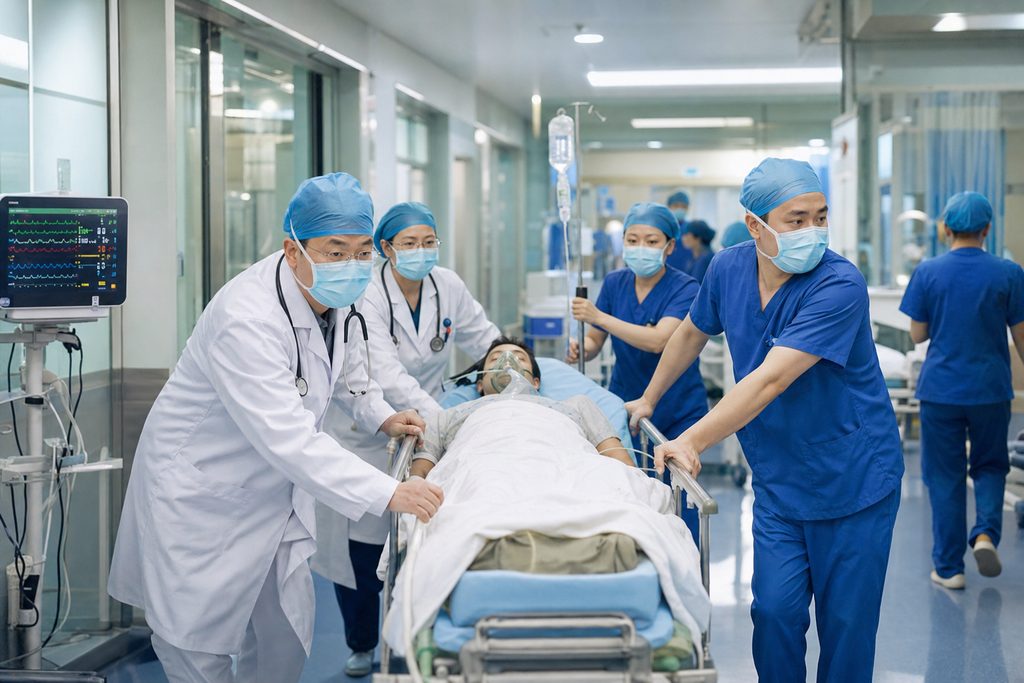
Key Takeaways
- Sepsis kills approximately 11 million people globally each year — rapid, protocol-driven ICU care is the single biggest factor in survival.
- China’s top-tier hospitals run infectious disease ICUs at volumes Western centers rarely match, with full ECMO, CRRT, and molecular diagnostics on standby.
- A foreigner cannot simply walk into a Chinese public ER and secure an ICU bed — language barriers, payment deposits, and visa status complicate everything.
- Understanding the real sepsis emergency treatment cost China hospitals charge — and how to coordinate care before a crisis hits — changes outcomes.
The Problem: Sepsis Doesn’t Wait for a Flight Home
A severe infection can turn septic in hours. Not days. Hours. The window for source control and broad-spectrum antibiotics is brutally narrow. The Surviving Sepsis Campaign’s 2021 guidelines make it clear: every hour of delayed antimicrobial therapy raises mortality by 7-8%. Now imagine this happens while you are traveling in a country where you do not speak the language, cannot read the hospital signage, and have no idea which facility actually stocks meropenem and runs a 24-hour infectious disease consult service. That is the reality for thousands of international visitors and expatriates in China each year. They need sepsis emergency treatment cost China data and hospital access — and they need it immediately.
The clinical picture is unforgiving. A urinary tract infection escalates. A post-surgical wound colonizes with resistant organisms. Pneumonia consolidates faster than oral antibiotics can work. The patient spikes a fever, drops their blood pressure, and drifts into confusion. This is the sepsis cascade. It demands a multidisciplinary ICU with intensivists, infectious disease specialists, and advanced organ support. China has these units. But finding one as a foreigner — while calculating the real cost and navigating the admission process — is where the system breaks down without local guidance.
Who We Are
We are not a hospital. We do not provide medical treatment, prescribe medications, or make clinical decisions. Our team functions as your logistical architects — we bridge the gap between you and China’s infectious disease critical care infrastructure. We maintain current relationships with the international patient centers at over 340 top-ranked hospitals across 37 cities. When a patient faces a severe infection and needs ICU-level care, we coordinate the admission pathway, the bilingual medical translation, the payment logistics, and the visa documentation. We exist so that clinical teams can focus on medicine while we handle everything else.
Why China’s Infectious Disease Critical Care System Delivers Results
Clinical Volume Forges Diagnostic Speed
Chinese infectious disease departments in major teaching hospitals manage caseloads that are difficult to grasp from a Western perspective. A single infectious disease ward at Huashan Hospital in Shanghai — home to one of China’s most respected ID programs — handles over 1,200 inpatient admissions annually for complex febrile illnesses alone. That volume compresses the learning curve. Fever of unknown origin workups that might take five to seven days in a lower-volume center get compressed into 48-72 hours. The differential diagnosis narrows faster. Empiric therapy gets refined sooner. For a septic patient, that compression is everything.
This is not just about manpower. It is about pattern recognition at scale. When an ID attending has seen 300 cases of complicated intra-abdominal sepsis in a year, the clinical gestalt sharpens. The resident training under them learns to recognize the subtle signs of anaerobic coverage failure. The microbiology lab processes so many blood culture bottles that turnaround times shrink. Scale changes outcomes.
Technology Infrastructure That Matches Any Western ICU
There is a persistent myth that lower costs mean outdated equipment. Walk into the medical ICU at Peking Union Medical College Hospital and you will see the opposite. ECMO circuits. High-flow nasal cannula arrays. Continuous renal replacement therapy machines running 24 hours. Molecular diagnostic platforms that identify pathogens from blood samples in under four hours — no culture wait required. The best hospital for severe infection care Beijing offers is equipped with exactly the same hardware you would find at a major US academic medical center.
The difference is operational tempo. Chinese ICUs run lean on nursing ratios compared to some Western standards, but they compensate with physician density. It is common to see an intensivist, an ID consultant, and a clinical pharmacist rounding together at the bedside — three specialists simultaneously reviewing one patient’s antibiotics, pressors, and source control plan. That multidisciplinary intensity is baked into the system, not bolted on as an extra consult.
The Cost Reality: Understanding Sepsis Emergency Treatment Cost China
Let us address the question directly. The sepsis emergency treatment cost China hospitals charge international patients through their VIP or international departments typically ranges from $8,000 to $35,000 for a full ICU stay of 7-14 days. That includes the ICU bed, continuous monitoring, IV antibiotics, vasopressor support, and basic organ support. If ECMO is required, the figure climbs — $50,000 to $80,000 is realistic for a prolonged ECMO run with full critical care. These are cash-pay estimates. They vary by hospital, by city, and by case complexity.
For comparison, a comparable sepsis ICU stay in the United States often bills between $80,000 and $200,000 before insurance negotiations. The structural reasons for China’s lower costs are straightforward: lower physician labor costs, hospital-owned equipment without the reimbursement markup, and a high-volume model that spreads fixed costs across more patients. Quality does not drop with the price. The same Surviving Sepsis Campaign bundles that guide care in Boston guide care in Beijing.
| ICU Intervention | Estimated Cost China (Int’l Dept) | Estimated Cost US (Before Insurance) |
|---|---|---|
| ICU Bed Day (with monitoring) | $800 – $1,500 | $4,000 – $7,000 |
| Broad-Spectrum IV Antibiotics (daily) | $200 – $600 | $1,000 – $3,000 |
| CRRT (Continuous Dialysis, per day) | $1,200 – $2,000 | $4,500 – $8,000 |
| ECMO Initiation + First 3 Days | $25,000 – $40,000 | $80,000 – $150,000 |
| Infectious Disease Consult (initial) | $150 – $350 | $500 – $1,200 |
These numbers answer the question how much does infectious disease ICU cost in China in practical terms. They are not low by any absolute standard. But for patients facing catastrophic out-of-pocket costs in their home country — or those already in China when sepsis strikes — the economics shift the calculus entirely.
What You Need to Know Before Going Alone
Honesty matters here. The Chinese healthcare system is not designed for walk-in foreign patients. It is built for a domestic population of 1.4 billion people. Trying to navigate it solo during a medical emergency is genuinely dangerous. Here is what you will face:
- Emergency Department Triage Reality: A public hospital ER in China may see over 1,000 patients daily. Triage nurses do not typically speak English. If you arrive without a Chinese speaker, you will wait — possibly hours — while more communicative patients move ahead. Sepsis does not tolerate that delay. International departments exist precisely to bypass this bottleneck, but they require advance coordination or an immediate connection through a service that knows the internal phone numbers.
- Payment Deposits Are Non-Negotiable: Chinese public hospitals require a cash deposit before ICU admission. For international patients without Chinese insurance, this deposit typically ranges from $15,000 to $40,000 upfront, depending on the anticipated length of stay and interventions. Credit cards work at international departments. Wire transfers are common. But no deposit means no bed — there is no “treat first, bill later” safety net for visitors. This is a structural fact, not a negotiable policy.
- Medical Records and Antibiotic Histories Must Be Translated: If you have a known infection history, prior culture results, or antibiotic allergy documentation, it needs to be in Chinese before the ID team can use it effectively. A Google Translate screenshot of your discharge summary will not suffice for a clinician deciding between vancomycin and linezolid. Professional medical translation — done fast — is a prerequisite for safe care.
How We Help You Navigate This
These barriers are real. They are also surmountable with the right coordination. When a patient or their family contacts us with a severe infection emergency, our process activates within hours — not days.
Before travel, we handle the hospital matching. Not every Chinese hospital with an ICU has a dedicated infectious disease critical care team. We identify the facilities — in Beijing, Shanghai, Guangzhou, or whichever city is closest — that run full-spectrum ID-ICU services with English-speaking coordinators. We confirm bed availability, deposit requirements, and the specific documentation the admitting team needs. We coordinate the S2 visa invitation letter that the hospital’s international department issues, which is the correct document for medical treatment entry. The M visa is for business — it does not apply here, and using it for medical care creates legal exposure.
During the acute episode, we deploy a bilingual medical companion. This person is not a clinician, but they are fluent in medical Chinese and English. They stay with the patient through ER triage, ICU admission, and daily rounds. They translate the intensivist’s plan into clear English for the family. They relay the family’s questions back to the clinical team without distortion. They handle the payment desk, the pharmacy runs, and the paperwork that would otherwise consume hours of a stressed family member’s time.
After stabilization, we coordinate the discharge plan. This might mean arranging a step-down bed at a private international hospital like United Family for continued IV antibiotics. It might mean organizing a written discharge summary translated into English for the patient’s home-country physician. It might mean coordinating a medical evacuation if the patient is stable enough to fly but not well enough to manage commercial travel alone. Every step is documented. Every cost is quoted before it is incurred.
Can a Foreigner Actually Get Emergency Sepsis Treatment in China?
For hospitals where we have existing relationships and the patient’s documentation is ready, we can often confirm an international department ICU bed within 2-4 hours during business hours. After hours, the timeline extends — midnight admissions are harder everywhere. This is not a guarantee of a specific bed at a specific moment. It is a realistic estimate based on years of doing this work. The limiting factor is usually the hospital’s bed availability, not our coordination speed.
China’s tertiary hospitals manage high volumes of MDR infections — including CRE, MRSA, and multidrug-resistant Acinetobacter. They stock colistin, ceftazidime-avibactam, and other reserve antibiotics. Microbiology labs run susceptibility testing routinely. The clinical challenge is real — MDR sepsis carries a higher mortality everywhere in the world — but the therapeutic armamentarium in a top Chinese ID center is equivalent to any Western academic hospital. No treatment is guaranteed to work. But the tools are there.
If you are already in China on a tourist (L) or business (M) visa and develop sepsis, you receive emergency care under your existing visa status — hospitals do not check visas before treating emergencies. If you are traveling to China specifically for planned infectious disease care or a high-risk surgery with a contingency plan, the correct visa is the S2 with a medical treatment annotation. Our team guides you through the invitation letter process. Do not use an M visa for planned medical treatment — it creates documentation problems that are entirely avoidable.
Your Next Step
Sepsis is a race against time. The right ICU, with the right specialists, at the right moment, changes survival odds. China’s top infectious disease critical care units are world-class — but they are not easily accessible to a foreigner navigating the system alone. Understanding the real costs, the admission pathways, and the coordination required is the difference between a chaotic emergency and a managed medical event.
If you are planning travel to China and want to establish a contingency plan, or if you are facing a severe infection now and need immediate coordination, our team is available. There is no pressure and no pitch. Just a conversation about your situation and what is possible. Contact our coordination team to discuss your needs. We will tell you honestly what we can do and what it will cost — and we will do it fast.
Medical Disclaimer: This article provides general information about accessing infectious disease critical care in China. It does not constitute medical advice, diagnosis, or treatment recommendations. Sepsis is a life-threatening emergency. If you or someone near you shows signs of sepsis — confusion, rapid breathing, low blood pressure, fever with organ dysfunction — seek emergency medical care immediately. Always consult a qualified physician for individual medical decisions.
Frequently Asked Questions
Yes. The hospitals used for international patients are JCI-accredited or major Grade 3A tertiary centres and follow the same international safety standards as top hospitals in the US and Europe. Surgical teams perform high volumes of procedures — often more than their Western counterparts — which studies show leads to better outcomes.
Costs vary by procedure and hospital, but international patients typically save 40-80% compared to US prices — even when factoring in travel and accommodation. A consultation with our team will give you an exact, all-inclusive quote with no hidden fees.
Send us your existing medical reports. The relevant specialty reviews them and gives you a written opinion, including treatment direction and options, before you commit to any travel. From there you can add a video consultation with the doctor, or have us attend an appointment on your behalf.
For more medical information and treatment options in China, visit chinamedservices.com (China Medical Services).
